

Third party api integration best practices center on treating every external dependency as a potential point of failure: vet vendors before committing, design for graceful degradation when a third-party API goes down or slows down, abstract the dependency behind your own interface so switching providers doesn’t mean rewriting your application, and monitor the integration independently rather than only finding out it’s broken when a customer complains. Every one of these exists because a third-party API, however well-documented and reliable it looks in a demo, is a piece of infrastructure you don’t control.
That loss of control is the entire subject of this guide. Most businesses integrate several third-party APIs without ever formally assessing what happens when one of them fails, changes its pricing, gets deprecated, or has a security incident of its own. If you’re scoping a new integration, or auditing ones already running in production, this covers both the risks worth taking seriously and the specific practices that keep a third-party dependency from becoming your outage. This is also directly relevant to any API and backend development work, since how an application handles external dependencies is as much an architecture decision as anything built entirely in-house.
What Is Third-Party API Integration?
Third-party API integration is the practice of connecting an application to an external service, payment processing, mapping, messaging, authentication, or data enrichment, through that service’s API rather than building the equivalent functionality in-house. It’s how most modern applications get built faster than they otherwise would, but every integration also imports that vendor’s own reliability, security posture, and business decisions into your application’s dependency chain, whether or not anyone explicitly signed up for that risk.
Why Third-Party API Integration Risk Is Growing
The risk profile here has shifted meaningfully in the last few years, and it’s worth understanding why before getting into specific mitigations. Verizon’s 2026 Data Breach Investigations Report found that third-party involvement now factors into 48 percent of all breaches, a 60 percent jump, as applications increasingly depend on external vendors, service providers, and integrated platforms rather than self-contained, in-house systems. That single stat reframes the entire conversation: third-party API integration risk isn’t a niche security concern anymore, it’s close to becoming the default breach vector businesses need to plan around.
Part of what’s driving this is simply how many external dependencies a typical modern application now carries. A single checkout flow might touch a payment processor, a tax calculation service, a fraud detection API, and an email provider, each one a separate vendor with its own uptime record, its own security practices, and its own incentive structure that doesn’t automatically align with yours.
Core Risks of Third-Party API Integration
1. Vendor Reliability and Uptime Risk
When a third-party API goes down, any feature depending on it goes down too, unless the application was specifically built to handle that failure gracefully. This is the most immediately visible risk and also the one most teams underestimate, since a vendor’s status page showing “99.9% uptime” still means real, regular outages across a full year.
2. Security and Data Exposure Risk
Every third-party integration is a new place sensitive data can leak, whether through a vulnerability in the vendor’s own systems or through data being sent to a provider that doesn’t handle it as carefully as your own application does. The OWASP API Security Top 10 specifically calls out excessive data exposure and broken object-level authorization as recurring API vulnerability patterns, and both risks compound the moment an API sits outside your own team’s direct oversight.
The same discipline covered in our web app security checklist applies just as directly to what a third-party vendor is doing with data on your behalf as it does to systems you control entirely; vendor oversight is an extension of your own security posture, not separate from it.
3. Breaking Changes and Deprecation Risk
A third-party API can change its contract, deprecate an endpoint, or shut down entirely on a timeline that has nothing to do with your own release schedule. Applications that integrate tightly against a specific API version without any abstraction layer are the ones that end up scrambling when a vendor announces a deprecation with sixty days’ notice.
4. Vendor Lock-In
The deeper an application’s business logic gets tied to a specific vendor’s API shape, the more expensive it becomes to switch providers later, even when a better or cheaper option becomes available. This isn’t a reason to avoid third-party APIs, it’s a reason to integrate them in a way that keeps switching costs manageable.
5. Compliance and Data Residency Risk
Sending customer data to a third-party API can trigger compliance obligations that didn’t exist before that integration, particularly around data residency and processing agreements under regulations like GDPR. A vendor’s own compliance posture becomes part of your compliance posture the moment their API is handling regulated data on your behalf.
Third-Party API Integration Best Practices
1. Vet Vendors Before Integrating
A vendor evaluation should cover more than API documentation quality, uptime history, incident response transparency, security certifications, and financial stability (a vendor that goes out of business is functionally the same risk as one that has a prolonged outage) all belong in the same evaluation. NIST’s Cybersecurity Supply Chain Risk Management guidance is written for a broader supply chain context, but its core principle, that risk needs to be assessed and monitored continuously rather than checked once at signup, applies directly to ongoing API vendor relationships.
2. Design for Failure: Circuit Breakers and Fallbacks
Timeout and Retry Strategy
Every call to a third-party API needs an explicit timeout, without one, a slow or hanging vendor response can tie up your own application’s resources indefinitely, turning a vendor’s slowdown into your own outage.
Graceful Degradation
The circuit breaker pattern, widely referenced in resilience engineering, stops an application from repeatedly calling a third-party API that’s already failing, failing fast instead of letting requests pile up waiting on a service that isn’t going to respond in time.
Example: A Payment Provider Outage
An application that shows a clear “payment processing is temporarily unavailable, please try again shortly” message during a payment provider’s outage is a fundamentally better experience than one that hangs indefinitely or throws a generic error, and building that graceful fallback is a design decision made in advance, not something improvised during an actual incident.
3. Abstract Third-Party Dependencies Behind Your Own Interface
Wrapping a third-party API behind an internal interface, rather than calling the vendor’s SDK directly from throughout your application’s codebase, means a future vendor switch touches one integration layer instead of every place that vendor’s specific API shape was referenced. This discipline connects directly to the kind of architecture decisions covered in our SaaS web app architecture guide, where planning for future flexibility early is consistently cheaper than retrofitting it after a dependency has spread throughout a codebase.
4. Monitor Third-Party API Health Independently
Relying solely on a vendor’s own status page misses the outages and slowdowns that affect your specific traffic pattern or region without showing up as a broad, publicly acknowledged incident. Independent monitoring of response times and error rates for every third-party integration catches degradation before it becomes a full outage, and before customers notice it first.
5. Have a Contractual SLA, Not Just a Verbal Assurance
A documented service level agreement, with real, enforceable uptime and response-time commitments, is worth having for any third-party API a business genuinely depends on. It doesn’t prevent outages, but it does create accountability and, in many cases, financial recourse when a vendor’s reliability falls meaningfully short of what was promised.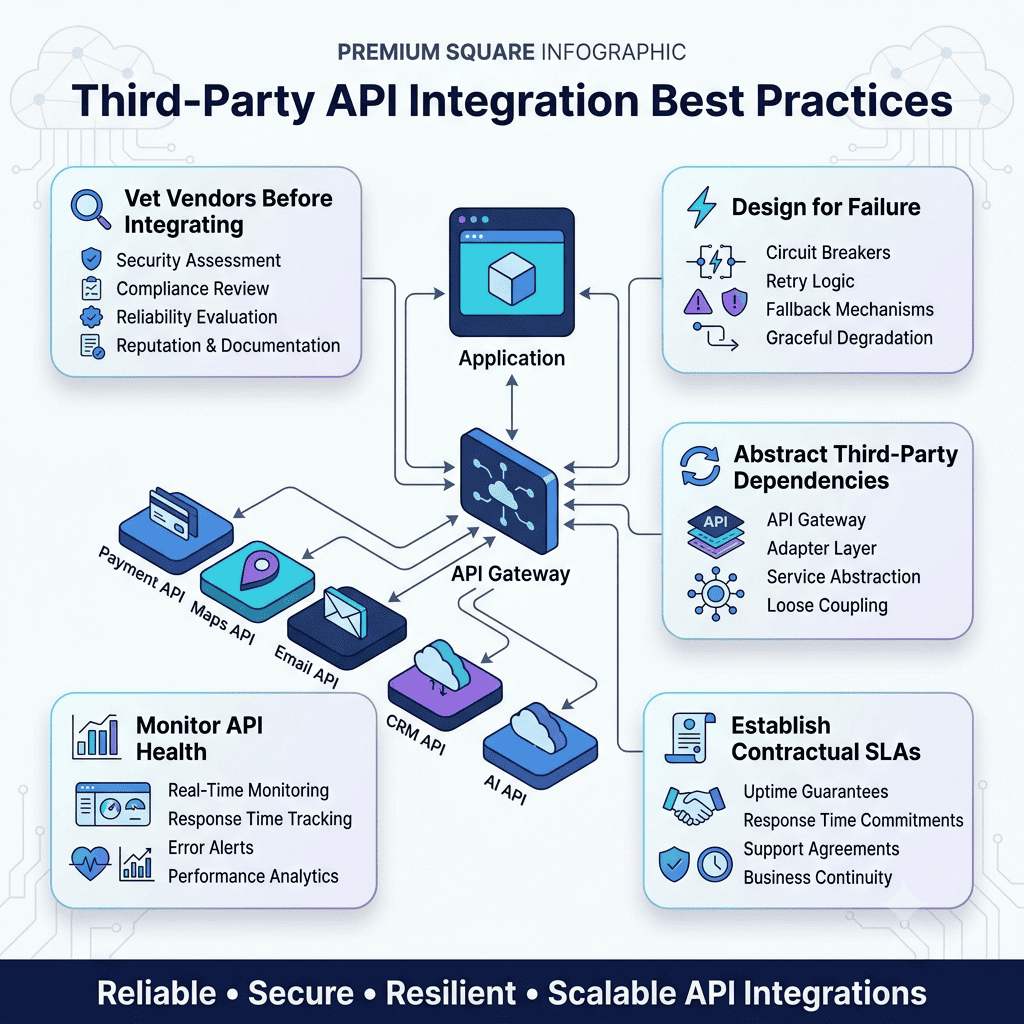
Third-Party Risk Looks Different for Mobile Apps
Mobile applications carry a specific version of this risk that’s worth calling out separately: third-party SDKs, analytics tools, ad networks, crash reporting, social login, get embedded directly into the app binary itself rather than called over the network at request time. That means a vulnerability or a privacy misstep in a third-party SDK ships inside your own app and can’t be patched server-side the way a backend API integration can, it requires a full app update and the delay of app store review to fix. Our mobile app security best practices guide covers this distinction in more depth, since the review and vetting process for a third-party SDK genuinely needs to be more conservative than for a backend API you can swap out or patch around on your own timeline.
In-House Build vs. Third-Party API Integration
This is the decision underneath every specific integration choice, and it’s worth making deliberately rather than defaulting to whichever option seems faster in the moment.
Factor | In-House Build | Third-Party API Integration |
Time to launch | Slower, requires building and maintaining functionality | Faster, functionality exists already |
Ongoing maintenance | Full responsibility sits with your team | Shared with the vendor, but not eliminated |
Control over reliability | Full control | Dependent on vendor’s own infrastructure |
Cost structure | Upfront development cost, lower marginal cost | Usually ongoing, often usage-based cost |
Best fit | Core differentiating functionality | Commoditized functionality (payments, maps, messaging) |
Risk profile | Risk is internal and directly manageable | Risk is external and only partially manageable |
The right answer is rarely all-in on one side. Commoditized functionality, payment processing, mapping, transactional email, is usually not worth building in-house, since specialized vendors do it better and more reliably than most teams could justify building internally. Core, differentiating functionality is the opposite case, where the control and reliability of an in-house build is worth the additional development cost.
Planning for Vendor Offboarding Before You Need It
Most integration planning focuses entirely on getting a third-party API connected and working, and almost none of it considers what happens when that relationship eventually ends, whether by choice or because the vendor forces the issue through a deprecation, a pricing change, or a shutdown. Knowing in advance what a migration off a given vendor would actually involve, which parts of the application reference it directly, how much data would need to be exported and in what format, is far cheaper to figure out calmly in advance than to reconstruct under the time pressure of a sixty-day deprecation notice. This is really an extension of the abstraction principle covered above: a business that has never once asked “what would it take to leave this vendor” usually finds out the hard way that the answer is worse than expected.
Common Mistakes in Third-Party API Integration
Teams frequently integrate a vendor’s SDK directly throughout the codebase without any abstraction layer, which turns a future vendor switch into a much larger rewrite than it needed to be. Timeouts get left at default values, which are often far too generous for a user-facing request, meaning a slow third-party API can hang a request for far longer than any real user should ever be made to wait. Vendor evaluation frequently stops at “does the API work in a test call” without any real assessment of uptime history or incident transparency, information most reputable vendors publish and most teams simply never check. And monitoring often only exists for a business’s own infrastructure, leaving third-party dependencies as a blind spot that only becomes visible once something has already broken in production.
How The Apps Developers Approaches Third-Party API Integration
Every integration gets evaluated against the same criteria we’d apply to any part of a web app’s architecture, reliability, security posture, and how much lock-in a given vendor choice actually creates, rather than defaulting to whichever integration is quickest to wire up.
The monitoring and resilience patterns that make third-party dependencies safe to run in production, circuit breakers, independent health checks, alerting, are built through the same DevOps and cloud solutions practice that handles infrastructure monitoring generally, since a third-party API outage deserves the same operational attention as an outage in your own infrastructure.
If you’re integrating a new third-party API and want it built to fail gracefully rather than take your application down with it, or auditing existing integrations you’re not confident about, that’s worth a direct conversation. You’re welcome to talk to our team about what a properly resilient integration would look like for your specific dependencies.