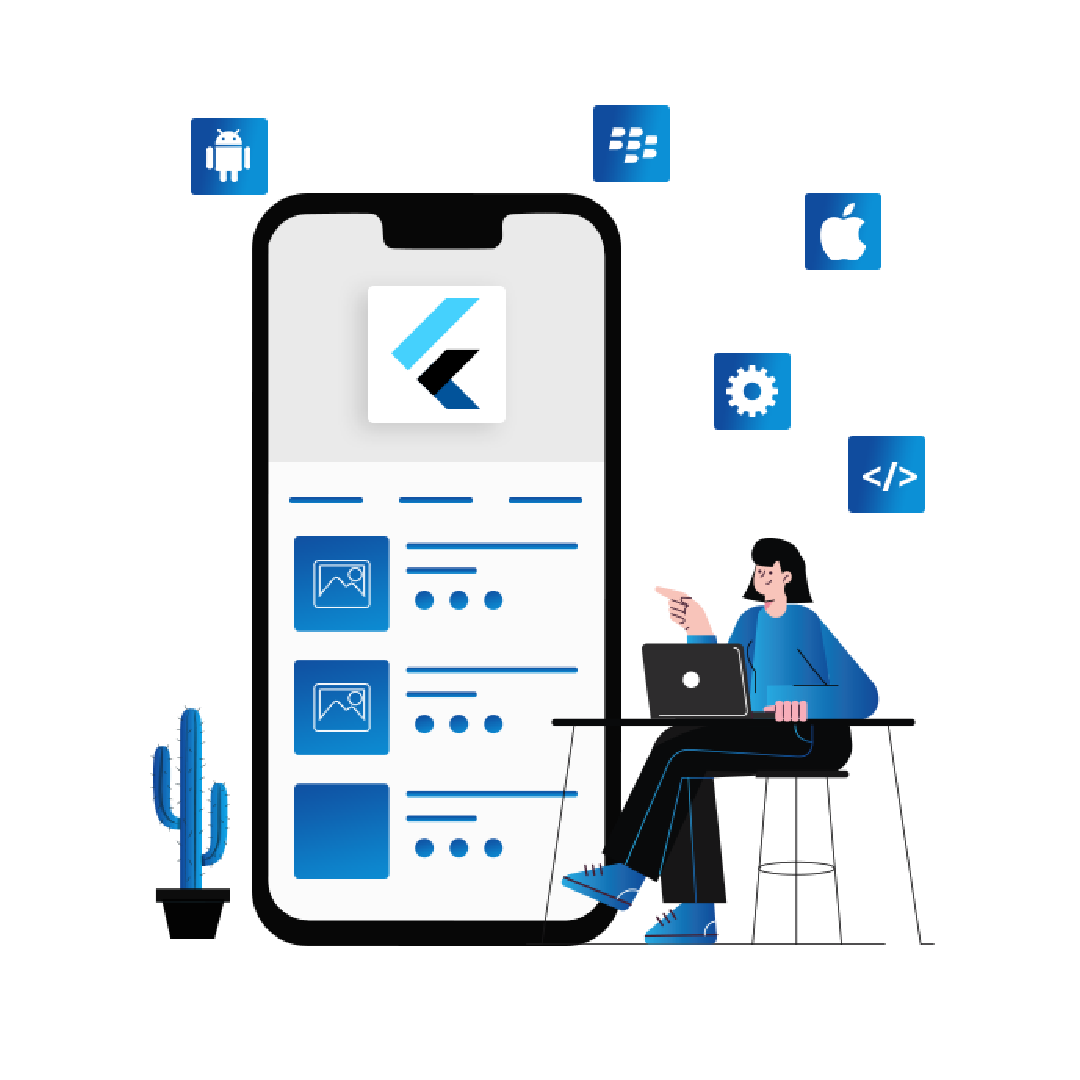
Custom Flutter Apps Engineered to Pass Both App Stores, Not Just One
Custom Flutter app development services in the USA, built by a Flutter app development company that treats Apple's and Google's separate review requirements as two real constraints from day one, not a single generic build hoping to clear both.
What Makes Flutter App Development Different
Flutter app development isn't really about writing the UI once. It's about whatever Apple and Google each separately enforce, App Store review policy on one side, Play Store data safety requirements on the other, all while keeping one Dart codebase clean enough that a platform-specific fix doesn't quietly break the other platform's build. Get that balance wrong and the app becomes two review cycles instead of one launch.
Most Flutter app development services in USA fail the same way: a build that clears Google Play fine but gets bounced on the App Store side over a permission or privacy disclosure nobody scoped for iOS specifically, because cross-platform got treated as one set of rules instead of two.
6 Steps of Flutter App Development Process
As a Flutter app development company, we follow a clear process from platform scoping and UI/UX design to shared development, native integration, cross-device testing, and dual-store launch.
Discovery & NDA
We sign an NDA before any technical discussion begins, then map your product requirements, target platforms, and compliance needs into a clear development scope, not a vague build-for-both starting points.
UX Research & Wireframes
We research how your actual users move through the app on each platform, then build wireframes around those real workflows, not one generic flow stretched across both.
Flutter UI Design (Widgets)
High-fidelity Flutter screens are built with platform-aware widgets, so the app feels native enough on both iOS and Android, not like a compromise wearing two different skins.
Agile Dart Development
Development happens in two-week sprints with working builds you can actually test on real devices, on both platforms, not a single reveal after months of silence.
QA & Dual Store Review Prep
We test across real iPhone and Android models, then check the build against both Apple's current review guidelines and Google's Play Store policies before either submission goes out.
Launch, ASO & Warranty
We handle both submissions, respond to reviewer questions on either side, optimize your listings on both stores, and stay on for a defined warranty period after launch.
The Technologies Behind Our Flutter Apps
From Dart and Flutter's cross-platform framework to state management, native integrations, backend APIs, cloud infrastructure, databases, automated testing, analytics, and multi-platform deployment.

Core Flutter & Dart
State, Navigation & Architecture
Native & Device Integration
Backend & APIs
Cloud & Multi-Platform Delivery
Databases & Local Storage
Testing & Monitoring
Security, Analytics & Integrations
How Long Does Custom Flutter App Development Take?
As one of the most trusted Flutter app development companies in the USA, we prioritize on-time delivery for our clients. We deliver most Flutter apps end-to-end in 10 to 18 weeks: 1 week of discovery, 2–3 weeks of UI design, 6–10 weeks of Dart development, plus 2 weeks of dual-platform QA and store submission. Basic MVPs are delivered in 6–10 weeks, whereas enterprise and regulated Flutter apps take 5–10 months. Flutter's single codebase can save real time compared to building two native apps separately, but that saving narrows on projects needing deep platform-specific integrations on both sides.
MVP Track
A simple MVP of a single-feature Flutter app. We test it on current iPhone and Android flagship models. This version is ideal for pre-PMF founders and seed-stage startups. We release a test build on TestFlight and Play Store internal testing within a 6-week timeframe.
Standard Flutter App
Standard time where most US Flutter apps ship. This app has full custom UI design, a scalable backend, multi-device QA across both platforms, app analytics, and dual-store ASO.
Enterprise / Regulated
Enterprise-grade Flutter app with multi-surface support where platform APIs allow it. HIPAA, PCI-DSS, and SOC 2 compliance, SSO, enterprise integrations, full QA across current iOS and Android versions, and penetration testing.
Should Your App Be Flutter, Native Swift, or React Native?
This is the decision most founders get talked into skipping, because whichever agency you ask usually recommends whatever they're better staffed to build. It's also not permanent, teams migrate later, but starting on the wrong side costs real time to unwind. Here's the honest breakdown, including where Flutter genuinely isn't the right call.
Flutter
Best when you need iOS and Android launched together on one team and one budget, with UI-heavy screens that don't depend on deep platform-specific hardware access.
Choose Flutter When
- Budget or timeline requires one codebase for both platforms
- The app is content and form-heavy rather than integration-heavy
- You need to validate across both platforms at once
Not Ideal If
- You need deep iOS-specific APIs the moment Apple ships them
- Your product's whole differentiation is a fully platform-native feel
Native Swift (Xcode) + Kotlin
Best when performance, deep OS-specific integration, or long-term platform-native polish matter more than shared-codebase speed.
Choose Native When
- You need HealthKit, ARKit, CarPlay, or other deep hardware/OS integration on iOS specifically
- Performance is a hard real-time requirement
- You're building for years, not validating in three months
Not Ideal If
- You need both platforms live on a tight budget and timeline
- Native means two separate builds and two separate timelines
React Native
Best when your team already has strong JavaScript/React expertise and wants a large existing ecosystem of libraries.
Choose React Native When
- Your engineering team's existing skill set is JavaScript-heavy
- That matters more than Flutter's more consistent rendering engine
Not Ideal If
- You need Flutter's typically smoother animation performance
- You want fewer native-bridge-related bugs over time
The honest tradeoff: Flutter gets you to both stores faster and cheaper than building native twice. What you give up is the deepest possible platform integration on either side, and you're still going through two separate, genuinely different review processes at the end regardless of which framework you picked.
Get Our Recommendation →Industry Expertise Our Flutter Development Experts Bring
A great Flutter developer solves half the problem. Domain knowledge solves the other half. Here's where our Flutter team has built repeatedly, not once.
Healthcare
Flutter developers in the USA who understand HealthKit and Google Fit integration, PHI handling on both platforms, and the extra scrutiny health-data apps get from both app stores, so you're not paying someone to learn compliance basics twice.
Explore →Retail
Engineers who've shipped Apple Pay and Google Pay checkout flows in the same codebase, inventory-synced storefronts, and loyalty features, not developers figuring out two separate payment integrations for the first time on your app.
Explore →Logistics
Flutter developers in the USA experienced with GPS-accurate tracking and offline-capable field apps that behave consistently across iOS and Android hardware, built for drivers and warehouse staff, not just office Wi-Fi.
Explore →Fintech
Developers who build to the security bar financial data actually requires on both platforms, biometric authentication and encrypted local storage, not a generic login screen that only got hardened on one side.
Explore →Automotive
Experience bridging CarPlay and Android Auto integration from a single codebase, plus the real-time telematics data that separates a functional automotive app from a demo.
Explore →E-Commerce
Developers who've built full checkout flows and dual-platform payment integration under real transaction volume, not just a shopping cart that works in a walkthrough on one device.
Explore →Education
Flutter developers experienced with offline course downloads and cross-device, cross-platform progress sync, plus the accessibility requirements education apps need to meet on both stores.
Explore →Sports
Experience building for real-time score feeds and push notifications that stay in sync across iOS and Android, not a stats screen that updates reliably on one platform and lags on the other.
Explore →Built for Both App Stores You Actually Ship To
We Test on Real Hardware. Not Simulators.
We review every build against both Apple's current Human Interface Guidelines and Google's Play Store policies before submission, not after one side rejects it. Shipping to one store is a review problem. Shipping to both, from one codebase, without either side feeling like an afterthought, is the thing most agencies quietly underinvest in.
Built for Dual-Store Compliance
Every build reviewed against both Apple's and Google's current policies, not just one.
NDA Before Discovery
Signed before any technical discussion begins.
Senior Flutter Engineers Only
No junior rotation on your project, ever.
Fixed-Scope, Fixed-Price
The number we quote is the number you pay.
The Reason Flutter Apps Get Rejected? Usually Just One Side.
App rejection on Flutter projects rarely happens on both stores at once, it's almost always one side catching something the other didn't require. Apple's Privacy Manifest and Google's Data Safety form ask for genuinely different disclosures, and a build scoped for one doesn't automatically satisfy the other. We check both before either submission goes out. Every Flutter app we ship comes with a complete Privacy Manifest for the App Store side (mandatory since May 1, 2024) and an accurate Data Safety form for Play Store, plus a regulatory profile matched to your actual industry, HIPAA, PCI-DSS, SOC 2, GDPR, or CCPA, scoped to what your app actually touches on both platforms, not a single checklist assumed to cover both stores equally.
App Store Privacy Manifest
Declared data types and API usage, mandatory since May 1, 2024.
App Store ReadyPlay Store Data Safety Form
Accurate data collection and sharing disclosure matched to what the app actually does.
Play Store ReadyHIPAA & PHI
BAA-ready architecture, end-to-end encryption, and audit logging.
Healthcare ReadyPCI-DSS
Tokenization, dual-platform payment integration, and no raw card data at rest.
Payment SecuritySOC 2 / ISO 27001
Access controls, audit logs, and least-privilege by default.
Enterprise ReadyGDPR & CCPA
Data export, deletion, and consent management across both platforms.
Privacy ReadyUs vs. a Typical Flutter Agency
Custom Apps We've Shipped
Explore digital products designed to improve operations, customer experiences, and business performance across multiple industries.
Our Clients Simply Love What We Do
Proud to support ambitious teams with reliable product development, clear communication, and long-term technical expertise.
“Our Play Store submission was fine, but the App Store side kept bouncing over a data disclosure mismatch. They found it in a day.”
“One codebase actually working well on both platforms was the whole point of going Flutter. This team delivered that, not a compromise.”
“Dual payment integration, Apple Pay and Google Pay, went in clean the first submission on both sides.”
“Communication was consistent. A working build every two weeks, tested on real devices on both platforms.”
“They caught a Play Store data safety mismatch before submission that would have delayed our launch by weeks.”
“Post-launch support meant an actual fix within days when an OS update broke a feature, not a ticket sitting in a queue.”
01 How much does Flutter app development cost in the USA?
Cost depends mainly on how many platform-specific integrations the app needs and how much custom design work is involved. A basic single-feature app costs far less than a platform with dual-store payment integration and platform-specific features. Get a scoped estimate based on your actual requirements rather than a flat per-screen number.
02 Is Flutter good for app development?
Yes, for the right kind of project. Flutter is genuinely strong when you need iOS and Android launched together on one budget with UI-heavy, content-driven screens. It's a weaker fit when your app depends on deep, platform-specific hardware or OS integration the moment a platform ships it, that's where native development still has a real advantage.
03 Flutter, React Native, or native Xcode/Kotlin development, what's the real tradeoff?
Flutter and React Native both trade some platform-specific polish for one shared codebase and faster, cheaper delivery across iOS and Android. Native Swift (Xcode) and Kotlin give you the deepest possible platform integration and performance ceiling, at the cost of building and maintaining two separate apps. The right choice depends on whether your app's value comes from platform-specific depth or from reaching both platforms fast with one team.
04 How long does it take to build a Flutter app?
Most focused Flutter apps take 10 to 18 weeks from discovery to dual-store launch, with basic MVPs shipping in 6 to 10 weeks and enterprise or regulated builds taking 5 to 10 months. The biggest variable is how many platform-specific integrations and compliance requirements the app needs on each side.
05 Do you build both the Flutter app and its backend?
Yes, when needed. Flutter apps depend on backend reliability and API performance the same way native apps do, so we design the backend and the app together rather than as separate handoffs.
06 Can a Flutter app development company in the USA work with a startup, or only enterprise clients?
Both. Engagements scale from a single MVP for a pre-funding startup to full enterprise Flutter development with HIPAA, PCI-DSS, or SOC 2 compliance built in across both platforms.
07 What happens after my Flutter app launches on both stores?
Every build includes a defined post-launch support window covering OS updates on both platforms, bug fixes, and store policy changes, since Apple and Google each update their requirements on their own schedule. We don't consider the engagement done the day it goes live.
Let's Build a Flutter App That Passes Both Stores the First Time
Whether it's a single-feature MVP, a full enterprise platform, or fixing a compliance gap in something already live on one or both stores, let's start with an honest look at your current requirements.
Start Your Flutter App →