SaaS web app architecture is the structure that lets a single application serve many customers reliably, securely, and cost-effectively as the business grows, built around layers for presentation, business logic, data, and infrastructure, plus a deliberate approach to multi-tenancy. Get the tenancy model wrong early, and it’s rarely a quick fix later. It’s frequently a six-to-twelve-month re-architecture once the customer base and data volume have grown large enough to make the original shortcut expensive.
That single decision, made early and often without much thought, is the one architectural choice technical founders most consistently underestimate. This guide covers what SaaS architecture actually involves, the multi-tenancy models available, and the specific mistakes that turn a fast MVP into a costly rebuild a year or two in.
What Is SaaS Web App Architecture?
SaaS web app architecture is the overall system design that determines how a software-as-a-service product handles multiple customers, scales under growing load, and keeps each customer’s data properly isolated, all while staying maintainable as the product evolves. It’s not just a tech stack choice. It’s a set of decisions about tenancy, data isolation, and scaling that shape nearly everything else built on top of them.
The Core Layers of a SaaS Architecture
Most SaaS products break down into a consistent set of layers, regardless of the specific technologies chosen. The presentation layer is what users actually interact with, the web app’s interface. The application layer holds the business logic, processing requests, applying rules, and enforcing tenant-specific behavior. The data layer stores everything, and its design determines how customer data stays isolated. The infrastructure layer covers where the code actually runs, cloud provider, deployment pipelines, and monitoring. Authentication and billing typically sit as their own core modules threaded through all of it, since both touch nearly every other layer in some way.
Multi-Tenant vs. Single-Tenant: Which Should You Start With?
This is the first major fork in the road, and it shapes cost, compliance posture, and engineering effort for every customer that comes after.
| Factor | Single-Tenant | Multi-Tenant |
| Infrastructure cost | Scales linearly, each customer adds a full instance | Scales far more gradually, since infrastructure is shared |
| Data isolation | Maximum, since each customer has a fully separate environment | Requires deliberate engineering, tenant boundaries enforced in code |
| Maintenance | Each instance patched and updated separately | One deployment updates every customer at once |
| Best fit | Regulated industries needing contractual or physical data separation | Most SaaS products, especially in earlier growth stages |
For most SaaS products, multi-tenancy is the right starting default. Running a fully separate instance per customer becomes financially impractical well before a product reaches meaningful scale, which is exactly why most established SaaS platforms run shared infrastructure with strong logical isolation rather than physically separate environments for every account.
The Multi-Tenancy Models
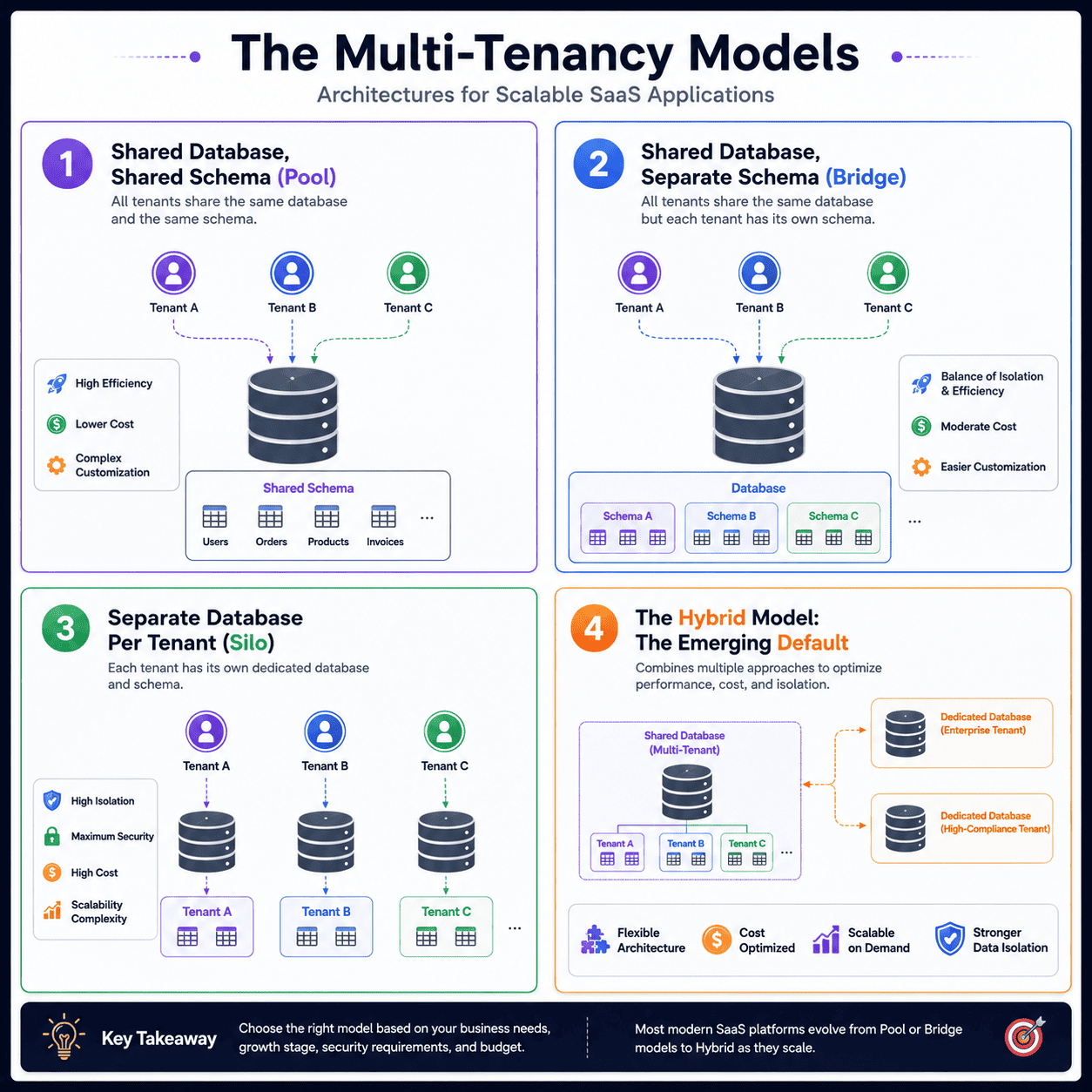
Shared Database, Shared Schema (Pool)
Every tenant’s data lives in the same tables, separated only by a tenant ID column. This is the cheapest and fastest model to ship, and it’s the right starting point for most SaaS products, provided tenant isolation is enforced properly at the database level through row-level security, not left to application code alone to get right every time.
Shared Database, Separate Schema (Bridge)
Tenants share a database instance but get their own schema, offering stronger separation than a shared table while still keeping infrastructure manageable. This tends to fit mid-market products that need more isolation than the pool model but don’t yet justify fully dedicated infrastructure per customer.
Separate Database Per Tenant (Silo)
Each tenant gets a fully dedicated database. This provides the strongest isolation and simplifies compliance audits, since customer data is physically separated, but it comes with real infrastructure cost and operational complexity that most early-stage products don’t need yet.
The Hybrid Model: The Emerging Default
Rather than picking one model for the entire product, most mature SaaS platforms now run a mix: standard-tier customers on shared infrastructure, enterprise customers with compliance requirements or heavy usage moved to dedicated environments. AWS’s own SaaS Lens guidance documents this hybrid pattern in detail, and even major cloud providers have shifted their own recommendations toward mixed models rather than picking one tenancy approach and committing to it universally. This tiered approach lets a product keep costs low for most customers while still winning the enterprise deals that specifically require stronger isolation.
Architecture Decisions Founders Get Wrong Early
1. Picking an Isolation Model Before Understanding Isolation Requirements
This is consistently cited as the single most expensive early mistake in SaaS architecture. A founder builds a basic schema, ships an MVP, and six months later a customer with real compliance requirements arrives to find there’s no clean way to isolate their data without a significant rebuild. Designing the shared-pool model correctly from the start, with tenant boundaries built in from day one, keeps the door open to upgrading specific customers later without a full rebuild.
2. Building Custom Authentication
Rolling a custom auth system in 2026 without a dedicated security engineer and a very specific, unmet need is a common and often costly decision. The cost of getting authentication wrong, credential stuffing, session fixation, token leakage, tends to be severe, and established authentication providers have already solved most of these problems more thoroughly than a first attempt built under deadline pressure typically will. Security fundamentals here overlap directly with the practices covered in our mobile app security best practices guide, even though that post is framed around mobile rather than web.
3. Over-Engineering Microservices Too Early
Splitting a product into microservices before there’s a real operational reason to do so adds coordination overhead most early-stage teams don’t need yet. A clean, well-organized monolith, with clear internal boundaries, tends to serve a growing SaaS product far better in its first stage than a distributed system built for a scale the product hasn’t reached.
4. Running Heavy Tasks Inside the Request Cycle
Processing large reports, sending bulk notifications, or running expensive computations directly inside a user’s request slows everything down and creates a fragile user experience. Background job systems exist specifically to move that work out of the request-response cycle, and skipping this early tends to surface as a performance problem that’s much harder to retrofit later.
5. Skipping Tenant-Scoped Observability
Aggregate performance metrics can look completely healthy while one specific enterprise customer quietly experiences terrible response times. Without tenant-tagged monitoring, that kind of problem stays invisible until it becomes a churn risk or a support escalation, rather than something caught and fixed proactively.
When to Upgrade Your Isolation Model
A regulated-industry customer asking about compliance certifications, a specific data residency requirement, or an enterprise contract demanding physical data separation are the signals that typically force an isolation upgrade sooner than founders expect. Building the shared-pool model with clean tenant boundaries from the start is what makes that eventual upgrade a targeted migration for specific customers, rather than a full-product rebuild under time pressure.
How SaaS Architecture Connects to the Rest of Your Product
Architecture decisions made early ripple through everything built afterward, from how API and backend development gets structured to how the product scales under real infrastructure demands, covered in more depth in our DevOps and cloud solutions work. Treating architecture as a foundational decision made deliberately, rather than whatever gets shipped fastest under deadline pressure, is what keeps a growing SaaS product from hitting an expensive wall a year or two in.
How The Apps Developers Approaches SaaS Architecture
We design web application development projects with tenant isolation and scaling built in from the start, not bolted on once the first enterprise customer forces the question. That means the right isolation model for your actual compliance and growth needs, not a default that happens to be fastest to ship this quarter. If you’re planning a SaaS product or trying to figure out whether your current architecture will hold up at ten times your current customer count, we’re glad to help you think it through.
Conclusion
SaaS web app architecture isn’t a one-time technical decision made in the first sprint and forgotten. The isolation model chosen early determines how expensive every future compliance requirement, enterprise deal, and performance problem turns out to be. Start with a shared-pool model built with real tenant boundaries, avoid the common early mistakes, and leave room to upgrade specific customers to stronger isolation as your product actually needs it, not before.
If you’re planning a SaaS product and want an architecture built to scale without an expensive rebuild down the line, get in touch. We can help you think through what your specific product actually needs.