
A realistic MVP development timeline runs 8 to 16 weeks from idea to launch for most startup MVPs, with simple, narrowly scoped products landing on the shorter end and MVPs requiring custom infrastructure or compliance review extending toward the longer end or beyond. Founders consistently underestimate this timeline by a wide margin, not because development itself is slow, but because discovery, design, and testing take real time too, and skipping them tends to cost more time later than it saves upfront.
That gap between expectation and reality is worth addressing directly before getting into phase-by-phase detail. “Minimum viable product” gets misread as “minimum time investment,” when in practice the phases surrounding actual coding, defining what to build, designing it clearly, testing it properly, are what separate a rushed product from one that generates genuinely useful validation data. Our MVP app development guide covers the build-and-launch process this timeline maps onto, worth reading alongside this breakdown if you’re still deciding whether an MVP is the right approach at all.
This guide breaks the timeline down phase by phase, as part of the same Mobile App Development planning that should happen before a launch date gets promised to anyone.
These ranges reflect consistent patterns across independent industry sources, though any specific project should be scoped against its actual requirements rather than assumed from a table. Our MVP development cost guide covers the budget side of this same complexity breakdown, since cost and timeline tend to scale together for the same underlying reasons.
What Determines an MVP Development Timeline?
An MVP development timeline is shaped primarily by feature scope, backend complexity, platform choice, and how quickly decisions get made during the project, not by coding speed alone. Teams that assume more developers or faster typing solves timeline pressure consistently discover that scope discipline and decision speed matter more than raw development throughput, since most real-world timeline slippage traces back to scope changes and delayed decisions rather than the engineering work itself running slowly.MVP Development Timeline: Phase by Phase
Phase 1: Discovery and Scoping (1 to 3 Weeks)
This phase defines exactly what hypothesis the MVP needs to test and which features are genuinely required to test it, nothing more. Teams that rush or skip this phase consistently end up reworking significant portions of the product later, since decisions made without real clarity here tend to surface as expensive changes mid-development rather than cheap adjustments before any code exists.Phase 2: Design (1 to 3 Weeks, Often Overlapping With Discovery)
Design at MVP stage means mapping the core user flow clearly enough that real users can complete the core action without confusion, not building a comprehensive design system. This phase heavily influences the overall timeline, since a poorly defined user flow going into development almost always resurfaces as rework once real screens get built against it.Phase 3: Development (4 to 10 Weeks, Depending on Complexity)
This is typically the longest phase and the one most sensitive to scope discipline. A simple, single-platform MVP with minimal backend needs can complete development in four to six weeks, while an MVP requiring real backend infrastructure, multiple integrations, or cross-platform builds can extend to eight to ten weeks or more. Working in short, testable increments during this phase, rather than one long build with a single delivery point at the end, is what keeps scope and timeline problems visible early enough to actually address them.Phase 4: Testing and QA (1 to 2 Weeks)
Skipping or compressing testing to hit a launch date is one of the most common, most damaging timeline shortcuts, since bugs that reach real early users during the validation phase generate misleading feedback, frustration with basic functionality rather than genuine signal about the core idea.Phase 5: Launch and Initial Measurement (Ongoing)
Launch isn’t the end of the timeline, it’s the start of the phase the entire MVP was built to reach: collecting real usage data against the original hypothesis. Budgeting time for this phase, not just the build leading up to it, is what actually completes the process.Structuring Development in Sprints, Not One Long Build
Treating MVP development as a single, months-long build with one delivery date at the end is a common structural mistake that makes timeline problems harder to catch early. Breaking development into short, two-week sprints, each producing a genuinely working increment rather than a partial, untestable piece, surfaces scope and timeline problems within weeks instead of only becoming visible near a launch date that’s already been promised to stakeholders. Y Combinator’s own startup advice consistently emphasizes shipping something real quickly and iterating from actual usage, a sprint-based structure is the practical mechanism that makes that advice achievable rather than aspirational. This same build-measure-learn discipline, central to the Lean Startup methodology that popularized the MVP approach in the first place, treats the launch date not as a finish line but as the first checkpoint in an ongoing cycle, which is also why padding a timeline with buffer for “final polish” often misses the point, the goal is reaching real users quickly enough to start that cycle, not delivering a flawless artifact.Factors That Extend an MVP Timeline
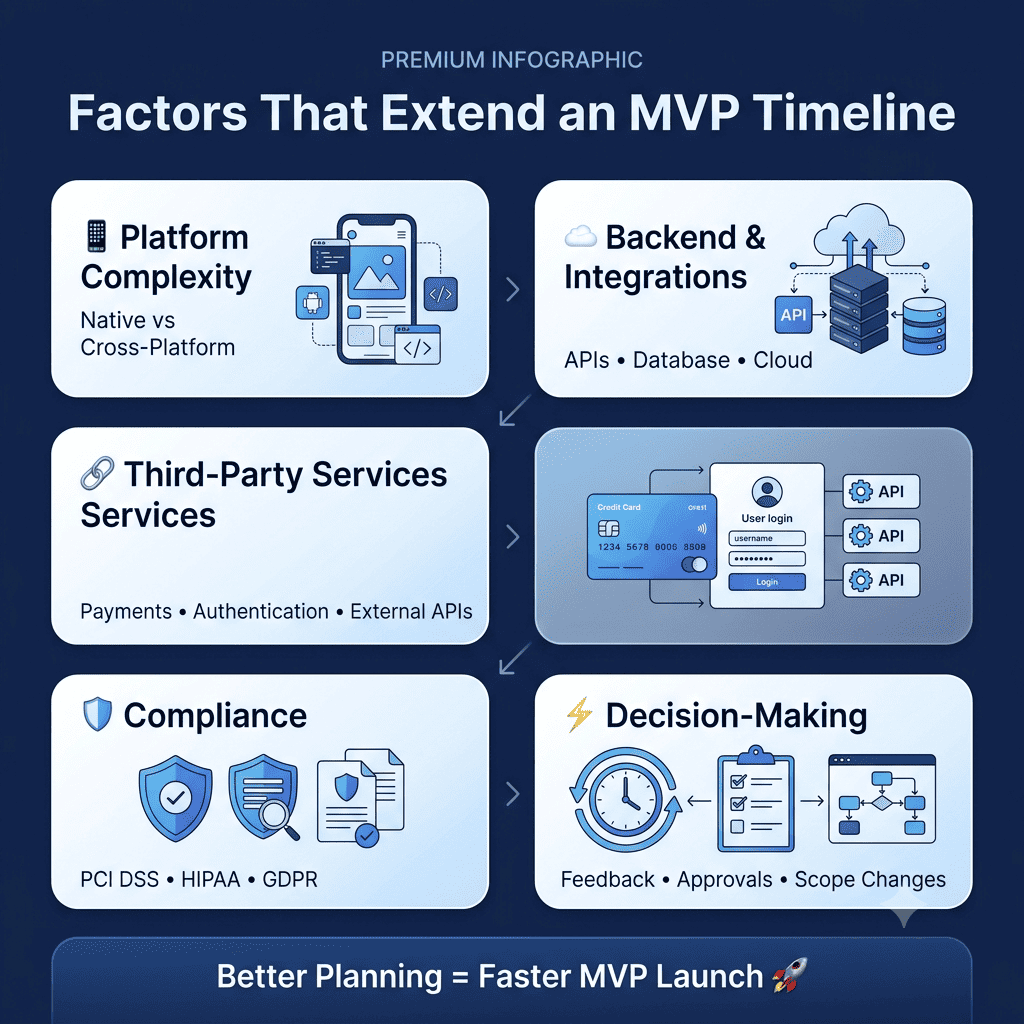
Platform and Cross-Platform Complexity
Building native apps for both iOS and Android, rather than a single web build or a cross-platform mobile approach, meaningfully extends development time, since it’s effectively duplicating a meaningful share of the build work across two separate codebases.Backend and Integration Requirements
Third-Party Integrations
Payment processing, authentication providers, and other third-party integrations each add their own setup, testing, and edge-case handling time, and they’re frequently underestimated in initial timeline planning because they look simple from the outside.Compliance and Regulatory Review
For MVPs in regulated spaces, healthcare, fintech, anything handling sensitive personal data, compliance review can extend the realistic timeline substantially beyond what pure development estimates suggest.Example: A Fintech MVP’s Extended Timeline
An MVP handling payment data that requires PCI compliance considerations, or one collecting health information that needs to account for HIPAA requirements, will realistically run longer than a comparably scoped MVP in an unregulated space, since legal and compliance review happens on its own timeline, largely independent of how fast the engineering team can actually build.Decision-Making Speed
A founder or stakeholder slow to make scope decisions, provide feedback, or approve design directions adds real delay that has nothing to do with development speed itself, and it’s consistently one of the most underestimated timeline factors in practice.
Realistic Timeline by MVP Complexity
| Complexity Level | Typical Timeline | Example |
| Simple, single-platform | 6 to 8 weeks | Basic tool with 3 to 5 core features, minimal backend |
| Standard startup MVP | 8 to 14 weeks | Cross-platform or web app with real backend, basic integrations |
| Complex, regulated, or multi-integration | 14 to 20+ weeks | Fintech, healthcare, or marketplace MVP with compliance review |