
MVP development cost typically ranges from around 15,000 dollars for a simple, single-platform validation app to 80,000 dollars or more for a multi-platform MVP with real backend infrastructure and third-party integrations, with most startup MVPs landing between 25,000 and 50,000 dollars. According to Clutch’s own pricing research, an MVP built by an offshore team commonly lands around 40,000 dollars, a useful benchmark, though your actual number depends heavily on scope, platform, and who builds it.
If you’re at the point of budgeting a real MVP rather than researching whether the MVP approach makes sense in general, generic pricing pages aren’t much help. What you need is a way to map your specific scope to a realistic number, and a clear sense of where a quote could be underscoping the real cost. That’s what this guide is built for, as part of the same Mobile App Development budgeting conversation that should happen before any contract gets signed.
These are illustrative ranges based on typical project patterns and Clutch’s published benchmarking, not a quote. Treat this table as a starting framework for a scoping conversation, not a substitute for an estimate against your actual requirements.
An in-house hire is rarely the right first move for a single MVP, the fixed cost of hiring doesn’t make sense for a project meant to be fast and disposable if the idea doesn’t validate. A freelancer can work well for a very narrowly scoped MVP but carries real risk if that one person becomes unavailable mid-project. An agency with genuine MVP experience, not just general development experience, tends to be the more capital-efficient choice for most first-time founders, since the project management overhead an agency provides is exactly what keeps a tight MVP timeline from slipping.
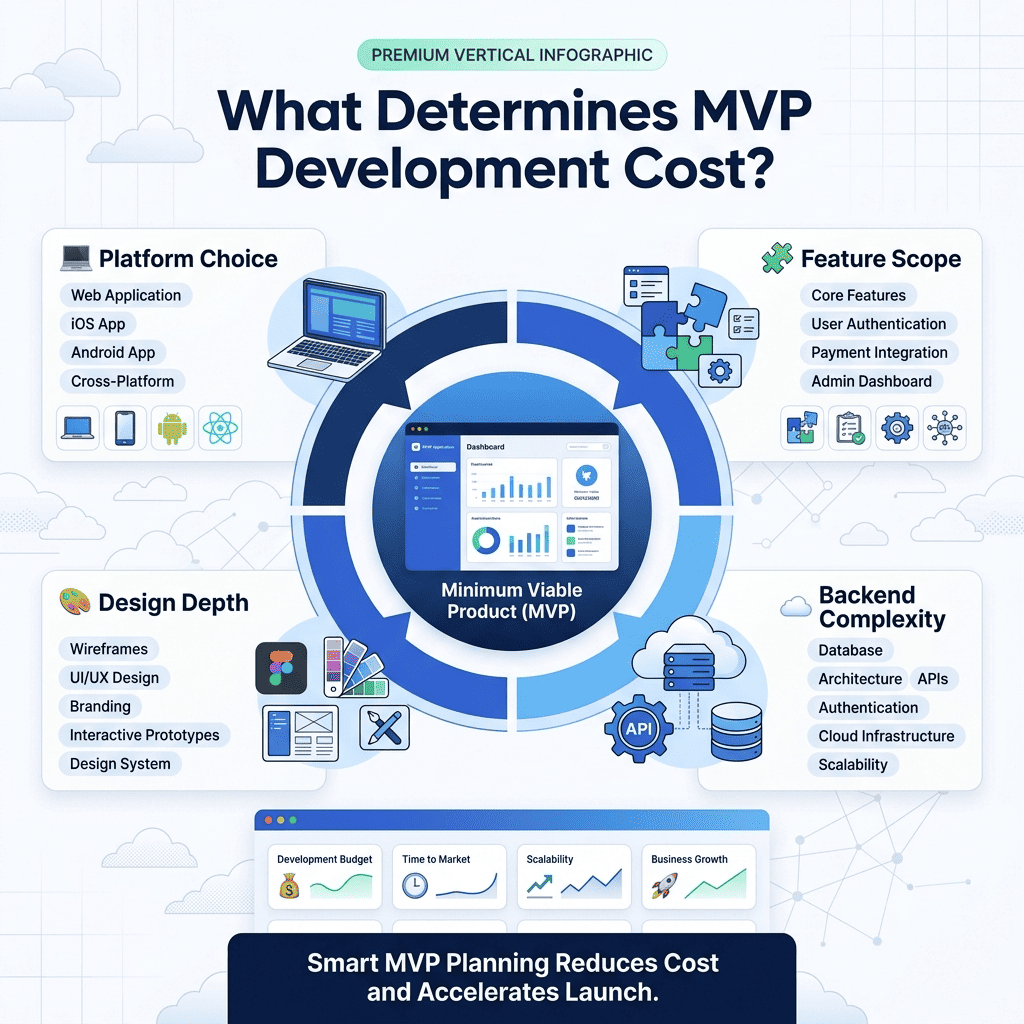
What Determines MVP Development Cost?
Platform Choice: Web, iOS, Android, or Cross-Platform
The platform an MVP targets is one of the largest cost variables, since building for a single platform is meaningfully cheaper than building native apps for both iOS and Android separately. A web-based MVP, or a cross-platform mobile MVP built from a single codebase, is generally the most budget-efficient starting point for validating an idea, since it avoids paying for two separate native builds before you’ve even confirmed the core idea works.Feature Scope
The single biggest lever within any given platform choice is how disciplined the feature list actually stays. An MVP scoped tightly around one core hypothesis costs meaningfully less than one that quietly absorbs “just one more feature” requests throughout development, the scope creep that turns a validation-stage budget into a full-product budget without anyone deciding that on purpose.Backend Complexity
An MVP that’s mostly a client-side experience with minimal data persistence costs considerably less than one requiring real backend infrastructure, user authentication, third-party API integrations, or payment processing. This is often where MVP budgets are underestimated, teams price the visible frontend work carefully but underprice the backend plumbing that makes it actually function.Design Depth
MVP design work should be scoped to “clear and usable,” not a full design system, but it shouldn’t be skipped either, since confusing UX generates misleading validation data as easily as a broken feature does. This is where UI/UX design scoped specifically for validation, not for a polished, market-ready product, keeps cost proportionate to what an MVP is actually meant to prove. Our UX research on a budget for startups guide covers how to get genuine design and user insight without the cost of a full research program, directly relevant to keeping MVP design spend proportionate to its actual purpose.
MVP Development Cost by Complexity Tier
| Tier | Typical Range (USD) | What’s Included |
| Basic validation MVP | 15,000 to 25,000 | Single platform, minimal backend, core hypothesis test only |
| Standard startup MVP | 25,000 to 50,000 | Cross-platform or web, real backend, basic integrations |
| Complex MVP | 50,000 to 80,000+ | Multiple integrations, payment processing, more advanced backend |
How Developer Location Affects MVP Cost
Geography remains one of the largest swing factors in any development quote, MVP included. Industry rate surveys consistently show senior US-based developers commanding roughly 125 to 250 dollars or more per hour, while Eastern European talent typically runs 40 to 80 dollars per hour for comparable seniority, and South Asian rates often sit lower still. A lower hourly rate doesn’t automatically translate to a proportionally lower total MVP cost, though, since communication overhead, time zone coordination, and unfamiliarity with your specific market can add real friction that a straight hourly comparison misses entirely. The right question isn’t which region is cheapest, it’s which team, at whatever rate, can actually deliver a working, well-scoped MVP on the tight timeline the validation process depends on.In-House vs. Freelancer vs. Agency for MVP Development
Who builds your MVP affects both cost and risk, and the tradeoffs are sharper at MVP stage than for a mature product, since an MVP’s tight timeline leaves little room to recover from a bad hire or a missed deadline.| Factor | In-House Hire | Freelancer | Agency |
| Typical cost | Highest (salary, benefits, ramp-up time) | Lowest hourly rate, variable total cost | Mid-range, project-managed |
| Speed to start | Slow, requires hiring | Fast | Fast |
| Risk if unavailable | Low, if team is stable | High, single point of failure | Low, team redundancy |
| Best fit | Long-term product with ongoing roadmap | Very narrow, well-defined MVP scope | Startups wanting full ownership without hiring |
| Hidden risk | Expensive for a short validation project | No backup, uneven skill coverage | Requires vetting for genuine startup MVP experience |