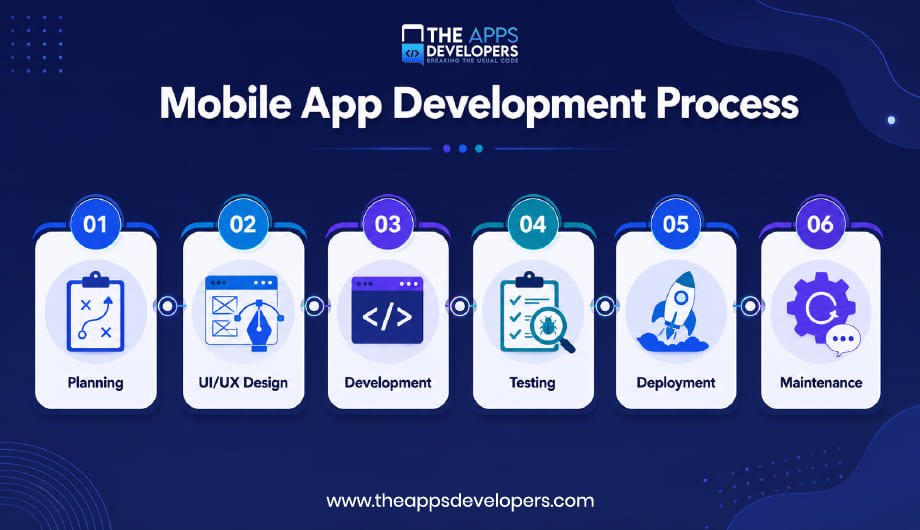
Building a mobile app involves more than just writing code. A successful app moves through a structured process that starts with idea validation and continues through planning, design, development, testing, launch, and post-launch maintenance.
Whether you are building a customer-facing product, an internal business application, or a startup MVP, understanding the mobile app development process helps you make better decisions about scope, budget, timelines, and technical requirements.
This guide explains each stage of the mobile app development lifecycle, what happens in that stage, and what teams typically deliver before moving to the next step.
Mobile App Development Process at a Glance
The mobile app development process typically includes seven stages, from validating the initial idea to maintaining the application after launch. Each stage has specific activities, deliverables, and timelines. The table below provides a quick overview of what happens at each step and how long it may take.
| Development Stage | Key Activities | Expected Deliverables | Estimated Timeline |
|---|---|---|---|
| 1. Market Research and Idea Validation | Research target users, competitors, and market demand | Validated app concept and research findings | 1–2 weeks |
| 2. Requirements Gathering and Planning | Define features, user flows, MVP scope, and priorities | Requirements document and product roadmap | 1–3 weeks |
| 3. UI/UX Design and Prototyping | Create wireframes, user journeys, and interactive prototypes | Approved designs and clickable prototypes | 2–4 weeks |
| 4. Mobile App Development and Integration | Build frontend, backend, APIs, and core functionality | Working application and integrated features | 6–16+ weeks |
| 5. Testing and Quality Assurance | Test functionality, usability, security, and performance | Test results and release-ready build | 2–4 weeks |
| 6. App Deployment and Launch | Prepare production builds and publish to app stores | Published application | Around 1 week |
| 7. Post-Launch Maintenance and Updates | Monitor performance, fix bugs, and release improvements | Updates and ongoing support | Ongoing |
These timelines are general estimates rather than fixed schedules. Development and testing often overlap, particularly in Agile projects, so the individual durations should not be added together to calculate the total project timeline. The overall schedule depends on app complexity, supported platforms, third-party integrations, and approval requirements.
Step 1: Market Research and App Idea Validation
Make sure other people will adore your app idea before you fall deeply in love with it! Testing your idea against reality is the main goal of this initial phase.
Describe Your App’s Goal
Determine the precise business issue that your app will address first. Which problem are you trying to solve? Next, set specific goals and objectives. Are you attempting to increase revenue, enhance client interaction, or optimize an internal procedure? Your project stays on course when it has a clear goal.
Examine Your Target Market
Next, familiarize yourself with the target audience. Examine user demographics such as geography, age, and tech inclinations. Understanding their expectations and pain spots is very crucial. You may create something that your audience will genuinely use if you have a better understanding of them.
Examine Your Rivals
Examine comparable apps that are currently available. What do they excel at? What are their shortcomings? These gaps present fantastic chances for your app to excel and differentiate yourself from the competition.
Verify the App Concept
Lastly, test your concept. Use polls, interviews, or an interest-gauging landing page to get feedback. You can avoid the heartache of launching something that no one wants by first validating actual market demand.
Step 2: Requirements Gathering and App Planning
After your proposal has been verified, it’s time to plan the next steps. This phase transforms your vision into a workable plan.
Describe the Key Features
Make two lists: the characteristics you absolutely must have and the features you would want to have. While nice-to-haves can wait for further upgrades, your must-haves serve as the cornerstone of your minimum viable product (MVP). Your initial build remains focused and lean thanks to this prioritizing.
Make a roadmap for your product.
Establish a realistic development timeline and project milestones. A roadmap helps you track your progress along the way and provides everyone with a clear sense of direction.
Select the Appropriate Development Strategy
This is a crucial choice: how will your app be developed? There are three primary alternatives available to you:
Native apps: Designed with a particular platform (iOS or Android) in mind, they provide excellent performance.
Cross-platform programs save time and money by being written once and implemented on several platforms.
Hybrid apps: A combination of native and web technologies that strike a balance between cost and versatility.
Your budget, schedule, and performance requirements will all influence your decision.
Step 3: UI/UX Design and Prototyping
Bringing your app to live visually is now the exciting part! The goal of great design is to create an experience that users truly love, not just to look good.
Make User Flows
Start by outlining user journeys, or the routes users will travel within your application to achieve their objectives. Simplifying navigation is the aim in order to prevent users from becoming lost or dissatisfied.
Create Wireframes
The basic blueprints for your app’s screens are called wireframes. Without becoming bogged down in colors or graphics, they display each screen’s visual structure and arrangement. Consider them as preliminary sketches that determine the direction of everything.
Construct Interactive Prototypes
Make interactive prototypes from those wireframes after that. Before writing a single line of code, you can evaluate usability with these clickable mockups, which is a great method to identify issues early and affordably.
Pay Attention to User Experience
Keep the user at the core of the design process. Make your software mobile responsive across devices, prioritize accessibility so that anyone can use it, and keep design aspects consistent. What draws customers back for more is a well-designed, user-friendly experience!
Step 4: Mobile App Development and Integration
This is the stage where the application is actually built. Development involves translating approved designs and business requirements into working features.
Mobile app development usually includes frontend development, backend development, database setup, and integration with third-party services.
Frontend Development
Frontend development focuses on the part of the app users interact with directly. This includes screens, buttons, forms, navigation, animations, and overall interface behavior.
For native mobile apps, development is typically done using Swift or SwiftUI for iOS and Kotlin or Jetpack Compose for Android. Cross-platform app development often uses frameworks such as Flutter or React Native when businesses want to support multiple platforms with shared code.
The right approach depends on the app’s performance requirements, long-term scalability, feature complexity, and the need for platform-specific device capabilities.
Businesses exploring platform-specific builds can also review the process of how to build an iOS app and how to build an Android app.
Backend Development
Backend development supports the app behind the scenes. It manages server-side logic, user authentication, databases, APIs, notifications, admin functionality, and data processing.
For example, if an app allows users to create accounts, place orders, upload files, or receive real-time updates, those actions usually depend on backend systems.
Applications with custom workflows, dashboards, payment systems, or integrations often require strong API and backend development to connect the mobile interface with business logic and external services.
Feature Integrations
Many apps also rely on external services such as payment gateways, maps, chat systems, analytics tools, CRMs, or push notification services. These integrations should be planned early because they can affect both timelines and testing requirements.
Agile Development Workflow
Most modern app teams use Agile or sprint-based delivery. Instead of building everything at once, the work is divided into smaller units that are designed, developed, reviewed, and tested in cycles.
This approach helps teams prioritize essential features, respond to feedback, and identify issues earlier in the process.
At the end of this stage, the team should have a working application build that reflects the approved scope and can move into structured testing.
Step 5: Mobile App Testing and Quality Assurance
You wouldn’t offer food without first tasting it, would you? This also applies to your app. Thorough testing guarantees that everything functions perfectly before it is used by actual consumers.
Testing for functionality
This confirms that each feature functions just as planned. Does the login button allow users to log in? Are the results from the search bar correct? The items that just don’t work are caught via functional testing.
Evaluation of Performance
Here, responsiveness and speed are measured. This step guarantees that your software remains responsive even when it is heavily used. A slow, sluggish app is a guaranteed way to lose consumers.
Testing for Security
Security cannot be compromised. In order to safeguard your users’ information from dangers, this stage focuses on data protection and vulnerability assessments. I promise you that identifying security vulnerabilities early on is vastly preferable to dealing with a breach later!
Testing for Device Compatibility
Your application must function on many operating systems and screen sizes. Compatibility testing ensures that your software works and looks great on both the newest flagship phone and more affordable models.
Optimization and Bug Fixing
Squash those bugs at last! In order to give consumers a seamless, dependable experience right away, this phase is all about enhancing stability and refining your app until it shines.
Step 6: App Deployment and Launch
Once the app has passed testing, it can move into deployment and launch.
This stage includes preparing the production build, configuring release settings, finalizing app store assets, and submitting the application to the Apple App Store and Google Play Store. It may also include backend production setup, analytics configuration, crash reporting tools, and release monitoring.
Launching an app is not the end of the development process. It is the point where the product becomes available to real users, which means the next phase of optimization begins immediately.
Step 7: Post-Launch Maintenance and Updates
After the app goes live, ongoing support becomes essential.
Post-launch maintenance includes monitoring app performance, fixing bugs, improving compatibility with operating system updates, refining the user experience, and releasing new features based on user feedback or business priorities.
Maintenance may involve:
- performance monitoring,
- crash analysis,
- user feedback review,
- version updates,
- security updates,
- feature enhancements,
- and infrastructure scaling.
An app is a living product. User expectations, device ecosystems, and business requirements continue to evolve, so long-term maintenance should be planned from the beginning.
Best Practices for a Successful Mobile App Development Process
A structured process improves delivery, but execution quality also depends on how the project is managed. These practices help reduce delays and improve outcomes.
- Validate the app idea before committing to full-scale development.
- Define the MVP clearly so the first version stays focused.
- Align business goals, user needs, and technical decisions early.
- Use wireframes and prototypes to reduce design rework.
- Plan integrations and backend requirements before development begins.
- Test on real devices and realistic user scenarios.
- Prepare for maintenance and future updates before launch.
How Much Does the Mobile App Development Process Cost?
The cost of mobile app development depends on factors such as app complexity, number of features, supported platforms, backend requirements, integrations, and design scope.
Because cost varies significantly from one project to another, it is better to review it in a dedicated pricing guide rather than overloading this article. For a more detailed breakdown, see our mobile app development cost guide.
Conclusion
The mobile app development process follows a clear progression: validate the idea, define the requirements, design the experience, build the product, test it thoroughly, launch it properly, and continue improving it after release.
Each stage contributes to the quality and long-term success of the app. When the process is handled with clear planning and technical discipline, businesses are in a much better position to launch products that are functional, scalable, and aligned with user needs.
If you are planning to build a mobile application, working with an experienced mobile app development company can help you move from concept to launch with a more structured and reliable delivery process.
Frequently Asked Questions
How much time does it take to develop a mobile app?
Developing a mobile application typically takes three to twelve months. The precise timeframe is determined by a number of variables, including features, complexity, team size, and technology selection. While sophisticated, feature-rich apps inevitably take longer to develop, simple apps can be completed more quickly.
Which phase of the app development process is the most crucial?
Although each step is important, market research and idea validation may lay the groundwork for everything else. If you construct something that the market doesn’t desire, no amount of excellent design or coding will save it, thus skipping this phase is dangerous.
Why is pre-launch app testing crucial?
Testing guarantees that your software functions properly, performs smoothly, and protects user data on many devices. Finding flaws and vulnerabilities prior to launch preserves your brand and ensures that users have a seamless, reliable experience from the first.
After launch, how frequently should mobile apps be updated?
For long-term success, regular upgrades are essential. Release security patches and problem fixes as needed, and introduce new features on a regular basis in response to user input. To maintain security and freshness, many popular apps update every few weeks.