Flutter app development cost in 2026 comes down to application complexity, features, backend requirements, integrations, design work, and where your development team sits. A simple Flutter MVP and a complex enterprise app can be ten times apart in price, and both get called “a Flutter app” in casual conversation. Knowing why that gap exists is what lets you walk into a vendor call with realistic expectations instead of sticker shock.
People pick Flutter for a pretty simple reason: one codebase, two app stores. Instead of funding a separate iOS team and a separate Android team, you build once in Dart and ship both. That’s exactly why it’s become the default for so many startups and mid-size companies. But “one codebase” doesn’t mean “one flat price,” and that’s the part most pricing pages conveniently skip.
So let’s actually dig into it. We’ll cover cost by complexity, cost by feature, how Flutter stacks up against native pricing, realistic timelines, the costs nobody mentions until after launch, and how to get an estimate you can actually trust. This is the same breakdown our Flutter app development team walks through with clients before anyone signs anything.
What Is Flutter App Development Cost?
Flutter app development cost is the total you spend to plan, design, build, test, launch, and maintain an app built on Google’s Flutter framework. Not just the coding hours. A proper quote accounts for every stage a product actually moves through, before launch and well after it.
Here’s what that usually breaks down into:
- Discovery and planning. Nailing down requirements, user flows, and the technical approach.
- UI/UX design. Wireframes, prototypes, the whole visual system.
- Flutter development. The actual app code is shared across iOS and Android.
- Backend development. Servers, database, the APIs the app talks to.
- Third-party integrations. Payments, maps, push notifications, whatever your app needs to connect to.
- Testing. On both platforms, across real devices, not just a simulator.
- Deployment. Getting through the App Store and Google Play review.
- Maintenance. Keeping the thing running once it’s live.
Skip even one of these when estimating, and the quote you get back won’t match what you actually pay by the end.
How Much Does Flutter App Development Cost in 2026?
Expect $15,000 to $40,000 for a simple app, $25,000 to $60,000 for an MVP, $60,000 to $150,000 for medium complexity, $150,000 to $300,000 for something complex, and $300,000 to $600,000 or more once you’re in enterprise territory.
| App Complexity | Typical Features | Estimated Cost |
| Simple Flutter App | Basic screens, login, simple functionality | $15,000 to $40,000 |
| Flutter MVP | Core features, backend, user accounts | $25,000 to $60,000 |
| Medium Complexity App | Payments, APIs, notifications, integrations | $60,000 to $150,000 |
| Complex Flutter App | Real-time features, multiple user roles, advanced integrations | $150,000 to $300,000 |
| Enterprise Flutter App | Advanced security, scalability, complex workflows | $300,000 to $600,000+ |
Treat these as planning numbers, not a quote with your name on it. Rates shift by team location, how deep the feature list goes, and how many integrations get stitched together, so check them against your own project before you build a budget around them.
Flutter App Development Cost by App Type
Industry adds its own pressure on top of raw feature count, mostly through compliance and the integrations that come with it.
-
- Ecommerce apps need catalogs, checkout, often multi-vendor support.
- Healthcare apps carry HIPAA requirements and usually need EHR integration. Our guide to HIPAA-compliant app development covers what that adds to a budget.
- Fintech apps need KYC, fraud prevention, secure payment rails.
- On-demand apps, think delivery or ride-hailing, need live tracking and dispatch logic.
- Social networking apps need real-time feeds, messaging, content moderation.
- Education apps need course content, progress tracking, often video.
- SaaS mobile apps need multi-tenant architecture and subscription billing.
What Actually Moves Flutter App Development Cost?
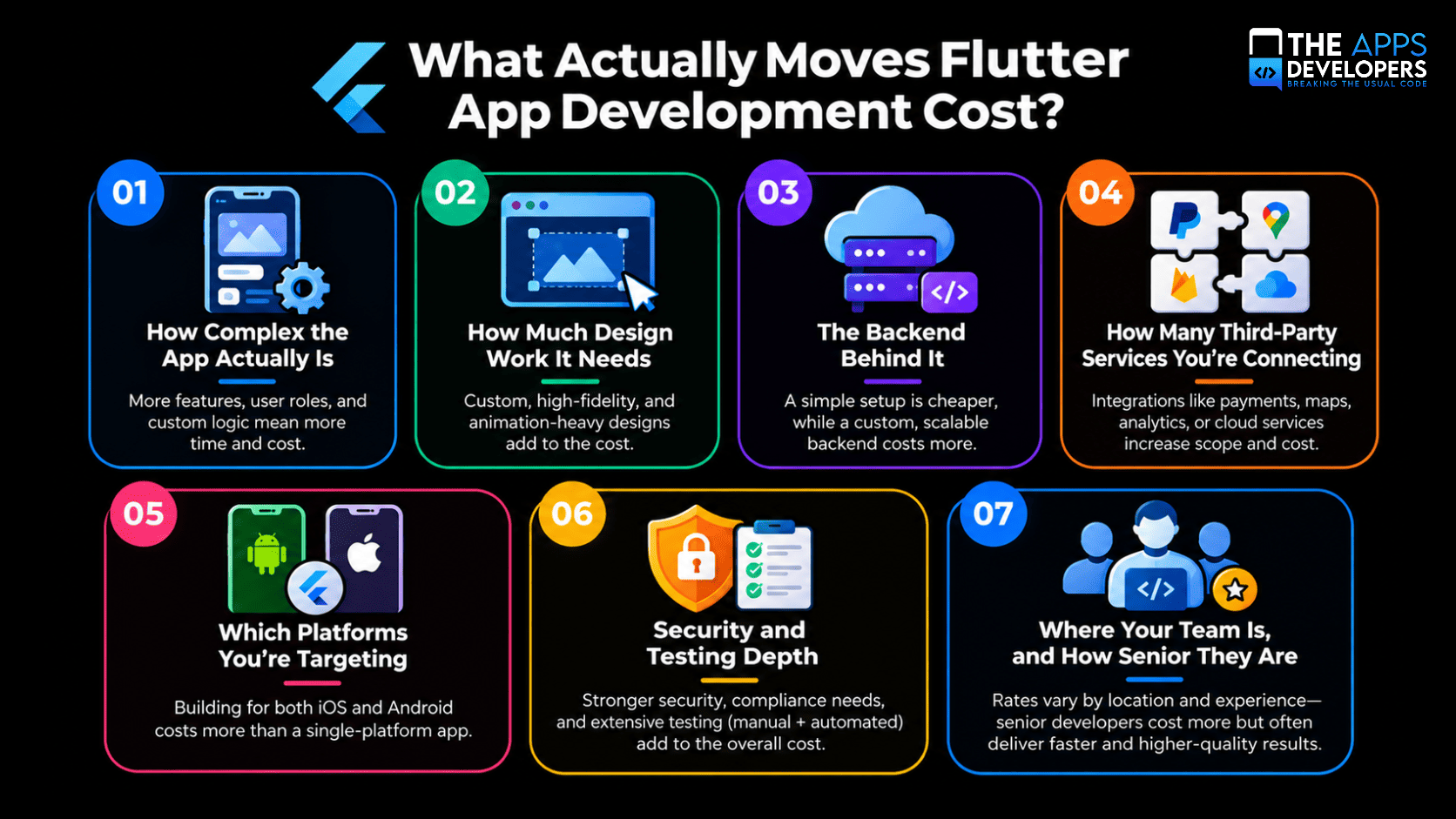
1. How Complex the App Actually Is
More user roles, more workflows, more conditional logic, more hours. An app with one kind of user is a completely different build than one juggling customers, vendors, and admins at once, each needing their own screens and permissions.
2. How Much Design Work It Needs
Basic wireframes cost less than a custom interface with original animations and a full design language. Worth saying: a clean, well-tested design usually pays for itself later. Confusing screens generate support tickets and kill retention. That’s why our UI/UX design team scopes this separately from development rather than bundling it in.
3. The Backend Behind It
Flutter handles what you see. Almost every real app also needs APIs, authentication, a database, cloud storage, and often an admin dashboard behind the scenes. Honestly, this is often the biggest line item on the whole project, bigger than the front-end code itself. Our API and backend development team usually scopes this alongside the Flutter build, not as an afterthought once the UI is done.
4. How Many Third-Party Services You’re Connecting
Payment gateways, Google Maps, Firebase, your CRM, analytics, push notifications. Each one adds setup and testing time, usually a few days to a couple weeks. Fine on its own. Add five or six of them together and it adds up fast.
5. Which Platforms You’re Targeting
iOS only or Android only costs less than both, though Flutter closes that gap a lot compared to building two separate native apps. Add web or desktop on top, and yes, Flutter supports that from the same codebase in theory, but it still costs more in practice.
6. Security and Testing Depth
Encryption, secure auth, device compatibility checks, dedicated performance and security testing, all real hours. An app touching payments or health data needs a lot more of this than a basic content app ever will.
7. Where Your Team Is, and How Senior They Are
This one swings the number more than almost anything else, often three to five times between regions. Our guide to Flutter developer hourly rates breaks that down by region and experience level if you want the specifics.
Flutter App Development Cost by Feature
Every feature adds its own slice to the bill, and a few of them add way more than their screen count would suggest.
| Feature | Cost Impact |
| User Registration and Login | Low to Medium |
| Social Login | Low to Medium |
| Push Notifications | Low to Medium |
| Payment Integration | Medium |
| GPS and Location Tracking | Medium to High |
| Real-Time Chat | High |
| Video Calling | High |
| AI-Powered Features | Medium to Very High |
| Offline Functionality | Medium to High |
| Admin Dashboard | Medium to High |
Take real-time chat. It looks like one messaging screen on a mockup. It isn’t. You’re usually looking at WebSockets for live delivery, message storage, read receipts, delivery status, and syncing across devices. The UI is maybe 10% of the actual work.
Flutter vs Native: Which Actually Costs Less?
| Factor | Flutter | Native Development |
| Codebase | Shared codebase | Separate codebases |
| iOS and Android | Supported from one build | Built and maintained separately |
| Development Effort | Often lower | Often higher |
| Platform Integration | Supports native integration | Direct platform access |
| Maintenance | Shared code can simplify updates | Separate platform work |
| Best For | Cross-platform products | Platform-specific requirements |
Flutter saves you the duplicated work of one team building two codebases. What it doesn’t save you from is backend work, design, QA, or the platform-specific integrations every serious app still needs on both iOS and Android. Still weighing this? Our comparison of native, hybrid, and cross-platform apps goes deeper into the trade-offs beyond just Flutter.
How Long Does Flutter App Development Actually Take?
| Project Type | Estimated Timeline |
| Simple App | 1 to 3 months |
| Flutter MVP | 2 to 4 months |
| Medium Complexity App | 3 to 6 months |
| Complex Application | 6 to 9+ months |
| Enterprise Application | Depends on scope |
Scope drives the timeline more than anything else, but it’s not the only variable. Team size, integration count, and how thoroughly the app gets tested before launch can stretch or shrink things just as much as the feature list on its own.
The Costs That Show Up After Launch
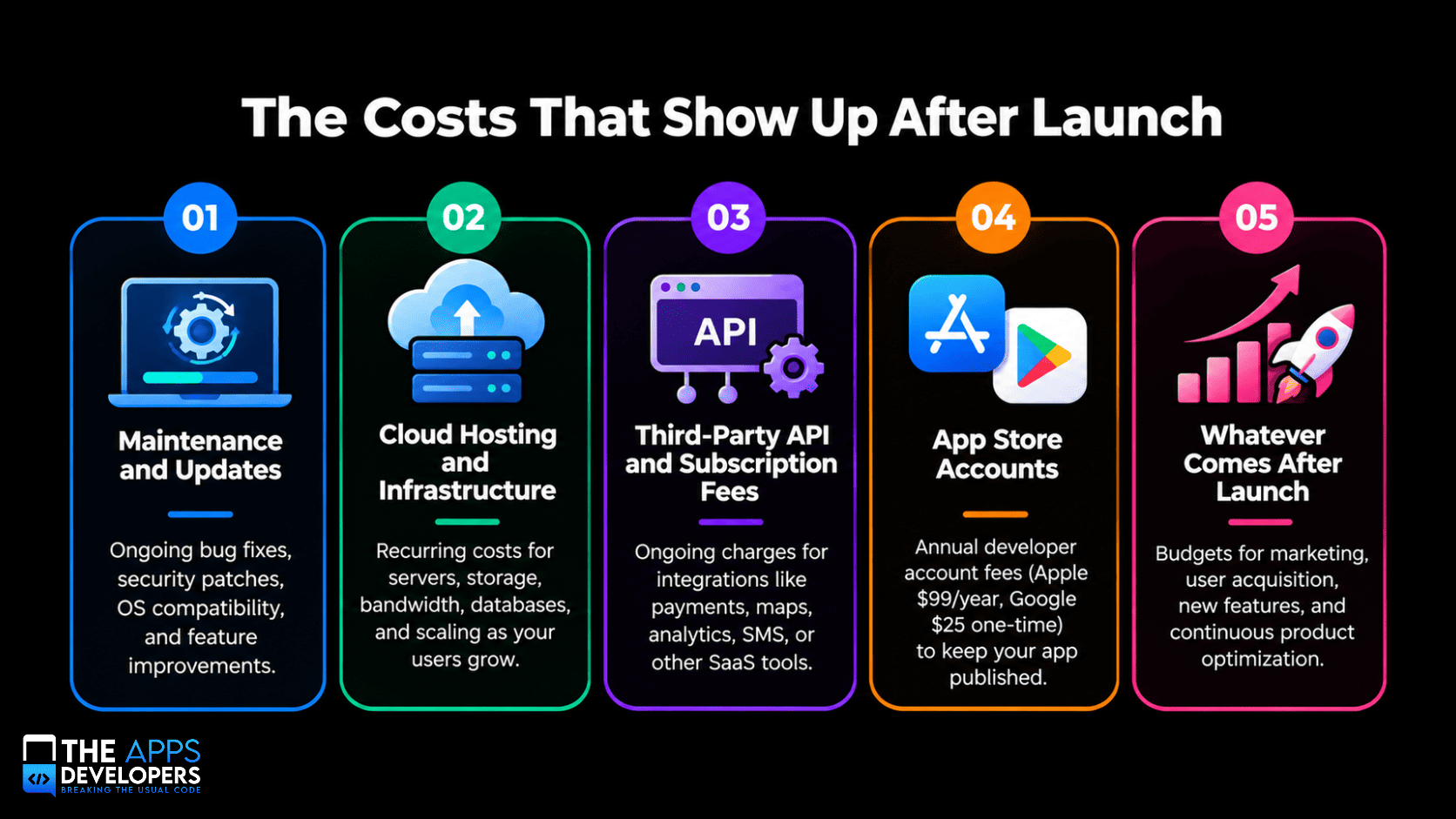
Most pricing conversations stop at the build and never mention what comes after, which is exactly where budgets get blindsided.
Maintenance and Updates
Bug fixes, compatibility updates for new OS versions, security patches, ongoing performance work. It’s never really done. Our mobile app maintenance cost guide breaks down what a realistic yearly budget looks like.
Cloud Hosting and Infrastructure
Hosting, storage, bandwidth, all of it grows as your user base grows, and none of it shows up in an initial development quote. Our DevOps and cloud solutions team builds this into the infrastructure plan from day one instead of bolting it on later.
Third-Party API and Subscription Fees
Maps, SMS, email, payment processing, analytics, AI APIs, almost all of these get billed separately, usually by usage. None of it appears in the build quote. All of it becomes a real monthly line item once people are actually using the app.
App Store Accounts
Apple’s Developer Program runs $99 a year. Google Play charges a one-time $25 registration fee. Small amounts on their own, but Apple’s one renews every single year the app stays live, so budget for it.
Whatever Comes After Launch
Launch day isn’t the finish line, it’s more like the starting gun. New features, redesigns, fixes based on what real users actually do, all of that keeps costing money well past the initial build.
How to Spend Less Without Cutting Corners
- Start with an MVP. Ship the core, learn from real usage, build the rest based on what people actually want.
- Prioritize ruthlessly. Not every idea needs to be in version one.
- Nail requirements before anyone writes code. Clarity upfront is cheaper than changing mid-build, every time.
- Pick the right team, not just the cheapest rate. These are rarely the same thing.
- Reuse what already works instead of rebuilding everything from scratch.
- Skip integrations that don’t add real value. Just because you can connect it doesn’t mean you should.
- Budget for maintenance from day one. Make it a line item, not a surprise six months in.
Still figuring out what belongs in that first version? Our MVP development cost guide walks through scoping one properly.
How to Get a Cost Estimate You Can Actually Trust
Before you even reach out for a quote, it helps to have answers ready for a few questions:
- What problem is this app actually solving?
- Who’s it for?
- Which platforms do you need?
- What features are must-haves for launch, and what can wait?
- Does it need a custom backend?
- Any payments or third-party integrations involved?
- What’s the realistic timeline?
- What kind of support do you want after launch?
You don’t need every technical detail figured out. A good partner helps you work through the rest. What really matters is asking for an itemized estimate instead of accepting one mystery number. You want to see exactly where the money’s going.
Build Your Flutter App With the Right Team
Picking Flutter is really just step one. The architecture, the feature planning, the actual user experience, backend integration, testing, all of that shapes the final investment just as much as the framework itself does. At The Apps Developers, we help businesses plan and build Flutter apps around what their product actually needs, not a generic template.
Ready to scope your Flutter app? Talk to our Flutter app development services team, and we’ll put together an itemized estimate based on what your app actually needs, not a guess.
Frequently Asked Questions
How much does it cost to build a Flutter app in 2026?
Usually $15,000 to $40,000 for something simple, $25,000 to $60,000 for an MVP, and up to $300,000 or more once you’re building something complex or enterprise-grade, depending on features and integrations.
Is Flutter cheaper than native app development?
Generally, yes. One shared codebase across iOS and Android cuts development effort compared to building and maintaining two separate native apps, though backend, design, and testing costs still apply no matter what you choose.
How much does a Flutter MVP cost?
Typically $25,000 to $60,000, taking about 2 to 4 months, covering core features, a basic backend, and user accounts.
Does Flutter support both iOS and Android?
Yes, from a single codebase. It also handles web and desktop, though those add their own polish and testing time.
How long does it take to develop a Flutter app?
Anywhere from 1 to 3 months for something simple to 6 to 9 months or more for a complex app, depending on scope, integrations, and team size.
What increases Flutter app development costs?
Mostly how complex the app is, how custom the UI/UX work is, backend complexity, how many third-party integrations you need, security and testing requirements, and where your development team is based.
How much does Flutter app maintenance cost?
A common rule of thumb is 15% to 20% of the original development cost per year, covering bug fixes, OS compatibility updates, security patches, and performance work.