
Many Dallas businesses are moving app development from offshore teams to local or US-based developers because of time zone gaps, communication problems, quality issues that lead to costly rework, intellectual property concerns, and stricter data privacy requirements. Offshore development can still work well, but a growing number of companies now prefer local teams or a hybrid model with US-based leadership, so they get faster collaboration and more accountability without paying top local rates for every role.
The story usually goes something like this. A Dallas company hires an offshore team because the quote is half of what local agencies charged. The first few weeks look great. Then the questions start piling up overnight, features come back slightly wrong, and every small fix takes another day because the team is asleep during your workday. Six months later, the “cheap” app has cost more than the local quote, and it still isn’t finished.
That doesn’t mean offshore development is always a mistake. Plenty of successful apps were built by offshore teams. But for many Dallas businesses, the hidden costs have changed the math. In this guide, we’ll look at why companies are bringing app development closer to home, when offshore still makes sense, and how to choose the right model for your mobile app development project.
What Is the Difference Between Offshore, Nearshore, and Local App Development?
Offshore app development means hiring a team in a distant country, usually with a large time zone difference. Nearshore means hiring in a nearby country with similar working hours. Local or onshore development means hiring a team in the same country, often in or near your own city.
| Model | Typical Locations for a Dallas Business | Time Difference From Dallas | Typical Rates | Collaboration |
| Local (Dallas) | Dallas–Fort Worth | None | Highest | In person and real time |
| Onshore (US remote) | Anywhere in the US | 0 to 2 hours | High | Real time |
| Nearshore | Mexico, Colombia, Brazil, other parts of Latin America | 0 to 3 hours | Moderate | Mostly real time |
| Offshore | India, Pakistan, the Philippines, Eastern Europe | Roughly 7 to 14 hours | Lowest | Mostly asynchronous |
| Hybrid | US-based leadership with a distributed delivery team | Overlap managed by the US team | Blended | Real time for key decisions |
Why Dallas Businesses Are Moving App Development Closer to Home
Here are the reasons Dallas companies most often give for hiring local app developers or US-led teams instead of fully offshore ones.
1. Time Zones Slow Everything Down
Dallas runs on Central Time. A team in India or Pakistan is roughly 10 to 11.5 hours ahead, depending on daylight saving time, and the Philippines is even further. That means a question you ask at 2 p.m. may not get answered until the next morning, and a bug found at launch can sit for hours before anyone on the team is awake.
Over a long project, those overnight delays add up to weeks. Local and US-based teams can solve problems in a single conversation instead of a two-day email chain.
2. Communication Gaps Create Costly Rework
Most failed app projects don’t fail on code. They fail on misunderstandings. Language differences, cultural communication styles, and limited live discussion can all lead to features that technically match the spec but miss what you actually needed.
Every misunderstanding means rework, and rework is where “cheap” projects become expensive. Local teams can join a whiteboard session, test the app with your users in person, and catch problems before they’re built.
3. Hidden Costs Erase the Hourly Rate Savings
Offshore hourly rates look attractive on paper, but the total cost of a project includes much more than the rate:
- Extra project management time to coordinate across time zones.
- Rework from misunderstood requirements.
- Delays that push back your launch and revenue.
- Quality fixes after delivery, sometimes by a second team.
- Travel or extra tools to keep everyone aligned.
When Dallas companies compare total cost of ownership instead of hourly rates, the gap between offshore and local often shrinks, and sometimes disappears.
4. Intellectual Property and Legal Protection
When you hire a team in another country, enforcing your contract and protecting your intellectual property can be harder and more expensive. Under US copyright law, work created by an outside contractor isn’t automatically owned by the client, so your contract must clearly assign the code to you. The US Copyright Office’s guide to works made for hire explains why that written assignment matters.
With a US-based partner, contracts fall under US law, disputes are easier to resolve, and you have more confidence that the code and IP are truly yours. Our guide on whether you can patent your mobile app covers other ways to protect what you build.
5. Data Privacy and Compliance Are Getting Stricter
Apps now handle more sensitive data than ever, and regulations have caught up. Texas has the Texas Data Privacy and Security Act, healthcare apps must meet HIPAA, and financial apps face their own rules. Many Dallas companies, especially in healthcare, finance, and government contracting, prefer partners who understand US compliance requirements and can keep sensitive data and access under tighter control.
6. Quality and Accountability
When something goes wrong, you want someone who picks up the phone during your business hours and takes ownership. Local and US-based teams are often easier to hold accountable, simpler to visit, and more invested in long-term relationships with clients in their own market.
7. Speed to Market
Faster feedback loops mean faster releases. When product owners, designers, and developers work the same hours, decisions happen in meetings instead of across multiple days, and Agile sprints actually run on schedule.
Is Offshore App Development Still a Good Option?
Yes, in the right situations. Offshore development can work well for projects with clear, stable requirements, strong internal project management, and a budget that leaves room for coordination and quality control.
Offshore can be a smart choice when:
- Your requirements are detailed and unlikely to change.
- You have an experienced in-house product manager or technical lead.
- The work is well-defined, like maintenance, testing, or specific features.
- Budget is the most important constraint and you can accept slower communication.
Problems usually start when companies choose offshore purely on price, with vague requirements and nobody on their side managing the work.
The Hybrid Model: Why Many Dallas Companies Choose It
Fully local teams cost more for a reason: US software developer pay is among the highest in the world, as the Bureau of Labor Statistics’ software developer outlook shows. That’s why a growing number of businesses don’t pick one extreme. They choose a hybrid model: US-based leadership, such as a project manager, product strategist, or technical lead, who works in your time zone and owns communication and quality, supported by a distributed delivery team.
| Factor | Pure Offshore | Hybrid (US-Led) | Fully Local |
| Cost | Lowest | Moderate | Highest |
| Communication | Mostly asynchronous | Real time for decisions and reviews | Real time |
| Accountability | Harder to enforce | Clear US point of contact | Clear |
| Speed of decisions | Slower | Fast | Fast |
| Best for | Well-defined, budget-first projects | Most startups and growing businesses | Projects needing constant in-person work |
The key is how the hybrid team actually works. Look for daily overlap with Central Time, a single accountable point of contact, written scope, regular demos you can see, and contracts under US law.
Local vs Offshore: Questions to Ask Before You Decide
- How many hours of real-time overlap will we have each day?
- Who is my main point of contact, and where are they located?
- Which laws govern the contract, and who owns the code?
- How do you prevent and handle rework?
- Can I see working software every one to two weeks?
- How do you handle sensitive data and compliance?
For a full checklist, see our guide to the 12 questions to ask before hiring a Dallas app developer.
How to Switch From an Offshore Team to a Local or Hybrid Partner
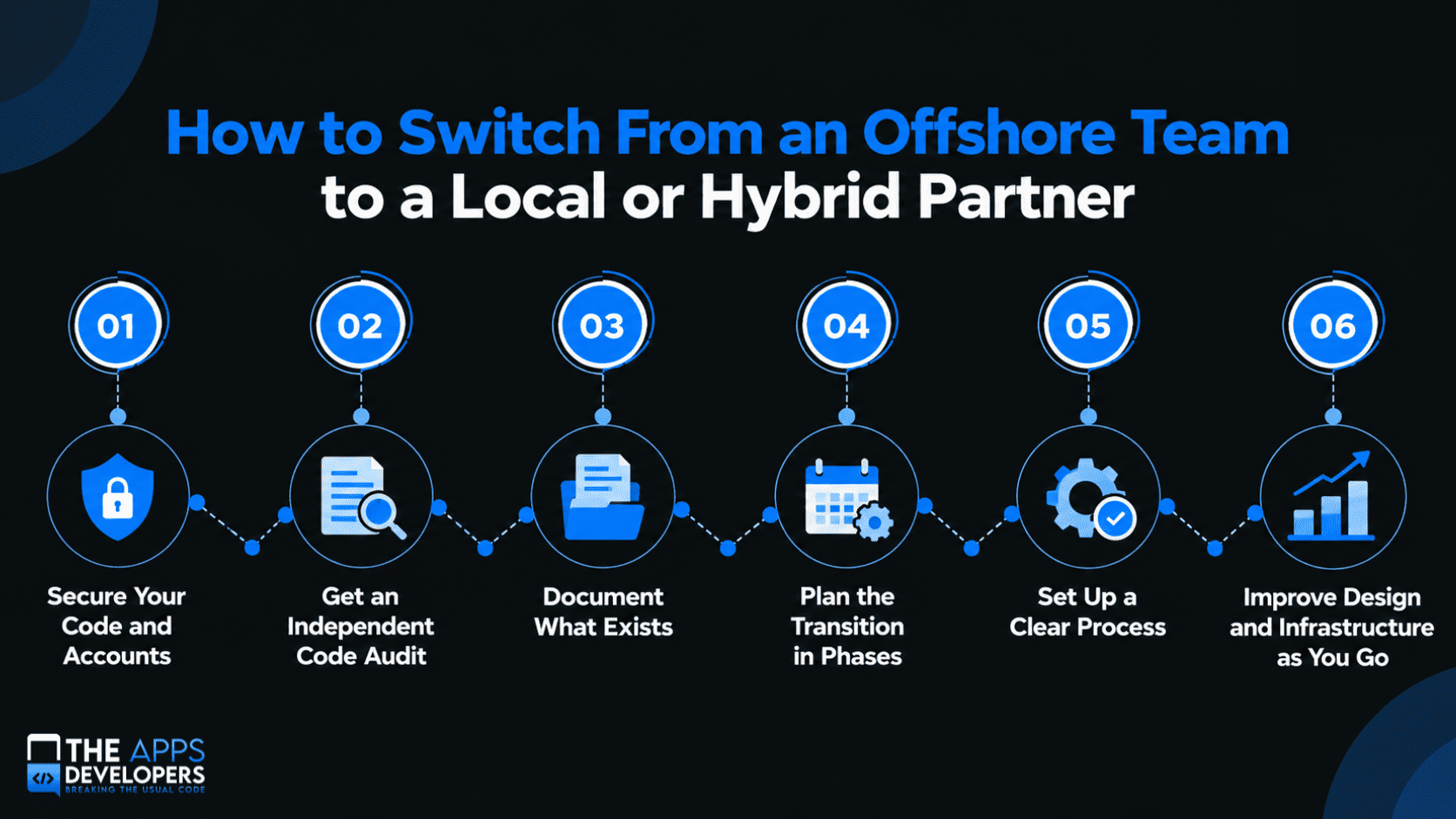
Step 1: Secure Your Code and Accounts
Make sure you have full access to your source code repositories, app store accounts, cloud hosting, domains, and third-party services. These should always be in your company’s name, not the vendor’s.
Step 2: Get an Independent Code Audit
Ask your new partner to review the existing code before making promises. An audit shows what can be kept, what needs fixing, and what should be rebuilt.
Step 3: Document What Exists
Collect requirements, designs, API documentation, and known issues. Even rough notes save weeks of rediscovery.
Step 4: Plan the Transition in Phases
Avoid a hard cutover. Run a short overlap period, prioritize critical fixes, and move feature development gradually.
Step 5: Set Up a Clear Process
Agree on sprint length, demo schedule, communication tools, and how changes are approved. If you’re unsure which delivery approach fits, our comparison of Waterfall vs Agile explains the options.
Step 6: Improve Design and Infrastructure as You Go
Rescue projects are often a chance to fix deeper issues. Fresh UI/UX design work can address usability problems.
Reliable DevOps and cloud solutions can stabilize deployments and hosting.
How The Apps Developers Works With Dallas Businesses
The Apps Developers work with businesses across the US, including Dallas. Every project starts with discovery and a written scope, and work moves in two-week sprints with a working demo at the end of each one, so you always see real progress. You get a dedicated point of contact, flexible engagement models, and a contract that assigns the code and intellectual property to you.
We also help rescue projects that have stalled with other vendors. One fintech founder, Samantha Lowe of AppNova, brought us in on a failing build, and within two sprints our team had diagnosed the architecture problems and laid out a clear rebuild plan.
Conclusion
Dallas businesses aren’t abandoning offshore development because it never works. They’re moving closer to home because time zones, communication gaps, rework, legal risk, and compliance pressure often make the cheapest quote the most expensive choice. The best decision comes from comparing total cost, accountability, and speed, not just hourly rates. For many companies, a local or US-led hybrid team delivers that balance.
Thinking about switching development partners or starting a new app? Book a free consultation with The Apps Developers, and we’ll review your project, your current setup, and the model that fits your goals and budget.
Frequently Asked Questions
Why are businesses moving away from offshore app development?
Businesses move away from offshore app development mainly because of time zone delays, communication gaps, rework costs, intellectual property concerns, and stricter data privacy and compliance requirements.
Is offshore app development cheaper than local development?
Offshore hourly rates are usually lower, but total project costs can rise because of coordination time, rework, delays, and quality fixes. Comparing total cost of ownership gives a more accurate picture than hourly rates alone.
What is the difference between offshore and nearshore development?
Offshore development uses teams in distant countries with large time zone differences, while nearshore development uses teams in nearby countries, such as Latin America for US businesses, with similar working hours.
What is a hybrid app development model?
A hybrid model combines US-based leadership, such as a project manager or technical lead in your time zone, with a distributed delivery team, balancing cost with real-time communication and accountability.
How do I switch from an offshore developer to a local one?
Secure access to your code and accounts, get an independent code audit, document what exists, plan a phased transition, and agree on a clear process with your new partner.
Who owns the code when you hire an offshore developer?
You own the code only if your contract clearly assigns it to you. Contracts with overseas vendors can also be harder to enforce, so review ownership and governing law carefully.
When does offshore development make sense?
Offshore development makes sense for well-defined projects with stable requirements, strong internal project management, and budgets where cost savings matter more than real-time collaboration.
How much overlap with Central Time should my development team have?
Aim for at least three to four hours of daily overlap with Central Time, so questions, reviews, and urgent issues can be handled during your working day.