
- Home
- App Development
- Blog Details
- 12 mins read
Waterfall vs Agile: What Is the Difference Between These Methodologies?
- Published on:
- Written by:
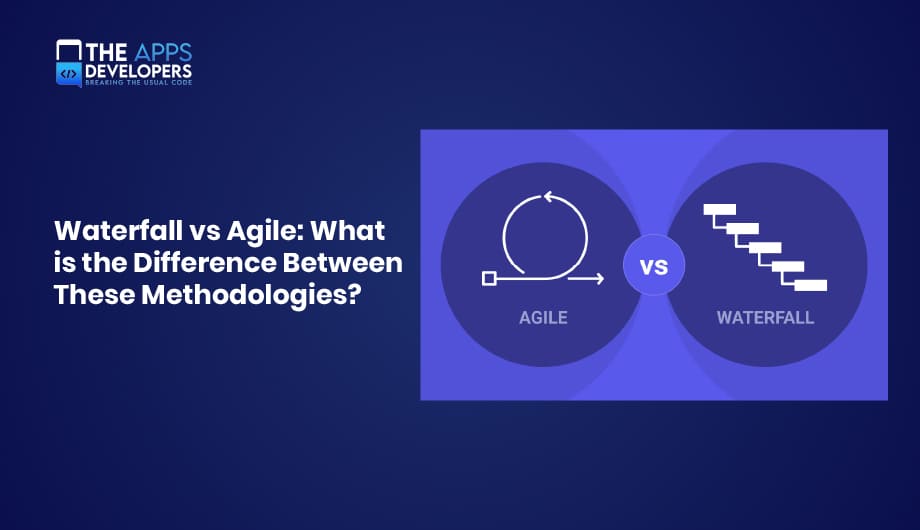
Waterfall is a linear, plan-driven methodology where each phase, from requirements to design, build, testing, and launch, is finished before the next begins. Agile is an iterative methodology where teams deliver working software in short cycles, gather feedback, and adjust as they go. Waterfall suits projects with fixed, well-understood requirements, while Agile suits projects where requirements are likely to change or need to be discovered along the way.
Picture two teams building the same app. The first spends three months writing a detailed specification, signs it off, builds for six months, tests for two, and launches. The second ships a basic working version in four weeks, shows it to real users, and improves it every two weeks after that. Which team wins?
It depends on the project, and that’s exactly why the Waterfall vs Agile debate keeps coming up. Neither methodology is better in every situation. In this guide, we’ll explain how each one works, compare them side by side, walk through the same project built both ways, and help you decide which approach fits your next build. It’s a choice we help clients make at the start of every web application development project.
Waterfall vs Agile at a Glance
| Factor | Waterfall | Agile |
| Approach | Linear and sequential | Iterative and incremental |
| Planning | Detailed, upfront for the whole project | High-level upfront, detailed each cycle |
| Requirements | Fixed early, changes are costly | Expected to evolve |
| Delivery | One release at the end | Working software every few weeks |
| Customer involvement | Mainly at the start and end | Ongoing throughout the project |
| Testing | A separate phase after development | Continuous, in every iteration |
| Documentation | Extensive and formal | Lean, “just enough” |
| Budget and timeline | Fixed estimates upfront | Often fixed per sprint, flexible scope |
| Biggest risk | Building the wrong thing and discovering it late | Scope creep without strong prioritization |
| Best for | Stable, well-defined, regulated, or fixed-price projects | New products, uncertain requirements, fast-moving markets |
What Is the Waterfall Methodology?
The Waterfall methodology is a sequential project management approach in which a project moves through fixed phases, such as requirements, design, implementation, testing, and deployment, with each phase completed and approved before the next one starts.
It’s called “waterfall” because progress flows one way, like water down steps. Going back to an earlier phase is possible but expensive, so getting each phase right the first time is the whole game.
The Phases of the Waterfall Model
| Phase | What Happens | Main Output |
| 1. Requirements | Gather and document everything the system must do | Requirements specification |
| 2. Design | Plan the architecture, data, and interfaces | Design documents |
| 3. Implementation | Write the code | Working software components |
| 4. Testing | Verify the whole system against requirements | Test reports, fixed defects |
| 5. Deployment | Release to users | Live product |
| 6. Maintenance | Fix issues and make updates after launch | Patches and updates |
A Little History Most People Get Wrong
Waterfall is usually traced to Winston Royce’s 1970 paper on managing large software projects. Interestingly, Royce never used the word “waterfall,” and he warned that a strictly single-pass approach was risky. He recommended iteration and early prototyping, ideas that look a lot like what Agile later made popular.
What Is the Agile Methodology?
The Agile methodology is an iterative approach to software development in which cross-functional teams deliver small, working increments of a product in short cycles, gather feedback from users and stakeholders, and continuously adapt the plan.
Agile took shape in 2001, when seventeen software practitioners published the Manifesto for Agile Software Development. In plain terms, it values people and collaboration over rigid process, working software over heavy documentation, close customer partnership over contract negotiation, and responding to change over sticking to a fixed plan. It doesn’t say the second items have no value, only that the first items matter more.
Popular Agile Frameworks
Agile is a mindset, not a single process. Teams usually put it into practice with a framework:
- Scrum: work happens in fixed-length sprints, usually two weeks, with defined roles like Product Owner and Scrum Master. The official Scrum Guide explains the framework in detail.
- Kanban: work flows continuously across a visual board, with limits on how much is in progress at once.
- Extreme Programming (XP): engineering practices like pair programming, test-driven development, and continuous integration.
- SAFe and other scaling frameworks: used by large organizations coordinating many Agile teams.
Waterfall vs Agile: The Key Differences
Here’s how Agile vs Waterfall compare on the eight factors that shape a project most.
1. Planning
Waterfall plans the whole project upfront, including scope, schedule, and budget. Agile sets a product vision and a rough roadmap, then plans in detail one iteration at a time.
2. Requirements and Change
In Waterfall, requirements are fixed early, and changes go through formal change control. In Agile, changing requirements are expected and welcomed, because they usually mean the team has learned something.
3. Delivery
Waterfall delivers one finished product at the end. Agile delivers working, usable software every few weeks, so value reaches users much earlier.
4. Testing
Waterfall tests after the build phase is complete, which can uncover major issues late. Agile tests continuously within each iteration, often with automated tests running on every change.
5. Customer Involvement
Waterfall involves customers mostly at the start, to define requirements, and at the end, to accept the product. Agile involves them throughout, reviewing working software at the end of every sprint.
6. Documentation
Waterfall relies on detailed documents at every phase. Agile keeps documentation lean and focuses on working software, though good Agile teams still document what matters.
7. Team Structure
Waterfall often hands work between specialized groups, such as analysts, designers, developers, and testers. Agile uses small, cross-functional teams that own the work together.
8. Risk
Waterfall’s biggest risk is discovering late that you built the wrong thing. Agile reduces that risk by getting feedback early, but it needs strong prioritization to avoid endless scope growth.
The Same Project, Built Two Ways
Let’s say a restaurant group wants a mobile ordering app.
With Waterfall: The team spends six weeks documenting every feature: menus, ordering, payments, loyalty points, reviews, and delivery tracking. Design takes another month. Development runs for five months, then testing for six weeks. On launch day, the team discovers customers barely use loyalty points but desperately want group ordering, which wasn’t in the spec. Adding it means a new change request and another round of development.
With Agile: In the first four weeks, the team ships a simple version with menus, ordering, and payments to one restaurant. Customer feedback shows that group orders are the most requested feature, and loyalty points can wait. The next sprints add group ordering, then delivery tracking. By month six, the app is live across all locations with the features people actually use.
Neither team was lazy or wrong. The Agile team simply learned what mattered sooner. If the restaurant had known exactly what it needed and nothing was likely to change, Waterfall would have worked just as well, often with a more predictable budget. This is the same lesson we cover in our guide on how to build an app like Uber: launch a focused version, then let real usage guide what comes next.
Pros and Cons of Waterfall vs Agile
Waterfall Pros and Cons
| Pros | Cons |
| Clear scope, timeline, and budget from the start | Hard and expensive to change once work begins |
| Easy to understand and manage | Users don’t see working software until late |
| Strong documentation for audits and handovers | Problems often surface late in testing |
| Works well with fixed-price contracts | Risk of delivering something outdated by launch |
| Less day-to-day time needed from stakeholders | Less room to learn and adapt along the way |
Agile Pros and Cons
| Pros | Cons |
| Delivers value early and often | Final cost and timeline are harder to predict upfront |
| Adapts easily to changing needs | Needs ongoing time and decisions from stakeholders |
| Catches problems early through continuous testing | Can drift without a strong product owner |
| Builds what users actually need | Lean documentation can be a gap in some industries |
| Keeps teams motivated with visible progress | Harder to scale across many teams without a framework |
When to Use Waterfall vs Agile
Use Waterfall When:
- Requirements are clear, stable, and unlikely to change.
- The project has strict regulatory or contractual documentation needs.
- You need a fixed price and fixed scope approved upfront.
- The work depends on physical or hardware components that are expensive to change.
- The technology and domain are well understood by the team.
Use Agile When:
- You’re building a new product and need to learn what users want.
- Requirements are likely to change as the market or business evolves.
- Getting a first version to market quickly matters.
- Stakeholders can review progress regularly and make decisions.
- The product will keep evolving long after the first release, like most apps and SaaS platforms.
Testing ideas with real users early is also one of the best defenses against the problems we describe in why most apps fail after launch.
| Project Type | Better Fit |
| New mobile app or startup MVP | Agile |
| SaaS product with ongoing releases | Agile |
| Fixed-scope government or regulated system | Waterfall or hybrid |
| Hardware-dependent or embedded system | Waterfall or hybrid |
| Small website with a clear brief | Waterfall |
| Large enterprise platform modernization | Hybrid |
Is Agile Better Than Waterfall?
Not universally. Agile is better when requirements are uncertain and fast feedback matters, which is true for most modern software products. Waterfall is better when requirements are stable, documentation is mandatory, or scope and budget must be locked in from day one.
Hybrid Approaches: The Best of Both Worlds
In practice, many organizations blend the two. A common pattern sometimes called “Water-Scrum-Fall” uses Waterfall-style planning, budgeting, and approvals at the start and end, with Agile sprints for the actual development in the middle.
This mix is now formally recognized in project management. PMI’s PMBOK Guide describes predictive (Waterfall-style), adaptive (Agile), and hybrid approaches, and encourages teams to choose the delivery approach that fits each project.
Hybrid works especially well when you need a fixed budget or regulatory sign-off but still want to build iteratively and get feedback early.
Scrum vs Kanban vs Waterfall
| Factor | Waterfall | Scrum | Kanban |
| Work structure | Sequential phases | Fixed-length sprints | Continuous flow |
| Planning | Upfront for the whole project | At the start of each sprint | Ongoing, as capacity frees up |
| Roles | Project manager and specialist teams | Product Owner, Scrum Master, developers | No required roles |
| Changes during work | Formal change control | Usually wait for the next sprint | Can be added anytime |
| Best for | Fixed, well-defined projects | Product development with regular releases | Support, maintenance, and steady workflows |
Can Agile Work in Regulated Industries?
Yes, and this is one of the biggest myths about Agile. Healthcare, finance, and government teams use Agile successfully by building compliance into each sprint, keeping traceable records in their tools, and automating testing and approvals. Documentation doesn’t disappear. It’s created continuously instead of all at once.
For larger organizations, Agile also has to fit with enterprise security, governance, and device management. Our enterprise mobile app development guide covers how those requirements fit into modern delivery.
How to Move From Waterfall to Agile
- Start with one pilot team and one product, not the whole organization.
- Pick a framework, usually Scrum for product work or Kanban for operational work.
- Name a product owner with real authority to prioritize.
- Break the backlog into small, valuable pieces that can be delivered in one sprint.
- Automate testing and deployment, so frequent releases are safe.
- Hold regular demos and retrospectives, and improve the process every cycle.
- Measure outcomes, like lead time, defect rates, and user satisfaction, not just velocity.
Frequent releases depend on solid automation. Our DevOps and cloud solutions team builds the CI/CD pipelines that make shipping every sprint routine instead of risky.
How We Approach Projects at The Apps Developers
Our own process is a practical hybrid. Every project starts with discovery and a written scope, so budgets and priorities are clear before development begins, which is the part of Waterfall most clients value. Then we build in two-week sprints with a working demo at the end of each one, so you see progress, give feedback, and adjust priorities as you learn.
Design follows the same rhythm. Our UI/UX design team prototypes and tests key screens with users early, so development starts on ideas that have already been validated.
The same approach applies across platforms, from web apps to mobile app development, where early releases and real user feedback make the biggest difference to the final product.
Conclusion
The Agile vs Waterfall decision isn’t a battle with a permanent winner. Waterfall gives you predictability when requirements are clear and stable. Agile gives you adaptability when you’re building something new and need to learn as you go. Many of the best teams use a hybrid: clear scope and budget upfront, then short iterations with real feedback. Choose based on how certain your requirements are, how much change you expect, and how involved your stakeholders can be.
Not sure which approach fits your project? Book a free consultation with The Apps Developers, and we’ll help you plan a delivery approach that balances predictability with the flexibility to build the right product.
Frequently Asked Questions
What is the main difference between Waterfall and Agile?
Waterfall completes each phase, from requirements to launch, in a fixed sequence and delivers once at the end. Agile delivers working software in short iterations and adapts the plan based on feedback throughout the project.
Is Agile better than Waterfall?
Agile is better for projects with changing or uncertain requirements, which includes most new software products. Waterfall is better when requirements are stable, documentation is mandatory, or a fixed scope and budget are required upfront.
Can you combine Waterfall and Agile?
Yes. Many teams use a hybrid approach, with Waterfall-style planning and approvals at the start and Agile sprints for development. PMI’s PMBOK Guide formally recognizes hybrid delivery approaches.
What are the phases of the Waterfall model?
The main phases of the Waterfall model are requirements, design, implementation, testing, deployment, and maintenance. Each phase is completed and approved before the next one begins.
Is Scrum the same as Agile?
No. Agile is a broader set of values and principles, while Scrum is one specific framework for practicing Agile, using sprints and defined roles. Kanban and XP are other Agile approaches.
When should you use the Waterfall methodology?
Use Waterfall when requirements are clear and unlikely to change, when strict documentation or regulatory approval is required, or when you need a fixed scope and price agreed before work begins.
Why do most software teams use Agile today?
Most software products change after launch, and users’ needs are rarely fully known upfront. Agile lets teams release early, learn from real users, and adjust, which reduces the risk of building the wrong thing.
Does Agile mean no documentation?
No. Agile values working software over excessive documentation, but teams still document what’s needed. In regulated projects, documentation is created continuously during each sprint rather than all at the start.