Cloud cost optimization means reducing AWS, Azure, or GCP spend without hurting performance or reliability, primarily through rightsizing compute resources, choosing the right pricing model for each workload, eliminating idle and orphaned resources, and building ongoing visibility into spend rather than reacting to a surprising bill once a quarter. Most organizations aren’t overspending because the cloud is inherently expensive, they’re overspending because nobody’s actively managing it as a continuous discipline.
That distinction matters more than it sounds like it should. According to Flexera’s 2026 State of the Cloud Report, organizations now waste an estimated 29 percent of their cloud spend, the first increase in five years after a period of steady improvement, and the same report found organizations exceeding their public cloud budgets by 17 percent on average. That’s not a small optimization opportunity, it’s close to a third of most cloud bills doing nothing useful, and it’s a number that’s trending in the wrong direction rather than settling into a manageable baseline. This guide covers where that waste actually comes from and the specific strategies that close the gap, whether your infrastructure runs on AWS, Azure, GCP, or some combination of the three.
What Is Cloud Cost Optimization?
Cloud cost optimization is the ongoing practice of reducing cloud infrastructure spend while maintaining the performance, reliability, and security a workload actually needs, achieved through rightsizing resources, selecting cost-efficient pricing models, and eliminating waste from idle or forgotten infrastructure. It’s distinct from simply cutting costs indiscriminately, the goal isn’t the smallest possible bill, it’s the lowest bill that still delivers what the business genuinely requires, which is a meaningfully different and more sustainable target.
Why Cloud Cost Optimization Matters More in 2026
Cloud spend has become harder to manage, not easier, even as tooling has matured. The Flexera data cited above points directly at why: AI workloads are growing fast, usage patterns are less predictable than traditional computers, and new pricing models are outpacing many teams’ ability to track and forecast spend accurately. This reverses several years of steady improvement, waste had been declining since 2019 before this year’s uptick, which suggests the tools and habits that worked for traditional infrastructure aren’t automatically carrying over to how organizations are using cloud today.
The FinOps Foundation, the leading industry body focused on cloud financial management, frames this as a cultural and organizational challenge as much as a technical one, cost optimization works best when engineering, finance, and business stakeholders are looking at the same data and making decisions together, rather than cost control living entirely with a finance team disconnected from the actual infrastructure decisions driving spend.
Core Cloud Cost Optimization Strategies
Rightsizing Compute Resources
Rightsizing means matching the actual size of a compute instance, CPU, memory, storage, to what a workload genuinely needs, rather than the size someone guessed at when the resource was first provisioned. Instances are consistently over-provisioned far more often than under-provisioned, since the safe instinct during initial setup is to size generously, and few teams ever circle back to right-size once real usage data exists to make that decision properly.
Reserved Instances vs. Spot Instances vs. On-Demand
Choosing the right pricing model for each workload is one of the highest-leverage decisions in cloud cost optimization, and the three main options serve genuinely different situations.
| Pricing Model | How It Works | Discount vs. On-Demand | Best Fit |
| On-Demand | Pay per second/hour with no commitment | None (baseline) | Unpredictable or short-lived workloads |
| Reserved Instances | Commit to 1-3 years of usage upfront | Up to roughly 40-60% | Steady, predictable, long-running workloads |
| Spot Instances | Bid on unused capacity, can be reclaimed with notice | Up to roughly 60-90% | Fault-tolerant, flexible workloads (batch jobs, CI/CD runners) |
The costliest mistake here isn’t picking the wrong model outright, it’s leaving everything on the default, On-Demand, indefinitely. A workload that’s been running steadily for six months and is still billed On-Demand is very likely leaving a meaningful discount on the table simply because nobody revisited the original default setting.
Autoscaling to Match Actual Demand
Infrastructure sized for peak load and left running at that size around the clock is one of the most common, most avoidable sources of cloud waste. Autoscaling configured to genuinely track demand, not just theoretically enabled but tuned with realistic thresholds, means paying for capacity that matches actual traffic rather than a worst-case scenario that only occurs a small fraction of the time.
Storage Tiering and Lifecycle Policies
Not all data needs to sit in the fastest, most expensive storage tier indefinitely. Moving infrequently accessed data to cheaper storage tiers, and setting lifecycle policies that automate this transition rather than relying on someone remembering to do it manually, is a straightforward way to reduce storage costs without touching computers at all.
Eliminating Idle and Orphaned Resources
Common Sources of Waste
Unattached storage volumes, unused load balancers, idle databases left running after a project wound down, and forgotten development environments are consistently among the largest categories of pure waste, since none of them are providing any active value while still generating a bill every month.
Unattached Storage Volumes
A storage volume detached from its original instance, whether because the instance was terminated or migrated, often keeps billing indefinitely unless someone explicitly notices and deletes it, since nothing in most cloud consoles surfaces this automatically as a problem.
Example: An Orphaned EBS Volume Still Being Billed
A development team that spins up and tears down test environments regularly, without a cleanup step removing the underlying storage volumes each time, can accumulate a meaningful and entirely avoidable monthly cost purely from volumes nobody’s actively using or even aware still exist.
Multi-Cloud and Vendor Negotiation Leverage
For organizations running meaningful spend across more than one provider, that multi-cloud position can itself become negotiating leverage, cloud providers are generally willing to discuss custom pricing and commitments for large, stable workloads, but only if a team actually has the spend visibility to make that case with real numbers rather than a rough estimate.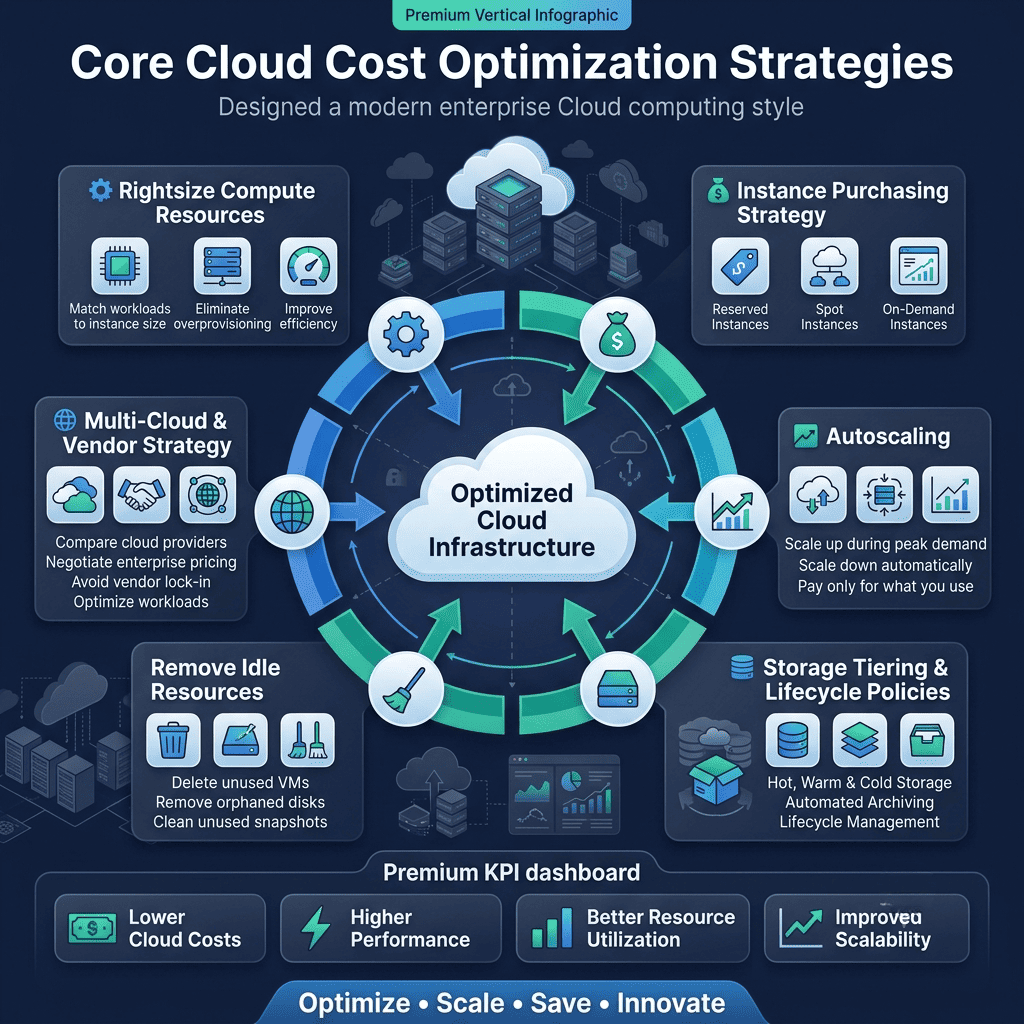
AWS vs. Azure vs. GCP: Cost Structure Differences
Cost optimization strategies transfer across providers in principle, but the specific mechanics differ enough to matter in practice.
Factor | AWS | Azure | GCP |
Reserved capacity model | Reserved Instances / Savings Plans | Reserved VM Instances | Committed Use Discounts |
Automatic discounting | Limited, mostly requires active commitment | Limited, mostly requires active commitment | Sustained Use Discounts applied automatically |
Spot/preemptible pricing | Spot Instances | Spot VMs | Spot VMs / Preemptible VMs |
Cost visibility tooling | AWS Cost Explorer, Cost and Usage Reports | Azure Cost Management | GCP Cost Management, BigQuery billing export |
Notable cost quirk | Data transfer costs between regions/AZs add up quickly | Complex licensing costs for Windows/SQL workloads | Automatic sustained-use discounts reduce need for manual reservation management |
Google Cloud’s automatic sustained-use discounts are a genuine structural difference worth knowing, they reduce the cost of consistently running workloads without requiring the same active reservation management AWS and Azure both need to capture equivalent savings, which shifts some of the optimization effort from “remember to reserve capacity” toward other levers entirely on that platform.
Building a FinOps Practice, Not Just a One-Time Cleanup
A cost optimization project that happens once, cleans up existing waste, and then stops is solving last quarter’s problem, not building a system that prevents the same waste from reaccumulating six months later once the initial cleanup fades from memory. The AWS Well-Architected Framework’s Cost Optimization pillar frames this explicitly as a continual process of refinement across a workload’s entire lifecycle, not a project with a defined end date. Building recurring cost review into the same cadence as other operational reviews, tagging resources consistently so spend can actually be attributed to the right team or project, and giving engineering teams visibility into what their own infrastructure decisions cost are what separate a genuine FinOps practice from a periodic cleanup exercise that quietly drifts back to the same waste within a year.
How Cloud Costs Fit Into Overall Project Budgeting
Cloud spend is frequently modeled as a rough, static line item during initial project budgeting, then left unrevisited as the actual infrastructure evolves well past that original estimate. This mirrors a pattern we’ve covered in the context of upfront development costs, our guide to mobile app development costs makes a similar point about post-launch expenses generally, an initial estimate is a starting point, not a number that should still be treated as accurate a year into a product’s life without ever being checked against real usage. Cloud infrastructure cost deserves the same ongoing scrutiny as any other recurring operational expense, reviewed against actual usage data on a regular cadence rather than assumed correct because it was once modeled carefully at the start.
Common Mistakes in Cloud Cost Optimization
Teams frequently treat cost optimization as a one-time project rather than an ongoing discipline, running a cleanup sprint and then letting waste reaccumulate over the following months with no process catching it. Reserved capacity gets purchased once based on a snapshot of usage and never revisited as workloads change, leaving commitments that no longer match actual needs. Tagging and cost attribution get skipped or done inconsistently, which means even when waste is visible in aggregate, nobody can trace it back to a specific team or project to actually address it. And autoscaling frequently gets configured once at launch and never returned as traffic patterns evolve, the same architectural oversight covered in our SaaS web app architecture guide, where infrastructure decisions made for launch-day traffic quietly stop matching reality as a product matures.
How The Apps Developers Approaches Cloud Cost Optimization
Cost efficiency is scoped as part of the same DevOps and cloud solutions work that handles infrastructure and deployment generally, since rightsizing, autoscaling configuration, and resource cleanup are operational disciplines that need to run continuously, not a one-time audit disconnected from how infrastructure actually gets built and maintained.
This connects directly to how we scope any API and backend development project too, infrastructure decisions made early, how a system scales, what gets cached, how workloads are sized, have a direct and lasting effect on cloud spend long after launch, which is exactly why cost efficiency belongs in the architecture conversation rather than a cleanup exercise addressed after the fact.
The same cost-awareness extends to web app builds broadly, since a well-architected web application backend is consistently cheaper to run at scale than one bolted together without cost in mind from the start.
Performance and cost are more connected than most teams treat them, the same principles covered in our Core Web Vitals guide, reducing unnecessary payload and server-side work, tend to reduce both page load time and the compute cost of serving each request at the same time.
If your cloud bill has grown faster than you can fully explain, or you’re scoping new infrastructure and want cost efficiency built in from the architecture phase, that’s worth a direct conversation. You’re welcome to talk to our team about what a real cloud cost optimization review would surface for your specific infrastructure.