


VR real estate virtual tours let buyers explore a property remotely through an interactive 360-degree walkthrough, either viewed on a standard screen or, less commonly, through a VR headset for full immersion, and the engagement data behind them is genuinely strong, listings with 3D virtual tours attract roughly 60 percent more online views and sell up to 31 percent faster than photo-only listings, according to research widely attributed to the National Association of Realtors. But there’s a real, honest tension worth understanding before investing in this technology.
According to NAR’s own 2026 Member Profile, based on 2025 transaction data and reported by HousingWire, 81 percent of Realtors say they got none of their 2025 business directly from virtual tours. That gap, strong engagement data on one side, very low direct attribution on the other, is the actual story worth understanding, not the version that only cites the flattering statistics. This guide covers what VR real estate virtual tours genuinely deliver, where that value actually shows up, and how to think honestly about the investment, as part of the same Mobile App Development process that virtual tour technology is built within.
What Is a VR Real Estate Virtual Tour?
A VR real estate virtual tour is an interactive, 360-degree digital walkthrough of a property that lets a viewer navigate rooms and explore details on their own, either through a standard web browser or mobile screen, or through a VR headset for a fully immersive experience. Most virtual tours in real estate today are technically 3D or 360-degree tours, viewable on any device without special hardware, while true headset-based VR tours remain a smaller, more specialized subset of the category, an important distinction most marketing content in this space blurs together.
360-Degree Tours vs. True VR Headset Tours
Understanding this distinction matters directly for both cost and audience reach.
| Factor | 360-Degree / 3D Web Tours | True VR Headset Tours |
| Hardware required | None, works on any browser or phone | VR headset required |
| Audience reach | Broad, anyone with internet access | Limited to headset owners |
| Typical cost | 150 to 500 dollars per listing (professional service) | Meaningfully higher, custom development |
| Immersion level | Moderate, screen-based navigation | Full, genuinely immersive |
| Best fit | Standard residential listings, broad buyer reach | Luxury, commercial, or new construction with dedicated VR investment |
Reading this table usefully means recognizing that when most real estate marketing discusses “virtual tours,” it’s referring to the 360-degree category specifically, which is why the adoption and cost data throughout this guide leans heavily on that more common format, while true headset-based VR remains the higher-investment, more specialized option most relevant to luxury or new-development marketing specifically.
The Real Engagement Data
What the Numbers Actually Show
Virtual tours increase listing engagement by 87 percent and reduce time-to-sale by 20 percent, according to research from Matterport cited in Zillow’s own analysis, and separately, NAR-attributed research puts 3D-toured listings at roughly 60 percent more online views and up to 31 percent faster sales than photo-only listings. Buyer behavior research adds useful texture here too, buyers spend the majority of their online research time looking at images rather than reading text, and virtual tours specifically function as a pre-qualification filter, buyers who complete a full tour before requesting an in-person showing arrive considerably more informed and genuinely interested than buyers working from photos alone.
Why This Reduces “Viewing Tourism”
Industry sources consistently describe virtual tours reducing wasted, low-intent in-person showings by around 40 percent, since a buyer who’s already walked through a property virtually and still requests a viewing is a meaningfully more qualified, serious prospect than one who’s only seen static photos, a real, practical benefit for agents managing limited showing time against a broader pool of casual browsers.
Video and Visual Content: The Broader Pattern Virtual Tours Fit Into
Virtual tours don’t exist in isolation, they’re part of a broader shift in real estate marketing toward richer visual content generally, and the data on that broader trend helps contextualize what virtual tours specifically contribute. Listings with video receive 403 percent more inquiries than listings without, according to NAR research, and homes marketed with video sell for an average of 6 percent more, a meaningful premium on a typical transaction. Yet only 26 percent of agents consistently use video for every listing, the same underutilization pattern this guide identified for virtual tours specifically, suggesting the gap isn’t really about whether rich visual content works, the data consistently says it does, it’s about how inconsistently the industry actually deploys tools it already knows are effective. This context matters for a business evaluating virtual tour investment specifically, since it’s one instance of a broader, well-documented pattern rather than an isolated or uncertain bet, the agents and brokerages already using rich visual content consistently are capturing a real, measurable advantage that a majority of the industry is still leaving on the table.
The Adoption Gap: What NAR’s Own Data Actually Shows
A Real, Honest Disconnect
This is the part of the story most content on this topic skips entirely. NAR’s 2026 Member Profile, covering 2025 transaction activity, found that 81 percent of Realtors reported getting none of their business directly from virtual tours, a strikingly low attribution number sitting right alongside the strong engagement statistics covered above.
What Explains the Gap
Attribution Is Genuinely Difficult
A buyer who views a virtual tour, gets genuinely more informed and interested as a result, then contacts the agent through a phone call or a referral rather than clicking directly from the tour itself, makes that lead’s true source difficult to track accurately, meaning the low direct-attribution number likely understates virtual tours’ real influence on a transaction rather than proving the tours don’t work.
Underutilization Is a Separate, Real Factor
Only 26 percent of agents consistently use video for every listing, according to the same broader research landscape, and a similar underutilization pattern likely applies to virtual tours specifically, a genuinely effective tool used inconsistently, or promoted poorly once created, will naturally show weak attribution regardless of its actual underlying value to buyers who do encounter it.
Example: A Tour That Worked, But Didn’t Get Credit
A buyer who explores a virtual tour late one evening, becomes genuinely interested, then calls the listing agent directly the next morning without ever mentioning the tour explicitly, represents exactly the kind of real, uncredited influence that shows up in strong engagement metrics but never gets recorded as “business generated by the virtual tour” in an agent’s own self-reported attribution.
What This Means for a Business Evaluating VR Real Estate Tours
The honest takeaway isn’t “virtual tours don’t work,” it’s that the value shows up in engagement, buyer qualification, and time savings more reliably and measurably than in clean, direct lead attribution, which matters for how a business should actually evaluate the investment. Judging a virtual tour program purely by how many leads agents report as directly sourced from it will understate the real value, while judging it by engagement, time-on-listing, and reduction in low-intent showings gives a more accurate picture of what the technology genuinely delivers.
How Different Buyer Segments Actually Use Virtual Tours
Buyer research suggests virtual tour usage patterns differ meaningfully by demographic, worth understanding for how a business targets and promotes tour content. Younger, digitally native buyers, millennials and Gen Z specifically, tend to use virtual tours to build genuine emotional connection with a property and show the highest willingness to make real decisions, including in some cases purchasing, based substantially on a remote tour experience. Older buyers, meanwhile, tend to use the same tours more functionally, checking accessibility, verifying room layout and ceiling heights, and using the tour primarily as a hard pre-selection filter to narrow down which properties actually justify an in-person visit. This distinction matters for how virtual tour content itself gets framed and promoted, an emotionally evocative, atmosphere-focused tour presentation may resonate more with younger buyers, while clear, functional information, room dimensions, layout clarity, accessibility details, matters more to buyers using tours primarily as an efficiency tool rather than a discovery experience.
Core Use Cases for VR in Real Estate
Residential Listings
Standard 360-degree tours serve the broadest residential use case, letting any buyer with a browser explore a property remotely, particularly valuable for out-of-market buyers or anyone narrowing down a shortlist before committing to in-person visits.
New Construction and Pre-Development Marketing
VR tours let developers market units that don’t physically exist yet, walking prospective buyers through a fully rendered space based on architectural plans well before construction completes, a use case where true immersive VR often earns its higher cost given the genuine absence of any physical alternative to show buyers.
Commercial and Luxury Real Estate
Higher-value properties and commercial spaces more commonly justify the investment in true headset-based VR specifically, since the buyer pool is smaller and more serious, and the property’s actual value more easily absorbs the additional production cost a fully immersive experience requires.
Remote and International Buyers
Buyers relocating from another city, state, or country benefit disproportionately from virtual tours, given the genuine cost and logistics of in-person visits across long distances, making this one of the clearest, least-disputed cases where virtual tour technology closes a real access gap rather than just adding convenience.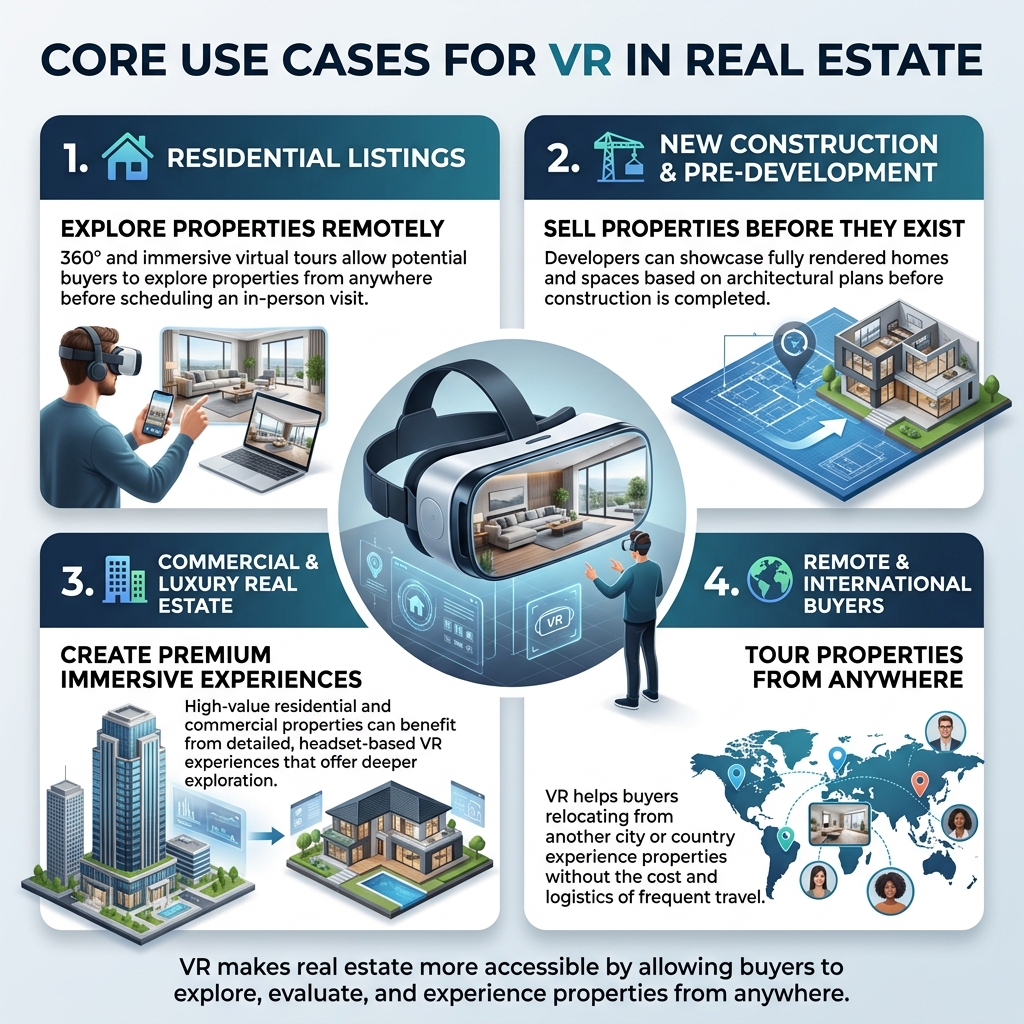
Measuring Virtual Tour ROI the Right Way
Given the honest attribution gap covered above, a business genuinely evaluating virtual tour ROI should track a broader set of signals than direct lead attribution alone. Time spent on a listing, tour completion rate, and the ratio of in-person showings to actual offers made are all more reliable indicators of whether virtual tour content is genuinely influencing buyer behavior than agent-reported lead source alone, which the NAR data itself suggests systematically understates the technology’s real impact. Comparing outcomes across similar listings with and without virtual tours, holding price point, location, and property type roughly constant, gives a more controlled, meaningful comparison than relying on any single agent’s subjective sense of where their business came from. Businesses that build this kind of measurement discipline into their virtual tour program from the start end up with a genuinely defensible ROI case, rather than either the overly optimistic marketing-stat version or the overly pessimistic direct-attribution version, both of which miss the more accurate, nuanced picture sitting in between.
Building a VR Real Estate Tour Application
Technical Considerations
Real estate VR tour platforms need reliable 360-degree or 3D content capture, a hosting and delivery infrastructure that performs well across varied internet connections, and, for headset-based experiences specifically, the same underlying VR app development considerations that apply to any immersive application, content complexity, platform target, and interaction design all shape both cost and the final experience quality.
Cost Considerations
Standard 360-degree tour production costs 150 to 500 dollars per listing through a professional service, a real, itemizable cost most agents can absorb per-listing, while custom, headset-based VR tour development follows the broader VR app development cost patterns covered in more depth elsewhere, driven primarily by 3D content complexity rather than a simple per-listing service fee.
Backend and Hosting Infrastructure
Reliable, scalable hosting for tour content, particularly for a brokerage or platform managing tours across many listings simultaneously, requires the same API and backend development discipline behind any application serving media-heavy content to a broad, varied audience reliably.
Common Mistakes in VR Real Estate Tour Adoption
Agents and brokerages frequently create a virtual tour and then fail to actively promote or feature it prominently within listing marketing, producing exactly the kind of underutilization that shows up as weak attribution despite the tour’s genuine underlying quality. Businesses sometimes invest in expensive, headset-based VR for standard residential listings where a much lower-cost 360-degree web tour would have reached a broader buyer audience just as effectively.
Success gets measured purely on directly attributed leads, missing the engagement, buyer qualification, and reduced showing waste that represent the technology’s more genuine, measurable value. And virtual tours get treated as a one-time technology purchase rather than an ongoing marketing asset that should be consistently applied across every listing, not selectively used only for higher-value properties where the inconsistency itself undermines the broader engagement benefit.
How The Apps Developers Approaches VR Real Estate Tour Development
We build virtual tour platforms scoped honestly against the actual audience and property type involved, standard 360-degree tours for broad residential reach, true immersive VR for luxury, commercial, or pre-construction marketing specifically, as part of the same Mobile App Development process we bring to any project.
Design and delivery infrastructure receive equal attention, since a tour that performs poorly on a slow connection or an unfamiliar interface undermines the same engagement benefit the technology is meant to provide, a genuine UI/UX design and infrastructure consideration, not just a content production question.
If you’re evaluating VR or virtual tour technology for your real estate business and want an honest assessment of what it would actually deliver, that’s worth a direct conversation. You’re welcome to talk to our team about what a properly scoped virtual tour platform would look like for your specific business.