

VR app development cost typically ranges from 10,000 to 50,000 dollars for a basic single-scene MVP, 50,000 to 200,000 dollars for a standard business application, and 200,000 to 500,000 dollars or more for an advanced, multi-platform enterprise system, with most commissioned business VR projects landing in that middle 50,000 to 200,000 dollar range. Labor, not software licensing, drives the overwhelming majority of that cost, and most of that labor is 3D asset production rather than code.
That labor breakdown matters more than most generic pricing pages acknowledge. According to cost analysis from Frame Sixty, labor accounts for 80 to 90 percent of a typical VR development budget, and a standard interactive training module runs 100,000 to 200,000 dollars specifically because of the 3D content work involved, not the underlying programming. The business case for that investment has real data behind it too, a Forrester Total Economic Impact study commissioned by Meta found enterprise VR training returned 219 percent ROI over three years. This guide breaks down what genuinely drives VR app development cost, as part of the same Mobile App Development budgeting conversation that should happen before any VR contract gets signed.
What Determines VR App Development Cost?
3D Content and Environment Creation
3D content and environment creation is consistently the largest cost driver in VR app development, since a fully immersive, three-dimensional environment requires meaningfully more asset production than a flat, two-dimensional app interface. Custom-built environments with scripted sequences, facility orientations, equipment familiarization, virtual tours of spaces that don’t physically exist yet, all require detailed 3D modeling work that scales directly with how much of the experience needs to be built from scratch versus reused from existing assets.
Interactivity Depth
A cinematic, largely observational VR experience, stereoscopic 360-degree footage with basic interactivity, costs meaningfully less than a full hands-on simulation with branching scenarios, performance scoring, and detailed analytics, since interactivity depth drives both development complexity and the underlying content that has to respond correctly to a much wider range of possible user actions.
Platform and Hardware Target
Building specifically for Apple’s Vision Pro costs roughly 3 to 4 times what a comparable Meta Quest-only build costs, according to cost analysis from Windstar Games, 50,000 to 200,000-plus dollars versus 15,000 to 80,000 dollars, reflecting both Vision Pro’s smaller install base and its more demanding technical requirements. Multi-platform builds targeting several headsets simultaneously add real, additional cost beyond a single-platform build.
Multi-User and Advanced Feature Requirements
Add-on features like multi-user support, AI-powered non-player characters for scenario training, or advanced assessment modes typically cost 2,000 to 10,000 dollars each on top of a base module, according to published pricing from VR training provider MadXR, real, itemizable costs worth accounting for explicitly rather than assuming they’re bundled into a base quote.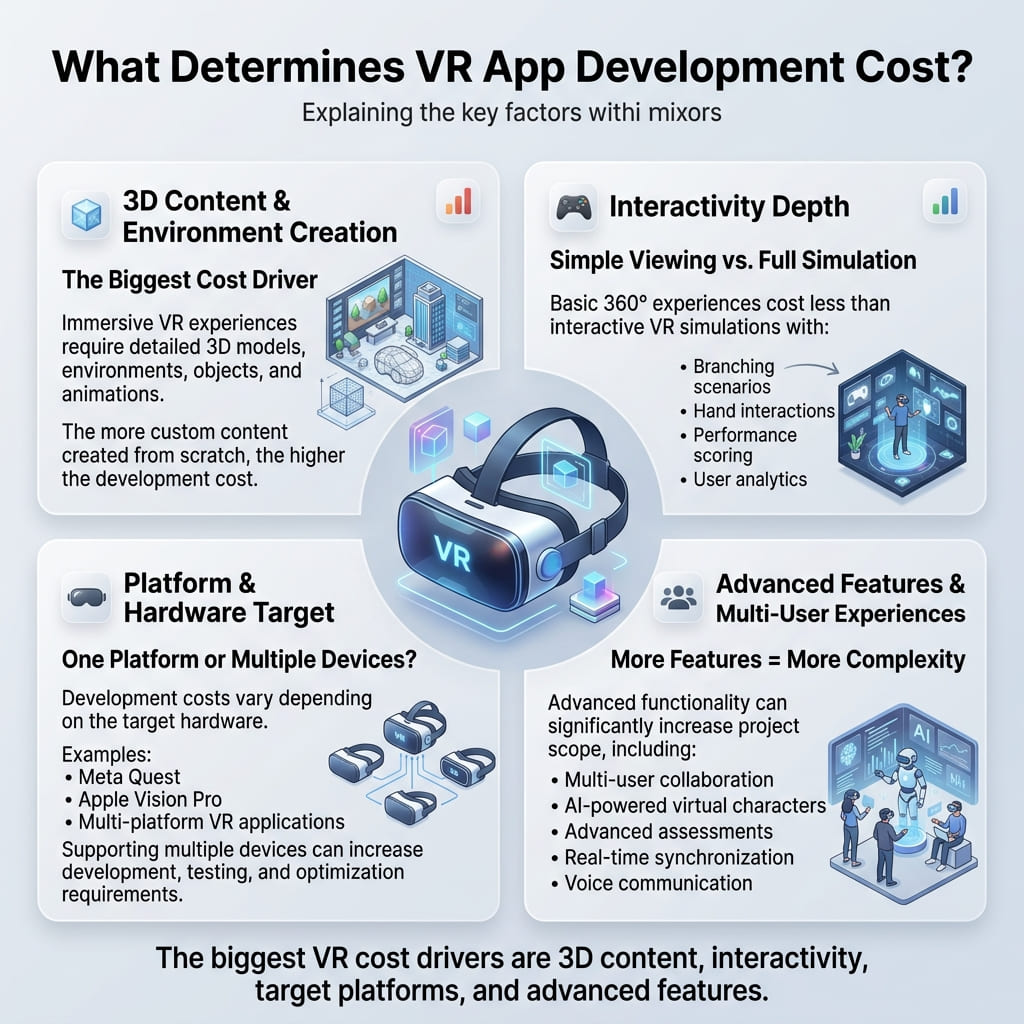
VR App Development Cost by Complexity Tier
Tier | Typical Cost Range (USD) | What’s Included |
Basic MVP / single-scene | 10,000 to 50,000 | Simple interaction, limited content, single platform |
Standard business application | 50,000 to 200,000 | Custom 3D environment, moderate interactivity, single or dual platform |
Advanced enterprise platform | 200,000 to 500,000+ | Multi-user, branching scenarios, analytics, multi-platform support |
These figures reflect a genuine convergence across multiple independent industry sources, DesignRush, Purrweb, Frame Sixty, and VR Vision Group all cite substantially similar ranges for 2026, which gives this table more confidence than a typical single-source cost estimate, though your specific project should still be scoped against a real quote rather than this table alone.
MVP vs. Standard vs. Enterprise VR Applications
Choosing the right complexity tier for your actual goal matters as much as understanding the cost itself.
Factor | MVP Tier | Standard Business Tier | Enterprise Tier |
Typical use case | Concept validation, simple pilot | Single-department training or visualization tool | Organization-wide platform, multiple scenarios |
Content volume | Minimal, one or two scenes | Moderate, one complete environment | Extensive, multiple environments and modules |
Multi-user support | Rarely included | Sometimes, as an add-on | Frequently core to the platform |
Timeline | 1 to 3 months | 3 to 6 months | 6 to 12+ months |
Best fit | Testing whether VR fits a use case at all | Most commissioned business VR projects | Large organizations scaling VR across many training scenarios |
Reading this table usefully means recognizing that most businesses evaluating VR for the first time genuinely belong in the MVP or standard tier, not the enterprise tier, since validating the concept and demonstrating real value at a smaller scale is both cheaper and lower-risk than committing to an enterprise-scale build before VR’s fit has been proven for your specific use case.
In-House vs. Specialized VR Studio vs. Freelancer
Factor | In-House Team | Freelancer | Specialized VR Studio |
Typical cost | Highest, fixed salary regardless of workload | Lowest hourly rate, variable total cost | Mid to high, project-managed |
3D content expertise | Requires hiring specifically for VR skills | Narrow, single specialty | Broad, covers 3D art, interaction design, and multiple platforms |
Best fit | Organizations building an ongoing VR content pipeline | Very narrow, well-defined single module | Most businesses commissioning their first VR project |
Given how heavily VR development cost concentrates in specialized 3D content skills, a studio with genuine, dedicated VR experience tends to be the more capital-efficient choice for most businesses building their first VR application, since assembling that specific skill combination, 3D modeling, interaction design, platform-specific optimization, in-house or through a single freelancer is genuinely difficult without an existing VR content pipeline already in place.
Follow-On Modules Cost Less Than the First
A detail worth understanding before budgeting for anything beyond a single VR module: follow-on modules typically cost 40 to 60 percent of the first module’s price, according to VR Vision Group’s 2026 pricing analysis, since the first module pays for the reusable 3D assets and interaction systems that subsequent modules can draw on directly. This has a real, practical implication for how a business should plan a multi-scenario VR training program, the first module is genuinely the most expensive one to build, and the per-module cost should be expected to decline as a broader curriculum gets built out, not stay flat across every new scenario added.
Fixed Price vs. Time and Materials for VR Projects
How a VR project gets billed affects both budget predictability and flexibility. A fixed-price contract works well once content scope is genuinely well-defined, a specific environment, a specific number of scenarios, a specific interactivity level, but VR projects where the exact content requirements are still being discovered through early concept work are a poor fit for fixed pricing upfront, since any expansion in 3D content scope typically triggers a real change order given how directly content volume drives cost. Time and materials billing offers more flexibility for exactly this kind of evolving scope, at the cost of less budget certainty before development starts. Many VR engagements benefit from a hybrid approach, a fixed price for an initial concept and content-scoping phase, followed by a fixed price for the actual build once that scoping phase has clarified the real 3D content and interactivity requirements a general concept description couldn’t fully specify upfront.
The ROI Case: Real Data Behind the Investment
The upfront cost of VR development is genuinely higher than a slide deck or e-learning module, but the business case has real, third-party research behind it, not just vendor marketing. Beyond the 219 percent three-year ROI figure from Forrester’s Meta-commissioned study, our VR training simulation use cases guide covers PwC’s own enterprise research in more depth, finding VR training reaches cost parity with classroom training at 375 learners and becomes 52 percent less expensive at 3,000 learners, real numbers worth weighing against a VR project’s actual upfront cost rather than evaluating that cost in isolation.
Hidden Costs in VR Development Budgets
Headset Hardware
Beyond software development, deploying VR training or applications at scale requires headset hardware itself, roughly 300 to 650 dollars per device according to current market pricing, a real, ongoing procurement cost separate from the development budget that’s easy to underestimate when planning for a larger trained population.
Content Updates and Maintenance
VR content needs the same ongoing maintenance discipline as any application, covered in more depth in our mobile app development cost guide, and initial development typically represents only 50 to 70 percent of a VR project’s total realistic spend, with content updates, maintenance, and the marketing or rollout effort needed to actually drive adoption making up the remainder.
Device Management at Scale
Deploying VR headsets across a larger organization requires device management infrastructure, tracking headset inventory, pushing content updates, and managing access across a distributed workforce, a genuine operational cost beyond the initial application build that scales with organization size.
How AI Is Changing VR Content Economics
Generative AI tools are beginning to meaningfully affect VR development cost specifically, since 3D content creation has historically been the largest cost driver. According to VR Vision Group’s 2026 analysis, generative environments, AI-driven training characters, and procedural scenario generation are reducing content creation costs by 30 to 50 percent on the specific project types where these tools genuinely apply, worth asking a development partner about directly, since this is a real, current shift in VR development economics, not a speculative future trend, though it doesn’t apply equally to every kind of VR content or use case.
How Developer Location Affects VR Development Cost
Geography remains a real factor in VR development pricing, the same way it does for standard app development, but it matters somewhat differently here given how concentrated VR cost is in specialized 3D content skills rather than general programming labor. A team in a lower-cost region with genuine, demonstrated VR-specific 3D art and interaction design experience can still deliver real savings, but the specialized nature of the skill set means the talent pool is narrower everywhere, making portfolio quality and genuine VR-specific experience a more important filter than in general app development, where a much broader base of qualified developers exists across virtually every region and price point. A lower quoted rate from a team without a real, demonstrated VR content portfolio is a genuine risk specifically because so much of the project’s success depends on 3D content quality, the exact area where inexperience shows up most visibly and expensively to fix after the fact.
How to Get an Accurate VR App Development Cost Estimate
A real estimate starts with clarity on your specific tier, MVP validation versus a standard business application versus an enterprise platform, and honesty about content volume, how much of the experience needs custom 3D environments versus simpler, more templated interactions. This connects to the same scoping discipline that applies to any custom software estimate, vague project descriptions produce vague, often inflated quotes, while a clearly defined scope, platform target, interactivity depth, content volume, produces a genuinely accurate number rather than a wide, unhelpful range.
Common Mistakes That Inflate VR App Development Cost
Businesses frequently commission an enterprise-tier build before validating the underlying use case at a smaller, MVP scale, committing significant budget to a platform before confirming VR actually delivers the value it’s expected to for that specific scenario, a costly way to discover a use case mismatch that a smaller pilot would have surfaced far more cheaply. Underestimating 3D content costs specifically is a near-universal mistake, since content, not code, drives the overwhelming majority of a typical VR budget, and a quote that doesn’t clearly itemize content production separately from technical development often understates the real cost significantly.
Building for Apple’s Vision Pro without accounting for its meaningfully higher cost multiplier, roughly 3 to 4 times a Quest-only build, catches businesses off guard when a multi-platform strategy was assumed to cost proportionally the same across every target device. And treating initial development as the entire budget, without planning for the ongoing maintenance, content updates, and device management costs that realistically make up 30 to 50 percent of total project spend, leaves a business under-resourced for genuinely sustaining a VR program past its initial launch, turning what should have been a successful pilot into a program that quietly stalls once the initial development budget runs out.
How The Apps Developers Prices VR App Development
Every VR quote starts with a genuine scoping conversation about complexity tier, content volume, and platform target, not a generic rate card, because the cost drivers covered above genuinely do produce very different numbers for VR projects that might sound similar on the surface. That’s part of the same Mobile App Development process we bring to any project.
The backend and infrastructure work behind multi-user VR experiences or applications requiring real-time data synchronization runs through the same API and backend development discipline we apply to any application with genuine reliability requirements, scoped as part of the overall VR project rather than discovered as a separate cost afterward.
Design work receives the same dedicated attention, since the discipline behind building a comfortable, genuinely effective VR interaction is a specialized part of UI/UX design with real cost implications tied directly to how much custom interaction work a specific experience requires.
If you’re trying to get from a rough range to an actual number for your specific VR project, that scoping conversation is the fastest way to get there. You’re welcome to talk to our team about what your VR application would realistically cost before committing to a number from a generic pricing page.