

The top companies using Node.js include Netflix, PayPal, LinkedIn, Walmart, Uber, NASA, Microsoft, eBay, Groupon, and Trello. They use it mainly for fast APIs, web servers that handle huge numbers of requests at once, and real-time features. Node.js is also the most used web technology among developers, at 48.7% in the Stack Overflow 2025 Developer Survey.
Search for “companies using Node.js” and you’ll find dozens of lists that look almost identical. Same logos, same big claims, and very few links back to where those claims came from. Some of the numbers floating around have been copied so many times that nobody remembers their source.
We took a different approach. For this list, we focused on companies that have publicly explained how and why they use Node.js, through their own engineering blogs, talks, or official case studies. We also note when each story was shared, because tech stacks change and a 2013 decision isn’t the same as a 2026 one. If you’re considering Node.js app development in USA for your own product or looking to hire a Node.js developer in USA, understanding how established companies use the technology can help you make a more informed decision. Our API and backend development team follows the same evidence-first approach when recommending a stack.
What Is Node.js?
Node.js is an open-source runtime that lets developers run JavaScript on the server, using a non-blocking, event-driven model that handles many simultaneous connections efficiently.
Before Node.js, JavaScript mostly lived in the browser. Node.js let teams use one language for both the frontend and the backend. It isn’t a framework itself. Frameworks like Express, NestJS, and Fastify are built on top of it.
Is There an Official Ranking of Companies Using Node.js?
No. There’s no official ranking of companies using Node.js, and most “rankings” you’ll see online are opinions. Companies rarely publish exactly how much of their stack runs on any single technology.
So here’s how we ranked ours. We gave priority to companies that:
- Have publicly documented their Node.js use through engineering blogs, talks, or case studies.
- Run at large scale, with millions of users or very high traffic.
- Used Node.js for something important to the business, not just an internal side project.
How Popular Is Node.js in 2026?
Node.js remains one of the most widely used technologies in software. In the Stack Overflow 2025 Developer Survey, 48.7% of developers said they had done extensive work with Node.js in the past year, making it the most used web technology in the survey. Express, the most popular Node.js framework, came in at 19.9%.
That popularity matters for businesses, too. A big developer community means easier hiring, more ready-made libraries, and faster security fixes.
Top Companies Using Node.js at a Glance
| Company | Industry | What Node.js Powers (Publicly Shared) | When Shared |
| Netflix | Streaming | Website UI layer and server rendering | 2015 |
| PayPal | Payments | Consumer-facing web applications | 2013 |
| Social and careers | Mobile app backend | 2011 | |
| Walmart | Retail | Mobile and web services, created the hapi framework | 2013 onward |
| Uber | Mobility | Early real-time dispatch systems | 2016 |
| NASA | Aerospace | API layer for spacesuit (EVA) data | Case study |
| Microsoft | Software | VS Code and other Electron-based apps | Ongoing |
| eBay | Ecommerce | Web services and real-time features | 2013 |
| Groupon | Ecommerce | Web layer migration | 2013 |
| Trello | Productivity | Real-time board updates | 2012 |
Top 10 Companies Using Node.js
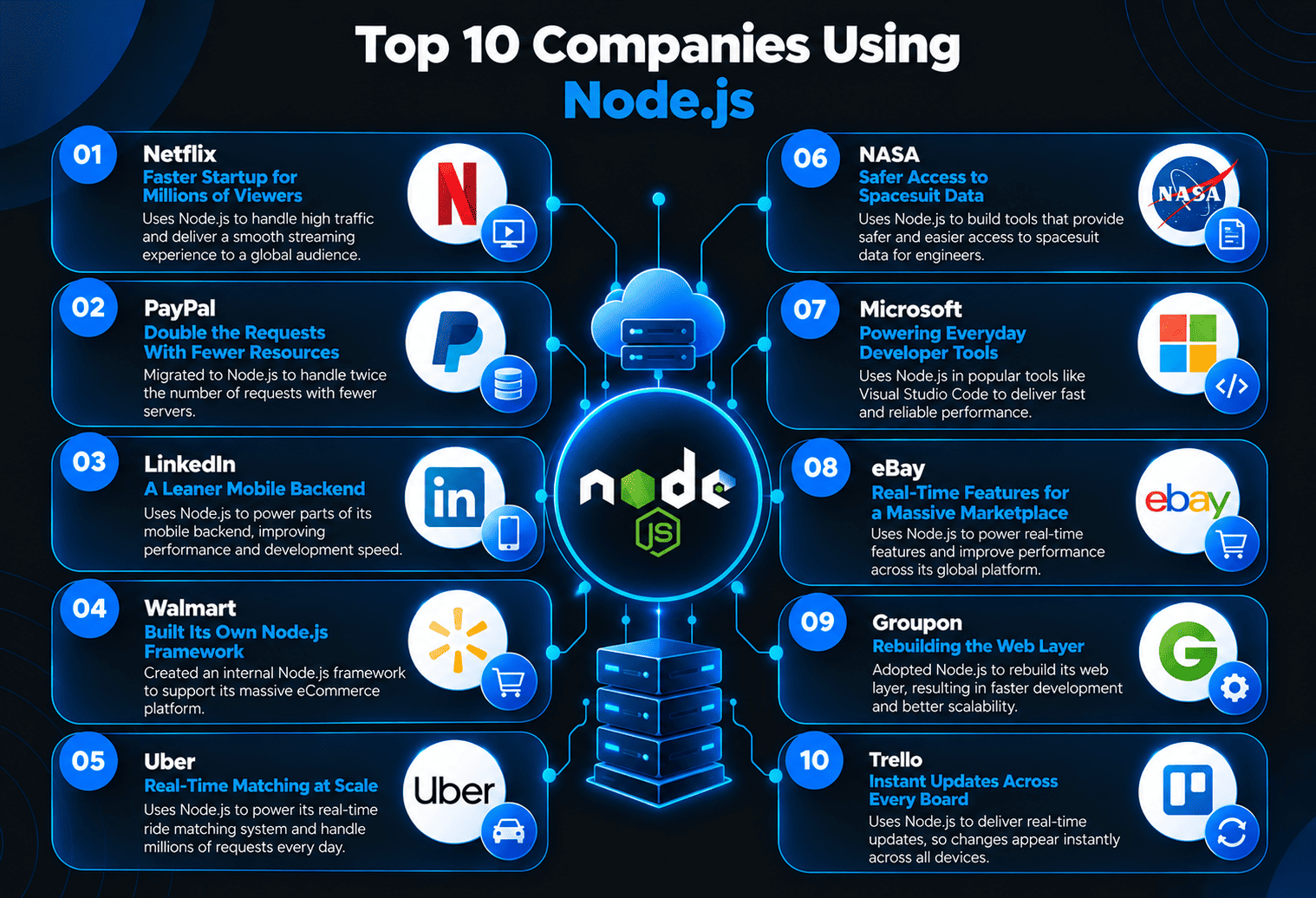
1. Netflix: Faster Startup for Millions of Viewers
Netflix’s website used to rely on a Java tier that generated most of each page on the server, which slowed things down. When the team rebuilt netflix.com, they moved to a new architecture built on Node.js and React so the same JavaScript could run on both server and client.
In its engineering blog post Making Netflix.com Faster, Netflix reported that the effort delivered a 70% reduction in startup time. That’s the kind of result that matters when every second of waiting can send a viewer elsewhere.
Why Node.js: one language across server and browser, faster page startup, and a more flexible UI layer.
2. PayPal: Double the Requests With Fewer Resources
PayPal is one of the best-documented Node.js stories. In 2013, its team rebuilt the account overview page, one of its most visited pages, in Node.js while a second team built the same page in Java as a comparison.
According to PayPal’s own engineering post, Node.js at PayPal, the Node.js version handled double the requests per second and cut average response time by 35%, serving pages about 200 milliseconds faster. Notably, those early results used a single core for Node.js versus five cores for Java. PayPal then decided that its consumer-facing web apps going forward would be built on Node.js.
Why Node.js: faster delivery, one team working across frontend and backend, and better performance.
3. LinkedIn: A Leaner Mobile Backend
LinkedIn moved its mobile app backend to Node.js in 2011, replacing an earlier Ruby on Rails setup. The team cited faster performance and the ability to run on far fewer servers, which simplified its infrastructure. It was one of the first high-profile signs that Node.js could handle serious production traffic.
Why Node.js: handling many simultaneous mobile requests efficiently.
4. Walmart: Built Its Own Node.js Framework
Walmart‘s engineering team didn’t just use Node.js. It helped shape the ecosystem. Walmart Labs created hapi, an open-source Node.js framework designed for large teams and high reliability, and used Node.js to power mobile and web services during some of retail’s busiest shopping periods. Walmart’s experience is also featured among the enterprise case studies collected by NodeSource.
Why Node.js: handling traffic spikes and giving many teams a consistent way to build services.
5. Uber: Real-Time Matching at Scale
Uber needs to process location updates from drivers and riders constantly. In its early years, Uber built core parts of its dispatch system with Node.js, because the event-driven model fits that kind of fast, real-time traffic. As the company grew, it adopted other languages like Go and Java for some services, which is a good reminder that large companies often use several technologies side by side.
Why Node.js: fast handling of many small, real-time requests.
6. NASA: Safer Access to Spacesuit Data
NASA‘s story is one of the most memorable. According to a Node.js Foundation case study, NASA used Node.js to build an API layer that brought spacesuit (EVA) data together from many separate databases into one accessible system. The goal was to make critical information easier and faster for engineers to reach, which matters a great deal when astronaut safety is involved.
Why Node.js: building modern, API-driven access to data scattered across older systems.
7. Microsoft: Powering Everyday Developer Tools
Many people use Node.js every day without knowing it. Visual Studio Code, Microsoft‘s popular code editor, is built on Electron, a framework that combines Node.js with a browser engine to create desktop apps. Microsoft also supports Node.js across Azure and its developer tools.
Why Node.js: building cross-platform desktop apps with web technologies.
8. eBay: Real-Time Features for a Massive Marketplace
eBay‘s engineers have written about building Node.js applications for parts of its marketplace that need fast, real-time responses. For a site with constant listing updates and live bidding activity, handling many open connections efficiently is a natural fit for Node.js.
Why Node.js: responsive, real-time services alongside its other technologies.
9. Groupon: Rebuilding the Web Layer
Groupon moved its web layer from Ruby on Rails to Node.js in 2013, splitting a large application into smaller Node.js services. The change helped its teams ship features independently and handle heavy traffic more efficiently.
Why Node.js: breaking a large app into smaller services teams could manage on their own.
10. Trello: Instant Updates Across Every Board
When you move a card in Trello, everyone looking at the same board sees it change almost instantly. Trello’s early backend used Node.js to support those real-time updates, along with fast prototyping while the product was still taking shape.
Why Node.js: real-time collaboration and quick iteration.
More Companies Known to Use Node.js
Beyond the top 10, several other well-known organizations have publicly shared Node.js use:
- Slack, whose desktop app is built on Electron, which runs on Node.js.
- Capital One, featured in Node.js Foundation enterprise case studies.
- Twitter (now X), which built its lightweight Twitter Lite web app with a Node.js server.
- Thousands of startups and SaaS companies that use Node.js for APIs, dashboards, and real-time features.
What These Companies Have in Common
Look across these stories and a few patterns jump out.
| Pattern | Why It Matters |
| Lots of simultaneous connections | Node.js handles many open requests without heavy overhead |
| Real-time features | Live updates, chat, tracking, and collaboration fit Node.js well |
| One language, frontend to backend | Teams move faster when they share JavaScript skills and code |
| Splitting big apps into services | Node.js suits microservices and smaller, independent services |
| Fast prototyping | Teams can test ideas quickly before committing |
Notice what’s missing, too. None of these companies picked Node.js for heavy number crunching or video encoding. They used it where it shines, and paired it with other technologies elsewhere.
Why Companies Choose Node.js
It Handles High Traffic Efficiently
Node.js doesn’t create a new thread for every request. Instead, it handles many connections in a single event loop, which makes it efficient for apps where most of the time is spent waiting on databases, APIs, or networks.
It Speeds Up Development
With JavaScript on both sides, teams can share code, validation logic, and developers. That’s exactly what PayPal described when it brought its frontend and backend engineers closer together.
It Has a Huge Ecosystem
The npm registry gives developers access to an enormous library of packages. That speeds up development, but it also means you need to manage dependencies carefully. Our guide to open source web application development covers how to do that safely.
It’s Great for Real-Time Apps
Chat, live tracking, notifications, dashboards, and collaboration tools all rely on keeping connections open and pushing updates instantly. If you’re deciding how to power those features, our comparison of Firebase vs a custom backend explains when a managed service is enough and when you need your own Node.js backend.
When Node.js Isn’t the Best Choice
Node.js is excellent, but it’s not right for everything. It’s a weaker fit for CPU-heavy work like video processing, large-scale data science, or complex calculations, where Go, Java, Python, or Rust may be better. Many companies on this list use Node.js for their web and API layers and other languages for heavier processing.
If you’re still comparing options, our guide to the best backend frameworks in 2026 compares Node.js frameworks with Django, FastAPI, Spring Boot, ASP.NET Core, and more.
How to Use Node.js Like the Big Players
You don’t need Netflix’s budget to benefit from Node.js. You do need the same discipline.
- Start with the right framework. Express for simple APIs, NestJS for large teams, Fastify for raw speed.
- Design for scale early. If you’re building a SaaS product for many customers, plan how you’ll keep their data separate. Our comparison of multi-tenant vs single-tenant SaaS walks through the options.
- Plan your cloud setup. Node.js apps scale best with containers, load balancing, and good monitoring, which our Cloud App Development team builds in from the start.
- Automate deployment and monitoring. Reliable DevOps and cloud solutions keep releases smooth and catch problems before users do.
- Productize carefully. If Node.js powers a subscription product, our SaaS Product Development team plans billing, user roles, and analytics around it.
Conclusion
The top companies using Node.js didn’t choose it because it was trendy. Netflix wanted faster startup, PayPal wanted one team moving faster, LinkedIn and Walmart needed to handle heavy mobile traffic, and NASA needed better access to critical data. The common thread is simple: Node.js is at its best for APIs, real-time features, and high-traffic web layers, and it works even better alongside the right tools for heavier tasks.
Thinking about Node.js for your next product? Book a free consultation with The Apps Developers, and we’ll help you decide whether it’s the right fit and how to build it to scale.
Frequently Asked Questions
What are the top companies using Node.js?
Top companies using Node.js include Netflix, PayPal, LinkedIn, Walmart, Uber, NASA, Microsoft, eBay, Groupon, and Trello. They use it mainly for APIs, web servers, and real-time features.
Is there an official ranking of companies using Node.js?
No. There’s no official ranking, because companies rarely publish how much of their stack runs on Node.js. Most lists, including ours, rank companies by public evidence and scale of use.
Does Netflix still use Node.js?
Netflix publicly shared its move to Node.js for its website UI layer in 2015, reporting a 70% reduction in startup time. Large companies evolve their stacks over time, so it’s best to check Netflix’s engineering blog for its latest architecture.
Why do big companies use Node.js?
Big companies use Node.js because it handles many simultaneous connections efficiently, supports real-time features, lets teams use JavaScript across frontend and backend, and has a huge library ecosystem.
How popular is Node.js in 2026?
Node.js is one of the most popular technologies in software. In the Stack Overflow 2025 Developer Survey, 48.7% of developers reported extensive work with Node.js, the highest of any web technology.
Is Node.js good for enterprise applications?
Yes. Companies like PayPal, Walmart, and Capital One have used Node.js in large-scale production. For enterprise apps, teams often add structure with frameworks like NestJS and pair Node.js with strong testing and monitoring.
Is Node.js a framework or a language?
Neither. Node.js is a runtime that lets JavaScript run on the server. JavaScript is the language, and frameworks like Express, NestJS, and Fastify are built on top of Node.js.