The best backend frameworks in 2026 are Express.js, ASP.NET Core, Spring Boot, Django, FastAPI, Laravel, NestJS, Ruby on Rails, Gin, and Phoenix. Express and ASP.NET Core are the most widely used, FastAPI is the fastest-growing, and Phoenix is the one developers love most. The right choice depends on your team’s language, your app’s scale, and how quickly you need to ship.
Ask ten developers which backend framework is best and you’ll start a friendly argument that lasts all afternoon. The Java folks will swear by Spring Boot, the Python crowd will pull up FastAPI benchmarks, and someone will quietly mention they shipped their whole startup on Rails and never looked back.
They’re all a little bit right. A backend framework isn’t a trophy. It’s a tool, and the best one is the tool that fits the job, the team, and the next five years of your product. In this guide, we compare the most popular backend frameworks using real adoption data, explain where each one shines, and help you pick with confidence. It’s the same thinking our team applies when we plan API and backend development for clients.
What Is a Backend Framework?
A backend framework is a ready-made set of code libraries, tools, and conventions that helps developers build the server side of an application, including routing, databases, authentication, APIs, and security, without writing everything from scratch.
Think of it as the foundation and plumbing of a building. Users never see it, but every login, payment, search, and saved setting depends on it. When people talk about backend software, server frameworks, or backend web development, this is the layer they mean.
What a Backend Framework Handles for You
- Routing: sending each request to the right piece of code.
- Data access: reading and writing to databases, often through an ORM.
- Authentication and permissions: who can log in and what they can do.
- APIs: REST or GraphQL endpoints that web and mobile apps talk to.
- Security defaults: protection against common attacks like SQL injection and cross-site scripting.
- Testing, logging, and configuration: the less glamorous backend tools that keep production stable.
Full-Featured vs Minimal Frameworks
Backend frameworks come in two broad styles. Full-featured, or “batteries-included,” frameworks like Django, Laravel, Rails, and Spring Boot give you most of what you need out of the box. Minimal, or micro, frameworks like Express, Flask, and Gin give you a small core and let you add only what you want. Neither style is better. Full-featured frameworks speed up standard apps, while minimal ones give experienced teams more control.
Most Popular Backend Frameworks: What the Data Says
Popularity isn’t everything, but it matters. A popular framework is easier to hire for, has more libraries, and gets security fixes faster.
According to the Stack Overflow 2025 Developer Survey, the most used web technologies among developers included Node.js at 48.7%, Express at 19.9%, ASP.NET Core at 19.7%, FastAPI at 14.8%, and Django at 12.6%. FastAPI posted the biggest jump of any web framework, up 5 percentage points from the year before, while Phoenix was named the most admired web framework at 79%.
In plain terms, the most popular backend frameworks of 2025 carried their lead into 2026: the JavaScript and .NET ecosystems still top the usage charts among popular web frameworks, Python frameworks are growing fastest thanks to AI work, and smaller frameworks like Phoenix win on developer happiness.
Top Backend Frameworks at a Glance
| Framework | Language | Style | Best For | Learning Curve |
| Express.js | JavaScript / TypeScript | Minimal | APIs, real-time apps, full-stack JavaScript | Easy |
| ASP.NET Core | C# | Full-featured | Enterprise apps, Microsoft environments | Moderate |
| Spring Boot | Java / Kotlin | Full-featured | Large enterprise systems, microservices | Steep |
| Django | Python | Full-featured | Data-heavy web apps, admin dashboards | Moderate |
| FastAPI | Python | Minimal, async | High-speed APIs, AI and ML services | Easy |
| Laravel | PHP | Full-featured | SaaS products, ecommerce, rapid builds | Easy to moderate |
| NestJS | TypeScript | Structured | Large Node.js apps and teams | Moderate |
| Ruby on Rails | Ruby | Full-featured | MVPs and fast product iteration | Easy to moderate |
| Gin | Go | Minimal | High-performance microservices | Moderate |
| Phoenix | Elixir | Full-featured | Real-time apps with huge concurrency | Steep |
10 Best Backend Frameworks in 2026
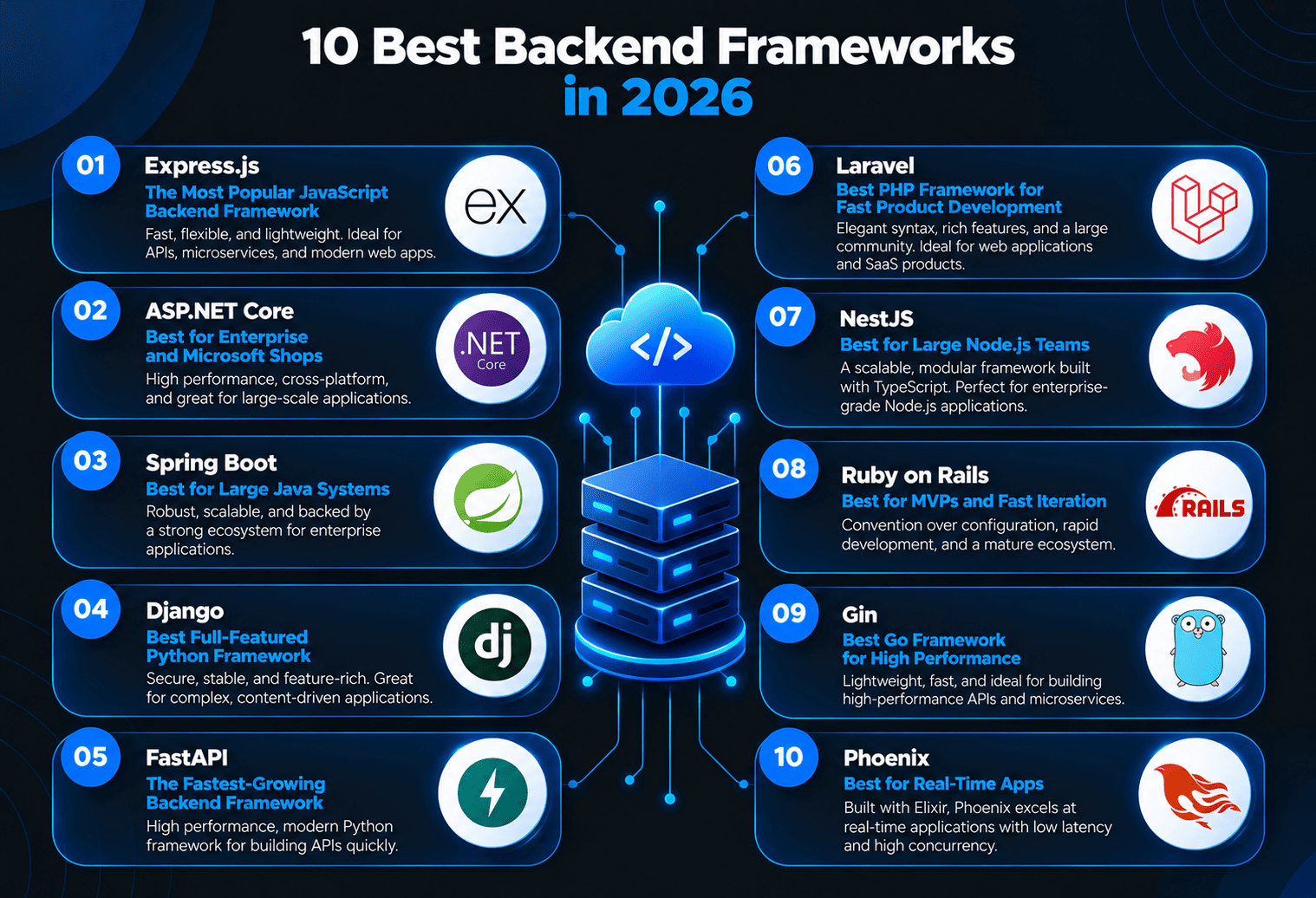
1. Express.js: The Most Popular JavaScript Backend Framework
Express is the default way to build a backend with Node.js. It’s small, fast to learn, and lets one team write both the frontend and backend in JavaScript or TypeScript. It doesn’t force a structure on you, which is great for small APIs and a little risky for very large codebases.
Best for: REST APIs, real-time features, startups using a full-stack JavaScript team.
Watch out for: large projects can become messy without agreed conventions.
2. ASP.NET Core: Best for Enterprise and Microsoft Shops
ASP.NET Core is Microsoft’s open-source, cross-platform framework for building web apps and APIs with C#. It’s fast, mature, and backed by excellent tooling. It’s one of the most in-demand backend frameworks in corporate environments, especially where teams already use Azure, SQL Server, or Microsoft 365.
Best for: enterprise systems, financial apps, high-traffic APIs.
Watch out for: the ecosystem works best if you’re comfortable in the Microsoft world.
3. Spring Boot: Best for Large Java Systems
Spring Boot makes Java’s huge Spring ecosystem easier to start with, using sensible defaults and built-in production features like health checks and metrics. Banks, insurers, telecoms, and large retailers rely on it for systems that can’t afford to fail.
Best for: enterprise microservices, complex business logic, long-lived platforms.
Watch out for: more setup and memory use than lighter frameworks.
4. Django: Best Full-Featured Python Framework
Django follows a “batteries-included” philosophy. It comes with an ORM, an automatic admin panel, authentication, and strong security defaults. It uses a model-template-view pattern and has powered large, data-driven websites for two decades.
Best for: content platforms, dashboards, healthcare and fintech apps with lots of data.
Watch out for: it can feel heavy for a small, API-only service.
5. FastAPI: The Fastest-Growing Backend Framework
FastAPI is a modern Python framework for building APIs. It uses Python type hints to validate data automatically and generates interactive API documentation for free. Its async support makes it fast, and it fits naturally alongside machine learning code, which is why so many AI products use it.
Best for: high-performance APIs, AI and ML services, microservices.
Watch out for: you’ll add your own choices for things like admin panels and ORM.
6. Laravel: Best PHP Framework for Fast Product Development
PHP still powers a large share of the web, and Laravel is its most popular modern framework. Its clean syntax, built-in tools for queues, authentication, and payments, and a rich ecosystem of official packages make it a favorite for SaaS products and ecommerce.
Best for: SaaS apps, ecommerce, content-heavy sites, quick MVPs.
Watch out for: very high-concurrency workloads may need extra architecture work.
7. NestJS: Best for Large Node.js Teams
NestJS brings structure to Node.js. Built with TypeScript, it uses modules, dependency injection, and patterns that feel familiar to Java or .NET developers. It sits on top of Express or Fastify, so you keep Node’s speed while gaining order.
Best for: enterprise Node.js apps, microservices, larger teams.
Watch out for: more boilerplate than plain Express.
8. Ruby on Rails: Best for MVPs and Fast Iteration
Rails pioneered “convention over configuration,” and it’s still one of the fastest ways to go from idea to working product. Plenty of well-known startups launched on it, and many still run on it at scale.
Best for: MVPs, marketplaces, SaaS products where speed to market matters most.
Watch out for: a smaller hiring pool than JavaScript, Python, or Java.
9. Gin: Best Go Framework for High Performance
Go is built for speed and concurrency, and Gin is one of its most popular web frameworks. It’s lightweight, extremely fast, and compiles to a single binary that’s easy to deploy in containers.
Best for: high-throughput microservices, internal platforms, cloud-native tools.
Watch out for: fewer built-in features, so you assemble more yourself.
10. Phoenix: Best for Real-Time Apps
Phoenix runs on Elixir and the Erlang virtual machine, a platform designed for millions of simultaneous connections. Its LiveView feature lets you build real-time interfaces with very little JavaScript. It’s not the most used framework, but developers who use it tend to love it.
Best for: chat, live dashboards, multiplayer features, IoT.
Watch out for: Elixir developers are harder to find.
Best JavaScript and Node.js Backend Frameworks
If your team already writes JavaScript or TypeScript, these are the main Node.js backend frameworks to consider:
| Framework | Why Teams Choose It |
| Express | The most widely used, simple, huge ecosystem |
| NestJS | Structure and TypeScript for large apps |
| Fastify | Very fast, with built-in schema validation |
| Koa | Minimal, modern async middleware from the Express creators |
| Hono | Lightweight, built for edge and serverless platforms |
Well-Known Companies Using Node.js
People often search for a ranking of top companies using Node.js. There’s no official ranking, but many large companies have publicly shared how they use it. Netflix, PayPal, LinkedIn, Uber, and Walmart have all discussed using Node.js for parts of their platforms, usually for fast APIs and services that handle many requests at once. The common thread is speed of development and handling lots of simultaneous connections, not raw number crunching.
Best Python Backend Frameworks
Python’s growth is driven largely by AI and data work, and Python backend frameworks are riding that wave.
| Framework | Best For |
| Django | Full web apps with admin panels and complex data |
| FastAPI | Fast APIs, AI services, and microservices |
| Flask | Small services and simple APIs with maximum flexibility |
Many teams now combine them, using Django for the main app and admin while FastAPI serves high-traffic or AI-powered endpoints. If you’re building in this space, it often makes sense to hire Python developers who know both.
Best Backend Programming Languages in 2026
Picking a framework usually starts with picking a language. Here’s how the most popular backend languages compare.
| Language | Popular Frameworks | Strengths |
| JavaScript / TypeScript | Express, NestJS, Fastify | One language across frontend and backend, huge talent pool |
| Python | Django, FastAPI, Flask | Readable, dominant in AI and data |
| Java | Spring Boot | Enterprise reliability and mature tooling |
| C# | ASP.NET Core | High performance, strong Microsoft ecosystem |
| Go | Gin, Echo, Fiber | Speed, concurrency, simple deployment |
| PHP | Laravel, Symfony | Fast web development, cheap hosting |
| Ruby | Rails | Developer productivity for startups |
| Elixir | Phoenix | Real-time and fault-tolerant systems |
So what’s the best backend programming language? For most new web products, JavaScript/TypeScript or Python is the practical choice because hiring is easier. For large enterprises, Java and C# remain the safest bets. For raw performance, Go is hard to beat.
How to Choose the Best Backend Framework
The best backend framework is the one your team can build, secure, and maintain well for years, matched to your app’s size, performance needs, and the talent you can hire. Here’s a quick guide by use case.
| If You’re Building… | Strong Choices |
| An MVP or startup product | Rails, Laravel, Express, Django |
| An enterprise platform | Spring Boot, ASP.NET Core, NestJS |
| AI or machine learning services | FastAPI, Django |
| High-performance microservices | Gin, ASP.NET Core, Fastify |
| Real-time chat or live dashboards | Phoenix, Express or NestJS with WebSockets |
| A multi-tenant SaaS product | Laravel, Django, NestJS, Spring Boot |
A few more things to check before you commit:
- Hiring market. Can you find developers in your region and budget?
- Long-term support. Check release and support schedules on endoflife.date so you aren’t building on a version that’s about to lose security updates.
- Security defaults. Look for built-in protection against the risks in the OWASP Top 10, plus solid authentication.
- Session handling. It’s one area teams often get wrong, and our guide to web app session management shows how to do it safely.
- Performance you actually need. Independent tests like the TechEmpower benchmarks are useful, but most apps are slowed by databases and network calls, not the framework.
- Architecture fit. If you’re building SaaS, decide early how you’ll separate customer data. Our comparison of multi-tenant vs single-tenant SaaS explains the trade-offs.
- Product goals. A backend for a subscription product needs billing, user roles, and analytics from day one, which is exactly what our SaaS Product Development team plans for.
Backend Frameworks vs Backend-as-a-Service (BaaS)
Sometimes you don’t need to build a backend from scratch at all. Backend-as-a-Service (BaaS) platforms give you a hosted database, authentication, file storage, and APIs out of the box, so a small team can launch faster.
| Platform | Best For |
| Firebase | Mobile apps with real-time data and Google Cloud integration |
| Supabase | Teams that want an open-source, Postgres-based alternative |
| AWS Amplify | Apps already built around AWS services |
| Appwrite | Self-hosted, open-source backend services |
The best backend as a service for you depends on how much control you’ll need later. BaaS is perfect for prototypes and early products, but complex business logic, strict compliance, or heavy traffic often push teams toward a custom backend. Our comparison of Firebase vs a custom backend walks through exactly when to switch.
You’ll also see full-stack platforms like Next.js on Vercel or Netlify, which let frontend components call backend functions directly. They’re excellent for content sites and lighter apps, and many teams pair them with a dedicated backend framework as the product grows.
Open Source Matters
Every framework on this list is open source, which keeps costs down and gives you a big community to lean on. It also means you need to track dependencies and licenses carefully. Our guide to open source web application development covers how to do that safely.
Choosing a Backend Development Partner
The framework is only part of the decision. The team that builds your backend solutions matters just as much. When you compare a backend development agency, ask which frameworks they’ve shipped to production, how they handle security and testing, and how they deploy and monitor what they build. Solid DevOps and cloud solutions are what keep a well-chosen framework fast and reliable after launch.
At The Apps Developers, every project starts with a written scope and moves in two-week sprints with a working demo at the end of each one, so you can see real progress against your backend plans, not just status reports.
Conclusion
The best backend frameworks in 2026 all have one thing in common: they’re well supported, secure by default, and backed by strong communities. Express and NestJS suit JavaScript teams, Django and FastAPI lead in Python, Spring Boot and ASP.NET Core power enterprises, Laravel and Rails help startups move fast, and Gin and Phoenix handle serious performance and real-time needs. Choose based on your team, your product, and the next few years, not on hype.
Need help choosing a backend framework or building the backend for your next product? Book a free consultation with The Apps Developers, and we’ll recommend a stack that fits your goals, team, and budget.
Frequently Asked Questions
What is the best backend framework in 2026?
There’s no single best backend framework in 2026. Express and ASP.NET Core are the most widely used, Spring Boot leads in large enterprises, Django and FastAPI lead in Python, and Phoenix is the most admired by developers.
What are the most popular backend frameworks?
According to the Stack Overflow 2025 Developer Survey, the most used backend technologies include Node.js (48.7%), Express (19.9%), ASP.NET Core (19.7%), FastAPI (14.8%), and Django (12.6%).
Which backend framework is most in demand?
Express, ASP.NET Core, Spring Boot, and Django are among the most in-demand backend frameworks because they’re widely used in production. FastAPI demand is rising fastest, driven by AI and data projects.
What is the best backend framework for beginners?
Express, Laravel, Django, and Rails are beginner-friendly backend frameworks. Express suits people who already know JavaScript, while Django is great for those starting with Python.
What is the best Python backend framework?
Django is best for full web applications with admin panels and complex data, FastAPI is best for fast APIs and AI services, and Flask is best for small, simple services.
Is Node.js a backend framework?
No. Node.js is a JavaScript runtime that lets JavaScript run on the server. Frameworks like Express, NestJS, Fastify, and Koa are built on top of Node.js.
What is the best backend programming language?
For most new products, JavaScript/TypeScript or Python is the most practical choice because of their large talent pools. Java and C# are strong for enterprises, and Go is best for high-performance services.
Should I use a backend framework or a backend-as-a-service?
Use a backend-as-a-service like Firebase or Supabase for prototypes and simple apps. Choose a backend framework when you need custom business logic, compliance controls, or room to scale.