
- Home
- App Development
- Blog Details
- 12 mins read
Tokenization vs Encryption: What’s the Difference in Payment Security?
- Last Updated: November 19, 2026
- Published on:
- Written by:
- Share:
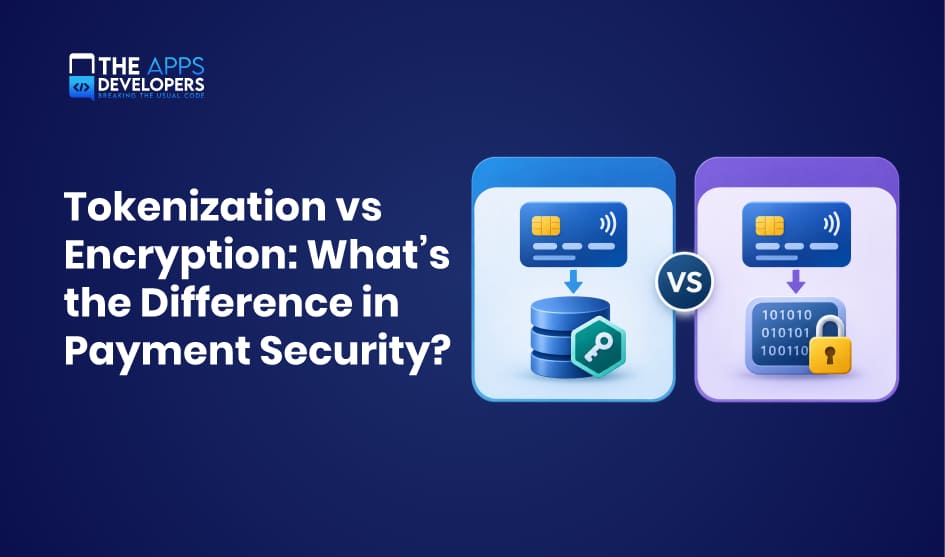
Encryption scrambles card data into ciphertext that can be mathematically reversed with the correct key. Tokenization replaces card data with a random, meaningless value that has no mathematical relationship to the original and can only be reversed by looking it up in a secure vault. Both protect payment data, but they fail differently, scope differently under PCI DSS, and most mature payment systems use them together rather than choosing one.
Ask three different payment vendors whether tokenization or encryption is the better choice and you’ll likely get three confident, contradictory answers, often shaped by which one that vendor happens to sell. The honest answer is that they solve different problems, and understanding where each one actually helps matters more during API and backend development than picking a side in a debate that shouldn’t really be a debate.
What Is Encryption?
Encryption is the process of converting readable data into ciphertext using a mathematical algorithm and a key, so that anyone with the correct key and algorithm can reverse the process and recover the original value. Common algorithms used for payment data include AES for symmetric encryption and RSA for asymmetric encryption. Because encryption is reversible by design, its entire security model rests on protecting the key, not the ciphertext itself.
What Is Tokenization?
Tokenization is the process of replacing sensitive payment data with a randomly generated surrogate value, called a token, that carries no mathematical relationship to the original data and cannot be reverse-engineered through computation alone. The real card number is stored separately in a token vault, and recovering it, called detokenization, requires looking up the mapping inside that vault rather than performing any calculation on the token itself.
Tokenization vs Encryption at a Glance
| Factor | Encryption | Tokenization |
|---|---|---|
| How it protects data | Mathematical transformation using a key | Substitution with a random, unrelated value |
| Reversibility | Reversible by anyone with the key | Reversible only by looking up the value in a vault |
| What attackers need to break it | The encryption key | Access to the token vault itself |
| Format of the output | Usually doesn’t resemble the original data | Can preserve the original format (same length, same character pattern) |
| Where it’s commonly used | Data in transit, data at rest, full-disk and database encryption | Stored card numbers referenced repeatedly across transactions |
| PCI DSS scope impact | Encrypted data can still be in scope if the system can decrypt it | Scope depends on vault location, not on tokenization as a technique alone |
How Each One Actually Protects Data
Encryption’s security lives entirely in the key. If an attacker steals encrypted card data but not the key, they have unusable ciphertext. If they steal both, the data is instantly readable. This is why key management, rotation schedules, access restrictions, and hardware security modules matter as much as the encryption algorithm itself.
Tokenization’s security lives in the vault. A stolen token is useless on its own, since there’s no mathematical path from token back to card number. The real risk shifts entirely to the vault that holds the token-to-data mapping, which is why that vault needs to be isolated, tightly access controlled, and monitored as a single high-value target rather than spread across a system the way an encryption key sometimes is.
What PCI DSS Actually Says About Scope
This is where a lot of vendor content oversimplifies things, usually in whichever direction favors the product being sold. The common claim is that “tokenization reduces PCI DSS scope while encryption doesn’t.” That’s not quite what PCI SSC itself says.
PCI SSC’s own FAQ on its tokenization guidance documents doesn’t make a blanket scope-reduction claim at all. Scope reduction from tokenization depends entirely on architecture, specifically, whether your own systems ever receive or store the real card number before it’s tokenized, and where the vault actually lives. If your server touches the raw PAN even briefly before handing it off to a token vault, that part of your environment is still in scope regardless of what happens afterward.
Our complete guide to PCI DSS for payment apps covers how scope is actually determined beyond just tokenization and encryption.
Point-to-point encryption, or P2PE, has a more clearly defined path. A PCI-validated P2PE solution encrypts card data at the point of capture, inside an approved device, and only decrypts it inside a separately validated decryption environment the merchant never touches. According to PCI SSC’s own P2PE documentation, a validated solution can significantly reduce a merchant’s validation effort, and merchants using one can typically qualify for SAQ P2PE, a self-assessment questionnaire built specifically for that scenario.
That’s a useful contrast with tokenization. P2PE’s scope reduction is formally defined by PCI SSC through a validated program and a dedicated questionnaire. Tokenization’s scope reduction is architecture-dependent and isn’t codified the same way, which is exactly the nuance most vendor comparisons skip. We cover how SAQ eligibility actually works in our guide to SAQ A vs SAQ A-EP, which applies the same underlying logic to outsourced payment pages.
Format-Preserving Encryption: Where the Lines Blur
Standard encryption changes both the content and the format of the data. A sixteen-digit card number encrypted with AES doesn’t come out looking like a sixteen-digit number anymore, which breaks systems built around that format. Format-preserving encryption, defined by NIST Special Publication 800-38G, solves this by producing ciphertext in the same format as the input, so a card number stays a sixteen-digit string even while encrypted.
This matters because format preservation is often cited as tokenization’s main practical advantage over encryption. Format-preserving encryption narrows that gap considerably, though it’s still mathematically reversible with a key, which means it inherits encryption’s key-management risk rather than tokenization’s vault-isolation model.
Stripe’s own comparison of the two techniques frames this well from the payments-infrastructure side: tokens bear no mathematical relationship to the original data at all, while even format-preserving ciphertext remains, at its core, a mathematical transformation someone with the key can undo.
When to Use Tokenization, Encryption, or Both
Tokenization tends to fit best when the same card number gets referenced repeatedly, a saved card for recurring billing, a loyalty program tied to a payment method, a stored card for faster future checkout, since the token can sit in your database indefinitely without ever representing usable card data on its own.
Encryption tends to fit best for data in transit and for information that genuinely needs to be recoverable in its original form for legitimate processing, such as data moving between a payment page and a processor, or full-disk encryption protecting a database as a baseline control regardless of what’s tokenized inside it.
In practice, mature payment architectures layer both. Card data gets tokenized for storage so the token, not the real number, lives in application databases, while the communication carrying that token, and any moment the real card number briefly exists during initial capture or processing, gets encrypted in transit. Neither technique replaces the other; each covers a different point in the data’s lifecycle. This is the same layered thinking behind how to prevent e-skimming attacks on a checkout page, where no single control is treated as sufficient on its own.
Common Mistakes Businesses Make With Both
Assuming tokenization automatically removes PCI DSS scope. It only does that if the real card number never lands on your own systems first. A poorly architected “tokenization” integration that still passes raw PANs through your server before tokenizing them doesn’t reduce scope at all.
Treating encryption keys like static secrets. Keys that are never rotated, shared across too many systems, or stored alongside the data they protect undermine the entire model, regardless of how strong the algorithm is.
Choosing a vendor’s token format without checking vault ownership. A third-party tokenization service that still gives you a path to detokenize data on demand means your access controls to that service are now part of your security boundary, not something you can ignore because “it’s tokenized.”
Building custom encryption instead of using vetted, standard algorithms. Payment data is the wrong place to experiment with proprietary cryptography. Stick to industry-standard algorithms implemented through established libraries, reviewed through proper web application development practices rather than built from scratch.
Treating this as purely a data-storage problem. The same discipline that protects stored card data needs to extend to the page collecting it in the first place. Our web app security checklist covers the broader controls that belong alongside tokenization and encryption, not instead of them.
What a Compromise Actually Looks Like for Each
The practical difference between tokenization and encryption shows up most clearly during an incident, not during normal operation.
If an attacker steals encrypted card data, the breach’s severity depends entirely on whether the key was also exposed. A key stored separately, rotated regularly, and protected by a hardware security module can mean stolen ciphertext is genuinely useless to the attacker. A key stored alongside the data it protects, or reused across too many systems, turns that same theft into a full exposure.
If an attacker steals tokens, they typically get nothing usable on their own, since there’s no computation that turns a token back into a card number. The real exposure risk concentrates entirely on the vault itself. A vault breach is rarer, since it’s usually a smaller, more tightly controlled system, but it’s also a far more complete failure when it happens, since the vault holds every token-to-data mapping at once rather than one encrypted record at a time.
This is why vault security deserves the same rigor as key management, not less. Treating a token vault as inherently safe because “it’s just tokens on the outside” misses that the vault itself is where all the real risk has been concentrated.
Build Your Payment Data Architecture the Right Way
The tokenization versus encryption question matters less than most vendor marketing suggests, because the real answer in a well-built payment system is almost always both, applied at the right points for the right reasons. Getting that architecture right from the start protects your customers and keeps your PCI DSS scope honest rather than optimistic. If you’re planning a payment integration and want the data architecture reviewed before it ships, not after, talk to our team about what your specific setup actually needs.
Frequently Asked Questions
Is tokenization more secure than encryption?
Neither is universally more secure. Tokenization removes the mathematical relationship to the original data entirely, which some consider stronger, but it shifts all the risk onto the vault. Encryption keeps a reversible relationship but distributes risk across key management instead. The right choice depends on your use case, not a general security ranking.
Does tokenization eliminate PCI DSS compliance requirements?
No. It can reduce the systems that fall inside PCI DSS scope if architected correctly, but the token vault itself remains in scope and subject to its own strict controls. Tokenization reduces your compliance burden; it doesn’t eliminate it.
Can tokenized data be decrypted?
Not in the traditional sense. Tokens have no mathematical path back to the original value. Recovering the real data means looking it up in the token vault, which is a database lookup under strict access controls, not a decryption operation.
What is point-to-point encryption and how is it different from regular encryption?
Point-to-point encryption, or P2PE, is a PCI SSC validated standard where card data is encrypted at the point of capture inside an approved device and only decrypted inside a separately validated environment the merchant never accesses. Regular encryption can happen anywhere in your own systems, which keeps more of your environment in PCI DSS scope than a validated P2PE solution typically does.
Should a new payment integration use tokenization, encryption, or both?
Both, in almost every real-world case. Tokenize card data you need to store or reference repeatedly, and encrypt data in transit and any point where the real card number briefly exists during processing. Treating this as an either-or decision usually means one part of the system ends up under-protected.
Table of Contents

Bilal Parker
Bilal Parker is a content writer and researcher with a passion for exploring new ideas, industry trends, and topics that shape modern life. He specializes in creating engaging, well-researched articles covering business, lifestyle, productivity, and digital trends. Through clear storytelling and practical insights, Bilal aims to simplify complex subjects, share valuable knowledge, and help readers stay informed, inspired, and ahead of the curve.