Telemedicine app development cost in 2026 usually lands between $40,000 and $70,000 for an MVP, $70,000 to $150,000 for a full patient and doctor app, and $150,000 to $300,000 or more for an enterprise telehealth platform. Video calls, HIPAA compliance, and EHR integration are what push the number up fastest.
“Just give me a ballpark.” We hear that in almost every first call with a clinic owner or health founder, and it’s a fair ask. The problem is that a telemedicine app can be a simple video booking tool for one family practice, or a multi-state platform with prescriptions, insurance billing, and hospital records. Those two projects aren’t even in the same price universe.
Virtual care also isn’t a pandemic experiment anymore. According to the CDC’s National Center for Health Statistics, 37% of US adults used telemedicine within a single 12-month period, and patients now expect it as a normal option. So instead of one vague number, here’s how the cost actually breaks down, using the same approach we follow when scoping projects in Healthcare App Development.
What Is a Telemedicine App?
A telemedicine app is a healthcare app that lets patients see a doctor remotely by video, voice, or secure chat, usually with scheduling, prescriptions, payments, and medical records built in.
Behind the patient’s screen, there are really three products. Patients get their app, doctors get their own app or a web dashboard, and clinic staff get an admin panel to manage it all. You’re paying for all three, which surprises a lot of first-time founders.
Telemedicine App Development Cost at a Glance
| App Type | What’s Included | Estimated Cost | Timeline |
| MVP | Patient profiles, scheduling, video calls, secure chat, basic admin | $40,000 to $70,000 | 4 to 6 months |
| Full patient and doctor app | MVP plus provider app, e-prescriptions, payments, notifications, ratings | $70,000 to $150,000 | 6 to 9 months |
| Enterprise telehealth platform | EHR integration, insurance billing, remote monitoring, analytics, multi-clinic support | $150,000 to $300,000+ | 9 to 15 months |
Treat these as typical ranges, not quotes. Two apps with the same feature list can still differ in cost by tens of thousands of dollars once integrations and compliance work are scoped properly.
What Affects Telemedicine App Development Cost?
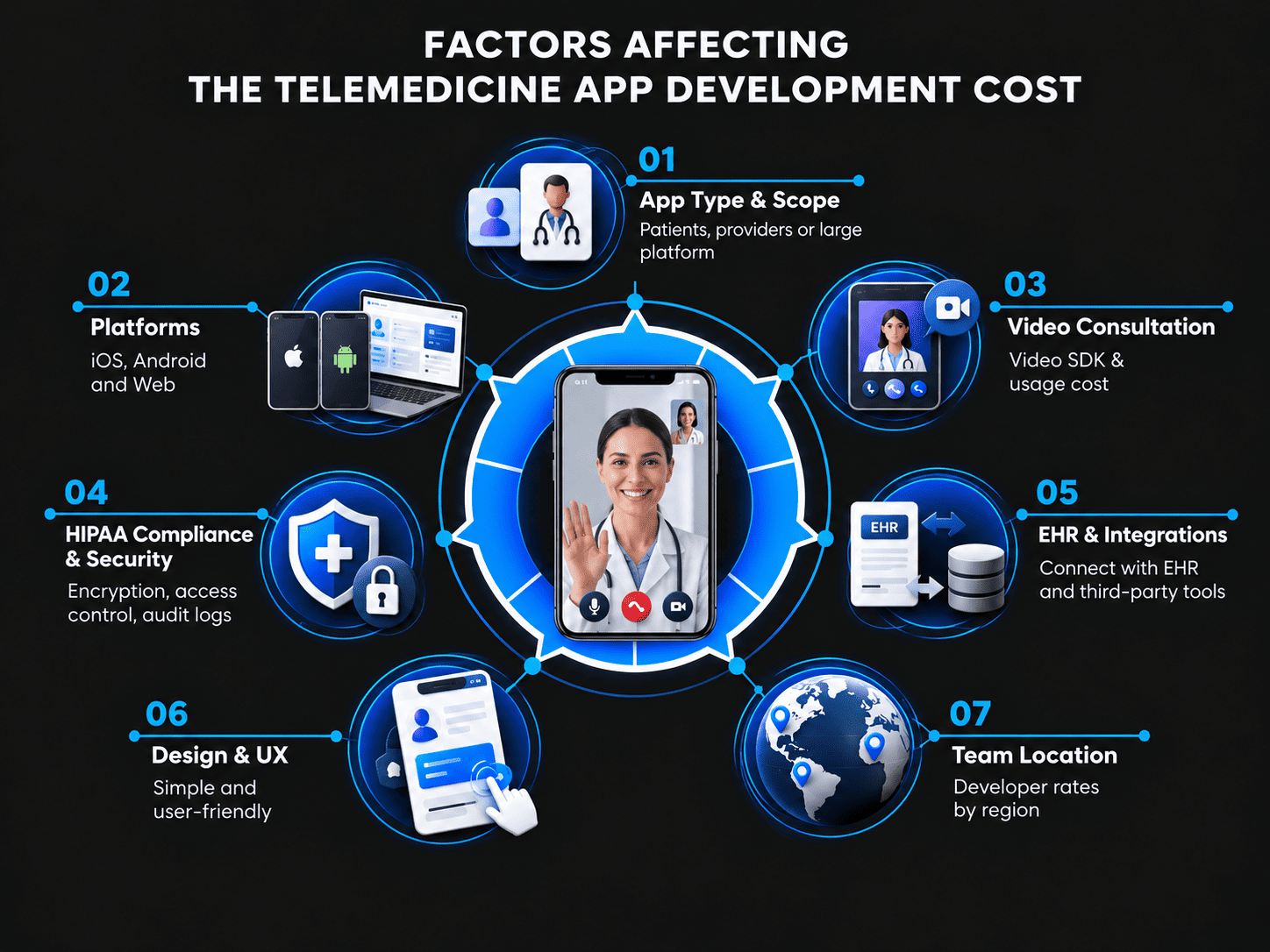
1. App Type and Scope
Say you run a three-doctor dermatology practice and just want patients to book and join video visits. That’s a very different build from a startup planning to serve thousands of providers across several states. Pin down who the app is really for before anything else, because every later decision follows from it.
2. Platforms: iOS, Android, and Web
Two separate native apps cost more than one cross-platform app. And don’t forget the doctors. Most of them work from a desktop during clinic hours, so a web portal for providers is almost always part of the plan.
3. Video Consultation Technology
Video is the feature everyone thinks about first, and it’s one of the pricier ones. Hardly anyone builds video infrastructure from scratch anymore. Instead, teams plug in a HIPAA-eligible video SDK from a vendor willing to sign a business associate agreement (BAA). The trade-off is a monthly bill that grows with every minute patients spend on calls.
4. HIPAA Compliance and Security
If your app handles protected health information for providers or health plans, the HIPAA Security Rule applies. That means encryption, access controls, audit logs, and careful choices about where data lives. It touches design, code, hosting, and testing, so it shows up in every line of the budget. This is also the last place we’d ever suggest cutting corners.
Logins deserve extra attention. Plenty of patients open health apps on a shared family tablet, so good web app session management, with automatic timeouts and a clean logout, quietly protects them.
5. EHR and Third-Party Integrations
Here’s the line item that surprises people most. Connecting to an electronic health record system is often the single most expensive feature in the whole app. The HL7 FHIR standard has made things easier, but each EHR vendor still has its own approval process, quirks, and sometimes fees. Getting that data flowing correctly takes solid API and backend development, and it’s worth paying for.
6. Design and User Experience
Think about who’s opening your app. Often it’s someone older, nervous, or feeling awful. If they can’t find the “Join Visit” button, the appointment is lost and your support line rings. Thoughtful UI/UX design costs more upfront and saves money for years after.
7. Development Team Location
Where your team sits changes the math a lot. Here’s roughly what hourly rates look like:
| Region | Typical Hourly Rate |
| United States and Canada | $100 to $200 |
| Western Europe | $70 to $150 |
| Eastern Europe | $40 to $80 |
| South Asia | $25 to $50 |
A cheaper rate isn’t automatically a cheaper project, though. A team that has handled healthcare compliance before will usually avoid the rework that eats up savings from a lower hourly price.
Telemedicine App Cost by Feature
Want to see where the money goes, feature by feature? These ranges help you compare priorities.
| Feature | Estimated Cost |
| User registration and patient profiles | $3,000 to $8,000 |
| Appointment scheduling and calendars | $4,000 to $10,000 |
| Video and voice consultations | $8,000 to $20,000 |
| Secure chat and file sharing | $5,000 to $12,000 |
| E-prescriptions | $8,000 to $20,000 |
| Payments and insurance handling | $5,000 to $15,000 |
| Push notifications and reminders | $2,000 to $5,000 |
| Provider dashboard and admin panel | $8,000 to $20,000 |
| EHR integration (per system) | $15,000 to $40,000+ |
| Remote patient monitoring and wearables | $15,000 to $40,000 |
| AI symptom checker or triage | $15,000 to $40,000 |
One caution: you can’t just add these up. Features share the same backend, design system, and testing, so a real project usually costs less than the sum of its parts.
Telemedicine App Cost by Development Stage
Coding isn’t where all the money goes. A typical budget splits up like this:
| Stage | Share of Budget | What Happens |
| Discovery and planning | 5% to 10% | Requirements, compliance review, technical architecture |
| UI/UX design | 10% to 15% | User flows, prototypes, accessibility |
| Development | 45% to 55% | Patient app, provider app, backend, integrations |
| Testing and QA | 15% to 20% | Functional, security, performance, and device testing |
| Deployment and launch | 5% | App store release, cloud setup, monitoring |
Ongoing Costs After Launch
Launch day isn’t the finish line for your budget. These costs keep coming every month or year:
- Cloud hosting on HIPAA-eligible services, with a signed BAA from your provider.
- Video usage fees, usually charged per minute or per participant.
- Maintenance and updates. A common rule of thumb is 15% to 20% of the original build cost each year.
- Security audits and penetration tests, ideally at least once a year.
- Third-party services like e-prescription networks, payment processing, SMS, and email.
A well-run cloud setup keeps those bills predictable. That’s where experienced DevOps and cloud solutions pay for themselves, especially when patient volume spikes during flu season.
Hidden Costs Most Budgets Miss
These are the ones that tend to show up halfway through a project:
- BAA pricing. Some vendors only sign BAAs on their more expensive plans.
- EHR vendor fees for API access or marketplace listings.
- Regulatory review. If your app helps diagnose or treat conditions, it may fall under FDA oversight, which adds legal and documentation work.
- Provider onboarding. Doctors are busy, and training them takes real time.
- Data migration. Moving old patient records into a new system is almost never as simple as it sounds.
How to Reduce Telemedicine App Development Cost
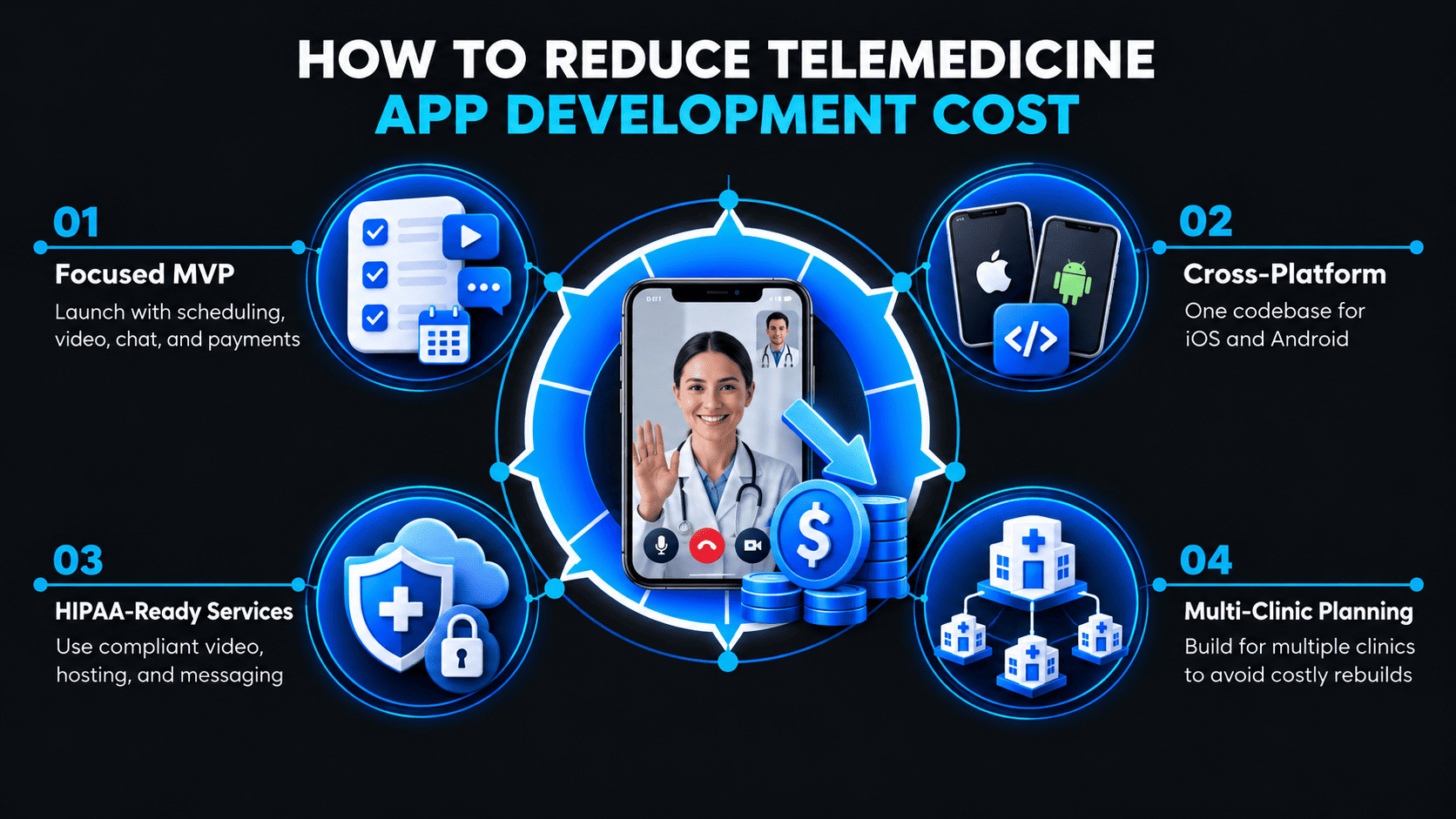
Start With a Focused MVP
You don’t need everything on day one. Scheduling, video visits, secure chat, and payments are enough to launch and learn. E-prescriptions, EHR integration, and remote monitoring can come later, once real patients show you what they actually use.
Use Cross-Platform Development
With Flutter or React Native, one team builds iOS and Android from a shared codebase. That cuts both the build cost and the cost of every update afterward.
Lean on Proven HIPAA-Eligible Services
Renting video, hosting, and messaging from vendors that sign BAAs is almost always faster and cheaper than building them yourself. Save your budget for the parts that make your product different.
Plan for Multiple Clinics From the Start
Planning to sell your platform to other practices someday? Design for that now. Our comparison of multi-tenant vs single-tenant SaaS explains how to keep each clinic’s data separate without an expensive rebuild down the road.
How Telemedicine Apps Make Money
The simplest model is charging per visit. Many platforms, though, have moved to monthly memberships that include a set number of consultations, which smooths out revenue. If that’s your direction, our guide on how to build a subscription-based app walks through pricing tiers and billing.
Other options include insurance billing, employer health contracts, licensing your platform to clinics, and adding medication delivery. That last one is growing fast, and our guide on how to develop an app like Life Pharmacy covers what it takes.
Conclusion
So what will your telemedicine app cost? Honestly, that depends far more on scope, compliance, and integrations than on the idea itself. A focused MVP with secure video and scheduling can launch for $40,000 to $70,000. A full enterprise platform with EHR connections and insurance billing can go well past $300,000. Our advice is the same for almost everyone: start small, build on HIPAA-eligible services, and let real patients tell you what to build next.
Want a number based on your actual plans? Book a free consultation with The Apps Developers, and we’ll walk through your features, compliance needs, and budget together.
Frequently Asked Questions
How much does it cost to develop a telemedicine app?
Telemedicine app development cost usually runs $40,000 to $70,000 for an MVP and $70,000 to $150,000 for a full patient and doctor app. Enterprise platforms often cost $150,000 to $300,000 or more.
How long does it take to build a telemedicine app?
Plan on four to six months for an MVP. A full patient and doctor app usually takes six to nine months, and an enterprise platform can take nine to fifteen months.
Why is telemedicine app development so expensive?
It comes down to secure video, HIPAA compliance, encrypted storage, and EHR integration. Each one adds design, development, testing, and hosting work that a regular consumer app simply doesn’t need.
Does a telemedicine app need to be HIPAA compliant?
Yes, if it handles protected health information for healthcare providers or health plans. In practice, that means encryption, access controls, audit logs, and signed business associate agreements with your vendors.
What features should a telemedicine app have?
At minimum: patient profiles, scheduling, video visits, secure chat, payments, notifications, and a provider dashboard. Most apps add e-prescriptions and EHR integration as they grow.
How much does it cost to maintain a telemedicine app?
A good rule of thumb is 15% to 20% of the original build cost per year. Add hosting, video usage fees, security audits, and third-party services on top of that.