

To develop an app like Life Pharmacy, you need a licensed pharmacy partner, a customer app with prescription upload and fast delivery, a pharmacist dashboard, a rider app, and health data hosted inside the UAE. A focused MVP usually costs $25,000 to $45,000 and takes three to four months to launch.
Picture a parent in Dubai at 11 pm with a feverish child and an empty medicine cabinet. A few years ago, that meant a drive to the nearest 24 hour pharmacy. Today, they open an app, upload a photo of the prescription, and a rider is at the door soon after. That shift is exactly why pharmacies and health startups across the Gulf want an app like Life Pharmacy.
Building one isn’t the same as building a regular shopping app, though. You’re handling prescriptions, patient data, and medicines that are tightly regulated. In this guide, we break down the features, compliance rules, tech stack, costs, and timeline, based on how we approach Healthcare App Development for our clients.
What Is Life Pharmacy?
Life Pharmacy is a UAE pharmacy chain that pairs its physical stores with an online store and mobile app for medicines, wellness, and beauty products. Its app lets customers shop healthcare products, scan and upload prescriptions for delivery from the nearest branch, order items by typing or snapping a photo, and earn reward vouchers. You can see the full list on the official Life Pharmacy app listing. Speed is a big part of the pitch. On its website, the company promotes delivery in under 30 minutes on many orders, and that sets the bar for anyone entering this space.Why Build a Pharmacy App Like Life Pharmacy?
A pharmacy app turns a one-off store visit into a long-term relationship. Patients with chronic conditions like diabetes or hypertension reorder the same medicines every month, and an app makes that effortless. Home delivery also gives people privacy when buying sensitive products. For existing pharmacy chains, an app protects market share and lets them serve whole neighborhoods without opening new branches. For startups, it’s a way into a market where convenience now decides where people shop.How Does an App Like Life Pharmacy Work?
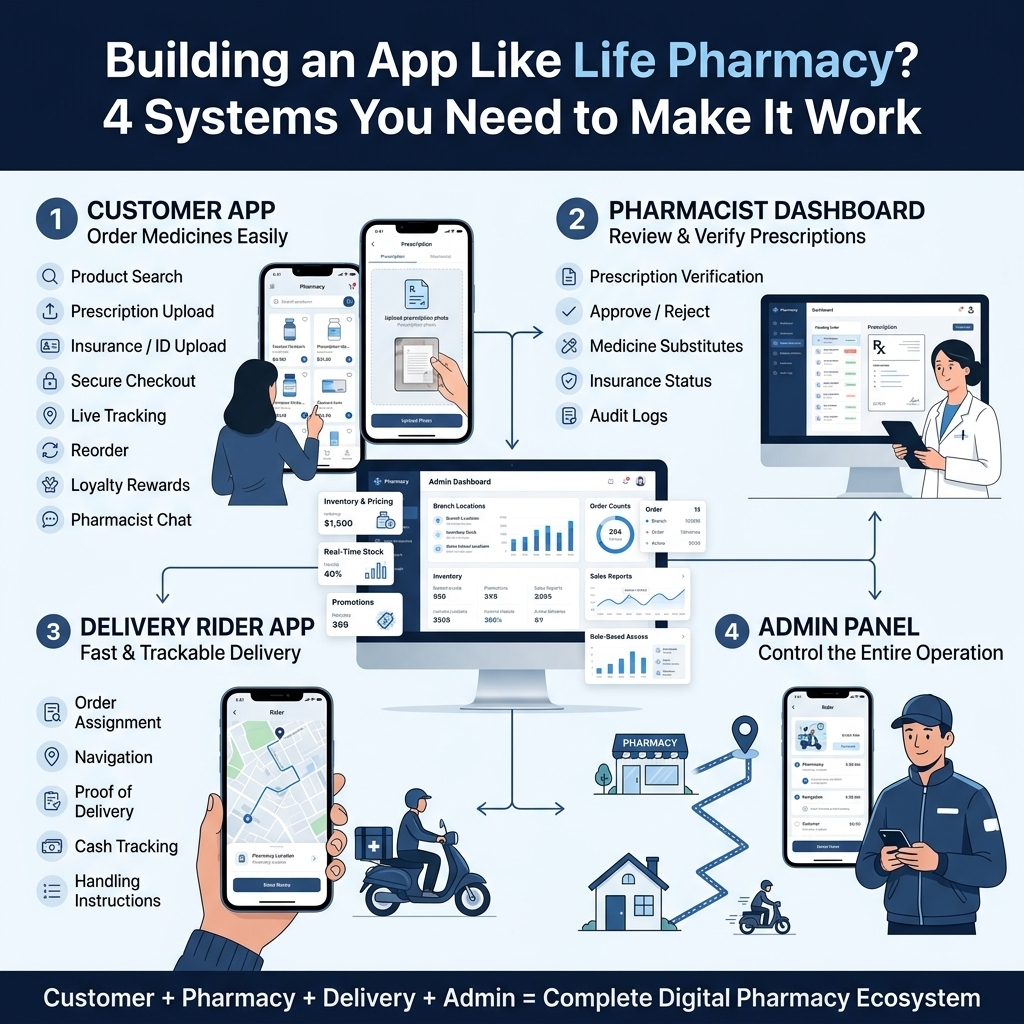
An app like Life Pharmacy works by connecting four parts: a customer app, a pharmacist dashboard, a delivery rider app, and an admin panel.- The customer browses products or uploads a prescription.
- A licensed pharmacist reviews and approves the prescription.
- The order goes to the nearest branch that has the items in stock.
- A rider picks it up, and the customer tracks it live.
- The customer pays by card, wallet, or cash on delivery, then rates the experience.
Must-Have Features of an App Like Life Pharmacy
Customer App Features
- Quick sign up with phone number and OTP
- Product search with filters by brand, category, and health need
- Prescription upload through the camera or gallery
- Insurance card and Emirates ID upload for covered prescriptions
- Cart, checkout, and multiple payment options
- Live order tracking and push notifications
- Order history with one tap reorder
- Loyalty points and vouchers
- In-app chat with a pharmacist
Pharmacist Dashboard Features
- Prescription queue with zoom and verification tools
- Approve, reject, or request clarification from the customer
- Substitute suggestions for out of stock items
- Flags and audit logs for controlled medicines
- Insurance approval status for each order
Delivery Rider App Features
- Order assignment based on rider location
- Turn by turn navigation
- Proof of delivery with a photo or OTP
- Cash collection tracking
- Handling notes for temperature sensitive items like insulin
Admin Panel Features
- Branch, inventory, and pricing management
- Real time stock sync with each store’s POS system
- Promotions, banners, and vouchers
- Reports on sales, delivery times, and refills
- Role based access for pharmacists, managers, and support staff
Advanced Features That Help You Compete
Copying Life Pharmacy feature for feature won’t win customers. These additions can.- Refill reminders and auto refills. Chronic patients get a nudge before they run out and can set up repeat orders. Our guide to building a subscription-based app covers the billing logic behind this.
- Insurance pre-approval. Show the copay before checkout, so there are no surprises at the door.
- Teleconsultation. Let users speak with a doctor or pharmacist by video, then order straight from the call.
- In-app wallet. Keep refunds and cashback in one balance. Our breakdown of mobile wallet development explains what it takes.
- True bilingual support. Full Arabic right to left layouts, not just translated labels.
UAE Compliance: Licenses and Health Data Rules
A pharmacy app in the UAE must dispense through a licensed pharmacy and must keep patient health data inside the country. Ignore either rule, and the app won’t stay live for long. Licensing depends on the emirate. The Dubai Health Authority (DHA) regulates Dubai, the Department of Health (DOH) regulates Abu Dhabi, and the Ministry of Health and Prevention (MOHAP) covers the Northern Emirates. Established pharmacies moving online typically need an extra approval for online or tele-pharmacy services, as this legal overview of UAE online pharmacy licensing explains. Health data falls under Federal Law No. 2 of 2019 on the use of ICT in health fields. In short, health data from services provided in the UAE generally has to stay in the UAE, remain confidential, and be retained for 25 years. The UAE government’s summary of the law is a good place to start. In practice, that means hosting on a UAE cloud region, encrypting prescriptions at rest and in transit, and protecting every account with proper web app session management. This section is general guidance, not legal advice, so confirm the details with the relevant authority before launch.Recommended Tech Stack for a Pharmacy App
| Layer | Recommended Options |
| Mobile apps | Flutter or React Native |
| Backend | Node.js or Python |
| Database | PostgreSQL, with Redis for caching |
| Cloud hosting | AWS (UAE region) or Microsoft Azure (UAE North) |
| Maps and tracking | Google Maps Platform |
| Payments | Local gateways with cards, Apple Pay, and cash on delivery |
| Notifications | Firebase Cloud Messaging |
| Prescription scanning | OCR, always followed by pharmacist review |
How to Develop an App Like Life Pharmacy: Step by Step
Step 1: Choose Your Licensing Model
Decide early whether you’ll run your own licensed pharmacy, partner with existing pharmacies, or build for a chain that already holds licenses. This choice shapes every feature that follows.Step 2: Research Your Users and Market
Talk to pharmacists, riders, and patients. Look at where Life Pharmacy, Aster, and BinSina are strong, and find the gap you’ll fill.Step 3: Define the MVP
Start with prescription upload, product ordering, pharmacist approval, delivery tracking, and payments. Save teleconsultation and AI features for later versions.Step 4: Design the Experience
A worried patient shouldn’t have to think. Simple flows, large tap targets, and bilingual layouts matter more than visual flair, which is why strong UI/UX design pays for itself here.Step 5: Build the Backend and Integrations
Connect inventory, POS, payments, maps, and insurance systems through secure APIs. Reliable API and backend development keeps stock accurate across every branch.Step 6: Test Thoroughly
Test prescription edge cases, peak hour traffic, Arabic layouts, and failed payments. Run a security audit before you go live.Step 7: Launch, Then Improve
Launch in one area first, measure delivery times and repeat orders, and expand once operations hold up.How Much Does It Cost to Develop an App Like Life Pharmacy?
The cost to develop an app like Life Pharmacy typically ranges from $25,000 for a focused MVP to $150,000 or more for a full platform. These are typical ranges based on scope, and your exact quote depends on features and integrations.| Version | What’s Included | Cost (USD) | Cost (AED) | Timeline |
| MVP | Customer app, prescription upload, pharmacist dashboard, basic delivery, payments | $25,000 to $45,000 | AED 92,000 to 165,000 | 3 to 4 months |
| Mid-level | MVP plus rider app, POS and inventory sync, loyalty, Arabic support | $45,000 to $90,000 | AED 165,000 to 330,000 | 4 to 6 months |
| Full platform | Multi-branch routing, insurance integration, teleconsultation, analytics, web store | $90,000 to $150,000+ | AED 330,000 to 550,000+ | 6 to 9 months |
What Affects the Cost?
- The number of platforms: iOS, Android, and web
- Integrations with POS, ERP, and insurance systems
- Arabic and English support
- Compliance work, including UAE data hosting and security audits
- Your team’s location and engagement model
How Do Pharmacy Apps Make Money?
- Margins on medicines, wellness, and beauty products
- Delivery fees or minimum order values
- Premium memberships with free delivery
- Sponsored placements for health and beauty brands
- Commission from partner pharmacies, if you run a marketplace
Common Challenges and How to Solve Them
- Prescription fraud. Require pharmacist review on every prescription and keep full audit logs.
- Stock mismatches. Sync inventory with each branch in real time, not once a day.
- Temperature sensitive items. Flag cold chain products and assign them to equipped riders.
- Peak demand. Use cloud auto scaling, so the app doesn’t slow down at night or during flu season.