Restaurant reservation app development has become core infrastructure for restaurants that want predictable covers, fewer no-shows, and direct access to guest data. Phone bookings and paper waitlists break down during peak hours, and third-party platforms charge for every seated guest while keeping much of the customer relationship.
A custom booking app puts that control back with the restaurant. This app development guide for restaurant owners, founders, and product teams explains how reservation systems work, which features matter, how to prevent double bookings, where AI fits, and what a realistic build costs.
Restaurant reservation systems are one part of a larger restaurant technology ecosystem. Our restaurant app development guide explains the different types of restaurant apps, their features, and how businesses can approach development.
What Is a Restaurant Reservation App?
A restaurant reservation app lets guests book a table for a specific date, time, and party size, and gives the restaurant one place to manage its seating inventory. Its purpose is to match demand to capacity without overbooking or leaving tables empty.
A typical booking flow works like this:
- The guest selects a restaurant, date, party size, and preferred time.
- The system checks table inventory, turn times, and existing bookings, then returns available slots.
- The guest confirms, the slot is locked, and a confirmation goes out by SMS, email, or push notification.
- Staff see the booking on a floor plan or timeline and can seat, modify, or mark it as a no-show.
Behind the interface sits a reservation engine: a set of rules covering table capacity, table combinations, dining duration, and buffers between seatings.
Types of Restaurant Reservation Apps
The right architecture depends on who the app serves.
- Single-restaurant apps are built for one brand or venue. They focus on direct bookings, brand experience, and loyalty, with no commission paid to a marketplace.
- Multi-location apps serve restaurant groups and chains. They need a central dashboard, location-specific floor plans and hours, shared guest profiles across venues, and group-level reporting.
- Restaurant aggregator apps are marketplaces listing many independent restaurants. Guests discover, compare, and book across venues, and the platform earns through commissions, subscriptions, or featured listings. This is the most complex model to build and operate.
Essential Features of a Restaurant Reservation App
A reservation platform has three user groups, and each needs its own feature set.
Customer Features
- Real-time availability search by date, time, and party size
- Booking, modification, and cancellation in a few taps
- Special requests for occasions, seating preferences, and dietary needs
- Confirmations and reminders via SMS, email, or push
- Digital waitlist for walk-ins and sold-out slots
- Deposits or prepayment for high-demand times
- Booking history and saved favorites
Restaurant Dashboard
- Visual floor plan and table management
- Reservation timeline by shift
- Walk-in and waitlist management
- Guest profiles with visit history and notes
- Capacity rules, shift settings, and blocked dates
- No-show and cancellation tracking
- Reports on covers, turn times, and booking sources
Admin Controls
- Restaurant onboarding and approval
- User roles and permissions
- Commission and subscription billing
- Content and review moderation
- Platform-wide analytics and notification templates
How to Implement a Restaurant Reservation System
The reservation engine is where most projects succeed or fail, so it deserves the most engineering attention.
Booking Workflow
Model each reservation as a state machine: pending, confirmed, seated, completed, cancelled, or no-show. When a guest picks a slot, the system places a short temporary hold (typically 5–10 minutes) while they enter details. Confirmation converts the hold into a booking and triggers notifications.
Table Availability
Do not rely on a fixed list of pre-generated slots. Calculate availability from tables, their party-size range, operating hours, blocked periods, and turn time by party size. A two-top might turn in 90 minutes, while a party of six needs two hours. Support table combinations so two four-tops can seat a party of eight.
Double-Booking Prevention
Two guests will eventually try to book the same table at the same moment. Protect against it at several layers:
- Wrap the hold and confirmation in a database transaction with row-level locking.
- In PostgreSQL, use an exclusion constraint on table ID and a time range so overlapping bookings are rejected by the database itself.
- Store temporary holds in Redis with an expiry so abandoned checkouts release automatically.
- Use idempotency keys on confirmation requests so network retries never create duplicates.
Database Logic
Core entities include restaurants, tables, table combinations, shifts, reservations, reservation-table links, guests, and waitlist entries. Store all timestamps in UTC alongside the restaurant’s time zone, and index reservations by restaurant and start time for fast availability queries.
Restaurant Aggregator App Development
An aggregator adds a discovery layer and a multi-tenant data model on top of the core reservation engine.
- Restaurant discovery: Search by cuisine, price range, rating, and, most importantly, live availability, such as “tables for four at 8 PM tonight.”
- Location filters: Geolocation, radius search, and map views, powered by geospatial indexing in PostGIS or Elasticsearch.
- Listing management: Self-serve onboarding for menus, photos, hours, and booking policies, with a verification workflow before listings go live. Venues that already use another reservation system need API sync so availability never goes stale.
- Multi-restaurant bookings: Each venue’s inventory stays isolated, while a guest’s account spans many venues. Apply each restaurant’s own cancellation policy, block a single user from holding overlapping bookings, and track commissions per seated cover.
How AI Can Reduce Restaurant Wait Times
AI improves the decisions a host makes under pressure, using the data your booking system already collects.
- Predictive wait times: Models trained on historical seating data, party size, day, time, and local events give walk-ins accurate quotes instead of guesses.
- Smart scheduling: Availability adjusts to predicted turn times rather than fixed durations, opening more slots on nights when tables turn faster.
- No-show prediction: Each booking gets a risk score based on guest history, lead time, party size, and booking channel. High-risk slots can trigger deposits, reconfirmation messages, or controlled overbooking.
- Table optimization: Assignment algorithms maximize seated covers, for example by avoiding a party of two at a six-top during peak hours.
Start with rule-based logic and reporting, then introduce machine learning once you have several months of clean booking data.
Technology Stack and Integrations
The stack should favor reliable transactions and real-time updates over novelty.
| Layer | Common choices |
| Mobile frontend | Flutter, React Native, Swift, Kotlin |
| Web app and dashboard | React, Next.js, Vue.js |
| Backend | Node.js (NestJS), Python (Django, FastAPI), Laravel |
| Reservation database | PostgreSQL, with Redis for holds and caching |
| Real-time updates | WebSockets, Firebase, Pusher |
| POS integration | Toast, Square, Lightspeed, Clover APIs |
| Maps and location | Google Maps Platform, Mapbox |
| SMS and notifications | Twilio, Firebase Cloud Messaging |
| Payments | Stripe, Adyen, Braintree |
| Cloud hosting | AWS, Google Cloud, Microsoft Azure |
POS integration often delivers the most operational value. It connects a seated table to its check, which enables accurate turn-time data and spend-per-guest reporting.
Restaurant Reservation App Development Cost
Cost depends mainly on scope, platforms, and integrations. These estimates provide a starting point for budgeting a reservation platform. For a broader breakdown of development expenses, including how features, complexity, and integrations affect the budget, see our restaurant app development cost guide.
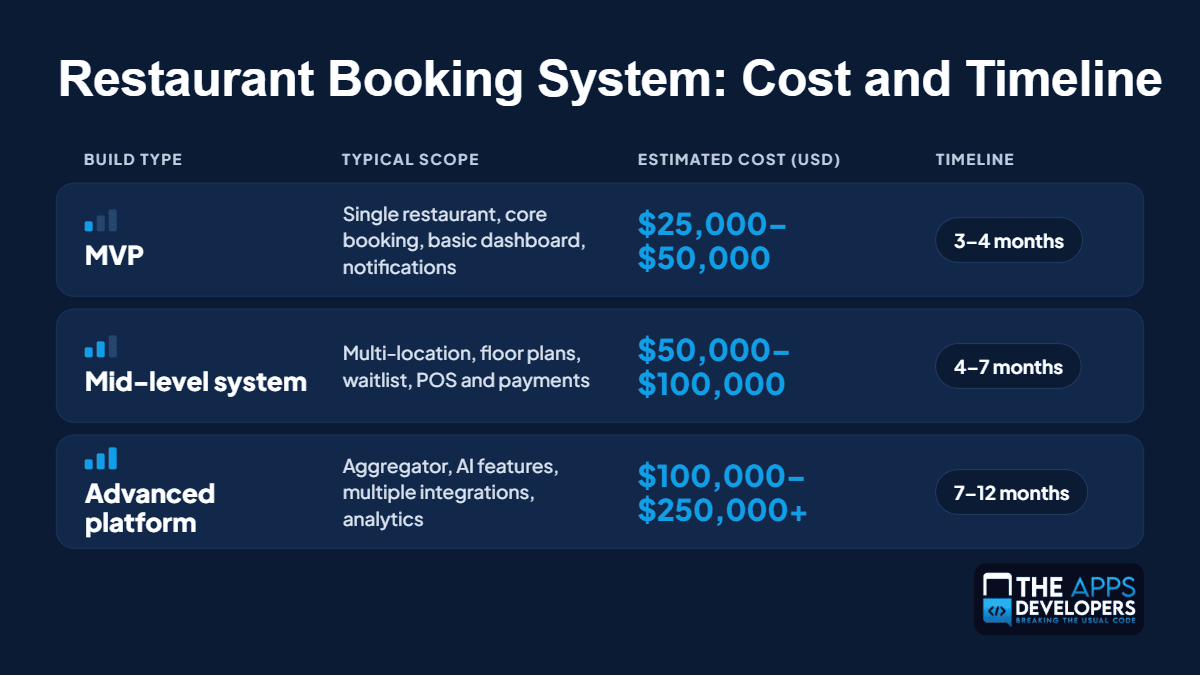
The main cost factors are:
- Number of platforms (iOS, Android, web)
- Number and complexity of third-party integrations
- Real-time features and expected traffic at peak hours
- AI and analytics requirements
- UI/UX complexity and custom floor-plan tools
- Development team location and hourly rates
- Ongoing maintenance, often 15–20% of the initial build cost per year
Custom Restaurant Reservation Software vs. Ready-Made Platforms
Ready-made platforms are fast to deploy, but you work within their pricing, data policies, and feature roadmap.
- Eat App offers reservation and table management on a subscription model, aimed at independent restaurants and groups.
- OpenTable brings a large diner network and discovery channel, with fees tied to covers booked through that network.
- SevenRooms focuses on guest CRM, marketing automation, and data, and is popular with hospitality groups and hotels.
Buy a platform if you run one or two locations with standard booking needs and want to launch quickly.
Build custom software if you operate a large group or an aggregator, want full ownership of guest data, need workflows that off-the-shelf tools cannot support, or are paying per-cover fees that grow with volume. If the booking app is your product, custom is the only real option.
A hybrid path also works: start on a platform, learn your booking patterns, then build once requirements are clear.
Common Challenges in Building a Restaurant Booking App
Most booking failures surface under load or at the edges of the data model.
- Peak-hour demand: Traffic spikes on Friday evenings and holidays. Plan for horizontal scaling, cached availability queries, and request queuing so the app stays responsive.
- Cancellations: Late cancellations cost revenue. Enforce clear policies, support card-on-file fees, and automatically offer freed slots to the waitlist.
- Concurrency: Simultaneous requests for the same table must resolve cleanly through locking, database constraints, and temporary holds.
- Time zones: Store times in UTC and display them in the restaurant’s local time. Test daylight-saving transitions, especially for aggregators operating across regions.
- Real-time synchronization: The guest app, staff dashboard, and external channels such as Reserve with Google must agree at all times. Keep one source of truth, push updates through WebSockets, and reconcile third-party bookings through webhooks.
How to Get Started With Restaurant Reservation App Development
A focused first release beats a feature-heavy launch. Follow this sequence:
- Choose your model: single restaurant, multi-location, or aggregator.
- Document your booking rules: tables, turn times, policies, and shifts.
- Build an MVP with core booking, a staff dashboard, and notifications.
- Add POS and payment integrations.
- Introduce AI features once you have reliable booking data.
The Apps Developers provides restaurant app development services in the USA, building custom booking platforms for single restaurants, multi-location businesses, and aggregator marketplaces. If you’re planning a restaurant reservation app, contact our team for a scoped estimate and a clear technical roadmap.
Related Insights
Explore these guides to learn more about restaurant app development, features, and budgeting.
- Restaurant Management App Development
- White-Label vs Custom Restaurant App Development: Which Is Better?
- Restaurant Loyalty App Development