


The must-have real estate app development features in 2026 are MLS-powered search with real-time filtering, map-based property discovery, saved searches with instant alerts, virtual tours, direct agent messaging, and mortgage affordability tools, and the buyer data behind why has genuinely shifted in the past year. Online search remains the most common first step for buyers, cited by 41 to 47 percent of buyers across the past several years, according to the National Association of Realtors’ own Profile of Home Buyers and Sellers, but the audience actually doing that searching looks meaningfully different than most real estate app content assumes.
The median home buyer age reached a record 59 in NAR’s most recent report, and Baby Boomers now make up 42 percent of all buyers, the single largest generational group, according to NAR’s 2026 Home Buyers and Sellers Generational Trends report, having overtaken Millennials, whose share dropped to 26 percent. That shift matters directly for feature prioritization, an app built purely around younger, mobile-native user assumptions is quietly misaligned with who’s actually driving the current buyer pool. This guide breaks down what actually belongs in a real estate app today, as part of the same Mobile App Development process that real estate applications are ultimately built within.
What Makes a Feature “Must-Have” in a Real Estate App in 2026?
A must-have real estate app feature is one grounded in documented buyer and seller behavior, not a generic checklist copied from a competitor’s app store listing. Search and filtering matter because online search remains the dominant first step in the buying process. Virtual tours matter because property visualization has become a baseline expectation. This guide prioritizes features against real NAR data and current compliance requirements, not assumptions about what a “modern” real estate app should include.
Feature 1: MLS-Powered Search and Real-Time Filtering
Why This Remains the Foundation
Search functionality is the entry point for the majority of the buyer journey, and it needs to run on genuinely current MLS data, not a stale or partial sync, since an app showing outdated listings or incorrect status immediately undermines the trust a buyer places in the platform for what’s often the largest financial decision of their life. Our real estate app development guide covers the MLS and IDX integration work this feature actually depends on, including the compliance changes that have reshaped what data can legally be displayed since the NAR settlement.
Filtering That Matches Real Buyer Priorities
NAR’s research found that lifestyle factors, neighborhood quality and proximity to friends and family, have surpassed job location as a top buyer priority, according to the same generational trends report, a genuine shift worth reflecting in filter design, location-based and lifestyle-oriented filters deserve real prominence alongside the standard price, bedroom, and square footage filters most apps default to.
Feature 2: Map-Based Property Discovery
Visual, map-based search lets buyers explore listings spatially rather than scrolling a flat list, particularly valuable given how heavily neighborhood characteristics now factor into buyer decisions. This is fundamentally a UI/UX design discipline as much as a technical one, presenting map data clearly, with genuinely usable clustering for dense listing areas and smooth performance on both mobile and larger screens, directly affects whether buyers actually use the feature or abandon it for a simpler list view.
Feature 3: Saved Searches and Instant Alerts
Why Timing Matters More Than Most Features Realize
In a market where equity-rich, well-financed buyers are increasingly competing for available inventory, according to NAR’s 2025 Profile findings on market extremes, being alerted to a new listing quickly, ideally in real time rather than a daily digest, can genuinely affect whether a buyer gets to view and offer on a property before it’s gone. This makes saved search and alert infrastructure a functional necessity in competitive markets specifically, not just a convenience feature.
The Technical Backbone
Building genuinely real-time alerts requires reliable, low-latency backend infrastructure watching MLS feed updates continuously, the same API and backend development discipline behind any application needing to react to external data changes quickly and accurately rather than on a slow, batch-processed schedule.
Feature 4: Virtual Tours and Rich Media
Property visualization has moved from differentiator to baseline expectation, and our VR in real estate guide covers the honest data behind this feature category directly, including the real gap between strong buyer engagement metrics and lower agent-reported direct attribution, useful context for scoping this feature proportionally rather than assuming every listing needs the most expensive tier of virtual tour technology available.
Feature 5: Direct Agent Messaging
Why Professional Connection Still Anchors the Experience
Despite the shift toward digital-first search, 88 percent of buyers and 91 percent of sellers used a real estate professional to complete their transaction, according to NAR’s 2025 Profile of Home Buyers and Sellers, meaning a real estate app’s role is overwhelmingly to support and streamline the agent relationship, not replace it. Direct, in-app messaging between buyers and their agent, or between prospective buyers and listing agents, deserves core feature status rather than an afterthought bolted onto contact forms.
A Compliance Layer This Feature Now Carries
Given the NAR settlement’s requirement for a written buyer-broker agreement before touring a home, covered in more depth in our real estate app development guide, messaging and scheduling features increasingly need to support this workflow directly, letting an agreement be reviewed and signed digitally as a natural step in the conversation, not a separate, disconnected process.
Feature 6: Mortgage and Affordability Tools
With first-time buyers at a record-low 21 percent share of the market and median down payments reaching historic highs, according to NAR’s 2025 research, affordability has become a genuinely central concern shaping how buyers actually use a real estate app. Built-in mortgage calculators, affordability estimators tied to real, current rate data, and down payment scenario tools help buyers self-qualify their search realistically before falling in love with a property outside their actual budget, reducing wasted time for both buyers and the agents working with them.
Feature 7: Document Management and Digital Signing
A Feature That’s Become More Central, Not Less
Beyond the buyer-broker agreement requirement covered above, real estate transactions genuinely involve substantial paperwork, disclosures, offers, counteroffers, inspection reports, and a real estate app that treats document handling as an afterthought misses a genuine opportunity to reduce friction at exactly the point in the process where delays and confusion are most costly. Centralizing document access, status, and digital signing within the app itself, rather than routing users out to separate email threads and third-party tools, keeps the transaction moving and gives both buyers and agents a single, reliable source of truth for where things stand.
Why This Matters More With an Older Buyer Population
Given the buyer demographic shift covered throughout this guide, a document management experience that’s genuinely intuitive, without assuming deep familiarity with digital signature workflows, serves the actual current buyer population better than an interface designed for users who grew up with these tools as second nature.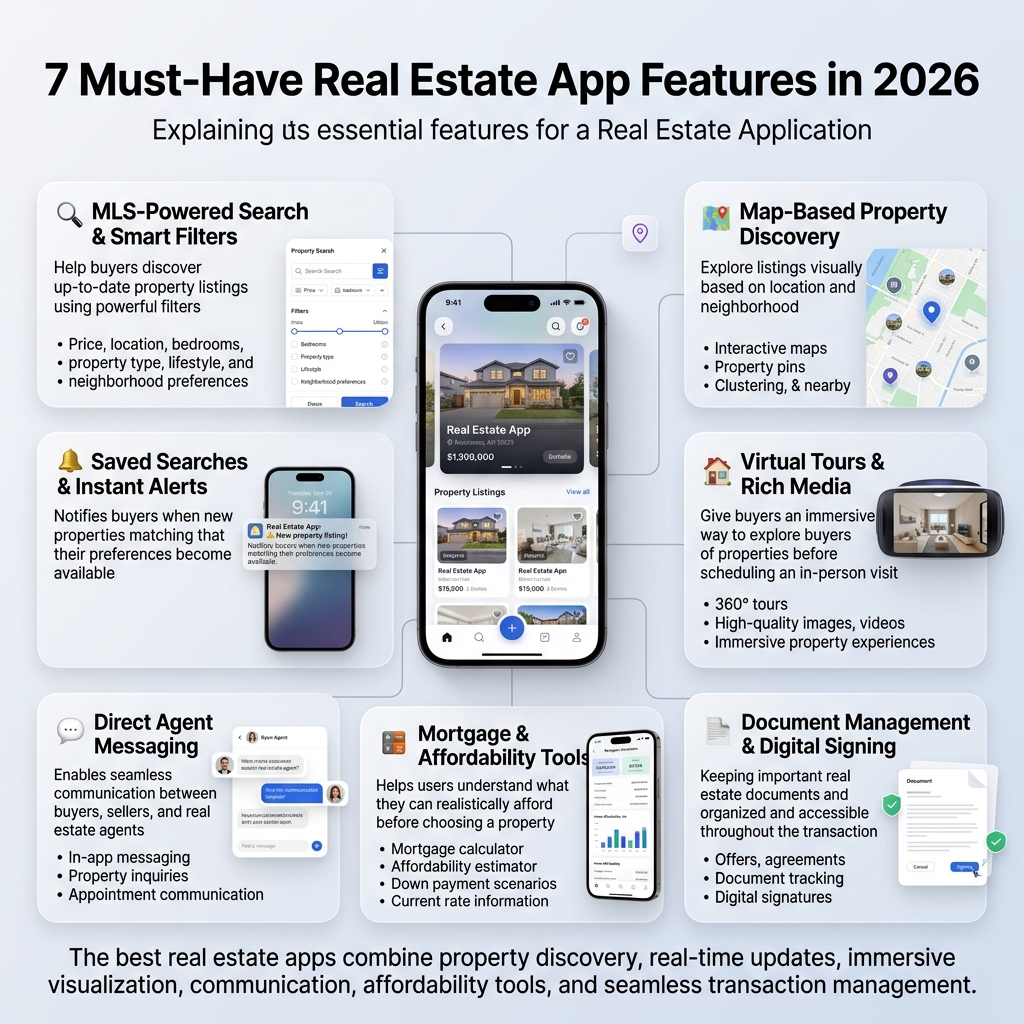
Feature Priority by Buyer Behavior Data
Understanding which features tie to the strongest documented buyer behavior helps sequence development when resources are genuinely limited.
Feature | Supporting Data | Why It Matters |
MLS-powered search | 41-47% of buyers start online | The primary entry point to the buying journey |
Saved searches/alerts | Equity-rich buyers moving fast in competitive markets | Speed to alert can determine whether a buyer even gets a viewing |
Agent messaging | 88% of buyers, 91% of sellers use an agent | The app supports, not replaces, the core professional relationship |
Affordability tools | First-time buyers at record-low 21%, down payments at historic highs | Affordability now shapes search behavior directly |
Virtual tours | Property visualization now baseline expectation | Reduces wasted in-person showings for both sides |
Reading this table usefully means recognizing that the features with the strongest, most direct data support are the ones anchoring the core transaction relationship and search experience, not the most visually impressive additions.
Notification Customization: Solving for Alert Fatigue
A genuinely well-built saved search and alert system needs real customization, not a single, undifferentiated notification stream, since a buyer actively house-hunting in a fast-moving market wants different alert behavior than a buyer casually browsing months before they’re ready to act. Letting users control alert frequency, immediate push notification for high-priority saved searches versus a daily or weekly digest for more exploratory ones, prevents the notification fatigue that causes users to disable alerts entirely, which defeats the entire purpose of the feature covered earlier in this guide. This is a genuinely easy feature to underbuild, a single fixed alert cadence applied uniformly across every saved search feels simple to implement but produces a worse real outcome than a system that respects how differently buyers actually behave depending on where they are in their own search timeline.
Accessibility: A Genuinely Underweighted Feature Category Given Current Buyer Demographics
Why This Deserves Real, Explicit Attention Now
Given that the median buyer age hit a record 59 in NAR’s most recent report and Baby Boomers now represent the largest single generational group of buyers, accessibility considerations, legible text sizing, sufficient color contrast, straightforward navigation that doesn’t assume gesture-heavy interaction patterns, deserve genuine design attention as a mainstream requirement, not a specialized accommodation for an edge-case user segment. Most competing real estate app content still writes feature guidance assuming a young, digitally native primary user, a real mismatch with who’s actually buying homes right now according to the industry’s own most current research.
Practical Implementation
This doesn’t mean building a separate, simplified app experience, it means genuinely testing core flows, search, saved alerts, messaging, scheduling, with users across the actual age range NAR’s data shows are buying homes today, and designing default text sizes, contrast, and interaction patterns that work well for that real population rather than an assumed younger one.
Neighborhood and Lifestyle Context Data
Given NAR’s finding that neighborhood quality and proximity to friends and family have overtaken job location as a top buyer priority, a real estate app benefits genuinely from surfacing neighborhood-level context directly alongside listings, school ratings, walkability, nearby amenities, commute estimates, rather than requiring a buyer to research this separately across other apps and websites. This is squarely a data integration challenge more than a design one, sourcing accurate, current neighborhood data from reliable third-party providers and presenting it clearly alongside listing details, and it directly reinforces the same lifestyle-driven priority shift shaping how buyers actually evaluate properties today. An app that treats a listing purely as a set of physical property attributes, bedrooms, bathrooms, square footage, without this surrounding context is increasingly out of step with what the data shows buyers actually weighing most heavily in their decision.
Common Mistakes in Real Estate App Feature Prioritization
Businesses frequently build feature sets around an assumed young, tech-forward buyer persona without checking that assumption against NAR’s own current data, missing that Baby Boomers, not Millennials or Gen Z, now represent the largest single buyer generation. Messaging and scheduling features get built without accounting for the mandatory buyer-broker agreement workflow the NAR settlement introduced, creating a booking experience that doesn’t match how the industry actually operates.
Virtual tour investment gets concentrated in the most expensive technology tier for every listing regardless of property type or price point, when the real data suggests a more proportional approach matched to where visual uncertainty genuinely drives buyer hesitation. And affordability tools get treated as a nice-to-have add-on rather than a core feature, despite record-high down payments and a record-low first-time buyer share making budget self-qualification more relevant to real buyer behavior than it’s been in decades.
How The Apps Developers Approaches Real Estate App Feature Development
We prioritize real estate app features against genuine, current buyer behavior data, not an assumed persona, as part of the same Mobile App Development process we bring to any project, ensuring the features anchoring the core search and agent relationship are solid before investing in differentiating extras.
Design work receives particular attention given the real, current shift in buyer demographics, since building genuinely accessible, age-inclusive interfaces is a specialized part of UI/UX design with real implications for whether an app actually serves the buyer population using it today.
If you’re building a real estate app and want the features that actually match current buyer behavior prioritized correctly, that’s worth a direct conversation. You’re welcome to talk to our team about what your specific real estate app actually needs.