

Choose React if you want the biggest ecosystem, the largest hiring pool, and an easy path to native mobile apps with React Native. Choose Vue if you want a gentler learning curve, official tools for routing and state built in, and fast delivery with a smaller team. In 2026, both are fast, mature, and production-ready, so the right pick depends on your team and project far more than on raw performance.
Every few months, someone on a product team asks the question: “Should we build this in React or Vue?” Then the debate starts. One developer loves React’s flexibility, another swears Vue is cleaner and faster to work with, and the founder just wants to know which one won’t cause problems a year from now.
Here’s the honest answer: you can build almost anything with either. The real differences show up in hiring, team experience, mobile plans, and how much structure your developers want out of the box. In this React vs Vue comparison, we’ll walk through those differences with current 2026 data, show you real code from both, and give you a simple way to decide. It’s the same evaluation our team runs at the start of every web application development project.
React vs Vue at a Glance
Here’s how React JS vs Vue JS compare on the points that matter most to product teams.
| Factor | React | Vue |
| Type | UI library | Progressive framework |
| Created by | Meta (Facebook) | Evan You and the Vue core team |
| First released | 2013 | 2014 |
| Component syntax | JSX (HTML inside JavaScript) | HTML-based templates in single-file components |
| Learning curve | Moderate | Gentle |
| Routing and state | Community choices (React Router, Redux, Zustand) | Official tools (Vue Router, Pinia) |
| Full-stack framework | Next.js | Nuxt |
| Native mobile | React Native | Capacitor, Ionic Vue, NativeScript-Vue |
| Developer usage (Stack Overflow 2025) | 44.7% | 17.6% |
| Developers who admire it (Stack Overflow 2025) | 52.1% | 50.9% |
What Is React?
React is an open-source JavaScript library from Meta for building user interfaces out of reusable components, using JSX to write markup directly inside JavaScript.
React only handles the view layer, which is both its strength and its catch. You get enormous flexibility, but you also choose your own tools for routing, data fetching, and state. That’s why the React team now recommends starting new apps with a framework like Next.js. It also officially sunset Create React App in 2025, so if a tutorial tells you to run create-react-app, it’s out of date.
React keeps evolving, too. Version 19 brought Server Components and Actions into the core, and the React Compiler now handles many performance optimizations that developers used to write by hand.
What Is Vue?
Vue (also written Vue.js or VueJS) is an open-source progressive JavaScript framework for building user interfaces, known for HTML-based templates, built-in reactivity, and official libraries for routing and state management.
“Progressive” means you can drop Vue into one part of an existing page or build a full single-page app with it. Modern Vue 3 offers the Composition API, <script setup> syntax, Pinia for state, and Vue Router, all maintained by the core team. Vue’s creator, Evan You, also created Vite, the build tool now used across much of the JavaScript world. The official Vue documentation is widely considered some of the best in front-end development.
React vs Vue: The Same Component, Two Ways
Sometimes the fastest way to understand Vue.js vs React is to see them side by side. Here’s a simple counter in each.
React (JSX):
import { useState } from “react”;
export default function Counter() {
const [count, setCount] = useState(0);
return (
<button onClick={() => setCount(count + 1)}>
Clicked {count} times
</button>
);
}
Vue (single-file component):
<script setup>
import { ref } from “vue”;
const count = ref(0);
</script>
<template>
<button @click=”count++”>Clicked {{ count }} times</button>
</template>
React keeps everything in JavaScript. Vue separates logic and template inside one file. Neither is better in absolute terms. React feels natural to people who think in JavaScript, while Vue often feels more familiar to people coming from HTML and CSS.
React vs Vue: Key Differences
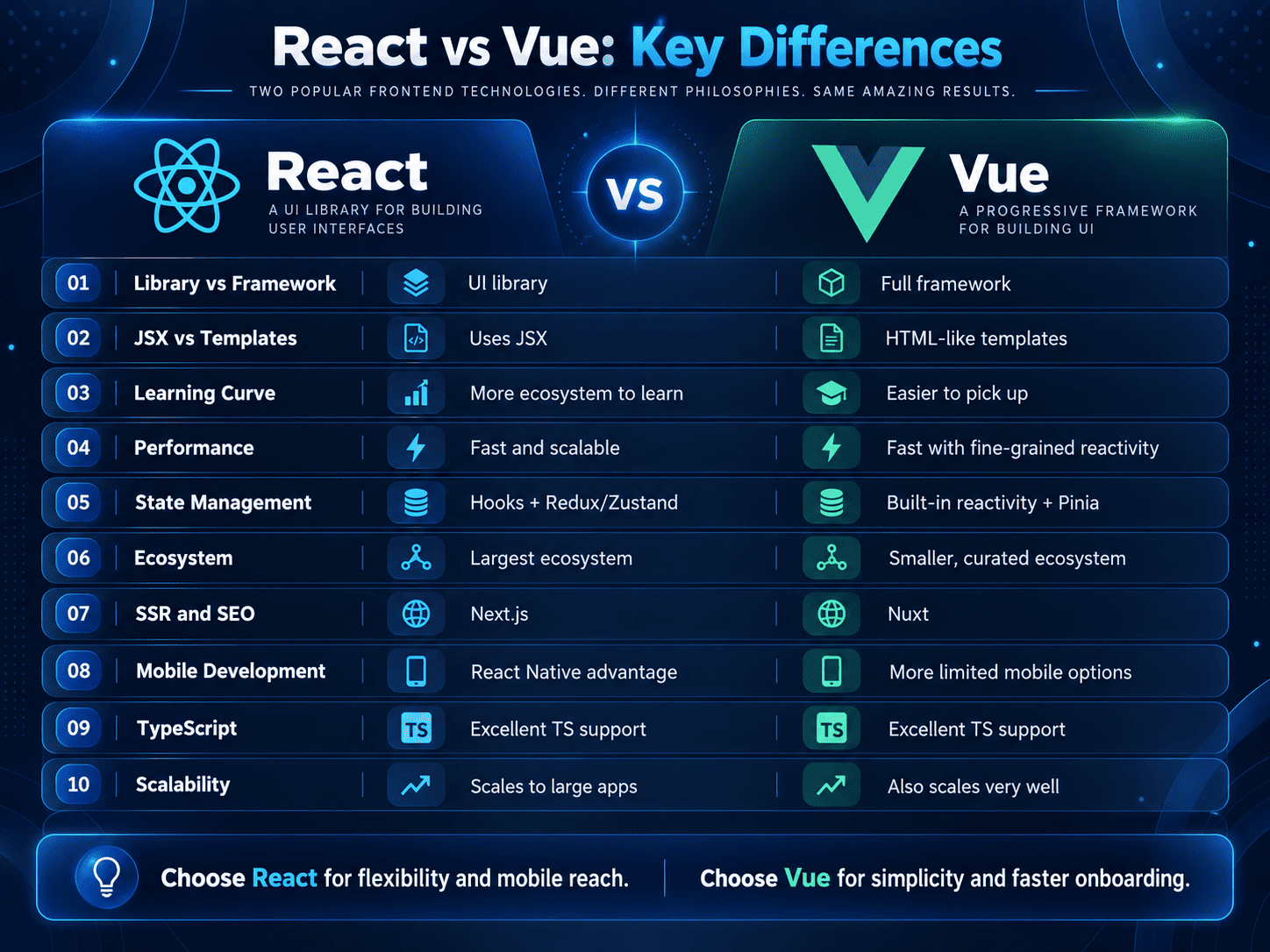
1. Library vs Framework
React is a library focused on the UI, so you assemble the rest yourself. Vue is a framework with official answers for routing, state, and tooling. If your team likes to choose every piece, React fits. If you’d rather start with sensible defaults, Vue does.
2. JSX vs Templates
React uses JSX, which mixes markup into JavaScript. Vue uses HTML-like templates with simple directives such as v-if and v-for. Designers and developers with an HTML background usually pick up Vue templates faster.
3. Learning Curve
Vue is generally easier to learn. Its docs walk you from a single script tag to a full app, and the core team’s official libraries remove a lot of decision-making. React itself is small, but learning hooks, effects, and the surrounding ecosystem takes longer.
4. Performance
For most real projects, the performance difference between React and Vue is too small to notice. Both use efficient rendering, both support lazy loading and code splitting, and both can be fast or slow depending on how they’re built. Vue’s fine-grained reactivity often means fewer unnecessary re-renders by default, while React relies on its compiler and memoization. Pick on fit, not benchmarks.
5. State Management
Vue ships with built-in reactivity, and Pinia is the official store for larger apps. React offers built-in hooks like useState and useContext, with libraries such as Redux Toolkit, Zustand, or TanStack Query for bigger needs. More choice in React, more consistency in Vue.
6. Ecosystem and Tooling
React’s ecosystem is the largest in front-end development, with libraries, UI kits, and integrations for almost anything. Vue’s ecosystem is smaller but more curated, and its official tools work closely together. Both now use Vite as the go-to build tool for new single-page apps.
7. Server-Side Rendering and SEO
On their own, both React and Vue render in the browser, which can make SEO harder. In practice, teams use a full-stack framework for server-side rendering: Next.js for React and Nuxt for Vue. Both give you fast, search-friendly pages. If you plan to use Next.js, our team can help you hire Next.js developers who know its rendering options well.
8. Mobile App Development
This is where React pulls clearly ahead. React Native lets you build real native iOS and Android apps while sharing knowledge, and often code, with your React web app. Vue has options like Capacitor, Ionic Vue, and NativeScript-Vue, but none has React Native’s reach. If mobile is on your roadmap, our React Native app development team can build both from one skill set.
9. TypeScript Support
Both have excellent TypeScript support in 2026. React has used TypeScript heavily for years, and Vue 3 was rewritten in TypeScript, so types work smoothly in both.
10. Scalability
Both scale to very large applications. React powers many of the world’s largest web apps, and Vue runs huge production sites too. At scale, your architecture, code standards, and team structure matter far more than the framework.
React vs Vue Popularity and Job Market
React is the more widely used framework, and that gives it a clear edge in the job market and in hiring. In the Stack Overflow 2025 Developer Survey, 44.7% of developers reported extensive work with React, compared with 17.6% for Vue. Interest follows a similar pattern: 30.7% of developers said they want to work with React next year, versus 15.3% for Vue.
Satisfaction tells a different story. React is admired by 52.1% of the developers who use it, and Vue by 50.9%, so people who use Vue are almost as happy with it as React users are with theirs.
For businesses, this means React developers are generally easier to find. Vue developers are fewer, but Vue’s simpler learning curve makes it easier to train people you already have. If you’re building a React team quickly, you can also hire React developers who are ready to contribute from week one.
Vue vs React: What They Have in Common
Before choosing, it helps to know how much they share:
- Component-based architecture for reusable, testable UI pieces.
- Efficient rendering that updates only what changed.
- Strong TypeScript support.
- Mature full-stack frameworks in Next.js and Nuxt.
- Vite as a fast, modern build tool.
- Browser DevTools extensions for inspecting components and state.
- Open-source licenses and large, active communities.
When Should You Choose React or Vue?
Choose React If You:
- Need the largest pool of developers to hire from.
- Plan to build native mobile apps with React Native.
- Want access to the biggest ecosystem of libraries and UI kits.
- Are building a large, long-lived product with many teams.
- Want to use Next.js for server rendering and full-stack features.
Choose Vue If You:
- Want your team productive quickly, especially if they’re newer to JavaScript frameworks.
- Prefer official, well-integrated tools over choosing everything yourself.
- Are adding interactive features to an existing site or server-rendered app.
- Work in a Laravel or PHP environment, where Vue has long been a popular pairing.
- Want clean, readable templates that designers can follow.
React vs Vue by Project Type
| Your Project | Better Fit | Why |
| Startup MVP with a small team | Vue or React | Vue for speed of learning, React if you’re hiring fast |
| Enterprise app with many teams | React | Bigger talent pool and ecosystem |
| Web app plus native mobile app | React | React Native shares skills and code |
| Adding interactivity to an existing site | Vue | Can be dropped into any page progressively |
| SEO-heavy marketing or content site | Either | Next.js and Nuxt both handle SEO well |
| Laravel or PHP backend | Vue | Long-standing, well-supported pairing |
| Large SaaS dashboard | Either | Choose based on team skills |
React and Vue With a CMS
Many sites need a content management system alongside the front end. Both frameworks work well with headless CMS platforms that deliver content through APIs.
Vue.js CMS options include Nuxt Content for file-based content inside Nuxt apps, Directus, whose admin app is built with Vue, and Storyblok, which offers a Vue SDK and visual editing. React teams commonly pair Next.js with Sanity, Contentful, or Strapi, whose admin panel is built with React. Most headless CMS platforms support both frameworks, so your CMS choice rarely forces your framework choice.
Still on Vue 2? Plan Your Upgrade
If your app runs on Vue 2, it’s time to plan a move. Vue 2 reached end of life on December 31, 2023, so it no longer receives regular updates or security fixes. The good news is that you have options: upgrade to Vue 3, which is the smoothest path for most teams, or treat the upgrade as a chance to rethink your stack.
The same is true for older React apps still built on Create React App. Moving to Vite or Next.js is worth planning now.
Open Source, Architecture, and the Bigger Picture
React and Vue are both open source, which keeps costs low but means you need to track dependencies and licenses carefully. Our guide to open source web application development covers how to do that safely.
The front end is also only half the decision. If you’re building a SaaS product, how you separate customer data matters just as much, and our comparison of multi-tenant vs single-tenant SaaS explains the trade-offs.
For the server side, our guide to the best backend frameworks in 2026 compares Node.js, Django, Laravel, and more.
Conclusion
Vue vs React isn’t really a fight with one winner. React gives you the biggest ecosystem, the largest hiring pool, and a direct path to native mobile. Vue gives you faster onboarding, cleaner defaults, and a framework your team can be productive in quickly. Look at your team’s skills, your mobile plans, and how much structure you want, and the right choice usually becomes obvious.
Not sure which one fits your next project? Book a free consultation with The Apps Developers, and we’ll recommend the right front-end stack for your product, team, and timeline.
Frequently Asked Questions
Is React better than Vue?
Neither is better for every project. React is better for large teams, hiring, and native mobile with React Native. Vue is better for faster onboarding, built-in tooling, and adding features to existing sites.
Is Vue easier to learn than React?
Yes, for most people. Vue’s HTML-based templates, official libraries, and clear documentation make it easier to start with, while React requires learning JSX, hooks, and more ecosystem choices.
Is React faster than Vue?
For most real-world apps, the speed difference between React and Vue is negligible. Both render efficiently, and performance depends far more on how the app is built than on the framework.
What does the React vs Vue job market look like in 2026?
React has the larger job market. In the Stack Overflow 2025 Developer Survey, 44.7% of developers used React compared with 17.6% for Vue, so React developers are easier to hire.
Which is better for SEO, React or Vue?
Both are equally good for SEO when paired with a server-rendering framework. Use Next.js with React or Nuxt with Vue to deliver fast, search-friendly pages.
Should I learn React or Vue in 2026?
Learn React if you want the most job opportunities and plan to build mobile apps too. Learn Vue if you want a faster start and work with Laravel or teams that already use Vue.
Is Vue still worth using in 2026?
Yes. Vue is actively maintained, widely used in production, and admired by about half of the developers who use it, nearly matching React’s satisfaction score.
Can I switch from Vue to React later?
Yes, but it usually means rewriting components, since the two use different syntax and patterns. It’s cheaper to choose carefully at the start, based on your team and roadmap.