
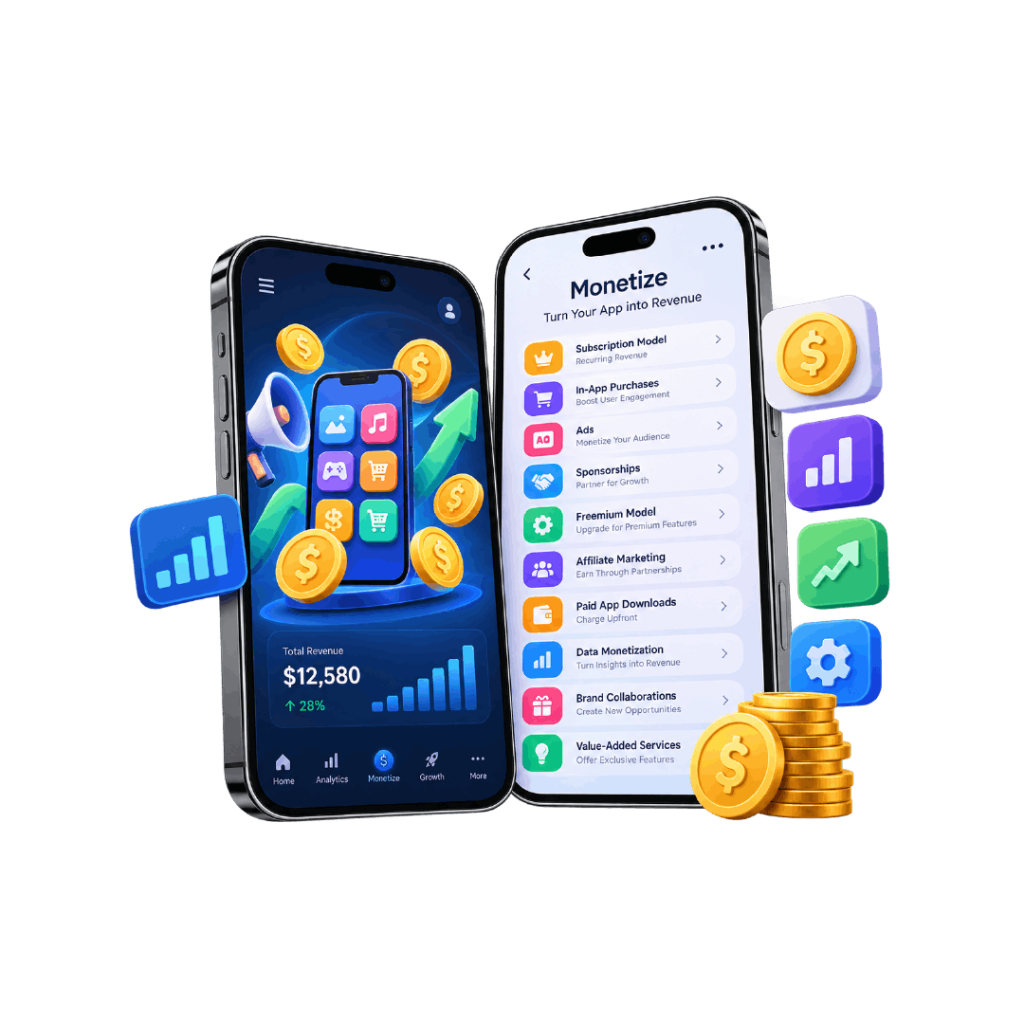
The most effective mobile app monetization strategies in 2026 include subscriptions, in-app purchases, advertising, freemium plans, transaction fees, affiliate partnerships, paid downloads, sponsorships, and hybrid revenue models. The right approach depends on your app type, audience, engagement level, and the value users receive.
Building an app is only half the challenge. The bigger question for many businesses is how that app will generate sustainable revenue.
A good monetization strategy should make money without making the product frustrating to use. That means choosing a model that fits how users interact with the app rather than simply adding ads or placing every feature behind a paywall.
Recent industry guidance continues to emphasize subscriptions, freemium models, advertising, and hybrid monetization while highlighting the importance of retention and user experience.
If you’re still planning the product itself, professional mobile app development services can help you build monetization into the product architecture from the beginning.
What Is Mobile App Monetization?
Mobile app monetization is the process of generating revenue from an application through methods such as subscriptions, purchases, advertising, commissions, or paid access.
The right model depends on:
- App category
- Target audience
- User engagement
- Free versus premium features
- Purchase frequency
- Operating costs
Here are 10 practical ways to monetize a mobile app.
1. Subscription Model
Subscriptions generate recurring revenue by charging users monthly, annually, or according to another billing period.
This model works particularly well for:
- Fitness apps
- Education apps
- Productivity tools
- Streaming platforms
- SaaS applications
- AI applications
The key is recurring value. Apple defines auto-renewable subscriptions as purchases that provide ongoing access to content, features, or services, while Google similarly requires subscription benefits to provide sustained or recurring value. (Apple Developer)
For businesses considering subscriptions, our guide to in-app purchases and subscription implementation covers the technical side of billing and renewal logic.
2. Freemium Model
The freemium model gives users free access to core functionality while charging for advanced features.
For example:
Free: Basic features
Premium: Advanced tools, higher limits, or additional functionality
Freemium works because users can experience the product before deciding whether premium features are worth paying for.
The challenge is finding the right balance. If the free version is too limited, users may leave. If it offers too much, there may be little reason to upgrade.
3. In-App Purchases
In-app purchases allow users to buy digital products, features, virtual goods, or additional functionality.
Examples include:
- Game items
- Premium content
- Virtual currency
- Extra features
- Digital services
Apple supports consumable, non-consumable, and subscription-based in-app purchases, while Google Play supports one-time products and subscriptions. (Apple Developer)
This model is particularly effective for gaming, entertainment, education, and productivity applications.
4. In-App Advertising
Advertising is one of the most established mobile app monetization strategies.
Common formats include:
- Banner ads
- Interstitial ads
- Rewarded ads
- Native ads
- Video ads
Advertising works best when an app has significant usage volume.
However, placing too many advertisements can damage retention. The objective should be to generate advertising revenue without interrupting important user journeys.
5. Transaction Fees
Marketplace and service apps can charge a percentage or fixed fee for transactions completed through the platform.
Examples include:
- Food delivery
- Booking platforms
- Marketplaces
- Freelance platforms
- Ticketing applications
The advantage is that revenue can grow alongside transaction volume rather than requiring every user to purchase a subscription.
6. Affiliate Marketing
Affiliate monetization involves earning a commission when users purchase products or services through your app.
This can work well for:
- Shopping apps
- Travel applications
- Finance platforms
- Product discovery apps
- Review platforms
The important factor is relevance. Promoted products should naturally fit the app’s audience.
7. Paid App Downloads
A paid app charges users before they can download or access the application.
This model is less flexible than freemium or subscription approaches but can still work when the application provides clear value from the beginning.
It can be suitable for:
- Professional tools
- Specialized utilities
- Premium productivity applications
- Niche software
Before choosing this approach, businesses should consider whether requiring payment upfront could reduce user acquisition.
8. Sponsorships and Brand Partnerships
Apps with a defined audience can generate revenue through sponsorships.
For example, a fitness app could partner with:
- Sports brands
- Nutrition companies
- Fitness equipment businesses
A dating or lifestyle application could collaborate with relevant consumer brands.
The partnership should enhance the product rather than feel like unrelated advertising.
9. Data and Insights
Some businesses generate revenue from aggregated, privacy-conscious insights.
This approach requires careful attention to:
- Privacy
- Consent
- Data protection
- Applicable regulations
- Transparency
Personal information should not be treated as a monetization shortcut. Any data strategy needs to be designed around applicable laws and platform requirements.
10. Hybrid Monetization
Hybrid monetization combines multiple revenue models within the same application.
For example:
App Model | Possible Revenue Sources |
Fitness App | Subscription + affiliate |
Gaming App | Ads + in-app purchases |
Marketplace | Transaction fees + subscriptions |
SaaS App | Freemium + subscription |
Content App | Ads + premium subscription |
For many products, a hybrid model can provide more flexibility than relying entirely on one revenue stream.
The important point is not to add every possible monetization method. Each revenue stream should have a clear purpose.
How to Choose the Right App Monetization Strategy
Start with your users rather than your revenue target.
Ask:
- How frequently do users use the app?
- What problem does the app solve?
- Does the app provide recurring value?
- Are users willing to pay for advanced features?
- Does advertising fit the user experience?
- Does the platform facilitate transactions?
For example, a productivity app may benefit from subscriptions, while a high-traffic content application may be better suited to advertising.
If you’re still validating the product, an MVP development approach can help you test user behavior before investing heavily in advanced monetization features.
Monetization Should Be Part of App Development
Monetization should not be treated as something added immediately before launch.
Payment flows, subscriptions, entitlements, advertising, analytics, and user access controls can affect the application’s backend and product architecture.
That is why revenue planning should happen during the mobile app development process.
You should also account for platform fees and billing requirements when calculating expected revenue. Apple and Google both publish specific rules and fee structures that can affect digital purchases and subscriptions. (Apple Developer)
How to Improve Mobile App Revenue
Choosing a monetization model is only the beginning.
Track metrics such as:
- Conversion rate
- Average revenue per user
- Customer lifetime value
- Subscription retention
- Churn
- Trial-to-paid conversion
- Ad revenue per user
The goal is to understand whether monetization is creating sustainable revenue without reducing retention.
Our mobile app revenue optimization guide covers how monetization decisions can be evaluated alongside engagement and retention.
Conclusion
Successful mobile app monetization strategies start with understanding what users value and how they naturally interact with the product.
Subscriptions, freemium plans, in-app purchases, advertising, transaction fees, affiliate revenue, sponsorships, and hybrid models can all work when matched with the right audience and business model.
The most important decision is not simply how much revenue an app can generate. It is whether the monetization model can generate revenue while giving users a reason to keep using the app.
If you’re planning an app and need help deciding how monetization should fit into its product architecture, The Apps Developers can help you plan and build the right solution from the beginning.
Frequently Asked Questions
What is the best way to monetize a mobile app?
There is no single best model. Subscriptions work well for recurring-value products, while ads, in-app purchases, transaction fees, and hybrid models can suit different app categories.
Can a free app make money?
Yes. Free apps can generate revenue through advertising, subscriptions, premium upgrades, affiliate partnerships, transactions, or in-app purchases.
Are subscriptions good for mobile apps?
Subscriptions can work well when an app continuously provides valuable content, features, or services. Both Apple and Google require subscription offerings to be clearly presented to users.
How can I monetize an app without ads?
You can use subscriptions, in-app purchases, paid downloads, transaction fees, affiliate partnerships, sponsorships, or premium upgrades.
Should an app use multiple monetization models?
A hybrid model can work well when each revenue stream fits the product and user experience. However, adding too many monetization methods can make the app confusing.