Game app development is the process of designing, building, and launching interactive games for mobile, web, or other platforms, covering everything from concept and game engine selection through development, testing, and post-launch monetization. For businesses, it ranges from a simple branded mini-game built for marketing to a full commercial mobile game built as its own standalone product.
Mobile gaming alone is projected to generate roughly 107 billion dollars in 2026, representing just over half of total global gaming industry revenue, according to Newzoo’s market research. That scale is exactly why more businesses, not just traditional game studios, are exploring game app development, whether as a direct product, a marketing tool, or a gamified layer added to an existing app. This guide covers what businesses actually need to know before starting, as part of the same Mobile App Development process that game development ultimately falls under from a technical standpoint.
What Is Game App Development?
Game app development is the technical and creative process of building an interactive game application, involving game design, engine selection, programming, art and UI/UX design, and testing, distinct from general app development primarily in its heavier emphasis on real-time performance, graphics rendering, and player engagement mechanics. A standard business app is usually built around completing tasks efficiently. A game is built around holding attention and creating an engaging, often deliberately extended, experience, which shapes nearly every technical and design decision differently.
Why Businesses Are Investing in Game App Development
Beyond the traditional game studio market, businesses across many industries are building games for reasons that have little to do with becoming a gaming company. Branded games extend marketing campaigns into something genuinely interactive rather than passive. Gamification layers added to existing apps, loyalty programs, fitness apps, educational platforms, increase engagement and retention using mechanics borrowed directly from game design. And some businesses build full commercial games as a standalone revenue line, entering a market where mobile alone now generates more revenue than console and PC combined.
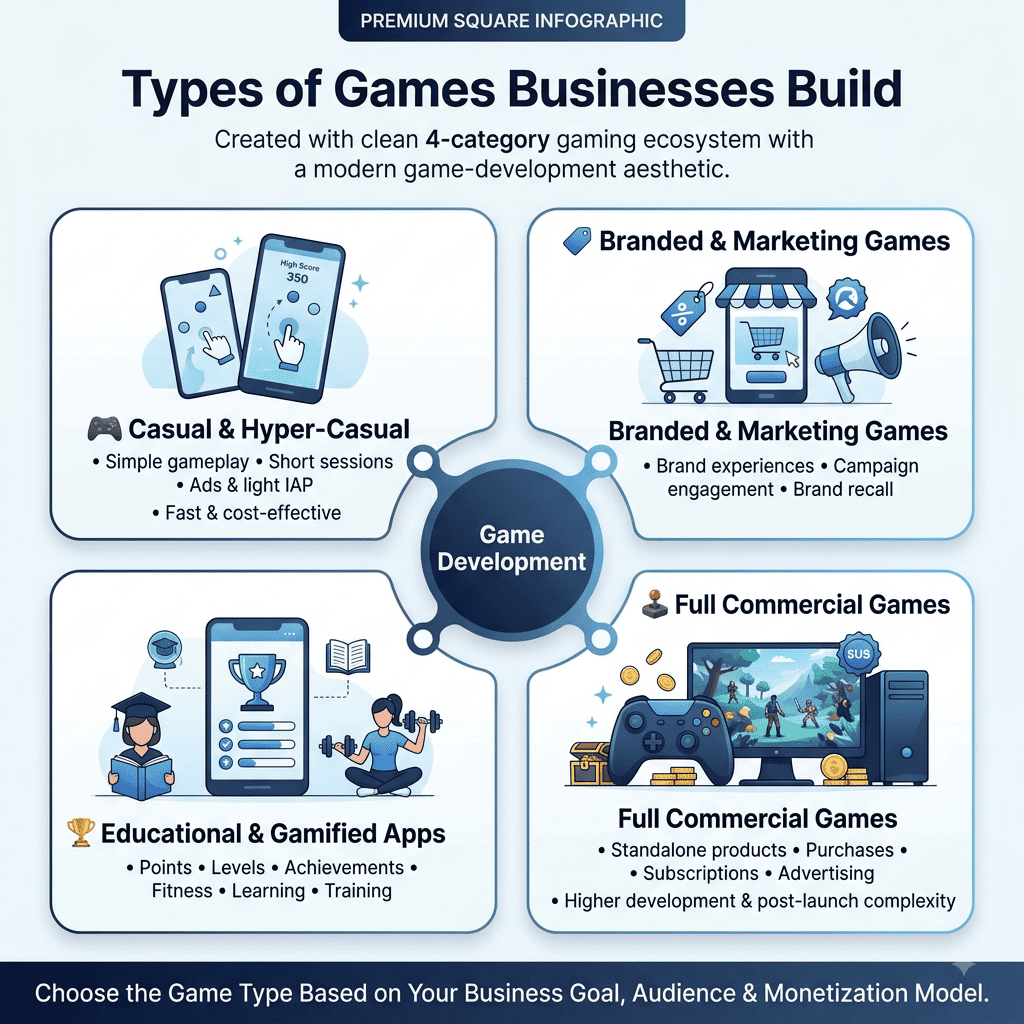
Types of Games Businesses Build
Casual and Hyper-Casual Games
Simple, easy-to-learn games with short play sessions, often free to download and monetized through ads or light in-app purchases. These are typically the fastest and least expensive to build, making them a common entry point for businesses testing the category.
Branded and Marketing Games
Games built specifically to extend a marketing campaign or brand experience, often simpler in scope than a commercial game since the goal is engagement and brand recall rather than long-term monetization.
Educational and Gamified Apps
Applications that use game mechanics, points, levels, achievements, to make a non-gaming product more engaging, common in fitness, language learning, and corporate training contexts, where the core product isn’t a game but benefits from game-like engagement patterns.
Full Commercial Games
Standalone games built as their own product, monetized directly through purchases, subscriptions, or advertising, and generally the most involved category in terms of both development scope and ongoing post-launch operations.
Team Composition for a Game App Development Project
A game project typically requires a broader mix of specialized roles than a standard app, which affects both cost and timeline planning. Game designers define mechanics, progression, and balance, a discipline distinct from UI/UX design even though the two overlap closely. Programmers implement gameplay logic, often with more real-time performance constraints than typical app development demands. Artists and animators produce the visual assets a game depends on far more heavily than most business apps require. Sound designers and composers contribute audio that meaningfully affects player experience and immersion. And for commercial games specifically, a live operations role often becomes necessary post-launch, monitoring player behavior and managing ongoing content and balance updates. Not every project needs every role at full-time capacity, but understanding the full team shape helps set realistic expectations before scoping begins.
Choosing a Game Engine: Unity vs. Unreal Engine
The game engine decision shapes nearly everything downstream, and it’s worth understanding the real tradeoffs rather than defaulting to whichever name is more familiar.
| Factor | Unity | Unreal Engine |
| Best fit | Mobile, casual, and cross-platform games | High-fidelity, graphics-intensive games |
| Learning curve | Generally gentler, large community and asset store | Steeper, more powerful for complex visuals |
| Mobile performance | Strong, widely used for mobile-first titles | Capable but often heavier for mobile constraints |
| Visual fidelity ceiling | Good, improving steadily | Very high, industry standard for AAA-level graphics |
| Typical use case | Most mobile and casual/mid-core games | Console, PC, and visually ambitious mobile titles |
Unity’s own platform remains the dominant choice for most mobile game development specifically, given its lighter performance footprint on mobile hardware and its large existing ecosystem of tools and assets.
Unreal Engine, built by Epic Games, is the stronger choice when visual fidelity is a genuine priority and the target platform can support its heavier performance demands, more common in console and PC titles, or ambitious, graphics-forward mobile games specifically.
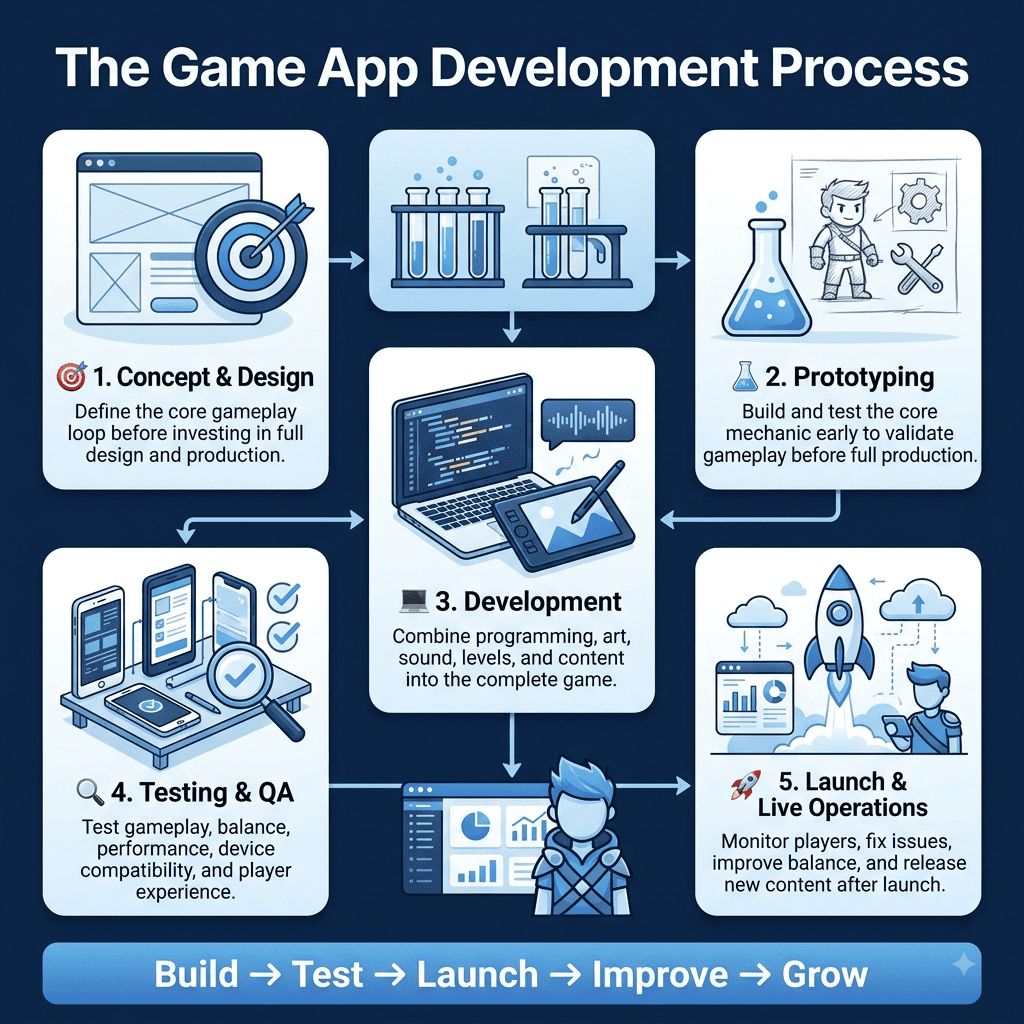
The Game App Development Process
Concept and Design
Defining the core gameplay loop, the single mechanic a player repeats and finds engaging, before any other design work begins, since a weak core loop rarely gets rescued by good art or polish added later.
Prototyping
Building a rough, functional version of the core mechanic early, to validate that the actual gameplay is fun before investing in full art, sound, and content production around it.
Development
The main build phase, where programming, art, sound, and level or content design come together, typically the longest phase and the one most sensitive to scope discipline, similar to any complex software project.
Testing and QA
Game testing carries specific demands beyond standard software QA, covering gameplay balance, performance across a wide range of devices, and genuine player experience testing, not just functional correctness.
Launch and Live Operations
For most commercial games, launch is the beginning of ongoing work, not the end, monitoring player behavior, patching balance issues, and often releasing new content to sustain engagement and monetization over time.
Monetization Models at a Glance
Free-to-play with in-app purchases is the dominant model across mobile gaming, letting players download at no cost while monetizing through optional purchases, cosmetics, currency, or progression boosts. Ad-supported monetization works well for casual and hyper-casual games with shorter play sessions and broad, high-volume audiences. Premium, pay-upfront pricing remains viable for certain genres, particularly on platforms or audiences less accustomed to free-to-play norms. And subscription models are growing steadily, offering recurring revenue in exchange for ad removal, exclusive content, or bundled access across a developer’s game catalog.
Platform Considerations: iOS, Android, or Both
Most commercial mobile games launch on both iOS and Android eventually, but the right starting point depends on the target audience and monetization model. iOS users historically show higher average revenue per user for in-app purchases in many markets, making it a common first-launch choice for premium or heavily monetized titles. Android’s larger global install base often makes it the stronger choice for ad-supported, high-volume casual games where reach matters more than per-user spend. Building with a cross-platform-capable engine like Unity from the start keeps this decision from becoming a hard fork later, letting a team launch on one platform first while keeping the door open to the other without a costly separate build.
What Game Development Shares With Standard App Development
Despite real technical differences, game development shares core disciplines with any serious Mobile App Development project.
Our mobile app development process guide covers the planning, testing, and iteration discipline that applies just as directly to a game as to any other app, even though the specific deliverables, gameplay mechanics rather than business logic, differ.
Budgeting realistically also follows similar patterns to those covered in our mobile app development cost guide, complexity, platform coverage, and integration requirements all drive cost in games the same way they do in any other app category.
Discoverability: Game Apps and App Store Optimization
A well-built game still needs to be found, and app store visibility works somewhat differently for games than for utility apps, given how crowded and competitive gaming categories are on both major app stores. Our app store optimization guide covers the fundamentals that apply directly to a game listing too, keyword-optimized titles and descriptions, compelling screenshots and preview videos, and a review and rating strategy, all of which matter even more in gaming categories where competition for attention is especially intense.
Common Mistakes in Game App Development
Businesses frequently underestimate how different game development actually is from standard app development, treating it as a simple feature-list project rather than a discipline requiring genuine game design expertise around fun, pacing, and player psychology, skills that don’t automatically come bundled with general software development experience. Choosing a game engine based on familiarity rather than fit, using Unreal Engine’s heavier footprint for a simple mobile casual game, or Unity where Unreal’s visual fidelity was actually the point, adds unnecessary cost or limits the final result.
Skipping genuine playtesting with real target players, relying only on internal team feedback, tends to miss the balance and engagement issues that only surface with people who have no stake in the game succeeding and no context that makes a confusing mechanic feel obvious. And treating launch as the finish line rather than the start of ongoing live operations leaves many commercial games without the post-launch support that player retention and monetization actually depend on, a mistake that shows up clearly in the gap between games that sustain an audience and ones that see a brief spike in downloads before fading entirely.
How The Apps Developers Approaches Game App Development
We scope game projects around the same disciplined process behind any Mobile App Development build, matched to the specific demands game development adds, engine selection, performance optimization, and genuine playtesting, rather than treating a game as a standard app with different graphics.
Design work receives particular attention given how directly it shapes player engagement, since the discipline behind creating a genuinely engaging interactive experience is a specialized skill within UI/UX design, not simply an extension of standard app interface design.
If you’re exploring game app development for your business, whether a branded marketing game, a gamified feature, or a full commercial title, that’s worth a direct conversation about what your specific goals actually require. You’re welcome to talk to our team about what a properly scoped game development project would look like for your idea.
Frequently Asked Questions
What's the difference between game app development and regular app development?
Game development places much heavier emphasis on real-time performance, graphics rendering, and player engagement mechanics like game design and balance, while standard app development typically prioritizes task completion and information flow. Both share planning, testing, and iteration disciplines, but games require specialized skills around fun and player psychology that standard app development doesn’t.
Should I use Unity or Unreal Engine for my game?
Unity is generally the stronger choice for mobile, casual, and cross-platform games given its lighter performance footprint and large ecosystem. Unreal Engine suits projects where visual fidelity is a genuine priority and the target platform can support its heavier performance demands, more common in console, PC, or visually ambitious mobile titles.
What types of games do businesses typically build?
Common categories include casual and hyper-casual games for broad, low-friction engagement, branded marketing games tied to a campaign, gamified features added to existing non-gaming apps, and full commercial games built as a standalone product and revenue line.
How is a game monetized?
Common models include free-to-play with in-app purchases, the dominant approach in mobile gaming, ad-supported monetization for casual titles with high download volume, premium upfront pricing for certain genres and platforms, and subscription models offering recurring revenue for ad removal or exclusive content.
Does game app development cost more than regular app development?
It often does, particularly for graphics-intensive or feature-rich games, since game development typically requires specialized art, sound, and game design work beyond standard app development, along with more extensive device-performance testing across a wide range of hardware.
What roles are typically needed for a game development project?
A full game team often includes game designers, programmers, artists and animators, sound designers, and for commercial games, a live operations role for post-launch support. Not every project needs every role at full capacity, but understanding the full scope helps set realistic budget and timeline expectations.
Can an existing business app be gamified without building a full separate game?
Yes, and this is a common, lower-risk starting point. Adding game mechanics like points, levels, streaks, or achievements to an existing app’s engagement or loyalty features borrows proven game design principles without the scope of building and launching a standalone game.