


In 2026, automotive app development cost typically ranges from $25,000 to $300,000+, while enterprise connected vehicle platforms with telematics, fleet management, AI, IoT, multiple user panels, or deep vehicle integrations can exceed $500,000. If you are already evaluating a real project, our Automotive App Development services can help you scope the vehicle data, integrations, platforms, backend infrastructure, and features that determine where your project actually falls within that range.
There is a reason automotive pricing varies so much.
A dealership service booking app and a connected fleet platform may both be called “automotive apps,” but technically they have very little in common. One might need customer accounts, appointment scheduling, payments, and notifications. The other may need continuous GPS data, vehicle diagnostics, OBD II connectivity, driver behavior monitoring, geofencing, cloud infrastructure, dispatch tools, and integrations with existing fleet systems.
That difference can move a project from $40,000 to well beyond $250,000.
For context, Clutch’s September 2026 app pricing data shows that most reviewed mobile app projects fall between $10,000 and $49,999, while the average project in its dataset is approximately $90,780. Automotive applications frequently move beyond those general averages because of real time data, integrations, hardware connectivity, security, and testing requirements.
This guide breaks down what you can realistically expect to spend, which features increase the budget, how different types of automotive apps compare, and where companies can reduce cost without creating expensive technical problems later.
Automotive App Development Cost at a Glance
For most buyers, the easiest way to estimate automotive app development cost is to start with complexity rather than counting screens.
| Automotive App Complexity | Typical Scope | Estimated Development Cost | Typical Timeline |
| Basic automotive MVP | Customer accounts, booking, vehicle records, notifications, basic admin | $25,000 to $60,000 | 2 to 4 months |
| Medium complexity automotive app | GPS, maps, payments, dashboards, APIs, multiple roles | $60,000 to $120,000 | 4 to 7 months |
| Advanced automotive platform | Telematics, fleet tools, OBD II, IoT, analytics, real time data | $120,000 to $250,000 | 6 to 10 months |
| Enterprise connected vehicle platform | AI, predictive maintenance, multiple fleets, OEM integrations, advanced cloud infrastructure | $250,000 to $500,000+ | 9 to 18+ months |
These numbers should be treated as budgeting ranges rather than fixed quotes.
A project with only eight mobile screens can still be expensive if each screen depends on live vehicle data coming from several different systems. At the same time, an app with thirty relatively simple screens can be cheaper when its backend and integrations are straightforward.
That is why a serious automotive development estimate should begin with architecture and data requirements, not just UI mockups.
What Is Automotive App Development?
Automotive App Development is the process of designing, engineering, integrating, testing, and maintaining software applications for drivers, vehicle owners, dealerships, fleets, mobility businesses, EV networks, and connected vehicles.
The category includes far more than consumer mobile applications.
Automotive software can include driver apps, fleet manager dashboards, dealership platforms, vehicle marketplaces, car rental systems, service booking applications, connected car platforms, EV charging applications, vehicle diagnostic tools, telematics systems, and applications built for in vehicle environments.
Some products primarily connect people with automotive businesses.
Others connect directly with vehicles.
That distinction matters because connecting software to a car introduces additional engineering work around connectivity, latency, hardware compatibility, permissions, safety, security, and data reliability.
Those requirements are some of the biggest reasons automotive app development cost can rise faster than the cost of a standard consumer app.
How Much Does It Cost to Develop Different Types of Automotive Apps?
The type of product you are building is one of the fastest ways to narrow your budget.
Car Dealership App Development Cost
A dealership app typically costs around $30,000 to $100,000, depending on how much of the sales and service journey needs to happen inside the application.
A simple version might allow customers to browse vehicles, request a test drive, schedule maintenance, contact the dealership, and receive notifications.
A more advanced dealership platform may include live inventory synchronization, CRM integration, financing applications, customer accounts, trade in workflows, document uploads, service history, loyalty features, online payments, and an administrative portal.
The CRM and dealership management system integrations usually matter more to the final cost than the vehicle listing interface itself.
If inventory data already exists inside an accessible API, integration may be relatively straightforward.
If the development team has to connect with an old dealership system using limited documentation or custom middleware, the integration workload can grow significantly.
Fleet Management App Development Cost
Fleet management app development cost typically ranges from $50,000 to $250,000+, depending on fleet size, data sources, tracking frequency, analytics, integrations, and automation requirements.
A basic fleet solution may provide:
- Vehicle locations
- Driver profiles
- Trip history
- Maintenance reminders
- Push notifications
- Basic reporting
A more advanced fleet management system can include dispatch management, geofencing, fuel monitoring, route optimization, vehicle diagnostics, driver behavior scores, ELD integrations, maintenance forecasting, asset tracking, incident management, and multi region analytics.
The architecture also becomes more expensive as the fleet grows.
Tracking 25 vehicles every few minutes is a different infrastructure problem from processing live telemetry from 20,000 vehicles while operations teams expect dashboards to update almost immediately.
For that reason, fleet management software should be scoped as an operational platform rather than simply a map inside a mobile app.
Connected Car App Development Cost
Connected car app development cost generally starts around $75,000 and can exceed $300,000 when the application communicates deeply with vehicle systems or OEM infrastructure.
Connected car applications can enable drivers to view vehicle status, find their car, check battery or fuel information, receive maintenance alerts, lock or unlock doors, start climate controls, review journeys, monitor charging, or access diagnostic information.
The visible mobile experience may seem simple.
The system underneath it is not.
Secure commands must move between the phone, cloud platform, connected vehicle services, and sometimes embedded vehicle systems. Authentication, response handling, offline behavior, latency, permissions, and failure states all need careful engineering.
A command that takes a few extra seconds to load in a shopping app may be annoying.
A vehicle command that fails without clearly telling the driver what happened is a much bigger product problem.
This is where experienced API and Backend Development becomes a major part of the automotive development budget. The mobile interface is only one layer of the system.
Telematics App Development Cost
Telematics app development cost commonly falls between $80,000 and $250,000+, depending on data volume, hardware, protocols, reporting requirements, and integrations.
Telematics platforms collect and process information such as:
- Vehicle position
- Speed
- Mileage
- Fuel consumption
- Engine conditions
- Diagnostic trouble codes
- Driver behavior
- Idling
- Battery health
- Trip history
The difficult part is rarely displaying those values.
The difficult part is reliably receiving, processing, storing, analyzing, and serving data from vehicles at scale.
A business that already has a mature telematics provider with a stable API will usually spend less than a company building custom hardware connectivity and data infrastructure from the ground up.
EV Charging App Development Cost
EV charging app development cost generally ranges from $40,000 to $250,000+ in 2026, depending on whether you need a simple station locator or a complete charging network platform.
A lightweight EV application might provide nearby charger discovery, availability information, navigation, user accounts, and basic session history.
A commercial charging platform can require charger communication, live availability, reservations, pricing rules, session start and stop, billing, wallets, roaming, fleet accounts, admin dashboards, energy monitoring, notifications, and smart charging logic.
If the product communicates directly with charging hardware or other connected devices, our IoT App Development services provide the architecture required to connect applications, devices, cloud infrastructure, and real time data reliably.
This is where EV charging software stops being “just another mobile app.”
It becomes a connected infrastructure product.
What Factors Affect Automotive App Development Cost?
The final number is usually determined by a combination of eight major variables.
1. Automotive App Features
Every feature has to be designed, developed, tested, secured, and supported.
A login screen is relatively inexpensive.
Live vehicle tracking is not.
Predictive maintenance using years of sensor data is substantially more complex again.
Here is how common automotive app features can affect development effort.
| Feature | Relative Cost Impact |
| User registration and profiles | Low |
| Vehicle profiles | Low |
| Service booking | Low to medium |
| Push notifications | Low |
| Payment integration | Medium |
| Vehicle marketplace | Medium |
| GPS and map integration | Medium |
| Live vehicle tracking | Medium to high |
| Geofencing | Medium to high |
| Driver behavior monitoring | High |
| OBD II integration | High |
| Telematics integration | High |
| EV charging integration | High |
| Route optimization | High |
| Voice interaction | High |
| Predictive maintenance | Very high |
| AI fleet analytics | Very high |
| OEM vehicle integration | Very high |
The biggest mistake businesses make is adding features because competitors have them rather than because users actually need them.
Every unnecessary feature increases the initial development budget and becomes another feature your company has to maintain indefinitely.
2. Vehicle Data and Telematics Integration
For many automotive products, this is the single biggest cost driver.
You need to know:
- Where the vehicle data comes from
- How frequently it updates
- Whether the provider has an API
- How stable that API is
- Whether historical data must be stored
- How many vehicles will send information
- Whether commands need to be sent back to the vehicle
- How the application behaves when connectivity disappears
An automotive app connected to a well documented telematics API can be significantly easier to build than one interacting with custom hardware or legacy systems.
At The Apps Developers, this is why automotive architecture is scoped around the data layer before the interface. A beautiful dashboard cannot compensate for unreliable vehicle data.
3. Native vs Cross Platform Automotive App Development
Platform strategy also affects automotive mobile app development cost.
For a dealership marketplace, booking product, or simple fleet companion app, Flutter or React Native may allow much of the iOS and Android experience to share one codebase.
Automotive apps requiring deeper Bluetooth access, extensive background processing, platform specific vehicle frameworks, or advanced in-car integrations may require more native engineering.
Our guide to Native vs Cross Platform app development explains the broader cost tradeoff.
For automotive products, however, the decision should never be made purely because cross platform development appears cheaper.
If engineers spend months building native workarounds around a framework that does not fit your vehicle integration requirements, the cheaper architecture quickly becomes the expensive one.
Platform and In Vehicle Integration Costs
Automotive development can target several very different environments.
Android Automotive App Development Cost
Android Auto and Android Automotive OS are not the same product.
Android Auto projects an experience from a user’s phone to the vehicle display. Android Automotive OS runs as part of the vehicle’s operating environment.
Google provides the Android for Cars App Library for supported categories and uses vehicle optimized templates designed around driver distraction requirements and different screen and input environments.
That means development teams cannot simply take an existing phone interface, stretch it across a dashboard display, and call the work finished.
Platform requirements must be included in design, development, testing, and release planning.
CarPlay App Development Cost
Apple CarPlay introduces its own frameworks, templates, supported categories, testing, entitlement requirements, and App Store considerations.
Apple specifically provides system controlled templates for CarPlay interfaces so developers can create experiences appropriate for use inside vehicles.
CarPlay applications may therefore require additional product planning and testing beyond the standard iPhone version of the application.
If your project supports both Android based vehicle environments and CarPlay, budget for the platform specific work rather than assuming one implementation automatically covers both ecosystems.
4. Backend Development
The backend is where a large percentage of serious automotive application complexity lives.
A production automotive backend might handle:
- Authentication
- Vehicle data ingestion
- Driver profiles
- Real time messaging
- Maps and location data
- Trip history
- Payments
- Notifications
- Reporting
- Fleet permissions
- Admin dashboards
- External API connections
- Device communication
- Analytics
- Audit logs
A consumer app serving 5,000 monthly users has different infrastructure requirements from an enterprise fleet platform receiving millions of vehicle events every day.
Your initial automotive app development cost therefore needs to account for expected scale, not just launch day traffic.
Planning the architecture correctly at the beginning is usually cheaper than rebuilding a rushed backend twelve months later.
5. UI/UX Design for Automotive Apps
UI/UX design is another part of the budget that deserves more attention than it usually gets.
Drivers, fleet managers, technicians, dealership staff, buyers, and administrators may all use the same platform in completely different ways.
The interface needs to reflect those differences.
A driver may need to understand a warning within seconds.
A fleet manager may need to compare hundreds of vehicles.
A technician may need detailed diagnostic information.
An executive may only care about operational trends.
Trying to force all four users into one generic dashboard usually creates an interface nobody enjoys using.
Our UI/UX Design services can be integrated with automotive development so workflows are validated before expensive engineering work begins.
Driver facing interfaces also need special consideration.
The National Highway Traffic Safety Administration publishes guidance addressing driver distraction associated with in vehicle electronic devices, reinforcing why automotive interface decisions cannot be treated like ordinary consumer app design.
6. Security Requirements
Automotive applications can handle sensitive data about vehicles, locations, routes, users, payments, and operational activity.
Connected car applications may also allow remote commands.
Security cannot be added at the end.
Authentication, authorization, API security, encryption, secure storage, session management, logging, privacy controls, and secure communication should be planned from architecture onward.
The OWASP Mobile Application Security Verification Standard provides security controls covering storage, cryptography, authentication, network communication, platform interaction, code quality, resilience, and privacy.
The deeper your application interacts with sensitive vehicle or customer data, the more budget should be allocated to security architecture and testing.
Skipping that work is not a realistic cost saving strategy.
It simply moves the expense to a much less convenient point in the product lifecycle.
7. Third Party Integrations
Automotive applications often depend on services outside the development team’s control.
Common integrations include mapping providers, payment processors, vehicle data platforms, CRMs, ERP systems, charging networks, insurance services, SMS platforms, email systems, analytics tools, customer support software, identity services, and cloud platforms.
Each integration introduces four separate costs.
First, it needs to be implemented.
Second, it needs to be tested.
Third, the provider may charge ongoing API or usage fees.
Fourth, somebody needs to maintain the integration when the provider changes its API.
When comparing quotes from automotive app development companies, check whether third party integrations are included or being treated as future change requests.
8. Development Team Location and Experience
Hourly rates still affect overall automotive software development cost.
Clutch’s 2026 pricing data reports a common mobile development company range of roughly $25 to $49 per hour across its reviewed providers, although rates vary substantially by region, company size, seniority, and specialist expertise.
The lowest hourly rate is not automatically the lowest project cost.
Automotive development rewards engineers who understand real time systems, mobile architecture, APIs, cloud infrastructure, IoT, vehicle connectivity, and the difference between a prototype that works in a controlled demo and a production system that works when connectivity is unreliable.
A $30 per hour team spending 5,000 hours fixing the wrong architecture is not cheaper than a $60 per hour team that gets the architecture right in 2,000.
Look at total project economics rather than the hourly rate in isolation.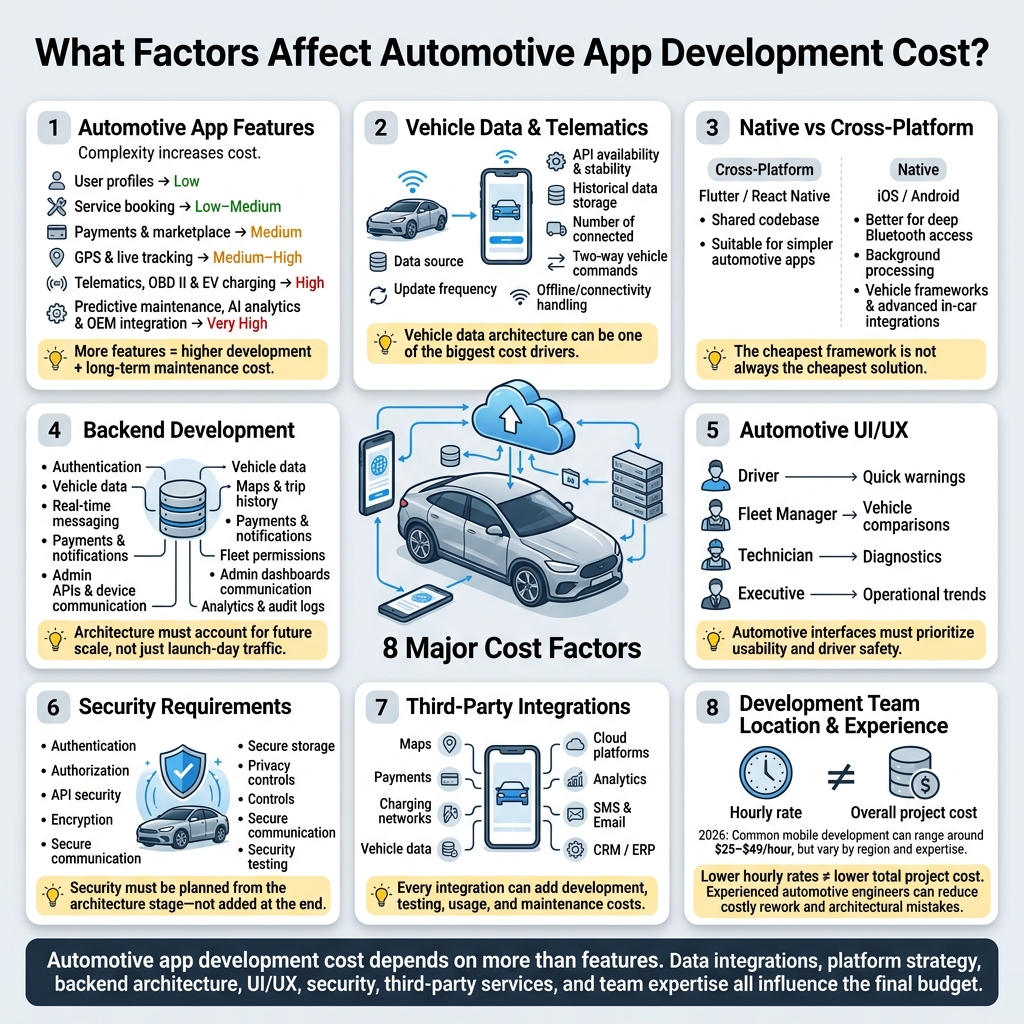
Automotive App Development Cost by Development Phase
Another way to plan the budget is by understanding where the money goes.
For a hypothetical $150,000 automotive platform, the investment might look something like this:
| Development Phase | Typical Share of Budget | Example on $150,000 Project |
| Discovery and technical planning | 5% to 10% | $7,500 to $15,000 |
| UI/UX design and prototyping | 10% to 15% | $15,000 to $22,500 |
| Mobile application development | 20% to 30% | $30,000 to $45,000 |
| Backend and database development | 20% to 30% | $30,000 to $45,000 |
| Vehicle and third party integrations | 10% to 25% | $15,000 to $37,500 |
| QA, security and performance testing | 10% to 15% | $15,000 to $22,500 |
| Deployment and launch | 3% to 5% | $4,500 to $7,500 |
These percentages overlap depending on how the project is structured, so they should be used for budget planning rather than accounting.
The important point is that mobile coding is only one part of automotive app development cost.
How Much Do AI Features Add to Automotive App Development Cost?
AI can add anywhere from $20,000 to well over $100,000 to an automotive platform depending on what the model is expected to do.
There is a major difference between calling an existing AI API and developing a proprietary predictive system using operational vehicle data.
Common automotive AI use cases include predictive maintenance, route optimization, driver risk scoring, automated claims analysis, vehicle damage recognition, conversational assistants, demand forecasting, anomaly detection, and fleet optimization.
Predictive maintenance is especially easy to underestimate.
Building an interface that says “maintenance predicted” is simple.
Developing a system that has enough high quality historical vehicle data to make that prediction trustworthy is not.
Before paying for AI, ask one question:
Do we have enough useful data to make this feature genuinely valuable?
If the answer is no, collect and structure the data first.
MVP Automotive App Development Cost
An automotive MVP typically costs $25,000 to $80,000, although telematics or hardware heavy MVPs can be higher.
The purpose of an MVP is not to produce a cheap version of the final platform.
The purpose is to validate the most important business assumption with the smallest responsible product.
For a fleet startup, the MVP might include vehicle tracking, driver accounts, trip history, alerts, and a basic manager dashboard.
For a dealership product, it might include inventory, vehicle detail pages, lead capture, appointments, and customer accounts.
For an EV startup, it might include charger discovery, real time status, navigation, and charging session management.
If you are deciding how much functionality belongs in version one, our MVP Development Cost guide provides a deeper breakdown of MVP budgeting.
The goal should be to cut optional scope.
Do not cut architecture, security, or essential testing just to make the first quote look smaller.
Native vs Cross Platform Automotive App Cost
For many businesses, the platform question can materially affect the budget.
| Approach | Development Cost | Best Fit |
| iOS only | Lower initial cost | Apple focused customer base |
| Android only | Lower initial cost | Android focused audience or specialized Android environment |
| Separate native iOS and Android apps | Highest | Deep platform functionality and maximum control |
| Flutter or React Native | Lower to medium | Standard customer and business applications |
| Cross platform plus native modules | Medium to high | Apps requiring some deeper device functionality |
A cross platform architecture can save money when most functionality is shared.
That advantage shrinks as platform specific vehicle integrations increase.
Do not choose Flutter, React Native, Swift, or Kotlin because one is fashionable.
Choose based on the data sources, device requirements, vehicle environment, expected performance, and long term roadmap.
Hidden Automotive App Development Costs Businesses Forget
The first development invoice is not the full cost of ownership.
A realistic automotive software budget should also consider several ongoing expenses.
Cloud Infrastructure
Real time vehicle applications can generate substantial backend traffic.
Storage, databases, queues, analytics, logs, maps, notifications, and monitoring all create cloud costs.
The amount depends heavily on vehicle count and event frequency.
Maps and Location APIs
Fleet tracking, charging applications, vehicle marketplaces, route planning, roadside assistance, and mobility platforms often depend on mapping services.
Usage based map pricing can become meaningful at scale.
Vehicle Data Providers
Some telematics, connected vehicle, VIN, diagnostic, or automotive data platforms charge setup fees, subscription costs, or usage based API fees.
Maintenance
Your app will need operating system updates, bug fixes, platform changes, API updates, security work, performance monitoring, and feature improvements.
A common planning benchmark is approximately 15% to 20% of the original development investment per year, although integration heavy automotive platforms can require more.
Our guide to annual app maintenance cost explains those recurring expenses in more detail.
Security Testing
Security is not a one time launch exercise.
Applications with sensitive vehicle and customer data should be reviewed as architecture, APIs, dependencies, operating systems, and threats change.
Automotive Platform Changes
Apple, Google, vehicle manufacturers, telematics providers, and API vendors continuously evolve their platforms.
A production automotive product needs a maintenance budget that assumes change will happen.
Because it will.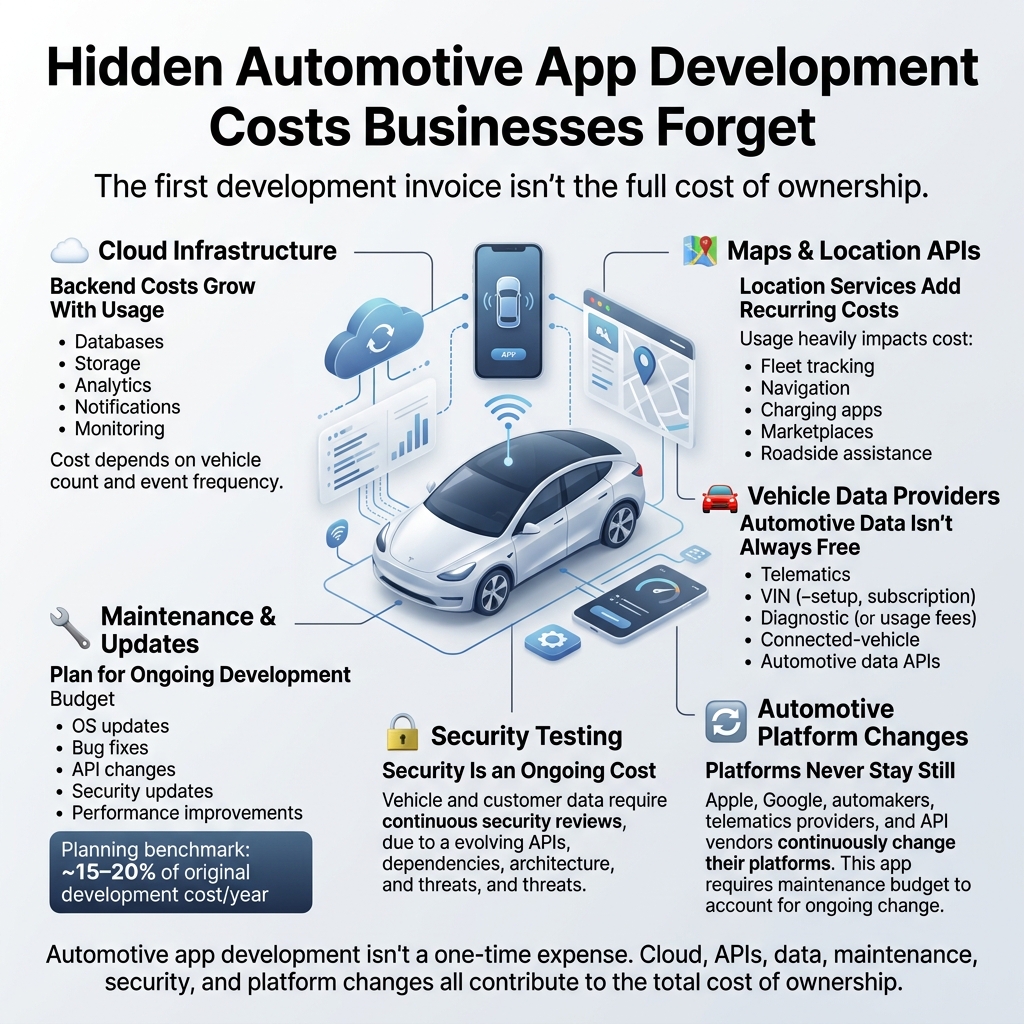
How to Reduce Automotive App Development Cost Without Cutting Quality
The safest cost reductions happen during planning.
1. Start With the Business Outcome
Do not begin with a list of fifty features.
Begin with the problem.
If the objective is reducing fleet downtime, features related to maintenance visibility may deserve priority over an elaborate messaging system.
If the objective is generating dealership leads, advanced vehicle telemetry probably has no place in version one.
2. Build an MVP With Real Architecture
Reduce product scope, not engineering quality.
A smaller well structured application can grow.
A rushed application with poor architecture may have to be rebuilt.
3. Confirm APIs Before Development
One of the fastest ways to blow an automotive development budget is discovering halfway through development that an essential vehicle system does not expose the data your product assumed it would.
Validate every major integration during discovery.
4. Reuse Proven Components
Authentication libraries, payment providers, mapping infrastructure, notification platforms, analytics services, and mature cloud components should usually be reused rather than rebuilt.
Custom development should focus on the parts that differentiate the product.
5. Prototype Before Coding
Changing a user flow in Figma is inexpensive.
Changing the same flow after mobile, backend, database, and API work has been completed is not.
6. Plan Version Two Before Building Version One
You do not need to build everything immediately.
You do need to understand what is coming.
That allows engineers to avoid architectural decisions that make future features unnecessarily expensive.
Automotive App Development Cost Example
Imagine a fleet business wants to build a platform for 500 vehicles.
The first release requires:
- iOS and Android driver applications
- Manager web dashboard
- Real time GPS tracking
- Driver profiles
- Trip history
- Geofencing
- Vehicle maintenance reminders
- Push notifications
- Existing telematics API integration
- Reports
- Admin controls
- Cloud deployment
This is no longer a $30,000 basic mobile application.
A realistic budget might sit around $100,000 to $180,000, depending on the telematics provider, update frequency, dashboard depth, reporting requirements, team rates, and infrastructure.
Now add OBD II hardware integration, predictive maintenance, video telematics, AI route optimization, multi region deployment, advanced permissions, and ERP integration.
The project can move beyond $200,000 to $350,000+ quickly.
That does not mean the second project is overpriced.
It means it is a fundamentally different software system.
How Long Does Automotive App Development Take?
Most automotive applications take approximately 3 to 12 months, with enterprise connected vehicle platforms requiring longer.
Project Type | Typical Timeline |
Automotive MVP | 2 to 4 months |
Dealership or service app | 3 to 5 months |
Fleet management platform | 5 to 9 months |
Connected car application | 6 to 10 months |
Advanced EV platform | 6 to 12 months |
Enterprise automotive ecosystem | 9 to 18+ months |
Integration testing is frequently the part buyers underestimate.
A mobile screen can be completed relatively quickly.
Making sure that screen behaves correctly when a vehicle loses connectivity, an API slows down, GPS accuracy drops, a sensor sends unusual data, or a third party service fails takes more engineering effort.
That work is what separates a demo from a reliable production application.
How to Get an Accurate Automotive App Development Cost Estimate
The fastest route to an accurate quote is to provide enough information for a development company to understand the system rather than simply the idea.
Before requesting an estimate, document:
- Your business model
- Target users
- iOS, Android, web, or vehicle platforms required
- Core features
- Vehicle data sources
- Existing telematics providers
- Third party APIs
- Hardware integrations
- Number of expected vehicles and users
- Real time data requirements
- Security requirements
- Admin dashboard requirements
- Required launch date
- Features planned for later versions
The stronger the scope, the more useful the quote.
A vendor giving you a fixed $40,000 price after hearing only “we need a fleet app” is not giving you certainty.
They are giving you a number before enough information exists to know whether that number is realistic.
If you are still evaluating potential vendors, our guide on how to choose a Mobile App Development company covers the technical, commercial, ownership, and support questions worth asking before signing a contract.
What Should an Automotive App Development Quote Include?
A professional proposal should make the assumptions behind the number visible.
Look for:
- Defined product scope
- Feature list
- Supported platforms
- User roles
- Integration requirements
- Architecture assumptions
- UI/UX deliverables
- Backend scope
- Development milestones
- Testing scope
- Security requirements
- Deployment responsibilities
- Source code ownership
- Documentation
- Post launch support
- Change request process
- Estimated third party costs
If two agencies quote dramatically different numbers, compare what each quote includes before deciding that one is expensive.
The cheaper proposal may simply exclude half the work.
Is Custom Automotive App Development Worth the Cost?
Custom development makes financial sense when software creates a meaningful competitive or operational advantage that an existing platform cannot provide.
For example, custom software may be justified when your business needs proprietary fleet workflows, specialized vehicle integrations, unique customer experiences, ownership of critical data, integration with existing enterprise systems, or automation that directly reduces operating costs.
It may not make sense when an off the shelf product already solves 90% of the problem.
A good automotive app development company should be willing to tell you that.
Custom software should exist because the business requires something custom.
Not because an agency wants a development contract.
Why Work With The Apps Developers for Automotive App Development?
Automotive products require more than attractive mobile interfaces.
The Apps Developers approach Automotive App Development as a connected software system involving mobile applications, backend architecture, APIs, cloud infrastructure, vehicle data, IoT, security, and user experience.
Our automotive development process begins with vehicle data and integration requirements before moving into interface design and engineering.
That matters because telematics, OBD II, GPS, connected devices, Android Automotive OS, CarPlay, fleet systems, and third party APIs can determine the architecture long before the first screen is coded.
Whether you are planning a dealership app, fleet platform, EV charging application, vehicle marketplace, connected car experience, or telematics product, the right first step is defining what the product needs to communicate with and what business outcome it needs to produce.
Planning an automotive application in 2026? Get a project specific estimate based on your features, integrations, platforms, vehicle data, and expected scale instead of relying on a generic industry average.
Conclusion
Automotive app development cost in 2026 is best understood as a range, not a single industry price.
A focused automotive MVP may cost around $25,000 to $60,000.
A commercial automotive application with multiple workflows, APIs, dashboards, payments, and GPS may cost $60,000 to $120,000.
A fleet, telematics, connected car, or EV platform can move into the $120,000 to $300,000+ range.
Enterprise automotive ecosystems involving large vehicle fleets, proprietary integrations, AI, advanced analytics, IoT, and complex cloud infrastructure can reach $300,000 to $500,000+.
The question is therefore not simply, “How much does automotive app development cost?”
The better question is:
What does your automotive product need to do, what systems must it communicate with, and what level of reliability does the business require?
Once those three things are clear, the budget becomes far easier to predict.
And that is exactly where a serious automotive development project should begin.