A mobile app needs GDPR compliance if it collects data from anyone in the EU or UK, regardless of where the business is based, and CCPA compliance if it meets California’s revenue or data volume thresholds and handles personal information from California residents. Most apps with any real user base end up needing to comply with both, along with a growing list of other US state privacy laws, so treating this as a single checkbox usually backfires later.
Here’s the thing founders get wrong most often: they assume privacy law is a legal problem to solve once, with a lawyer, after the app is built. In practice, GDPR and CCPA both reach directly into product decisions, what data you collect, how consent gets requested, what happens when someone asks you to delete their account, long before legal ever sees a contract. Baking this into Mobile App Development from the start costs far less than retrofitting it after your first data subject request shows up in an inbox nobody’s watching.
This guide walks through what GDPR and CCPA actually require for a mobile app specifically, where they overlap, where they genuinely differ, and the practical steps that get you from uncertain to defensible. Consider it the mobile app version of a compliance map, not a replacement for your own legal counsel.
What Is GDPR?
GDPR, the General Data Protection Regulation, is the European Union’s data protection law that gives individuals in the EU and UK specific rights over their personal data and requires any organization processing that data, anywhere in the world, to meet strict consent, security, and transparency standards.
GDPR applies based on whose data you’re handling, not where your company is headquartered. A mobile app built by a team in Texas still falls under GDPR the moment someone in Germany downloads it and the app collects their personal data. That extraterritorial reach is the single most misunderstood part of the regulation among US-based app teams.
What Is CCPA?
CCPA, the California Consumer Privacy Act, later expanded by the CPRA, is California’s state privacy law that gives California residents rights over their personal information and applies to businesses meeting specific revenue or data volume thresholds.
Unlike GDPR, CCPA doesn’t apply to every business by default. It kicks in once a business crosses one of three thresholds: annual gross revenue above roughly $26.6 million, buying or selling personal information from 100,000 or more California consumers or households, or earning at least half its annual revenue from selling or sharing personal information. A small app under all three thresholds has no CCPA obligation, even if every single user is in California.
GDPR vs CCPA: Key Differences for Mobile Apps
| Factor | GDPR | CCPA / CPRA |
| Who it applies to | Any organization processing EU/UK residents’ data | Businesses meeting specific revenue or data volume thresholds |
| Consent model | Opt-in required before most data collection | Opt-out model, with some exceptions for sensitive data |
| Maximum penalty | Up to €20 million or 4% of global annual turnover, whichever is higher | Up to $7,988 per intentional violation, with no stated aggregate cap |
| Enforcement body | National data protection authorities in each EU/UK member state | California Privacy Protection Agency and the California Attorney General |
| Private lawsuits | Limited, mainly through regulators | Yes, for certain data breaches involving unencrypted personal information |
| Data subject rights | Access, correction, deletion, portability, objection | Access, deletion, correction, opt-out of sale/sharing, limit use of sensitive data |
The opt-in versus opt-out distinction is the one that trips up the most mobile app teams. Under GDPR, you generally need a clear, affirmative action before collecting non-essential data. Under CCPA, the default assumption is that collection is allowed until someone actively opts out, which is a fundamentally different consent flow to design for.
Does Your Mobile App Need GDPR Compliance?
Your app needs GDPR compliance if it’s available to users in the EU or UK and collects any personal data from them, including something as basic as a device identifier, an email address, or location data. There’s no minimum user count or revenue threshold that exempts you. One EU user downloading your app is enough to trigger the obligation, so the real question isn’t whether you’re big enough to matter. It’s whether you’ve built the consent and data handling flows GDPR actually requires.
Does Your Mobile App Need CCPA Compliance?
Your app needs CCPA compliance if your business crosses one of the three thresholds above and you handle personal information from California residents. Plenty of early-stage apps genuinely fall below these thresholds, but growth can cross them quickly, especially the 100,000-consumer data volume trigger, which plenty of free apps hit well before they hit meaningful revenue. It’s worth checking this threshold at each funding milestone, not just once at launch.
Core Compliance Requirements for Mobile Apps
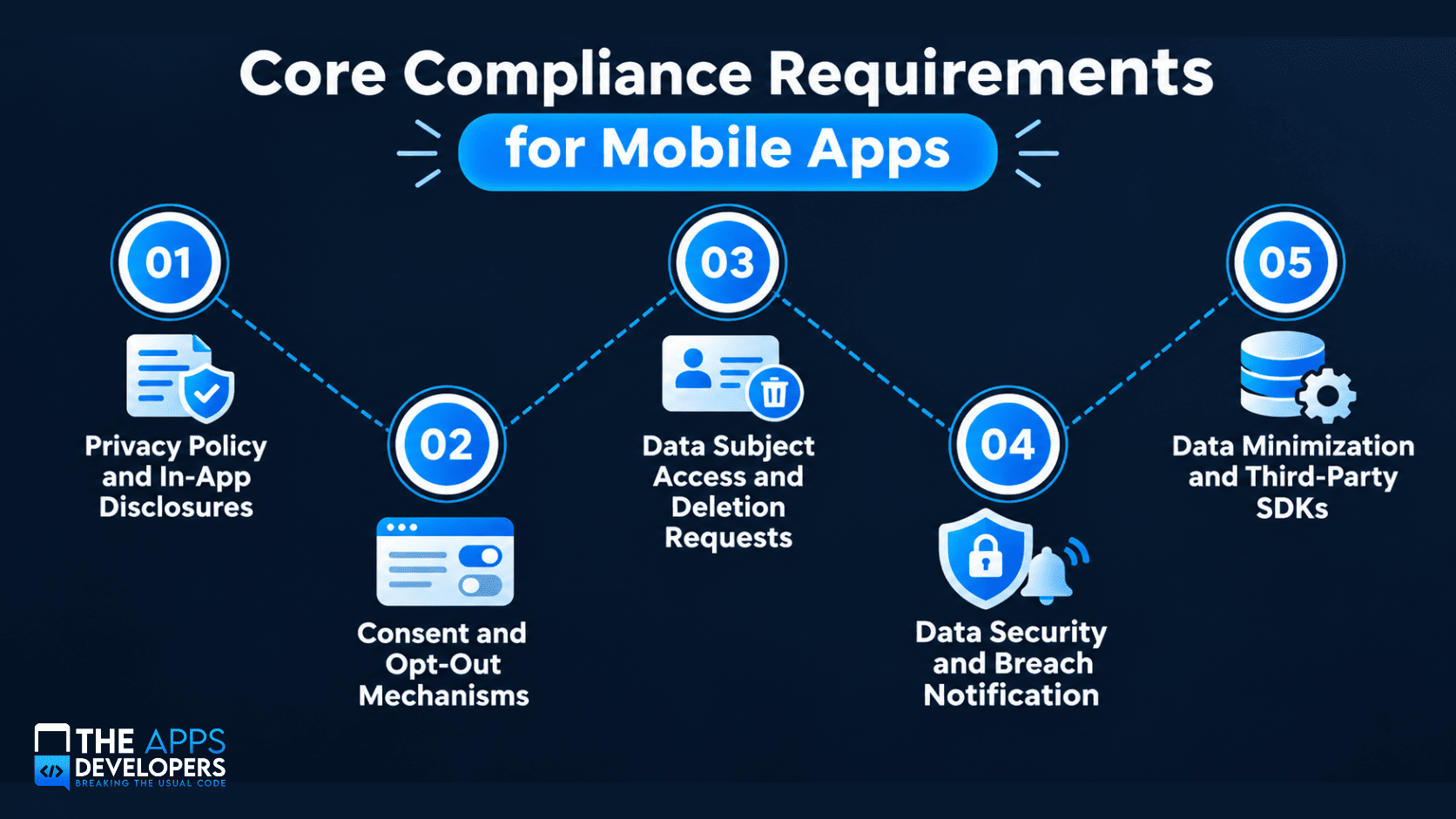
Privacy Policy and In-App Disclosures
Both laws require a clear, accessible privacy policy that explains what data you collect, why, and who you share it with. For a mobile app specifically, that disclosure has to live somewhere users will actually find it, not buried three menus deep, and it has to match what your app actually does. A privacy policy that says you don’t sell data while an analytics SDK quietly shares device identifiers with an ad network is exactly the kind of mismatch that draws regulatory attention.
Consent and Opt-Out Mechanisms
GDPR’s opt-in requirement means your app needs a genuine consent screen before non-essential data collection starts, not a pre-checked box buried in terms of service. CCPA’s opt-out model instead requires a clear, easy way for users to say “don’t sell or share my information,” often called a “Do Not Sell or Share My Personal Information” link or an equivalent in-app control. Thoughtful UI/UX Design work makes a real difference here, since a confusing consent flow creates both compliance risk and a worse first impression for new users.
Data Subject Access and Deletion Requests
Both laws give users the right to request a copy of their data, correct it, or have it deleted, and both expect a response within a defined window, typically 30 to 45 days depending on the law and circumstances. For a mobile app, this means your backend needs a real, repeatable process to locate every piece of a user’s data across your systems and act on it, not a manual scramble through a database the first time a request arrives. Solid API and Backend Development makes these requests something your system handles routinely instead of a fire drill.
Data Security and Breach Notification
GDPR requires “appropriate technical and organizational measures” to protect personal data, and CCPA’s private right of action specifically covers breaches involving unencrypted, unredacted personal information. In practice, that means encryption in transit and at rest, access controls, and monitoring that can actually detect a breach before a regulator or a lawsuit does it for you. Our DevOps and Cloud Solutions team builds this kind of monitoring and encryption into infrastructure from day one, since retrofitting it after an incident is a far more expensive and stressful way to get there.
Data Minimization and Third-Party SDKs
Collect only what the app genuinely needs, and that includes data pulled in by analytics, crash reporting, and advertising SDKs you didn’t write yourself. Those third-party libraries are a common blind spot, since a team can build a fully compliant app and still fall out of compliance because an embedded SDK quietly collects more than the privacy policy discloses. Auditing every SDK’s actual data behavior, not just its marketing page, is a step too many teams skip.
App Store Privacy Requirements You Also Have to Meet
Beyond GDPR and CCPA themselves, both major app stores layer their own privacy requirements on top. Apple requires a detailed App Privacy “nutrition label” disclosing exactly what data your app and its third-party SDKs collect, while Google requires a comparable Data safety section in Google Play. Getting these store disclosures wrong, even when your actual privacy policy is accurate, can trigger a rejection or a removal that has nothing to do with GDPR or CCPA directly, but everything to do with user trust.
Penalties for Non-Compliance
GDPR fines can reach up to €20 million or 4% of a company’s global annual turnover, whichever is higher, while CCPA penalties run up to $7,988 per intentional violation, with no stated cap on how many violations can accumulate.
California’s privacy regulator, the California Privacy Protection Agency, adjusts CCPA’s statutory penalty amounts for inflation every two years, and current figures sit at $2,663 per unintentional violation and $7,988 per intentional violation or one involving a minor’s data. Because CCPA penalties apply per violation and can affect every user a practice touches, a single bad data practice reaching thousands of users can add up to a real number quickly, even without GDPR’s headline-grabbing percentage-of-revenue structure.
The Growing US State Privacy Law Landscape
GDPR and CCPA aren’t the whole picture anymore. Roughly 20 US states now have comprehensive consumer privacy laws in effect, a number that’s climbed sharply in just a few years and keeps growing with each legislative session. The IAPP’s US State Privacy Legislation Tracker is the resource privacy teams actually use to keep up with this, since the landscape shifts often enough that a static list goes stale within months. If your app has users across the US, designing compliance around CCPA alone and assuming the rest will sort itself out is a bet that’s getting riskier every year.
How to Build a Compliant Mobile App: A Practical Checklist
- Map every place personal data gets collected, stored, and shared, including third-party SDKs.
- Build consent flows matched to each law, opt-in depth for GDPR, clear opt-out controls for CCPA.
- Design data subject request handling into your backend, not as a manual process.
- Encrypt data in transit and at rest, and monitor for breaches actively.
- Complete app store privacy disclosures accurately, matching what the app actually does.
- Review your compliance posture regularly, since both the laws and your app’s data practices change over time.
This overlaps meaningfully with other compliance work. If your app also touches health data, our HIPAA-compliant app development checklist covers that separate but related set of requirements.
If you’re building for any regulated industry broadly, our guide to cloud application development for regulated industries covers the infrastructure side in more depth.
And our web app security checklist covers the security practices that satisfy both GDPR’s security requirement and CCPA’s breach provisions at once.
Build Compliance In From the Start
GDPR and CCPA compliance for mobile apps isn’t a document you file away after launch. It’s a set of product and engineering decisions that shape how your app collects data, handles requests, and responds when something goes wrong. Get this right during Mobile App Development instead of after, and compliance becomes a feature of how your app works, not a scramble every time a regulation changes.
Not sure where your app stands on GDPR, CCPA, or the growing list of state privacy laws? Book a free consultation with The Apps Developers, and we’ll walk through what your specific app and user base actually require.
Frequently Asked Questions
Do all mobile apps need to comply with GDPR?
Only apps that collect personal data from users in the EU or UK need GDPR compliance, but there’s no minimum size or revenue threshold. A single EU user is enough to trigger the requirement.
Does CCPA apply to small mobile app businesses?
Not automatically. CCPA only applies once a business crosses specific thresholds, roughly $26.6 million in annual revenue, 100,000 or more California consumers’ data, or at least half of revenue from selling or sharing personal information.
What's the main difference between GDPR and CCPA?
GDPR requires opt-in consent before collecting most personal data and applies based on whose data is processed, while CCPA uses an opt-out model and applies based on specific business thresholds rather than user location alone.
How much can a company be fined for violating GDPR or CCPA?
GDPR fines can reach €20 million or 4% of global annual turnover, whichever is higher. CCPA penalties run up to $7,988 per intentional violation, with no stated cap on the total number of violations.
Do app store privacy labels replace the need for GDPR or CCPA compliance?
No. Apple’s App Privacy details and Google Play’s Data safety section are separate requirements from the app stores themselves, on top of, not instead of, your actual obligations under GDPR, CCPA, and other privacy laws.
Should a mobile app comply with CCPA even if it's not required to?
Often, yes. Many teams build CCPA-style controls in from the start anyway, since growth can cross the thresholds quickly and retrofitting consent flows later is more disruptive than building them in from day one.