
- Home
- App Development
- Blog Details
- 12 mins read
White-Label vs Custom Restaurant App Development: Which Is Better?
- Published on:
- Written by:
- Share:
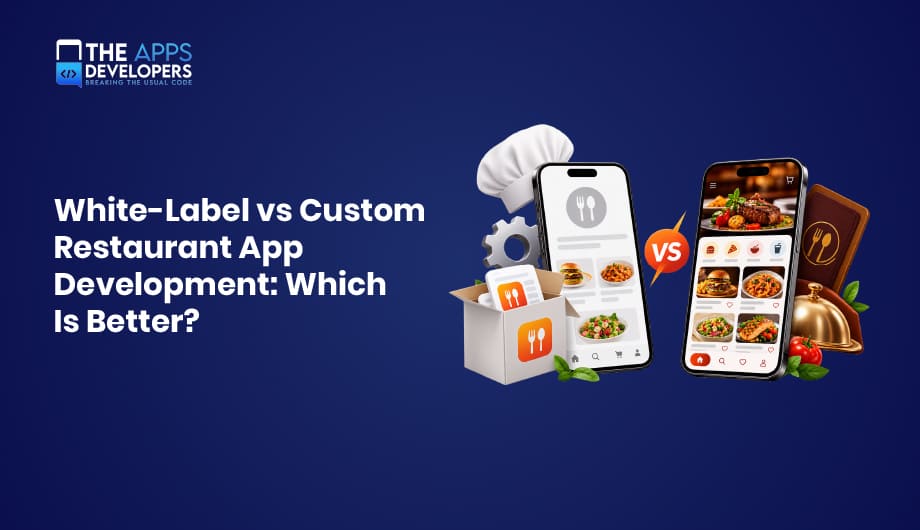
A white-label restaurant app is better if you need to launch fast on a small budget. A custom restaurant app is better if you need unique features, deep integrations, full data ownership, and room to scale across many locations.
Both paths get your brand onto customers’ phones, but they differ sharply in cost, control, and long-term value. This guide compares white-label vs custom restaurant app development side by side, so independent restaurants, cloud kitchens, QSRs, and restaurant chains can pick the approach that fits their stage and goals.
What Is White-Label Restaurant App Development?
White-label restaurant app development means licensing a ready-made app from a vendor and rebranding it with your logo, colors, and menu. The same core product powers hundreds of restaurants; only the branding and settings change.
How Does a White-Label Restaurant App Work?
The vendor maintains one codebase and hosts it on its own servers. You pick from a template, upload your menu, connect a supported payment gateway, and the vendor publishes a branded app to iOS and Android under your name. Most providers charge a monthly subscription, and some add a fee on every order.
Benefits and Limitations of White-Label Restaurant Apps
Benefits:
- Launch in days or a few weeks, not months.
- Low upfront cost with predictable monthly fees.
- Proven features out of the box: online ordering, push notifications, basic loyalty, and menu management.
- The vendor handles hosting, updates, and app store compliance.
Limitations:
- Customization stops at what the vendor’s template allows.
- You rarely own the source code, and data access depends on the contract.
- Vendor lock-in makes switching costly later.
- Transaction and subscription fees grow with your order volume.
What Is Custom Restaurant App Development?
Custom restaurant app development means building an app from scratch around your restaurant’s workflows, brand, and growth plans. Every screen, feature, and integration is designed for your business alone.
How Does Custom Restaurant App Development Work?
A development team gathers your requirements, designs the user experience, and builds native or cross-platform apps for iOS and Android. They connect your POS system, payment gateway, delivery partners, and other third-party APIs, then test and launch. You typically own the source code and the customer data.
Benefits and Limitations of Custom Restaurant Apps
Benefits:
- Unlimited customization of features, design, and user flows.
- Full ownership of source code, intellectual property, and customer data.
- Deep POS, ERP, and CRM integrations built to your exact setup.
- Architecture that scales with new locations, brands, and markets.
- No per-order commissions eating into margins.
Limitations:
- Higher upfront investment.
- Longer time to market, often several months.
- You are responsible for maintenance, hosting, and updates, or for paying a partner to handle them.
White-Label vs Custom Restaurant Apps: Key Differences
The core trade-off is speed and low cost versus control and long-term value.
| Factor | White-Label Restaurant App | Custom Restaurant App |
| Development cost | Low setup fee plus monthly subscription | Higher one-time build investment |
| Time to market | Days to a few weeks | Roughly 3–6+ months |
| Customization and branding | Logo, colors, and menu within a template | Fully custom design, features, and user flows |
| Features and POS integrations | Fixed feature set; only supported POS systems | Any feature; integrates with your existing POS and tools |
| Scalability and performance | Limited by shared vendor platform | Built to handle growth and peak traffic |
| Source code and data ownership | Vendor owns code; data access varies by contract | You own code, IP, and customer data |
| Maintenance and vendor dependency | Vendor-managed; high lock-in risk | Your team or partner manages; no lock-in |
White-Label vs Custom Restaurant App Development: Cost Comparison
White-label apps cost less to start, but custom apps often cost less over five years for high-volume restaurants. The figures below are typical industry ranges and vary by vendor, region, and scope.
Upfront Development Costs
A white-label restaurant app usually needs only a setup fee, often from nothing to around $2,000. A custom restaurant app typically costs $25,000 to $150,000 or more, depending on features, platforms, and integrations. A single-location ordering app sits at the lower end; a multi-brand chain app with loyalty and POS sync sits at the higher end.
Recurring Fees and Maintenance Costs
White-label vendors commonly charge $100 to $500 per month per location, and some add a transaction fee of 1–5% per order. Custom apps carry no license fees, but annual maintenance, hosting, and updates usually run about 15–20% of the original build cost.
Long-Term Total Cost of Ownership
Total cost of ownership is where the comparison flips. Subscription and per-order fees scale with every new location and every extra order. A custom app’s costs stay relatively flat as volume grows, and the app itself becomes a business asset. For a busy restaurant or chain, a custom build can deliver stronger ROI within two to four years.
Which Restaurant App Features Can You Customize?
With a white-label app you configure features; with a custom app you design them.
Online ordering and payment processing. White-label apps offer standard ordering flows and a short list of supported payment gateways. Custom apps let you build combo builders, scheduled orders, group ordering, and any local payment method or wallet your customers prefer.
Loyalty programs and customer engagement. White-label loyalty is usually points-based with preset rules. A custom app can run tiered rewards, personalized offers based on order history, referral programs, and targeted push notifications tied to your own CRM.
POS integration and multi-location management. White-label apps integrate only with POS systems the vendor already supports. Custom development connects to any POS, kitchen display, or inventory system and adds central dashboards for location-level menus, pricing, and reporting.
When Should You Choose a White-Label Restaurant App?
Choose a white-label restaurant app when speed and budget matter more than differentiation. It fits best if you:
- Run a single location or a small independent restaurant.
- Want to test whether customers will order through your own app.
- Have a limited budget and no in-house technical team.
- Need standard features only: ordering, payments, and basic loyalty.
- Use a POS system the vendor already supports.
When Should You Choose a Custom Restaurant App?
Choose a custom restaurant app when the app is a core part of your growth strategy. It fits best if you:
- Operate multiple locations, brands, or franchise units.
- Need integrations with a specific POS, ERP, or delivery setup.
- Want full ownership of customer data and source code.
- Process enough orders that per-order fees hurt margins.
- Plan unique features that competitors’ template apps cannot offer.
Can You Switch From a White-Label App to a Custom Restaurant App?
Yes, many restaurants start with white-label and move to custom once they outgrow it. The switch is smoothest when you plan for it from day one.
Before signing a white-label contract, confirm that you can export customer lists, order history, and loyalty balances in a usable format. Check whether the app store listing can transfer to your own developer account, so you keep your reviews and downloads. When you migrate, run both apps in parallel briefly and give loyal customers an incentive, such as bonus points, to download the new app.
White-Label or Custom Restaurant App: Which Is Better for Your Business?
The better option depends on your size, order volume, and growth plans.
- Independent restaurants: Start with white-label. It gets you a branded ordering app quickly without a large investment.
- Restaurant startups: Use white-label to validate demand, but negotiate data export rights so you can go custom later.
- Cloud kitchens: Choose custom if you run multiple virtual brands from one kitchen. White-label tools rarely handle multi-brand menus and routing well.
- Multi-location chains and QSRs: Choose custom. Centralized management, POS integration, data ownership, and lower long-term costs outweigh the higher upfront price.
If you are unsure, map your expected order volume over three years against both cost models. The point where cumulative white-label fees exceed a custom build is your answer.
Related Insights
Explore these guides to learn more about restaurant app development, customer engagement, and choosing the right solution for your business.
- Restaurant Management App Development
- Restaurant App Development Cost: What to Expect in 2026
- Restaurant Loyalty App Development
Table of Contents

Taha Mirza
Taha Hissam Mirza is a technology writer at The Apps Developers, covering mobile app development, web development, software engineering, and emerging technologies. He explores industry trends, development strategies, and practical solutions that help businesses make informed technology decisions. Through research-driven insights and easy-to-understand articles, Taha simplifies complex technical concepts and helps startups, entrepreneurs, and enterprises understand how to build scalable, secure, and user-friendly digital products.