

HIPAA-compliant app development means building a mobile or web app that protects patient health information the way the law requires: encryption, access controls, audit logs, breach notification workflows, and a signed Business Associate Agreement with every vendor that touches that data. It isn’t a feature you bolt on near launch. It’s an architecture decision you make in week one, because retrofitting it later usually means rebuilding the parts of the app that matter most.
Here’s a number worth sitting with. According to HIPAA Journal’s 2025 healthcare data breach report, roughly 140 million people had their health records exposed in breaches reported to federal regulators in 2025, on the heels of 289.8 million in 2024, most of that tied to the Change Healthcare attack. Healthcare is still one of the most targeted industries in software, and a compliance gap in your app isn’t theoretical. It’s the next headline waiting to happen.
We’ve built healthcare apps for long enough to watch the conversation shift. Five years ago, clients asked us to “add HIPAA stuff” after the demo looked good. Now the first question in discovery is usually “walk me through your compliance architecture.” That change didn’t come from a sudden love of federal paperwork. It came from patients who ask harder questions, breaches that cost real money, and an Office for Civil Rights that isn’t shy about issuing fines anymore.
This guide pulls together what we actually do on healthcare app development projects: the rules that matter, the skills a team needs, realistic costs, the mobile-specific requirements people miss, and the mistakes that turn a six-week fix into a six-month rebuild.
What Does HIPAA-Compliant App Development Actually Mean?
HIPAA-compliant app development is the practice of designing, building, and operating software so that any protected health information it touches stays encrypted, access-controlled, logged, and covered by a signed agreement with every vendor involved.
That’s a mouthful, so here’s the short version. If your app stores, processes, or transmits anything that identifies a patient alongside their health information, HIPAA applies, and the app has to be built around that fact from the first architecture diagram, not patched afterward.
HIPAA, Decoded: The Five Rules That Actually Shape Your App
HIPAA dates back to 1996, when a “mobile app” meant a calculator on a Palm Pilot. The law has aged better than that technology did, mostly because it describes outcomes rather than specific tools. Five rules sit underneath it, and most teams only know two of them.
| HIPAA Rule | What It Covers | What It Means for Your Build |
| Privacy Rule | Who can access PHI and under what conditions | Permission flows, consent screens, and data access controls |
| Security Rule | Technical, administrative, and physical safeguards for ePHI | Encryption standards, authentication, and audit logging |
| Enforcement Rule | How investigations and penalties work | How exposed you are if something goes wrong |
| Breach Notification Rule | Timelines and procedures for reporting a breach | Incident detection and notification workflows built in, not improvised |
| Omnibus Rule | Extends obligations to business associates | A BAA required for every vendor that touches PHI |
The one that catches people off guard is the Omnibus Rule. Your app can be locked down tight, and you’re still exposed if your analytics SDK or push notification provider never signed a Business Associate Agreement. HHS’s summary of the HIPAA Security Rule is worth reading once in full, not just skimming.
Why HIPAA Can’t Be a Feature You Add Later
We’ve lost count of how many calls start with “we built the app, now we need to make it HIPAA compliant.” It almost never works cleanly. The database wasn’t designed for field-level encryption. There’s no audit trail because nobody planned for one. What sounded like a two-week fix turns into months of rearchitecting, because compliance isn’t a layer you paint on top of a finished product.
Compliance also means something different depending on who you ask. Patients get real rights under the Privacy Rule, including 30 days to request their own records. Providers avoid fines, sure, but the bigger win is operational: fewer incidents, faster response when something does go wrong, and eligibility for the value-based care contracts that demand strict data governance. And for app owners, compliance opens doors that otherwise stay shut. Large health systems won’t sign with a vendor that can’t produce a BAA or a SOC 2 report on request, no matter how good the demo looked.
The Skillset a HIPAA-Compliant Build Actually Needs
This isn’t a project one generalist developer can carry alone. Here’s who you actually need on the team.
| Skill | Why It Matters | Typical Role |
| Healthcare domain knowledge | Knowing what counts as PHI and how clinical workflows really work | Business analysts, domain consultants |
| Security engineering | Threat modeling, encryption, and access control design | Security engineers, penetration testers |
| HIPAA-eligible cloud architecture | Building on AWS, Azure, or GCP with the right BAAs in place | Cloud architects, DevOps engineers |
| Regulatory compliance | Turning HIPAA legal language into technical requirements | Compliance officers, healthcare counsel |
| EHR and API integration | Connecting to Epic, Cerner, or similar systems through HL7 and FHIR | Backend developers, integration specialists |
| Mobile development | Certificate pinning, biometric auth, and secure local storage | Mobile engineers |
| Security-focused QA | Vulnerability scanning and compliance validation, not just functional testing | QA engineers, security analysts |
If you’re assembling that mix in-house, our guide to API and backend development covers the architecture work that integration and encryption actually require.
What HIPAA-Compliant App Development Costs in 2026
A HIPAA-compliant app typically costs $50,000 to $120,000 for an MVP, $120,000 to $350,000 for a mid-range product with EHR integration, and $350,000 to $800,000 or more for an enterprise platform. Exact figures depend on your blueprint, so treat these as planning ranges, not a quote.
| Complexity | What You’re Building | Estimated Cost | Timeline |
| MVP | Single platform, core features, foundational compliance | $50K to $120K | 3 to 5 months |
| Mid-range | Multi-platform, EHR integration, full security layer | $120K to $350K | 5 to 9 months |
| Enterprise | Full feature set, AI, multiple system integrations | $350K to $800K+ | 9 to 18 months |
| Large health system | Multi-tenant, analytics, custom clinical workflows | $800K to $3M+ | 12 to 24 months |
Where the Compliance Budget Actually Goes
Compliance work, encryption, audit trails, BAA management, and penetration testing, typically adds 15% to 25% on top of standard build costs. EHR integrations through HL7 and FHIR run anywhere from $30,000 to $100,000 or more, depending on how many systems you’re connecting to. Third-party services also cost more once they’re HIPAA-tier: Twilio’s HIPAA-eligible messaging plan, for instance, runs well above its standard pricing. Annual maintenance for ongoing audits, patches, and regulatory updates generally sits between $4,000 and $12,000, and a professional penetration test costs $15,000 to $50,000 per engagement, usually needed once a year at minimum. Our broader mobile app development cost guide walks through how these numbers compare to a non-regulated build.
Skipping these costs doesn’t save money. It defers it, usually with interest, since healthcare breaches remain among the most expensive in any industry to clean up.
Mobile-Specific Requirements You Can’t Skip
Mobile introduces its own layer of risk. Phones get lost, stolen, and resold, and a HIPAA-compliant mobile app has to assume that will happen to at least one of your users eventually.
- Remote wipe for lost or stolen devices
- Certificate pinning to block man-in-the-middle attacks
- No unencrypted PHI cached locally, encrypted-enclave storage only
- Re-authentication required after the app has been backgrounded
- Credentials stored only in the iOS Keychain or Android Keystore
- Testing across OS versions and device types to confirm consistent security behavior
Session handling deserves its own mention here. Our guide to web app session management covers the timeout and re-authentication patterns that keep a shared or lost device from becoming a breach.
Common Roadblocks in HIPAA App Development (and What Actually Fixes Them)
| Challenge | Why It’s Hard | What Works |
| Usability vs. compliance | Security controls add friction, and clinicians won’t use clunky tools | Healthcare-specific UX research, biometrics over passwords, invisible session management |
| PHI scattered across systems | Data lives across EHRs, labs, and pharmacies, each in a different format | HL7 FHIR as the interoperability layer, middleware for normalization |
| Regulations keep shifting | HIPAA evolves, states add their own rules, OCR’s enforcement focus changes | Dedicated regulatory tracking, proactive control updates |
| Third-party vendor risk | Every SDK and API touching PHI needs a signed BAA | A vendor compliance registry, reviewed annually |
| Staying compliant after launch | Threats evolve, staff change, systems age | Continuous monitoring, quarterly reviews, a living risk register |
| Cost overruns from late compliance | Retrofitting security onto existing code runs 3 to 5 times the cost | Security-by-design from sprint one, compliance checks in CI/CD |
Clunky, security-heavy interfaces are exactly what clinicians abandon first. Our UI/UX design team builds specifically for that time-pressured, interrupted way doctors actually use software.
We cover this in more depth in our guide to medical apps for doctors.
What It Actually Costs to Get HIPAA Wrong
HIPAA civil penalties for 2026 range from $145 to $2,190,294 per violation, and willful, uncorrected neglect can bring criminal penalties of up to $250,000 and ten years in prison.
| Tier | Level of Fault | Per-Violation Range | Calendar-Year Cap |
| 1 | No knowledge, and couldn’t reasonably have known | $145 to $73,011 | $2,190,294 |
| 2 | Reasonable cause, not willful neglect | $1,461 to $73,011 | $2,190,294 |
| 3 | Willful neglect, corrected within 30 days | $14,601 to $73,011 | $2,190,294 |
| 4 | Willful neglect, not corrected | $73,011 to $2,190,294 | $2,190,294 |
These figures reflect HHS’s 2026 inflation adjustment to HIPAA civil penalties, effective for penalties assessed on or after January 28, 2026. Each tier can also accrue separately for every day a violation continues, which is how a single gap turns into a seven-figure problem fast.
How to Build a HIPAA-Compliant App: Step by Step
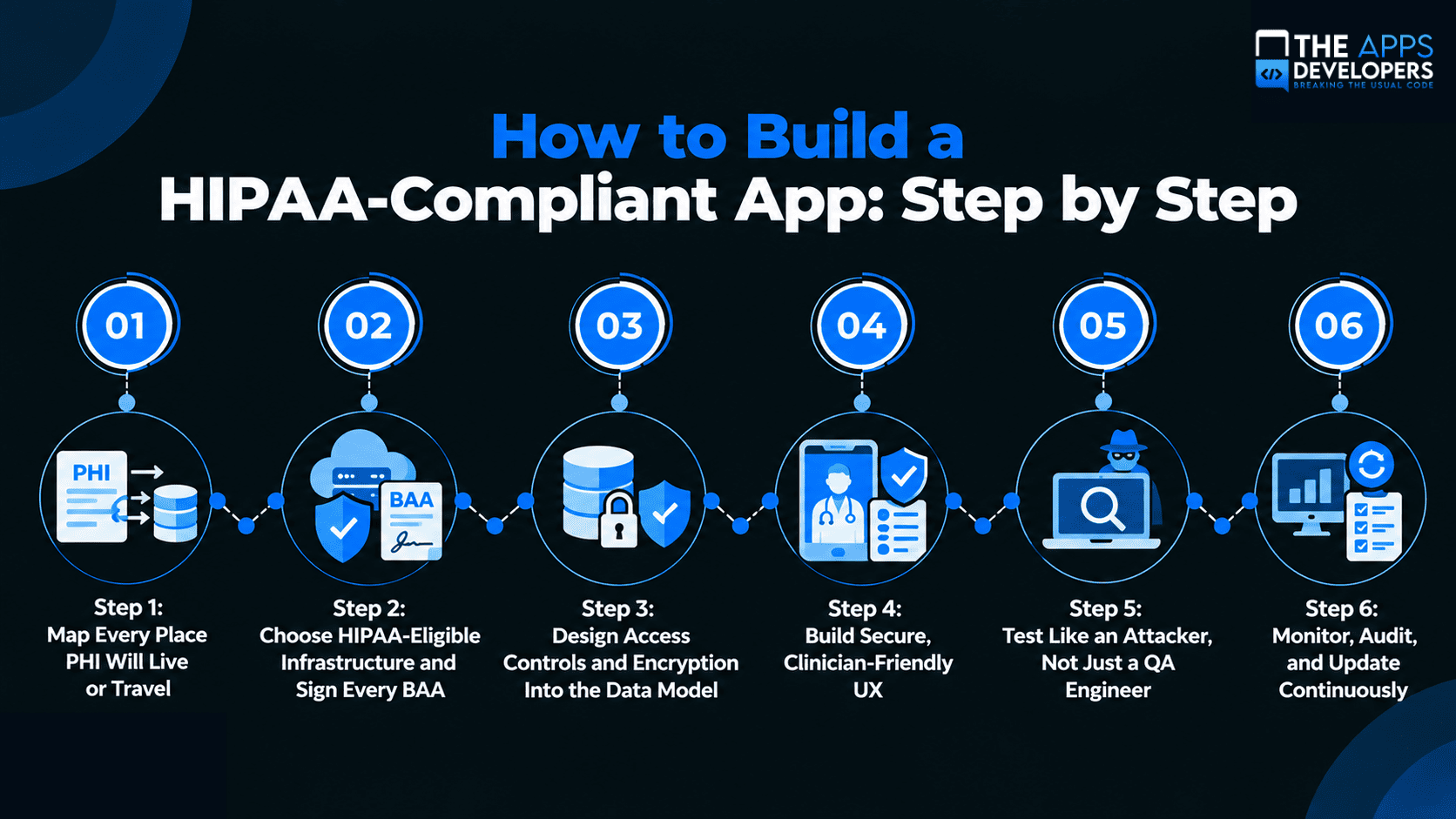
Step 1: Map Every Place PHI Will Live or Travel
Before any design work starts, trace every path PHI will take: where it’s entered, stored, transmitted, and by which vendors. You can’t secure what you haven’t mapped.
Step 2: Choose HIPAA-Eligible Infrastructure and Sign Every BAA
Pick cloud and third-party services that explicitly support HIPAA, and get a signed BAA in place before a single byte of PHI touches them. Our DevOps and cloud solutions team builds this into infrastructure from day one, not as a retrofit before an audit.
Our guide to cloud application development for regulated industries goes deeper on this layer.
Step 3: Design Access Controls and Encryption Into the Data Model
Role-based access, field-level encryption, and audit logging are schema decisions, not something you add in a later sprint. Get this wrong early and every table built afterward inherits the problem.
Step 4: Build Secure, Clinician-Friendly UX
Security that fights the user gets worked around. Favor biometrics over passwords, and design re-authentication so it interrupts a workflow as little as possible.
Step 5: Test Like an Attacker, Not Just a QA Engineer
Functional testing finds broken buttons. Security testing finds the path a breach actually takes. Both need to run before launch, and penetration testing needs to repeat at least annually after that.
Step 6: Monitor, Audit, and Update Continuously
A HIPAA-compliant app at launch can drift out of compliance within a year as dependencies update, staff turn over, and regulations shift. Quarterly reviews and a living risk register catch that drift before an auditor does.
Where We Can Help
Building a healthcare app means managing clinical workflow, legal requirements, and system architecture at the same time, which is exactly the intersection our healthcare app development team works in daily. Whether you’re launching a new telehealth platform, building a patient app from scratch, or bringing an existing product into compliance, the earlier HIPAA enters the conversation, the less it costs you later.
HIPAA compliance isn’t a box you check at the end. It’s the foundation everything else gets built on, from the data model to the login screen. Get the architecture right early, and every decision after that gets easier.
Planning a HIPAA-compliant app, or need an existing one brought into compliance? Book a free consultation with The Apps Developers, and we’ll map out what your project actually needs before you spend a dollar on development.
Frequently Asked Questions
What makes an app HIPAA compliant?
An app is HIPAA compliant when it protects protected health information with encryption, access controls, and audit logging, follows breach notification requirements, and has a signed Business Associate Agreement with every vendor that touches that data.
How much does HIPAA-compliant app development cost?
Costs typically range from $50,000 for a basic MVP to $800,000 or more for an enterprise platform, with compliance work alone adding roughly 15% to 25% on top of standard development costs.
Can I add HIPAA compliance to an app after it's built?
Technically yes, but it’s rarely efficient. Retrofitting encryption, audit trails, and access controls into an existing database and codebase typically costs 3 to 5 times more than building them in from the start.
What is a Business Associate Agreement, and when do I need one?
A BAA is a contract required under HIPAA’s Omnibus Rule between a covered entity and any vendor that creates, receives, stores, or transmits PHI on its behalf, including cloud hosts, analytics tools, and messaging providers.
What happens if my app has a HIPAA violation?
Penalties range from $145 to $2,190,294 per violation depending on fault, with an annual cap of $2,190,294 per identical provision. Willful, uncorrected violations can also carry criminal penalties.
Do I need HL7 or FHIR for a HIPAA-compliant app?
Only if your app exchanges data with EHR systems like Epic or Cerner. Our guide to HL7 vs FHIR explains which standard fits which kind of integration.