
A solid api testing guide covers five layers: unit tests for individual functions, integration tests for how components work together, contract tests for verifying API consumers and providers agree on behavior, load tests for performance under real traffic, and security testing for authentication and data exposure risks. Most teams do some of this, often quite well within a single layer. Few do all five deliberately and consistently, which is usually why a backend that passes every test still breaks in production the first time a consumer’s expectations and the API’s actual behavior quietly diverge.
That gap, between what gets tested and what actually breaks, is the real subject of this guide. Plenty of teams write unit tests diligently and still ship an API that breaks a partner integration, because unit tests were never going to catch a contract mismatch between two independently deployed services, no matter how thorough the coverage looks on paper. This is written for backend teams who want a genuinely complete testing strategy, not just more tests for the sake of a higher coverage number. If you’re scoping a new API and backend development project and want testing built in as a first-class part of the process, this covers what that actually looks like layer by layer.
What Is API Testing?
API testing is the practice of verifying that an API behaves correctly, returning the right data, handling errors appropriately, and enforcing authentication and authorization, independent of any user interface that might sit on top of it. That independence from the UI is what makes API testing distinct from broader application testing, an API test validates the contract between a request and a response directly, without needing a browser or a rendered screen to check whether the underlying logic actually works.
Why API Testing Principles Differ From UI Testing
UI testing has to account for rendering, visual state, and user interaction sequences, all of which are slow and comparatively fragile to automate. API testing skips all of that, a test can send a request and check the response in milliseconds, which is exactly why a well-built API test suite can run far more comprehensively and far more often than an equivalent UI test suite ever could. This isn’t a reason to skip UI testing entirely, but it is a reason API testing should carry the bulk of a backend team’s automated coverage, since it’s both faster to run and more precisely targeted at the logic actually being changed.
Types of API Testing
Unit Testing
Unit tests verify individual functions or methods in isolation, checking that a specific piece of business logic produces the correct output for a given input, without involving a real database, network call, or external dependency. These are the fastest tests to run and should make up the largest share of any test suite, since they catch logic errors immediately, right where the mistake was actually introduced.
Integration Testing
Integration tests verify that multiple components work correctly together, an endpoint that reads from a real (or realistic test) database, applies business logic, and returns a properly formatted response. These catch issues unit tests structurally can’t, problems in how pieces interact, even when each piece works correctly on its own.
Contract Testing
Consumer-Driven Contracts
Contract testing verifies that an API provider and its consumers agree on the shape of their interaction, the request format, the response structure, without requiring a full end-to-end integration test connecting both systems together. Pact, one of the most widely used contract testing tools, works on a consumer-driven model, where the consumer of an API defines what it expects, and that expectation becomes a contract the provider’s tests verify against.
Why Contract Testing Matters for Microservices
In a microservices architecture, where dozens of services might call each other independently, full end-to-end integration tests across every possible combination become slow and brittle fast. Contract testing solves this by letting each service verify its side of an interaction in isolation, catching a breaking change without needing every dependent service running simultaneously in a test environment.
Example: Catching a Breaking Change Before Deployment
A backend team that renames a field in an API response, without contract tests in place, might not discover the break until a mobile app consuming that field crashes for real users after deployment. With a contract test verifying the agreed-upon response shape, that same change fails in CI before it ever reaches production, exactly where a mistake like this should get caught.
Load and Performance Testing
Load testing verifies how an API behaves under realistic and peak traffic conditions, response time, error rate, and resource usage as concurrent requests increase. This is the layer most commonly skipped entirely until a real traffic spike exposes a bottleneck nobody tested for in advance, precisely the scenario a proper api testing guide is meant to prevent.
Security Testing
Security testing checks for the vulnerability patterns most common to APIs specifically, broken authentication, excessive data exposure, and improper authorization checks that let one user access another user’s data. The OWASP API Security Top 10 is the standard reference for what this testing should actually target, since general web security testing tools frequently miss API-specific failure patterns that don’t have an obvious UI-based equivalent to test against.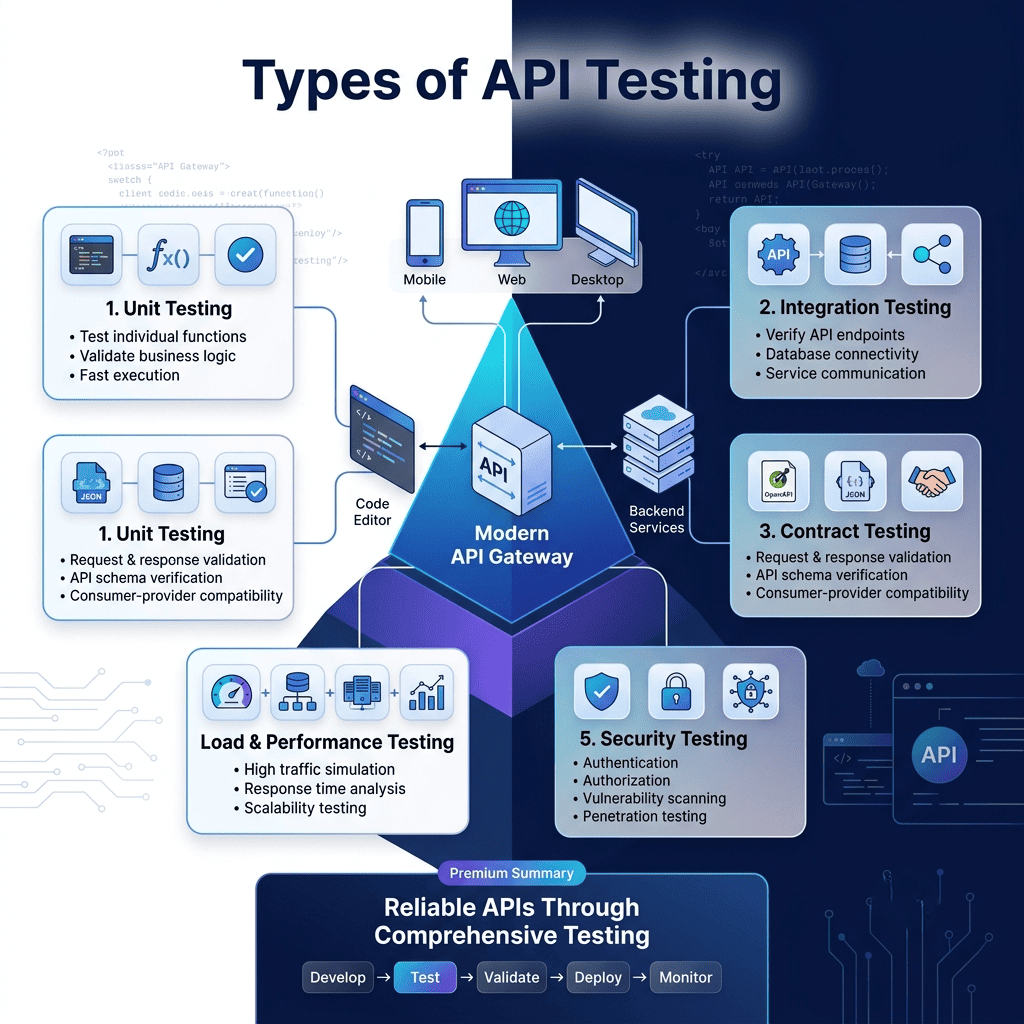
The API Testing Pyramid: How Much of Each Type
Not every testing layer deserves equal investment, and the classic testing pyramid concept applies directly here.
Layer | Relative Volume | Speed | What It Catches |
Unit tests | Most | Fastest | Logic errors in isolated functions |
Integration tests | Moderate | Fast | Component interaction issues |
Contract tests | Moderate | Fast | Consumer-provider mismatches |
Load/performance tests | Fewer, targeted | Slower | Scalability and performance bottlenecks |
End-to-end tests | Fewest | Slowest | Full-system, real-world scenarios |
Martin Fowler’s team has written extensively about this shape in the context of general software testing, and the core principle carries over directly to API testing: more tests at the fast, isolated, cheap-to-run layers, and progressively fewer at the slow, expensive, broad-coverage layers, rather than an inverted pyramid where a handful of slow end-to-end tests are asked to catch everything.
Manual vs. Automated API Testing
Both have a place in a mature api testing guide, and treating this as an either-or decision misses where each genuinely adds value.
Factor | Manual Testing | Automated Testing |
Speed | Slow, requires a person executing each test | Fast, runs in seconds to minutes |
Repeatability | Inconsistent, depends on the tester | Perfectly consistent every run |
Best fit | Exploratory testing, edge cases not yet automated | Regression testing, CI/CD integration |
Upfront cost | Low | Higher, requires writing and maintaining tests |
Ongoing cost | High, repeated manual effort every release | Low, once built, tests run indefinitely |
Automated tests should handle everything repeatable and well-defined, while manual, exploratory testing still earns its place for genuinely new functionality where the right test cases aren’t obvious yet, or for probing an API the way a creative, motivated attacker actually would, something automated security scanning alone doesn’t fully replicate.
Building API Testing Into CI/CD
Tests that only run manually, occasionally, before a release get skipped exactly when time pressure is highest, which is precisely when testing matters most. Running the full automated test suite, unit, integration, and contract tests at minimum, on every pull request, before code merges, catches problems while they’re cheap to fix rather than after they’ve shipped. This is the same discipline behind the DevOps and cloud solutions practices that automate deployment generally, testing and deployment pipelines are really the same underlying discipline, verify before you ship, applied to two different stages of the same process.
Test Environments and Data Management
A testing strategy is only as reliable as the environment it runs against. Running API tests against a shared, unstable staging environment that other teams are also actively changing produces exactly the flaky, inconsistent results that erode trust in a test suite over time. Isolated, disposable test environments, spun up fresh for each test run and torn down afterward, remove an entire category of false failures caused by leftover state from a previous run rather than an actual bug in the code being tested. This same environment discipline matters for any web app consuming the API being tested, since a frontend team debugging against an inconsistent backend test environment wastes time chasing problems that don’t actually exist in the code.
Test data itself deserves the same deliberate treatment. Synthetic data that closely mirrors real-world shapes and edge cases, rather than a handful of obviously fake placeholder records, catches far more genuine issues, particularly around how an API handles unusual but valid inputs, empty fields, unusual character sets, boundary values, that a lazily constructed test dataset simply never exercises.
Common Mistakes in API Testing
Teams frequently write extensive unit tests while skipping contract testing entirely, then discover integration breaks only when a consuming application fails in production, exactly the gap contract testing exists to close. Load testing gets treated as a pre-launch, one-time activity rather than an ongoing practice, so a system that was tested for its expected launch traffic never gets retested as real usage patterns evolve well beyond that original baseline. Security testing often gets folded into a general QA pass rather than specifically targeting the API vulnerability patterns covered in our web app security checklist, missing issues that a generic functional test would never be designed to catch. And test data management gets consistently underestimated, tests running against production-like data that isn’t properly isolated or reset between runs produce flaky, unreliable results that erode a team’s trust in the entire test suite over time.
A less obvious but equally damaging mistake is treating test coverage as a single number to optimize rather than a signal to interpret. A codebase can report high line coverage while still missing the specific edge cases and failure modes that actually matter, since coverage measures whether a line of code executed during a test run, not whether that line was tested against a meaningful, realistic scenario. Teams chasing a coverage percentage target sometimes end up with tests that technically execute the code without genuinely verifying its behavior, which produces a false sense of security that’s arguably worse than having no coverage metric at all, since it actively discourages further scrutiny of code that looks well-tested on paper.
How The Apps Developers Approaches API Testing
Testing is built into the same API and backend development process from the start, layered across unit, integration, contract, and security testing rather than treated as a single QA pass squeezed in before launch.
This connects directly to the architecture decisions covered in our SaaS web app architecture guide, since a system designed with clear service boundaries from the start is considerably easier to test thoroughly at every layer than one where responsibilities are tangled together and hard to isolate.
That discipline extends to how we think about testing across an entire product, the same layered approach covered in our mobile app testing guide applies just as directly to backend APIs as it does to the mobile clients consuming them, since both benefit from the same principle, catch issues at the fastest, cheapest layer possible rather than relying on expensive, slow end-to-end tests to catch everything.
If your current API testing strategy feels incomplete, or you’re scoping a new backend and want testing built in from the architecture phase rather than bolted on afterward, that’s worth a direct conversation. You’re welcome to talk to our team about what a genuinely complete testing strategy would look like for your specific system.