

Good API documentation best practices come down to three habits: writing docs as part of the development process rather than after it, documenting error cases as thoroughly as success cases, and keeping documentation versioned alongside the API itself so it never quietly drifts out of sync with what the code actually does. Most teams know this. Most teams still don’t do it, and the reasons why matter as much as the checklist itself.
That gap between knowing and doing is the real subject of this guide. Plenty of articles list what good documentation includes. Fewer address why developers, who are otherwise diligent, disciplined professionals, consistently treat documentation as the thing that gets cut when a deadline tightens. If you’re trying to fix that pattern on your own team, or you’re scoping a new API and backend development project and want documentation built in from day one rather than bolted on as an afterthought, understanding the why is what actually makes the fix stick.
What Is API Documentation?
API documentation is the reference material that explains how to use an API, covering available endpoints, required parameters, authentication, expected responses, and error conditions, written for the developers who need to integrate with it rather than the team that built it. Good documentation answers a specific, practical question, “how do I make this call and what will I get back,” without requiring the reader to read the underlying source code to find out.
Why Developers Skip Writing API Documentation
The honest answer isn’t laziness, and treating it that way is exactly why so many attempts to fix documentation culture fail. Documentation gets skipped because it sits outside the feedback loop that rewards everything else a developer does. Shipping a feature gets visible recognition. Fixing a bug gets a closed ticket and a sense of progress. Writing documentation produces no immediate, visible signal that the work mattered, until months later when someone hits a gap and the absence suddenly becomes very visible indeed, by which point the original context is already fading from memory.
There’s also a genuine skill mismatch. Writing clear documentation is a different discipline than writing clear code, and most engineering teams never explicitly train for it, they simply expect it to happen. According to Postman’s 2025 State of the API Report, documentation gaps were cited by 55 percent of API teams as an active collaboration problem, despite most of those same teams working in small, theoretically well-coordinated groups. That’s not a productivity problem so much as a structural one, documentation isn’t failing because teams don’t care, it’s failing because nothing in most workflows makes it stick.
The deadline dynamic makes this worse. Documentation is almost always deferrable in a way code isn’t, a shipped feature with no docs still works, at least for now, while a shipped feature with bugs visibly doesn’t. That asymmetry means documentation loses the priority fight nearly every time a schedule gets tight, and schedules are tight often enough that “later” quietly becomes “never” for a large share of what should have been written.
Tooling friction compounds all of this in ways that are easy to underestimate. When documentation lives in a separate system from the codebase, a wiki, a shared doc, a standalone docs site with its own login and publishing workflow, every update requires a developer to context-switch out of their actual working environment, and that small extra friction is often enough to tip an update from “quick fix” to “I’ll do it later.” The teams that maintain documentation well almost always have it living close to the code, not because the content itself is fundamentally different, but because proximity removes the exact friction that causes it to get skipped in the first place.
Core API Documentation Best Practices
1. Document as Part of the Development Process, Not After
The single highest-leverage change most teams can make is treating a documentation update as part of the definition of done for any API change, the same way tests are, rather than a separate task queued up for whenever there’s spare time. Once documentation is disconnected from the code change that made it necessary, the gap between what’s documented and what’s true starts growing immediately and rarely closes on its own. This discipline matters just as much for a web app’s internal APIs as it does for anything exposed publicly, since an internal API with stale docs creates the exact same onboarding friction for a new engineer that a public API creates for an external developer.
2. Use the OpenAPI Specification
Writing API documentation from a structured specification rather than free-form prose keeps documentation both human-readable and machine-generatable at the same time. The OpenAPI Specification, the industry standard for describing REST APIs, lets a single source of truth drive interactive documentation, client SDK generation, and automated testing simultaneously, which removes an entire category of drift that happens when documentation is maintained as a separate, hand-written document disconnected from the API’s actual contract.
3. Include Real, Runnable Examples
A parameter list without an example request and response is technically complete and practically useless. Developers integrating with an API almost always start by copying a working example and modifying it, not by assembling a request from a schema definition line by line, so an example that’s outdated or subtly wrong costs real integration time and trust.
4. Document Error Responses, Not Just Success Cases
Most API documentation thoroughly covers the happy path and treats error handling as an afterthought, a mismatch with how integration work actually happens, since a developer troubleshooting a failed request needs to know what a given error code means and how to resolve it far more urgently than they need another example of a successful call they’ve already gotten working.
5. Keep Docs Versioned Alongside the API
Automating Documentation Generation
Manually updating documentation for every API change is exactly the kind of repetitive task that quietly stops happening once a team is under pressure, which is precisely why automating as much of the process as possible matters more than writing better manual documentation.
Docs-as-Code Workflows
Treating documentation as code, stored in the same repository, reviewed in the same pull requests, and built through the same pipeline as the API itself, keeps it structurally tied to the change that necessitated it rather than living as a separate task someone has to remember to do. This is the same discipline behind the DevOps and cloud solutions practices that automate deployment and testing, applied to documentation instead of application code.
Example: Generating Docs From Code Comments in CI/CD
A CI/CD pipeline configured to regenerate interactive API documentation automatically from OpenAPI annotations in the codebase, on every merge to the main branch, removes the human step most likely to get skipped, someone remembering to manually update a separate docs site after the code already changed.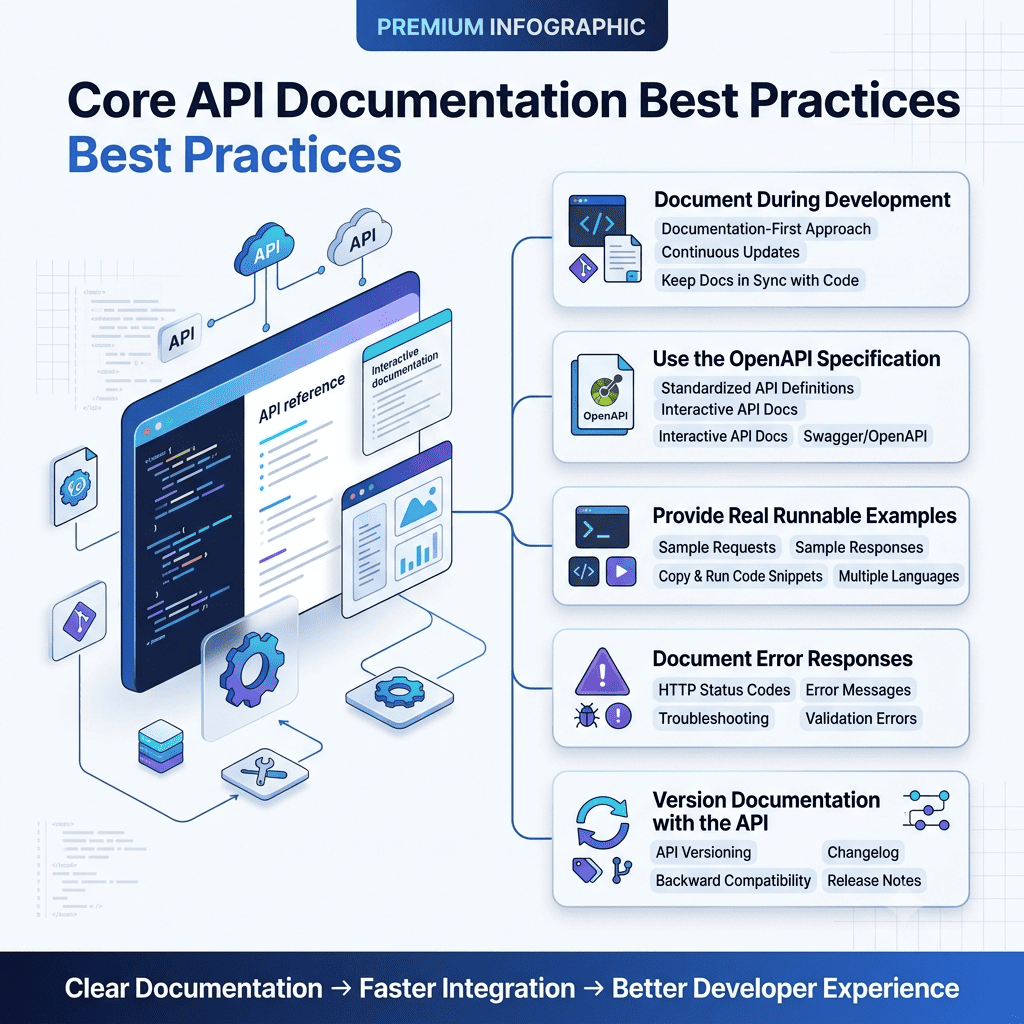
Writing for Different Documentation Audiences
Internal Engineering Docs
Documentation written for a team’s own engineers can reasonably assume shared context, familiarity with internal terminology, existing architecture decisions, prior naming conventions, that would need explaining for an outside audience. The risk here isn’t over-explaining, it’s under-documenting on the assumption that “everyone already knows this,” which stops being true the moment a new engineer joins or enough time passes that even the original author has forgotten the specifics.
Partner and Third-Party Integration Docs
Documentation meant for an external partner or third-party developer needs to assume considerably less shared context, and needs to be more defensive about edge cases, since an outside team can’t simply walk over and ask a clarifying question the way an internal engineer can. This audience also benefits most from the kind of thorough testing discipline covered in our mobile app testing guide, the same principle, verifying behavior thoroughly rather than assuming it works as documented, applies directly to making sure external-facing API documentation actually matches what the API does in every case a partner is likely to hit.
Public Developer Portal Documentation
A fully public API, one meant to attract external developers building on top of it, needs documentation treated as a genuine product surface, complete with a clear getting-started path, since a confusing first five minutes is often enough to lose a developer evaluating several API options at once. This is the audience where interactive documentation, letting a developer test a call directly from the docs page, tends to matter most, since it shortens the gap between reading about an endpoint and confirming it actually works as described.
Manually Written vs. Auto-Generated API Documentation
Neither approach is strictly superior, and most mature API documentation setups end up combining both rather than picking one exclusively.
Factor | Manually Written | Auto-Generated |
Accuracy over time | Drifts without disciplined maintenance | Stays in sync automatically with the codebase |
Narrative quality | Can explain context, use cases, and reasoning | Typically limited to structural, parameter-level detail |
Initial effort | Higher, requires dedicated writing time | Lower, generated from existing code annotations |
Best fit | Conceptual guides, getting-started tutorials | Endpoint reference, parameter and schema detail |
Maintenance burden | Ongoing, requires active upkeep | Minimal once the generation pipeline is set up |
The strongest documentation setups use auto-generation for the reference material, endpoints, parameters, response schemas, where accuracy matters most and narrative adds little, while reserving manually written content for conceptual guides and getting-started material where explaining the “why” behind an API’s design genuinely helps a developer integrate faster.
The Real Cost of Skipping API Documentation
Poor documentation doesn’t fail loudly. It fails as a slow accumulation of support tickets asking questions the documentation should have already answered, integration timelines that run longer than they should because a partner developer is reverse-engineering behavior from trial and error, and internal onboarding that takes noticeably longer every time a new engineer has to ask a teammate instead of finding the answer written down. None of these show up as a single dramatic incident, which is exactly why documentation debt is so easy to keep deprioritizing, the cost is real but diffuse, spread across many small frictions rather than one clear failure anyone gets blamed for.
There’s a security angle too, one that connects directly to broader API practice. Undocumented or poorly documented endpoints are more likely to be misused unintentionally, and our API security checklist covers several failure patterns, excessive data exposure in particular, that trace back to integrators not fully understanding what an endpoint actually returns because the documentation didn’t make it clear.
How to Get a Team to Actually Maintain API Documentation
Making documentation part of a pull request’s review checklist, not a separate ticket, is the single most effective cultural change most teams can make, since it puts documentation in front of the same review process and social accountability that already governs code quality. Assigning clear ownership matters too, documentation without a named owner tends to drift the same way an unowned codebase does, accumulating small inaccuracies nobody feels responsible for fixing. The Write the Docs community guide is a genuinely useful resource here, less a rulebook than a distilled set of practices from teams that have actually solved this problem repeatedly across very different engineering cultures.
Treating documentation quality as connected to the same processes that shape reliable software generally helps too. Our guide on mobile app development processes covers a similar dynamic, disciplines that feel like overhead in isolation, testing, documentation, code review, compound into meaningfully faster delivery once they’re built into the workflow rather than treated as optional extras squeezed in when time allows.
How The Apps Developers Approaches API Documentation
Documentation is scoped as part of the same process that shapes API and backend development work generally, using the OpenAPI Specification as the source of truth from the start rather than treating documentation as a deliverable requested separately once a project is nearly finished.
That discipline mirrors Google’s own widely referenced API design guide, which treats documentation and interface design as inseparable, an API’s usability is shaped as much by how clearly it’s explained as by how well it’s built underneath.
If your team is dealing with the support burden or onboarding friction that comes from documentation that’s fallen behind, or you’re scoping a new API and want documentation built in as a first-class part of the process, that’s worth a direct conversation. You’re welcome to talk to our team about what a properly documented, properly maintained API setup would look like for your specific project.