Mobile app development is the process of designing, building, testing, launching, and maintaining software applications that run on smartphones, tablets, and other mobile devices. Businesses use mobile applications to improve customer experiences, automate operations, increase revenue opportunities, and create scalable digital products.
Mobile applications have become one of the most important tools for businesses looking to build stronger relationships with customers and improve internal processes.
From ecommerce and banking to healthcare, education, logistics, and enterprise software, mobile apps help organizations deliver faster, more personalized, and more convenient digital experiences.
However, successful mobile app development involves much more than writing code.
Businesses need to make strategic decisions about:
- App platforms
- User experience
- Technology selection
- Security
- Backend infrastructure
- Scalability
- Maintenance
Choosing the wrong approach can increase development costs, create performance issues, and limit future growth.
This guide explains everything businesses need to know about mobile app development, including:
- What mobile app development means
- Types of mobile applications
- Development process
- Technology choices
- Cost factors
- Development timelines
- Best practices
- How to choose the right development partner
What Is Mobile App Development?
Mobile app development is the process of creating software applications specifically designed to operate on mobile devices such as smartphones and tablets. It includes planning, designing, programming, testing, deployment, and ongoing maintenance.
A modern mobile application usually consists of three major layers:
1. Mobile Frontend
The frontend is the part users interact with.
Examples include:
- Screens
- Buttons
- Navigation
- Forms
- Animations
- User interactions
The frontend determines how users experience the application.
2. Backend Infrastructure
The backend powers the functionality behind the application.
It manages:
- User accounts
- Databases
- APIs
- Authentication
- Business logic
- Cloud services
For example, a food delivery application requires backend systems to manage:
- Restaurants
- Orders
- Payments
- Delivery tracking
- Notifications
3. Administration Dashboard
Many business applications require a web-based dashboard where companies can manage:
- Users
- Content
- Orders
- Reports
- Analytics
- Application settings
A complete mobile solution often requires frontend development, backend engineering, database architecture, and administration tools working together.
Businesses looking to build scalable applications often partner with experienced mobile app development services providers to ensure the product is designed for long-term growth.
Why Mobile App Development Matters for Businesses
Mobile apps are no longer only customer engagement tools.
They have become important business platforms that help companies improve operations, increase revenue, and deliver better user experiences.
Improve Customer Engagement
Mobile applications allow businesses to communicate directly with users through:
- Push notifications
- Personalized recommendations
- Loyalty programs
- In-app messaging
- Customer support features
Unlike websites, mobile apps create a direct connection with users through their devices.
Create New Revenue Channels
Businesses use mobile applications to generate revenue through:
- Ecommerce transactions
- Subscription services
- Marketplace models
- Digital products
- In-app purchases
Many modern companies have built entire business models around mobile-first experiences.
Improve Business Operations
Mobile apps can also improve internal workflows.
Organizations use enterprise mobile applications for:
- Employee management
- Field service operations
- Inventory tracking
- Logistics management
- Sales automation
For example, a manufacturing company may use a mobile application to help employees monitor equipment performance in real time.
Strengthen Brand Presence
A well-designed mobile application improves:
- Brand recognition
- Customer loyalty
- Retention rates
- User satisfaction
A mobile app provides businesses with a consistent digital channel where customers can interact with their products and services.
Types of Mobile Applications
Businesses have several options when choosing a mobile app development approach.
The right option depends on:
- Business goals
- Target audience
- Budget
- Performance requirements
- Long-term strategy
The main types of mobile applications include:
- Native mobile applications
- Cross-platform applications
- Hybrid applications
- Progressive Web Applications
Native Mobile App Development
Native mobile app development refers to building applications specifically for one operating system using platform-specific programming languages and development tools.
Examples:
iOS Native Development
Technologies:
- Swift
- Objective-C
- Xcode
Android Native Development
Technologies:
- Kotlin
- Java
- Android Studio
Native applications are optimized specifically for their operating systems.
Advantages of Native Apps
Native apps provide:
Better Performance
Because they are built specifically for one platform, they can maximize device performance.
Better Hardware Access
Native applications can easily integrate with:
- Camera
- GPS
- Bluetooth
- Sensors
- Biometrics
Strong User Experience
They follow platform-specific design guidelines.
Best Use Cases for Native Apps
Native development is commonly used for:
- Banking applications
- Healthcare applications
- High-performance products
- Gaming applications
- Apps requiring advanced device features
Cross Platform Mobile App Development
Cross-platform mobile app development allows businesses to create applications for multiple platforms using a shared codebase.
Popular frameworks include:
- Flutter
- React Native
- .NET MAUI
Cross-platform development has become popular because it allows companies to launch applications faster while reducing development effort.
Advantages of Cross Platform Apps
Benefits include:
Faster Development
Developers can reuse code across multiple platforms.
Lower Development Cost
Businesses do not need completely separate teams for iOS and Android.
Easier Maintenance
Updates can be managed more efficiently.
Faster Market Launch
Companies can validate products faster.
For startups and businesses building MVPs, cross-platform development can provide an efficient way to test ideas before investing heavily.
Native vs Cross Platform Mobile App Development
| Factor | Native Development | Cross Platform Development |
| Performance | Excellent | Very Good |
| Development Speed | Slower | Faster |
| Cost | Higher | Lower |
| Code Reuse | Limited | High |
| Maintenance | More complex | Easier |
| Platform Optimization | Maximum | Good |
| Best For | Complex apps | Faster multi-platform launches |
There is no universal winner between native and cross-platform development.
The correct choice depends on:
- Application complexity
- Performance expectations
- Budget
- Target users
- Future roadmap
Hybrid Mobile Applications
Hybrid mobile applications combine web technologies with native application capabilities to deliver mobile experiences.
Hybrid apps are commonly built using:
- HTML
- CSS
- JavaScript frameworks
They can be useful for:
- Simple applications
- Internal business tools
- Content-based apps
However, applications requiring advanced performance often benefit from native or cross-platform approaches.
Progressive Web Applications (PWAs)
A Progressive Web Application is a web application that provides app-like experiences through modern browser technologies.
PWAs can offer:
- Offline functionality
- Fast loading
- Push notifications
- Home screen installation
They are useful for businesses that want mobile accessibility without building separate applications for different platforms.
According to Google, progressive web apps combine the reach of the web with modern application capabilities.External reference: https://web.dev/explore/progressive-web-apps
Mobile App Development Process: 6 Key Stages
The mobile app development process includes six major stages: discovery, UI/UX design, development, testing, deployment, and maintenance. Each stage helps transform a business idea into a secure, scalable, and user-friendly mobile application.
A structured development process helps businesses reduce risks, control costs, and create applications that meet both user expectations and business goals.
The six stages include:
- Discovery and strategy
- UI/UX design
- Mobile app development
- Quality assurance and testing
- App deployment
- Maintenance and continuous improvement
Step 1: Discovery and Strategy
The discovery phase defines the purpose, requirements, and roadmap of the application.
Before development begins, teams analyze:
- Business objectives
- Target audience
- Competitor applications
- Required features
- Platform requirements
- Technology stack
- Budget expectations
During this stage, businesses answer important questions:
- What problem will the app solve?
- Who are the target users?
- Should the app support iOS, Android, or both?
- Which features are required for launch?
- What future scalability requirements exist?
A detailed discovery process helps prevent unnecessary development costs and ensures the application is aligned with business goals.
Step 2: Mobile App UI/UX Design
The UI/UX design stage focuses on creating an application experience that is simple, intuitive, and engaging.
The design process includes:
- User research
- Customer journey mapping
- Wireframes
- Interactive prototypes
- Visual design
- Usability testing
A successful mobile application design should prioritize:
- Easy navigation
- Fast interactions
- Accessibility
- Consistent branding
- User satisfaction
Professional UI/UX design services help businesses create applications that users can understand and navigate easily.
Step 3: Mobile App Development
The development phase transforms approved designs into a working mobile application.
Developers build:
- Frontend interfaces
- Backend systems
- APIs
- Databases
- Third-party integrations
- Security features
Mobile app development usually consists of two core areas:
Frontend Development
Frontend development focuses on the user-facing application.
It includes:
- Screens
- Navigation
- Forms
- Animations
- User interactions
- Device features
The goal is to create a smooth experience across different devices and operating systems.
Backend Development
Backend development manages the systems that power the application.
It includes:
- Database management
- User authentication
- APIs
- Business logic
- Cloud infrastructure
Applications requiring advanced integrations often need reliable API development services to connect mobile applications with external platforms, payment systems, and enterprise software.
Step 4: Quality Assurance and Testing
Testing ensures the application works correctly, performs reliably, and provides a secure experience.
Mobile app testing includes:
Functional Testing
Checks whether features work properly.
Examples:
- User registration
- Login
- Payments
- Search
- Notifications
Performance Testing
Evaluates:
- Loading speed
- Application stability
- Memory usage
- Battery consumption
Security Testing
Identifies vulnerabilities related to:
- Authentication
- Data protection
- Privacy
The OWASP Mobile Application Security Testing Guide provides security testing guidance for mobile applications.
Device Testing
Applications should be tested across:
- Different screen sizes
- Operating systems
- Hardware configurations
Step 5: App Deployment
After testing, the application is prepared for launch.
Deployment includes:
- App store submission
- Store optimization
- Screenshots and descriptions
- Compliance checks
- Release configuration
For iOS applications, businesses must follow the Apple App Store Review Guidelines.
For Android applications, developers follow the Google Play Console documentation.
Step 6: Mobile App Maintenance and Updates
Mobile app development continues after launch.
Regular maintenance helps businesses:
- Fix bugs
- Improve performance
- Add new features
- Maintain security
- Support operating system updates
Businesses planning long-term growth should consider mobile app maintenance services to keep their applications reliable and competitive.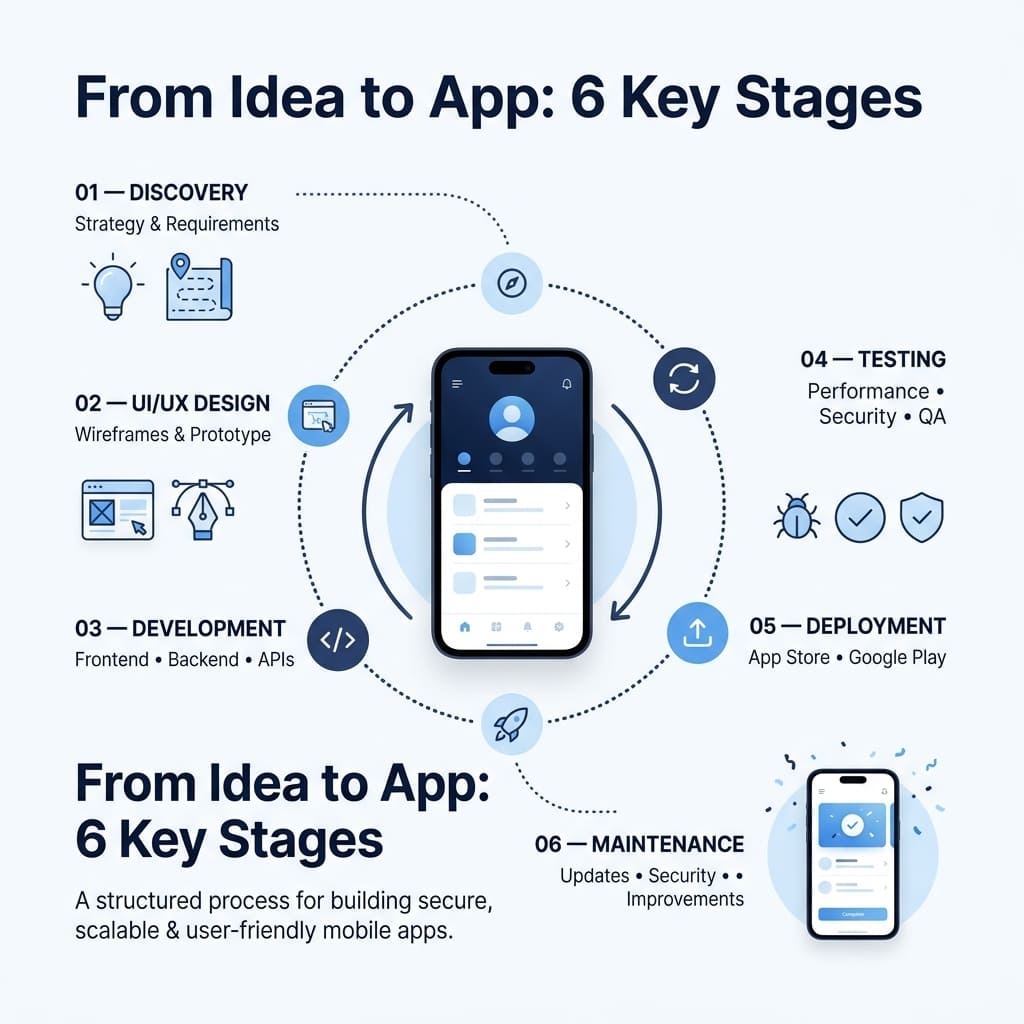
How Much Does Mobile App Development Cost?
Mobile app development costs typically range from $20,000 to $250,000+ depending on application complexity, features, platforms, design requirements, backend infrastructure, and development approach.
The final cost depends on several factors.
Mobile App Development Cost Breakdown
| Application Type | Estimated Cost | Development Timeline |
| Simple Mobile App | $20,000 to $50,000 | 3 to 6 months |
| Medium Complexity App | $50,000 to $150,000 | 6 to 9 months |
| Complex Enterprise App | $150,000+ | 9+ months |
These estimates vary based on:
- Features
- Technology stack
- Development team location
- Backend requirements
- Integrations
- Security requirements
For a detailed breakdown, businesses can explore this mobile app development cost guide.
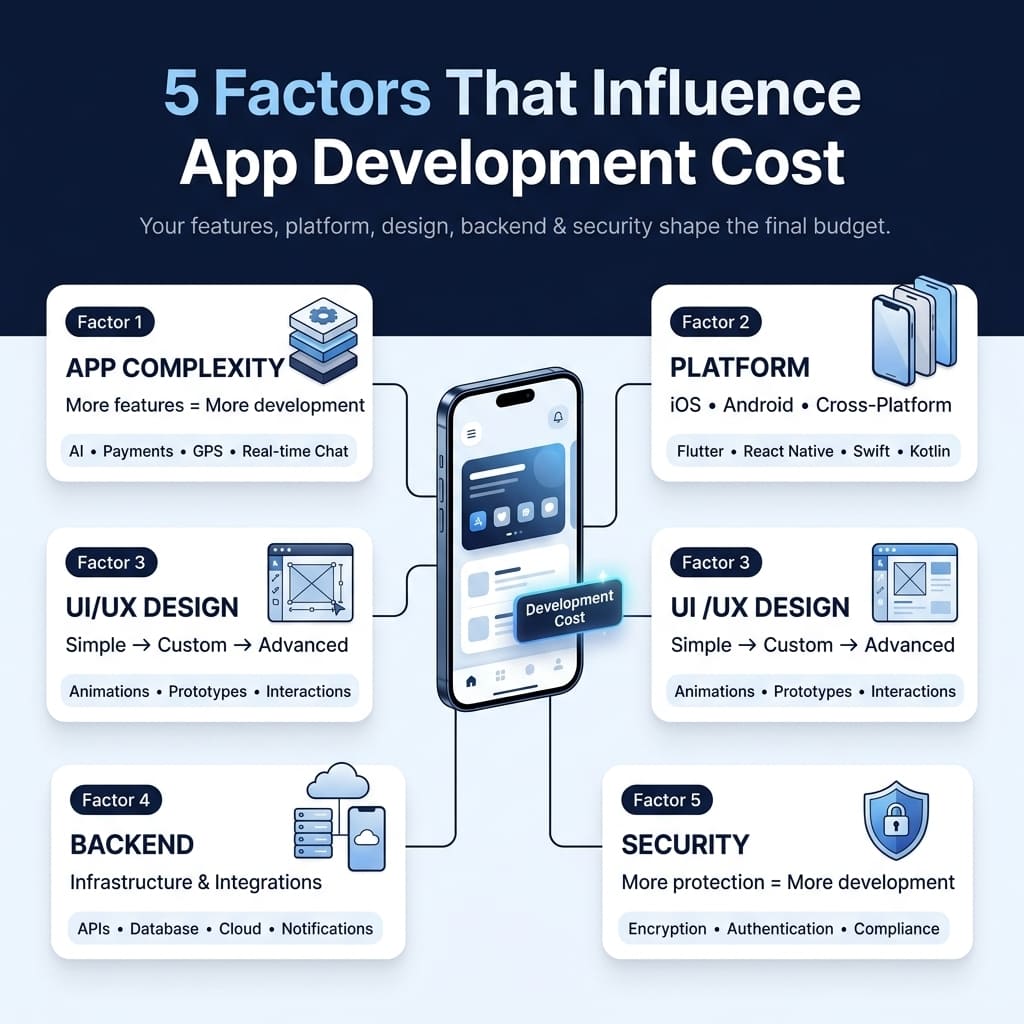
Factors That Influence Mobile App Development Cost
1. App Complexity
A basic application with limited features requires less investment than a complex platform.
Examples of complex features:
- Real-time messaging
- AI recommendations
- Payment processing
- GPS tracking
- Video streaming
- Advanced analytics
2. Platform Selection
Building for one platform generally costs less than creating separate applications for:
- iOS
- Android
Cross-platform frameworks can reduce development effort by allowing shared code.
Popular technologies include:
- Flutter
- React Native
- Kotlin
- Swift
Businesses comparing technologies can explore Flutter vs React Native for mobile app development before selecting a development approach.
3. UI/UX Requirements
Applications requiring advanced user experiences usually require more design effort.
Cost factors include:
- Custom illustrations
- Animations
- Interactive elements
- User research
- Prototyping
4. Backend Development
Many mobile apps require backend systems for:
- User management
- Data processing
- Payments
- Notifications
- Analytics
A simple application may require a basic backend, while enterprise applications need scalable cloud infrastructure.
5. Security Requirements
Applications handling sensitive data require additional security measures.
Examples:
- Encryption
- Secure authentication
- Access controls
- Compliance requirements
How Long Does It Take To Develop a Mobile App?
The average mobile app development timeline ranges from 3 months for simple applications to 12 months or more for complex enterprise solutions.
| App Complexity | Timeline |
| Simple Application | 3 to 6 months |
| Medium Complexity Application | 6 to 9 months |
| Enterprise Application | 9 to 18+ months |
Timeline depends on:
- Number of features
- Design complexity
- Testing requirements
- Team size
- Approval cycles
Mobile App Development Technologies
Choosing the right technology affects:
- Cost
- Performance
- Scalability
- Maintenance
Flutter Development
Flutter is Google’s cross-platform framework that allows developers to build applications from a single codebase.
Advantages:
- Faster development
- Consistent UI
- Reduced maintenance effort
Official reference:
Flutter Documentation
React Native Development
React Native allows developers to create mobile applications using JavaScript and React.
Advantages:
- Large developer ecosystem
- Code reuse
- Faster development
Official reference:
React Native Documentation
Native iOS Development
Native iOS development uses:
- Swift
- Xcode
Best for applications requiring maximum Apple ecosystem optimization.
Native Android Development
Native Android applications commonly use:
- Kotlin
- Android Studio
Best for applications requiring deep Android platform integration.
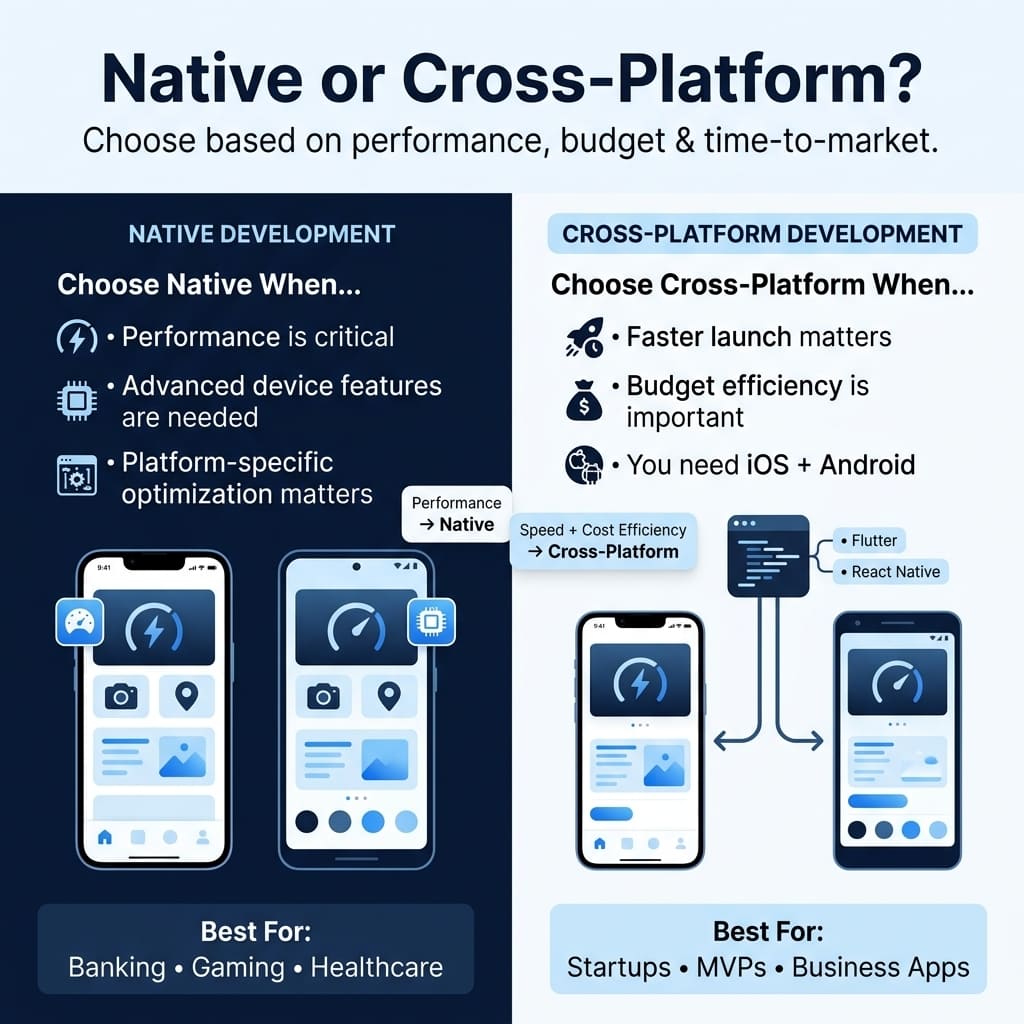
How To Choose The Right Mobile App Development Approach
Before building an application, businesses should evaluate:
Choose Native Development When:
- Performance is critical
- Advanced device features are required
- Platform-specific optimization matters
Examples:
- Banking apps
- Gaming apps
- Healthcare applications
Choose Cross Platform Development When:
- Faster launch is important
- Budget efficiency matters
- Multiple platforms are required
Examples:
- Startups
- MVP products
- Business applications
Common Mobile App Development Mistakes To Avoid
Building Too Many Features Initially
Many businesses try to launch with every possible feature.
Better approach:
Start with an MVP and improve based on user feedback.
Learn more about MVP development strategy.
Ignoring User Experience
A technically strong application can fail if users find it difficult to navigate.
Choosing Technology Without Strategy
Technology decisions should consider:
- Business goals
- Future scaling
- Maintenance requirements
Ignoring Security
Security should be considered from the beginning, not added later.
How To Choose A Mobile App Development Company
Choosing the right development partner is one of the most important decisions.
Businesses should evaluate:
Technical Expertise
Review experience with:
- Mobile platforms
- Backend systems
- Cloud infrastructure
- Security
Previous Projects
Look for:
- Similar industry experience
- Technical complexity
- Product understanding
Development Process
A reliable partner should have:
- Discovery process
- Design workflow
- Testing approach
- Communication system
Businesses evaluating vendors can also review this guide on how to choose a mobile app development company.
Mobile App Development Checklist
Before starting development, businesses should define:
✓ Target users✓ Business goals✓ Required platforms✓ Core features✓ Budget expectations✓ Development timeline✓ Technology approach✓ Security requirements✓ Maintenance plan
Build A Mobile Application That Supports Your Business Goals
Mobile app development is not just about creating software.
A successful application requires:
- Strong strategy
- User-focused design
- Reliable technology
- Scalable architecture
- Continuous improvement
Whether you are building a customer-facing application, enterprise solution, or digital product, choosing the right development approach can determine long-term success.
If you are planning a mobile application, The Apps Developers can help evaluate your idea, recommend the right technology approach, and create a scalable development roadmap.
Discuss your mobile app idea with our development experts and understand the right strategy before investing in development.
Frequently Asked Questions
What is mobile app development?
Mobile app development is the process of designing, creating, testing, deploying, and maintaining applications that run on smartphones and tablets. It involves frontend development, backend systems, UI/UX design, testing, and ongoing improvements.
How much does mobile app development cost?
Mobile app development costs usually range from $20,000 to $250,000+ depending on complexity, features, platforms, design requirements, backend infrastructure, and security needs.
How long does it take to build a mobile app?
A mobile app usually takes 3 to 12 months to develop. Simple applications require less time, while enterprise applications with advanced features may take a year or longer.
Which technology is best for mobile app development?
The best technology depends on project requirements. Flutter and React Native work well for cross-platform apps, while Swift and Kotlin are preferred for native iOS and Android applications.
Should businesses build native or cross-platform apps?
Native apps provide maximum platform optimization, while cross-platform apps offer faster development and lower costs. The right choice depends on performance needs, budget, and business goals.
Do mobile apps require maintenance after launch?
Yes. Mobile applications require ongoing maintenance for security updates, bug fixes, operating system changes, performance improvements, and new features.