

Mobile game development cost typically ranges from around 15,000 dollars for a simple hypercasual game to 60,000 dollars or more for a polished casual or mid-core title, with multiplayer and live-service games often exceeding 300,000 dollars once ongoing content and infrastructure are factored in. The honest answer to “how much does a mobile game cost” depends far more on genre and content volume than most generic pricing pages acknowledge.
If you’re past researching whether to build a game and need an actual number to plan against, this guide breaks down what genuinely drives that cost up or down, by genre, by feature, and by team structure, rather than repeating the same wide, unhelpful range every other cost guide leads with. This is the budgeting side of the same Mobile App Development process that shapes any serious game project, and it deserves the same real scrutiny as any other software investment.
What Determines Mobile Game Development Cost?
Genre and Content Volume
Genre is the single biggest predictor of mobile game development cost, since it determines how much content, how many levels, how much art, how complex the progression systems a game actually needs to feel complete. A hypercasual game built around one core mechanic needs comparatively little content to ship. A casual puzzle game, despite looking simple to a player, often needs hundreds of levels and a tuned difficulty curve, content costs that frequently exceed the cost of the core mechanic itself.
Platform Coverage
Building for both iOS and Android, rather than launching on a single platform first, adds real testing and optimization work, even when using a cross-platform engine like Unity, since device-specific performance tuning still varies meaningfully across the two ecosystems.
Art Style and Fidelity
Stylized 2D art is consistently cheaper to produce than high-fidelity 3D art, and it’s worth noting this isn’t purely a cost compromise, stylized aesthetics often age better and can outperform photorealistic graphics in player reception for mobile specifically, where screen size and typical play context don’t always reward maximum visual fidelity the way a console game might.
Backend and Multiplayer Infrastructure
Any game requiring real-time multiplayer, leaderboards, cloud saves, or live events needs genuine API and backend development, which adds both development cost and ongoing operational cost that a purely single-player, offline game doesn’t carry at all.
Budgeting for this work follows similar patterns to those covered in our mobile app development cost guide, backend complexity is consistently one of the most underestimated cost drivers across both games and standard apps alike, since the visible frontend work tends to get priced carefully while the backend plumbing behind it gets a rougher estimate.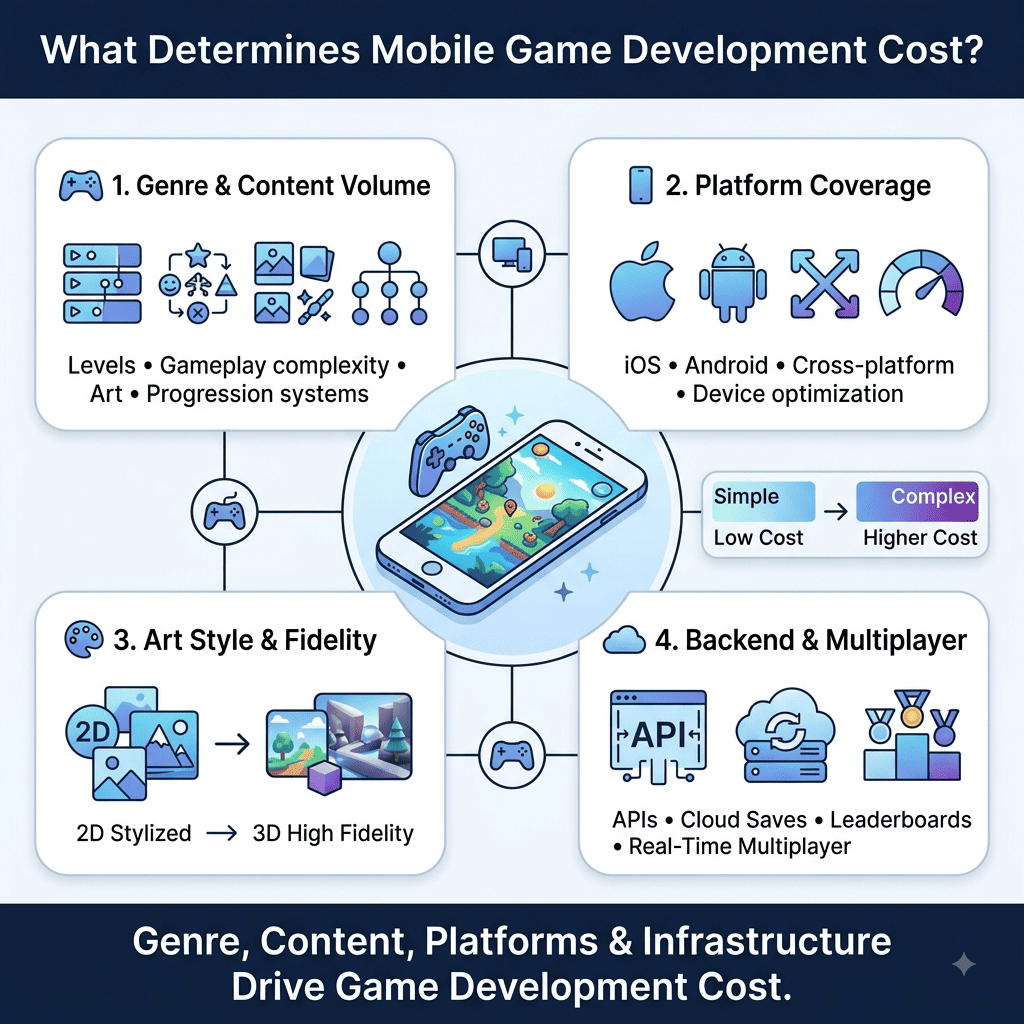
Mobile Game Development Cost by Genre
Genre | Typical Cost Range (USD) | What Drives It |
Hypercasual | 5,000 to 15,000 | Single core mechanic, minimal content, fast iteration cycle |
Casual / Puzzle | 15,000 to 60,000 | Hundreds of levels, difficulty tuning, meta progression layer |
Mid-core (RPG, strategy) | 60,000 to 300,000 | Character systems, progression, deeper content and balance |
Multiplayer / live-service | 300,000 and up | Server infrastructure, ongoing content, real-time systems |
These ranges reflect a synthesis of consistent patterns across independent industry sources, and given how widely individual quotes vary in this specific market, from a few thousand dollars for a bare MVP to seven figures for a live-service title, treat this table as a starting framework for a real scoping conversation, not a substitute for one.
In-House vs. Freelancer vs. Studio for Game Development
Factor | In-House Team | Freelancer | Development Studio |
Typical cost | Highest, fixed salary regardless of workload | Lowest hourly rate, variable total cost | Mid to high, project-managed |
Speed to start | Slow, requires hiring | Fast | Fast |
Skill breadth | Limited to what the team already knows | Narrow, single specialty | Broad, covers design, art, programming, QA |
Best fit | Long-term studios with ongoing game catalogs | Very narrow, well-defined scope | Most first-time or single-title game projects |
A development studio with genuine game-specific experience, not just general app development experience, tends to be the more capital-efficient choice for most businesses building their first game, since game development requires a specific mix of design, art, and technical skills that a general freelancer or a small in-house team often can’t fully cover on their own.
The Hidden Costs Beyond Initial Development
Marketing and User Acquisition
Marketing and user acquisition budgets frequently equal or exceed the development budget itself in competitive mobile gaming categories, a cost that catches first-time game businesses off guard when they’ve budgeted carefully for the build but treated discoverability as an afterthought.
App Store Fees
Both Apple and Google apply a commission on in-app purchases, worth checking Apple’s current developer program terms directly, since these rates and any small-developer exceptions can change and directly affect real revenue projections built around a game’s monetization model.
Google Play’s service fee policy applies a similar structure on the Android side, and the two platforms don’t always move their terms in lockstep, so budgeting off outdated information on either one is a real, avoidable risk.
Live Operations and Ongoing Content
For any game beyond a simple hypercasual title, ongoing content, new levels, seasonal events, balance updates, isn’t optional if the goal is sustained player engagement, and it needs its own recurring budget line separate from the initial build cost.
Server and Backend Infrastructure
Multiplayer or live-service games carry real, ongoing infrastructure costs, scaling with active player count, that a single-player offline game simply doesn’t have, worth modeling as an operating cost rather than a one-time development expense.
How Engine Choice Affects Cost
The choice between Unity and Unreal Engine, covered in more depth in our engine comparison guide, has a real cost implication beyond the technical tradeoffs. Unity’s lighter mobile footprint generally means less optimization work to hit acceptable performance across a wide range of devices, while Unreal Engine’s higher visual ceiling can justify its added development cost specifically when visual fidelity is a genuine differentiator for the game, not simply the default choice regardless of the project’s actual needs.
Monetization Model’s Effect on Development Cost
The monetization model chosen, covered in our monetization models guide, affects development cost directly, not just revenue potential. A pure ad-supported casual game needs simpler backend infrastructure than a game built around in-app purchases with virtual currency, inventory systems, and purchase validation, meaning the monetization decision should be factored into the budget conversation from the start rather than treated as a separate, later concern.
How Developer Location Affects Cost
Geography remains a real swing factor in game development quotes, the same way it does for general app development. A senior game developer in the US or Western Europe commands meaningfully higher rates than equivalent talent in Eastern Europe or South Asia, and offshore or nearshore teams can produce real savings for well-scoped projects. That said, game development leans more heavily on close creative collaboration, iterating on feel, balance, and player experience together, than a lot of standard app development does, which means communication overhead and time zone alignment can matter more here than in a typical business app project. A lower hourly rate that comes with real friction in creative back-and-forth isn’t always the actual cost-efficient choice once the full picture, not just the invoice, is considered.
Common Mistakes That Inflate Mobile Game Development Cost
Businesses frequently underestimate content costs specifically, budgeting generously for the core mechanic and art style while underestimating how much level design, balance tuning, and content volume a genre like casual puzzle actually requires to feel complete rather than thin, a gap that often only becomes visible once development is well underway and the content backlog is still growing. Choosing an engine or art style beyond what the project actually needs, Unreal Engine’s full rendering capabilities for a game that never needed console-quality visuals, adds real cost without a corresponding benefit to the actual player experience.
Skipping a real marketing budget while investing heavily in development is a particularly costly imbalance, since a technically excellent game with no discoverability plan struggles regardless of build quality in a market with tens of billions of downloads competing for attention every year. And treating live operations as optional for a game genre that genuinely depends on it, live-service and multiplayer titles specifically, leaves a launched game without the ongoing support that player retention and revenue actually depend on past the first few weeks, turning what should have been a sustainable product into a short-lived spike in downloads that fades once the initial novelty wears off.
How The Apps Developers Prices Mobile Game Development
Every game quote starts with a genuine scoping conversation about genre, content volume, and platform, not a generic rate card, because the cost drivers covered above genuinely do produce very different numbers for games that might look similar on the surface. That’s part of the same Mobile App Development process we bring to any project, matched specifically to the demands game development adds.
Design work receives particular attention in scoping, since the discipline behind creating an engaging player experience is a specialized part of UI/UX design with direct cost implications, not simply an extension of standard app interface work priced the same way.
If you’re trying to get from “roughly what should this cost” to an actual number for your specific game concept, that scoping conversation is the fastest way to get there. You’re welcome to talk to our team about what your game would realistically cost before committing to a number from a generic pricing page.