
Choosing a UI/UX design partner comes down to verifying research rigor, checking whether case studies show real business outcomes instead of just polished screens, and confirming the same senior team that pitches the project actually does the work. A beautiful portfolio gets you a conversation. It doesn’t tell you whether the team can actually solve your specific problem.
That distinction matters more than most buyers realize going in. A portfolio is a claim, not evidence, screens shown out of context, without the reasoning behind them, tell you almost nothing about whether an agency can diagnose a real product problem. This guide walks through how to evaluate a design partner past the polish, and it’s worth pairing with our broader guide on how to choose a mobile app development company if you’re also sourcing engineering, since design and development evaluation criteria overlap less than people assume.
What Does a UI/UX Design Partner Actually Do?
A UI/UX design partner is a team responsible for researching user needs, designing interfaces and flows, and validating that those designs actually solve the problem they were built for, rather than just producing visually polished screens. The strongest partners function closer to a product strategy team than a visual production shop, since design decisions made without research tend to be opinion-driven rather than grounded in real user behavior.
Design Partner vs. Full Development Company: Which Do You Need?
This decision comes before agency evaluation even starts, and getting it wrong wastes time on the wrong shortlist entirely.
| Factor | Standalone Design Partner | Full Development Company |
| Best fit | You have in-house engineering, or need design work independent of a build | You need research, design, and engineering under one accountable team |
| Primary deliverable | Research findings, wireframes, prototypes, design systems, dev-ready files | A shipped, working product |
| Handoff risk | Real, since design and engineering are separate teams that must coordinate | Lower, since the same team owns design through to shipped code |
| Evaluation focus | Research depth, design process, handoff quality | Everything a design partner needs, plus IP ownership, QA, and technical delivery |
If your team already has engineering capacity and just needs design expertise, this guide is the right one. If you need the whole product built end to end, the broader partner evaluation guide covers the additional criteria that matter once engineering enters the picture.
The Evaluation Framework
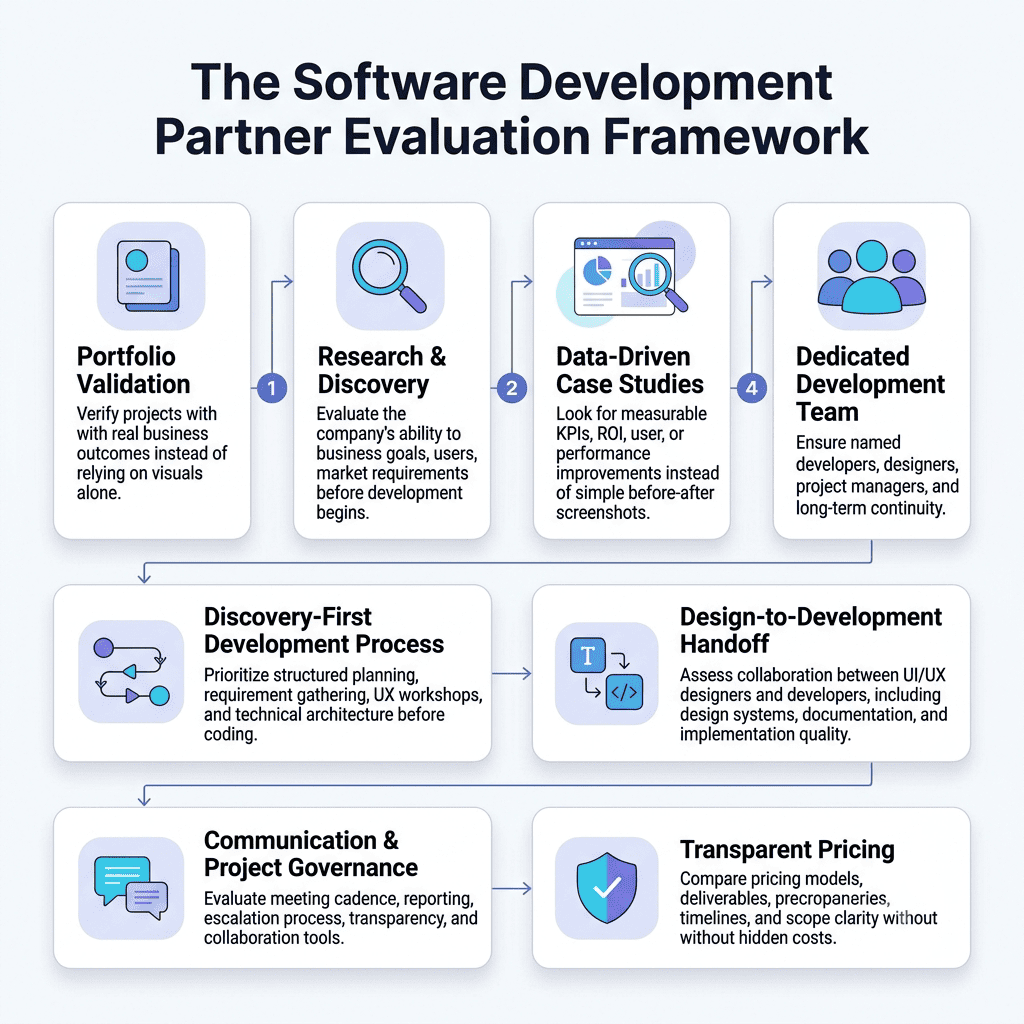
1. Treat the Portfolio as a Claim to Verify, Not a Decision to Make
A portfolio shows what an agency wants you to see. It doesn’t show the problem that required the design, the alternatives the team rejected, or whether the work is actually running in production with real users. Ask what was tried and abandoned along the way. Teams with real experience have discarded patterns that tested poorly, and that discarded work usually tells you more than the polished final screens do.
2. Research Depth Is the Real Differentiator
The single biggest gap between agencies that improve real product outcomes and agencies that improve surface aesthetics is how seriously they treat research before design work starts. Ask directly who runs research on their team and what methods they actually use, interviews, usability testing, behavioral analysis. An agency without a dedicated research capability is, in practice, a visual design shop rather than a full UX partner, which overlaps with the same distinction covered in our guide to usability testing methods by budget. Nielsen Norman Group’s research on UX return on investment is a useful, non-promotional reference for why this distinction matters financially, not just aesthetically.
3. Case Studies Need Metrics, Not Just Before/After Screens
“We redesigned the onboarding flow” describes an activity. A case study naming what changed afterward, activation, retention, support ticket volume, is evidence. If every case study in a portfolio leans on positive client quotes rather than measurable outcomes, that’s worth noticing rather than overlooking.
4. Named, Continuous Team Staffing
The senior designers in the pitch meeting should be the same people doing the actual work. Ask for named staffing in writing before signing anything, since a pitch team that vanishes after the contract is signed, replaced by junior staff mid-project, is one of the more common ways engagements quietly underdeliver.
5. A Real Discovery-First Process
A design partner worth hiring wants to understand the full system before touching any part of it, asking business questions before jumping to deliverables. If a team responds to a rough problem statement with a generic capabilities deck instead of real questions, that’s a signal about how the actual engagement will go.
6. Design-to-Development Handoff Quality
Design work that never accounts for how it gets built creates friction and rework once engineering picks it up. Ask how the team documents component states, spacing, and interaction details for a development team, and whether they’ve worked within an existing design system or built one from scratch, since that experience shapes how smoothly a handoff actually goes.
7. Communication Cadence and Escalation Path
Weekly working sessions and a named point of contact for questions predict a smoother engagement than status-only updates and vague turnaround times. Ask specifically how the team communicates day to day, not just how often they’ll present finished work.
8. Pricing Transparency
A clear fee structure, defined scope boundaries, and a written change-order process signal how an agency will handle the inevitable moments a project’s scope shifts. A proposal that seems unusually cheap compared to others is worth double-checking, since the gap often comes from cut research or reduced iteration rather than genuine efficiency.
Questions to Ask Before Signing
- Can you walk us through a project where research changed your original design direction?
- Who is the named senior designer on our project, and will they be doing the actual work?
- What metric defined success on your most recent comparable project, and how was it tracked?
- How do you structure design-to-development handoff, and have you worked within an existing design system before?
- What does your communication cadence actually look like week to week?
Red Flags Worth Walking Away From
A portfolio built entirely of polished final screens, with no explanation of the problem or process behind them, is one of the clearest signals to notice. So is a proposal that jumps straight to deliverables without asking a single real question about the business problem. A pitch team that can’t be named or guaranteed in writing, vague pricing with no defined scope boundaries, and case studies with zero mention of measurable outcomes all point in the same direction: a team optimized for winning the pitch, not necessarily for solving your actual problem.
Should You Run a Pilot Project First?
For an engagement with real budget and stakes, a focused pilot, redesigning one onboarding flow or one high-traffic screen, is a lower-risk way to evaluate process, communication, and actual output before committing to a larger scope. It reveals far more about how a team actually works than a proposal deck ever will, and it’s a reasonable ask of any agency confident in what they deliver.
How The Apps Developers Meets This Standard
Our UI/UX design work starts with research, not mockups, and our portfolio reflects shipped, verifiable products rather than concept pieces built purely for a case study page. If you’re evaluating design partners against the criteria in this guide, we’re comfortable being measured against it directly.
Conclusion
Choosing a UI/UX design partner is a risk decision dressed up as a creative one. Verify the portfolio instead of admiring it, weigh research depth over visual polish, and get named team staffing in writing before signing anything. The agencies worth hiring will welcome that scrutiny, not deflect it.
If you’re evaluating design partners for your next project, get in touch. We’re glad to walk through our process, our research approach, and our portfolio directly.