

- Home
- App Development
- Blog Details
- 12 mins read
How AI And ML Are Changing Mobile App Development
- Published on:
- Written by:
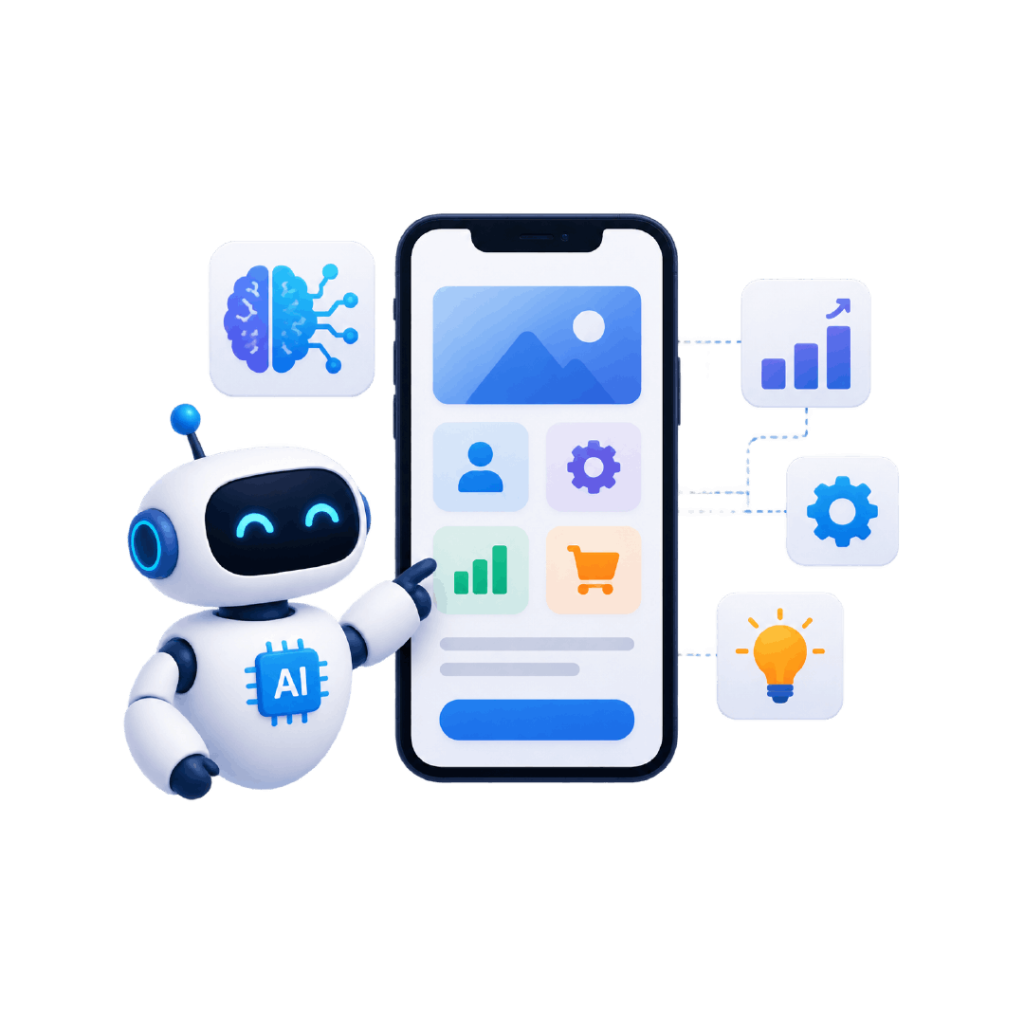
AI and machine learning are changing mobile app development in two ways: they expand what apps can do and improve how teams design, build, test, and optimize them. The strongest use cases solve a defined user or business problem rather than adding AI simply because the technology is available.
Businesses planning these capabilities should treat AI as part of the wider product architecture, not as an isolated feature. The same product, backend, UX, security, and scalability decisions still apply to mobile app development services.
What Role Do AI and ML Play in Mobile App Development?
AI and machine learning help mobile apps understand information, generate responses, automate decisions, and deliver more personalized experiences. AI handles tasks such as language processing, image recognition, and automation, while machine learning enables apps to identify patterns in user behavior and improve predictions, recommendations, and decision-making over time.
AI-powered mobile apps can use cloud-based models or on-device intelligence depending on the feature requirements. On-device AI improves response time, privacy, and offline functionality, while cloud AI supports complex models that require greater computing power. Many modern apps combine both approaches to balance performance, scalability, and user experience.
How Are AI and ML Changing Mobile App Features?
AI and ML make mobile apps more adaptive, predictive, and responsive to individual users. The most practical applications include personalization, recommendations, prediction, conversational interfaces, computer vision, and anomaly detection.
Personalized User Experiences
ML can adjust content, offers, navigation, or messaging based on user behavior and context. Personalization works best when it improves a specific interaction rather than changing every screen.
A recommendation system, for example, may rank products, videos, services, or content based on signals such as previous interactions and user preferences. Our guide to AI-driven mobile app personalization explains this use case in greater depth.
Predictive Analytics
Predictive models estimate what may happen next based on available data. Mobile apps can use predictions for demand forecasting, churn risk, maintenance alerts, fraud risk, delivery estimates, or user intent.
The prediction should lead to an action. A churn score has little product value unless the app or business can use it to improve retention.
Conversational, Voice, and Vision Features
AI allows users to interact with apps through natural language, speech, images, and camera input. Common applications include support assistants, voice search, document scanning, object recognition, translation, and content summarization.
These features change interface design as well. Users may complete a task through a conversation or camera instead of navigating several traditional screens.
Fraud and Anomaly Detection
ML can identify activity that differs from expected behavioral patterns. Financial, marketplace, ecommerce, and account-based applications can use anomaly detection to flag suspicious transactions, unusual logins, or abnormal usage.
The model should support existing security controls rather than replace authentication, authorization, or secure application architecture.
How Are AI and ML Changing the Mobile App Development Process?
AI is also changing how mobile apps are produced. Development teams can use AI-assisted tools during planning, coding, testing, debugging, and product analysis, but generated outputs still require technical validation.
Product Planning and Prototyping
AI can help teams analyze requirements, organize user feedback, explore user flows, and create early content or prototype variations. This can shorten exploratory work, but product decisions should still come from validated user and business requirements.
AI-Assisted Development
Developers can use AI tools for code suggestions, documentation, refactoring, repetitive implementation tasks, and debugging support. The benefit is primarily development efficiency.
Generated code still needs architecture review, security checks, testing, and maintainability assessment before it becomes production code.
Testing and Quality Assurance
AI-assisted testing can help generate test cases, identify patterns in failures, and prioritize areas that may require additional coverage. It does not eliminate traditional functional, integration, security, performance, and device testing.
What Technical Requirements Do AI-Powered Mobile Apps Need?
AI-powered apps need more than a model. They require suitable data, inference infrastructure, APIs or device-side integration, monitoring, security, and a clear method for handling inaccurate or unavailable AI outputs.
Data Quality and Availability
Machine learning depends on data that represents the problem being solved. Teams should define what data is needed, where it comes from, whether users have consented to its use, and whether it is accurate enough for the intended decision.
More data is not automatically better. Relevant and representative data matters more than collecting information without a specific purpose.
AI Models, APIs, and Backend Infrastructure
A mobile app can use a third-party AI API, a pre-trained model, or a custom model. The choice affects development effort, control, cost, privacy, and maintenance.
Cloud-based AI may also require backend services for authentication, request management, data processing, logging, usage controls, and model orchestration.
Performance, Latency, and Scalability
AI features must respond quickly enough for their user journey. A camera feature may need near-real-time inference, while a generated report can tolerate a longer response.
Teams should also plan for API limits, model size, battery use, bandwidth, concurrency, and inference costs as usage grows.
How Do AI and ML Affect App Development Cost and Timeline?
AI and machine learning can increase mobile app development cost and timeline depending on the complexity of the use case, data requirements, integration effort, and ongoing maintenance needs. The main cost drivers are not AI itself but the work required to prepare data, connect models, test performance, and maintain reliable AI functionality.
Third-party AI APIs and pre-trained models can reduce initial development time because the core intelligence already exists. However, they may introduce usage fees, platform limitations, and dependency on external providers. Custom AI models provide more control but require additional investment in data preparation, model development, testing, deployment, and specialized expertise.
Projects also take longer when data must be collected, cleaned, labeled, or connected from multiple sources before an AI feature can work effectively. Backend systems, authentication, existing databases, and business workflows can further impact integration effort. Businesses should evaluate AI-specific requirements alongside overall mobile app development costs.
AI features can also create ongoing expenses after launch, including model usage, cloud infrastructure, storage, monitoring, retraining, and technical maintenance. These recurring costs should be considered as part of the total ownership cost rather than only the initial development budget.
What Challenges Come With AI and ML Mobile Apps?
The main challenges are accuracy, data privacy, security, bias, and long-term model reliability. These issues should be considered during product design because an AI feature can produce technically valid output that is still wrong or inappropriate for the user.
Accuracy and Reliability
AI systems can make incorrect predictions or generate unreliable outputs. High-impact actions should therefore include validation rules, confidence thresholds, fallback behavior, or human review where appropriate.
The level of control should match the consequence of an incorrect result.
Privacy and Security
AI features may process personal, behavioral, financial, location, image, or conversational data. Teams should minimize unnecessary collection, protect data in transit and storage, secure backend APIs, and control access to sensitive information.
Bias and Model Monitoring
Models can produce poor results when training data does not represent real users or when user behavior changes after deployment. Teams should monitor model quality and evaluate whether performance differs across important user groups or scenarios.
When Should You Add AI or ML to a Mobile App?
Add AI when it solves a problem that conventional application logic cannot solve efficiently enough. A defined use case, suitable data, and measurable outcome should come before model or technology selection.
When AI Solves a Specific User Problem
Strong use cases begin with a task such as improving recommendations, detecting fraud, understanding images, predicting demand, or answering complex user questions.
“Add an AI assistant” is not a complete product requirement.
When Useful Data Is Available
ML becomes practical when the app has enough relevant data or can use a reliable pre-trained model. Products with little historical data may need to start with rules, third-party models, or a smaller validation experiment.
For new products, an MVP development approach can validate whether the AI feature improves the intended outcome before investing in a more complex model.
When Traditional Logic Is Not the Better Choice
AI should not replace deterministic logic when the answer can be defined reliably through simple rules. Calculations, permissions, fixed eligibility conditions, and predictable workflows often work better without machine learning.
The right architecture can combine traditional application logic with AI only where uncertainty, prediction, or unstructured data actually requires it.
How Should Businesses Approach AI And ML In Mobile Apps?
AI and machine learning can create valuable mobile experiences when they solve a specific user problem, improve decision-making, or automate complex tasks. The right approach starts with defining the business goal, selecting the appropriate AI capability, and building the required data and technical foundation.
Businesses should evaluate AI based on its long-term value, not just its novelty. A successful AI-powered mobile app requires the right balance of user experience, data quality, security, performance, and ongoing optimization after launch.
Working with an experienced mobile app development partner can help businesses identify practical AI opportunities, select suitable technologies, and build scalable solutions that support future growth.