- Home
- App Development
- Blog Details
- 12 mins read
Best Programming Languages for iOS App Development
- Published on:
- Written by:
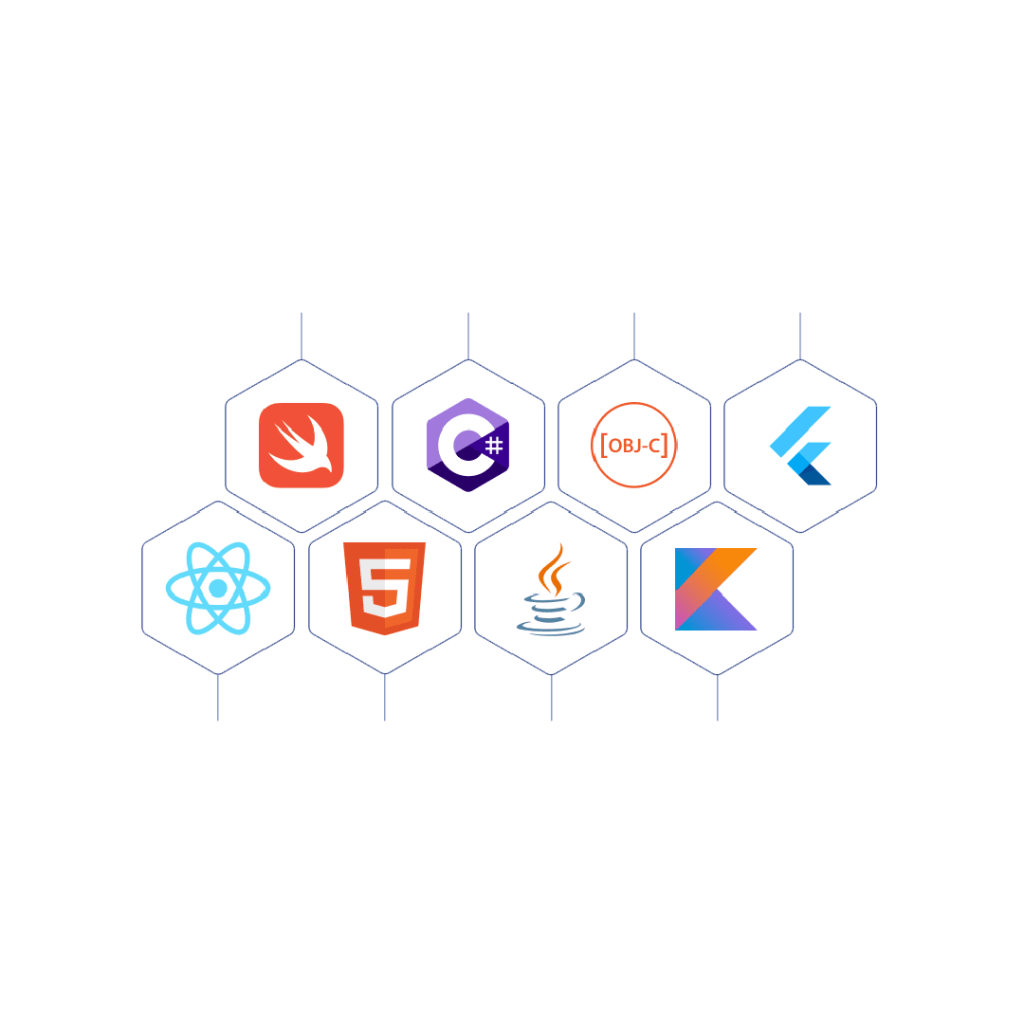
Swift is the standard programming language for iOS app development, but it isn’t the right choice for every project. If you’re building a new iOS app from scratch, Swift is usually the best option. If you’re maintaining an older app, Objective-C may still make sense. And if you need to launch on both iOS and Android, a cross-platform language such as Dart or JavaScript may be a better fit.
The right language affects more than how your developers write code. It influences development speed, access to new Apple features, hiring, maintenance, and how easily your app can evolve as your business grows. Choosing the wrong approach early can create unnecessary technical debt and make future changes more expensive.
This guide compares Swift, Objective-C, and the main cross-platform options for iOS development. You’ll learn when each language makes sense, what its limitations are, and which option is best for your specific type of app.
What Language Should You Use for iOS Development?
For any new iOS-only app in 2026, Swift is the default answer, and there’s genuinely little reason to consider anything else unless you’re maintaining an existing Objective-C codebase or building for multiple platforms simultaneously. The decision gets more nuanced once either of those two conditions applies, which is exactly where the rest of this guide is useful.
This nuance is exactly what most quick answers to this question skip past. A founder searching for the best iOS language usually gets a one-word answer, Swift, without any of the context that actually determines whether that answer fits their specific situation. A team inheriting a decade-old Objective-C app, or one that needs to launch on Android within the same quarter, is working from a genuinely different starting point than a team building something entirely new for iOS alone, and the right language choice reflects that difference rather than defaulting to whatever’s most popular in the abstract.
Swift: The Standard Language for iOS Development
What Is Swift?
Swift is Apple’s own programming language, introduced in 2014 specifically to replace Objective-C as the primary language for iOS, macOS, watchOS, and tvOS development, built on the LLVM compiler infrastructure with a focus on safety, speed, and modern language design.
Why Swift Is the Standard for iOS Development
Swift has held ABI stability since version 5.0, meaning binary compatibility across app updates without requiring a full recompile, and it offers structured concurrency through async/await syntax along with first-class support for SwiftUI, none of which Objective-C can match through bridging alone. Apple has also claimed Swift can run up to 2.6 times faster than Objective-C in certain benchmarks, though this gap isn’t universal across every workload, and the more consistent, practical advantage most teams actually experience is Swift’s safer syntax catching entire categories of bugs at compile time that Objective-C would only surface at runtime.
Beyond the technical specifics, Swift’s hiring and community advantage compounds over time in a way that’s easy to underweight when comparing languages purely on paper. A larger, growing developer community means more current documentation, faster answers to unusual problems, and a wider hiring pool as a team scales, all real, practical advantages that don’t show up in a feature comparison table but shape how smoothly a project actually runs day to day.
Objective-C for iOS App Development
What Is Objective-C?
Objective-C is an object-oriented language built directly on top of standard C, using Smalltalk-style dynamic messaging, developed in the early 1980s and adopted by Apple as the primary iOS and macOS development language before Swift’s introduction in 2014.
Is Objective-C Still Used for iOS Development?
Objective-C remains a first-class citizen in Apple’s own toolchain, and iOS itself is actually written in C, C++, and Objective-C at the system level, not Swift, which is part of why the language hasn’t been deprecated despite Apple’s clear investment in Swift for new development. Millions of lines of production Objective-C code continue to power stable, unrewritten enterprise, financial, and system-level apps that have run reliably for two decades, code that no business has a compelling reason to rewrite purely for the sake of using a newer language.
This is worth stating plainly since it often gets lost in language debates that treat older technology as automatically obsolete: stable, working code that reliably serves real users is not technical debt simply because a newer language exists. The actual cost-benefit question for any Objective-C codebase isn’t “should we modernize,” it’s whether a rewrite would deliver enough real business value, new capabilities the old code genuinely can’t support, meaningfully faster future development, to justify the real risk and cost a full rewrite always carries.
Swift vs Objective-C for iOS Development
Factor | Swift | Objective-C |
Introduced | 2014 | Early 1980s |
Best for | New iOS apps, modern development | Legacy codebases, maintenance |
Syntax | Concise, modern, type-safe | Verbose, C-based, dynamic messaging |
SwiftUI support | Native, first-class | Requires bridging |
Concurrency | Structured, async/await | Manual, more error-prone |
Community and hiring | Larger, growing | Smaller, specialized |
Interoperability with C/C++ | Good, through bridging | Zero-overhead, direct |
When Should You Use Objective-C Instead of Swift?
Objective-C remains the right choice in four specific situations, not as a general alternative to Swift for new work. Recognizing which of these actually applies to your project matters more than a general preference for either language, since the right answer genuinely differs depending on which of these four scenarios you’re actually in.
Legacy iOS apps already written in Objective-C can continue building on existing code rather than justifying a full rewrite purely for language modernity.
Mature libraries and dependencies written in Objective-C can be reused directly, saving real development time compared to finding or building a Swift equivalent from scratch.
Compute-intensive algorithmic processing sometimes runs efficiently in Objective-C given its zero-overhead interoperability with C and C++, useful for specific performance-critical code paths.
Apps requiring compatibility with older iOS versions may need Objective-C where certain modern Swift language features aren’t available on the deployment target you’re required to support.
Cross-Platform Programming Languages for iOS Development
Cross-platform languages solve a fundamentally different problem than Swift and Objective-C do, letting one codebase target both iOS and Android rather than optimizing purely for the best possible experience on Apple’s platform alone. This tradeoff is worth understanding clearly before choosing one, since a business genuinely committed to both platforms gains real development efficiency, while a business that only needs iOS gains nothing from this approach except unnecessary complexity.
Dart for Flutter iOS Development
Dart is Google’s language for Flutter, letting you write one codebase in Dart that compiles to native-feeling apps on both iOS and Android, a strong option when launching on both platforms is a near-term requirement rather than a future maybe.
JavaScript and TypeScript for React Native
JavaScript and TypeScript power React Native, Meta’s cross-platform framework, making it a natural fit for teams with existing web development experience in the React ecosystem who want to extend that knowledge into mobile without learning Swift and Kotlin separately.
C# for .NET MAUI
C# powers .NET MAUI, a reasonable choice specifically for teams already invested in the Microsoft ecosystem, though it carries a smaller mobile-specific community and hiring pool compared to Dart or JavaScript-based alternatives.
This is a genuinely different decision than choosing between Swift and Objective-C, since it’s really a framework and ecosystem choice as much as a language choice. If you’re weighing native iOS against a cross-platform approach more broadly, our guide on how to build an iOS app covers the tooling and setup differences in more depth.
Should You Use Python or C++ for iOS Development?
Python Is Not Suited to Native iOS Development
Python is not a practical choice for building a native iOS app, since it lacks the native integration and mobile-specific optimization Swift provides, and it’s far more commonly used for backend services and scripting than for anything user-facing on iOS directly. If your team’s strength is Python, that expertise is better applied to the backend supporting your iOS app rather than the app itself.
C++ Has a Narrow, Specific Role
C++ isn’t a primary iOS development language, but it plays a real, narrow role in performance-heavy work, game engines, complex simulations, or code shared across multiple platforms at the systems level, typically bridged into a Swift or Objective-C project rather than used to build the entire app. This mirrors the same pattern on Android, where C++ through the NDK handles specific performance-critical code without replacing Kotlin as the primary language, covered in more detail in our guide on how to build an Android app step by step.
Teams building cross-platform game engines specifically tend to reach for C++ deliberately, since it lets a single core engine, physics, rendering, game logic, run consistently across iOS, Android, and other platforms, with only the thin platform-specific integration layer written in each platform’s native language. This is a genuinely different use case than typical business app development, and conflating the two, assuming C++ is broadly useful for a standard business app the way it is for a game engine, leads teams toward unnecessary complexity for a project that doesn’t actually need it.
Swift 6 Migration: What Developers Need to Know
Swift 6 introduced strict concurrency checking as the compiler default, and adoption across the developer community has moved more gradually than earlier Swift version transitions, with a significant share of production codebases still running Swift 5.x as of 2026. This isn’t developer inertia, it’s a genuine technical hurdle: strict data-race checking surfaces real compiler errors that require meaningful refactoring work, not a simple find-and-replace across a config file. Teams planning a new Swift project should build with Swift 6 from the start, while teams maintaining an existing Swift 5.x codebase should treat migration as a deliberate, scoped project rather than something to squeeze in casually alongside regular feature work.
Think of each new Swift release as widening a gap for any team still deferring this migration. Every release adds language features, structured concurrency improvements, macros, refinements to the ownership model, that have no real equivalent in older Swift versions and can’t be expressed through a compatibility shim. The longer a team defers this work, the larger the eventual migration surface becomes, which makes an early, incremental approach, migrating module by module rather than attempting one large rewrite, the more realistic path for a codebase of any real size.
Choosing the Right Language for Your Project
The right programming language depends on your platform requirements, existing codebase, team expertise, and long-term product plans.
Choose Swift if you’re building a new iOS-only app and want native performance, direct access to Apple’s latest features, and the most straightforward path for future iOS development.
Choose Objective-C if you’re maintaining an existing Objective-C app or relying on mature Objective-C libraries that would be costly or risky to replace. A stable codebase doesn’t need to be rewritten simply because Swift is now the preferred language for new projects.
Choose Dart with Flutter, JavaScript or TypeScript with React Native, or C# with .NET MAUI if you need to launch on both iOS and Android and want to share a significant portion of the codebase between platforms. Our mobile app development services can help determine whether native or cross-platform development better fits your product requirements.
Team expertise should also influence the decision. A team with strong Objective-C experience may be better off continuing to maintain an established app in Objective-C rather than introducing a language migration that adds risk without delivering meaningful business value. For a new project, however, Swift is generally the more practical choice for iOS-first development.
Your decision also shouldn’t be treated as permanent. As your app grows, your hiring needs, platform strategy, and technical requirements can change. A codebase that made sense when the product launched may eventually benefit from modernization, a gradual migration, or a move toward a cross-platform architecture.
If you’re deciding between a native iOS app, a cross-platform approach, or a modernization of an existing app, our iOS app development in the USA team can help evaluate the tradeoffs based on your product, timeline, and technical requirements.
Frequently Asked Questions
What programming language do most iOS apps use?
Swift, currently used to build more than 70 percent of active iOS apps, with Objective-C still powering roughly 20 percent of codebases, largely legacy apps that haven't been rewritten, and cross-platform languages like Dart and JavaScript covering the remainder.
Should I use Swift or a cross-platform language like Flutter?
Use Swift if you're building an iOS-only app and want the best native performance and immediate access to new Apple features. Use a cross-platform language like Dart with Flutter if you need to launch on both iOS and Android within a similar timeframe and want to avoid maintaining two separate codebases.
Is Swift faster than Objective-C?
In certain benchmarks Apple has cited Swift as up to 2.6 times faster, though this difference isn't consistent across every workload, and in practice Swift's more meaningful advantage for most teams is its safer syntax catching bugs at compile time rather than raw execution speed alone.
Do I need C++ for iOS development?
Not for most apps. C++ plays a narrow role specifically in performance-heavy work like game engines or cross-platform system-level code, typically bridged into a Swift project rather than used to build the entire app from scratch.