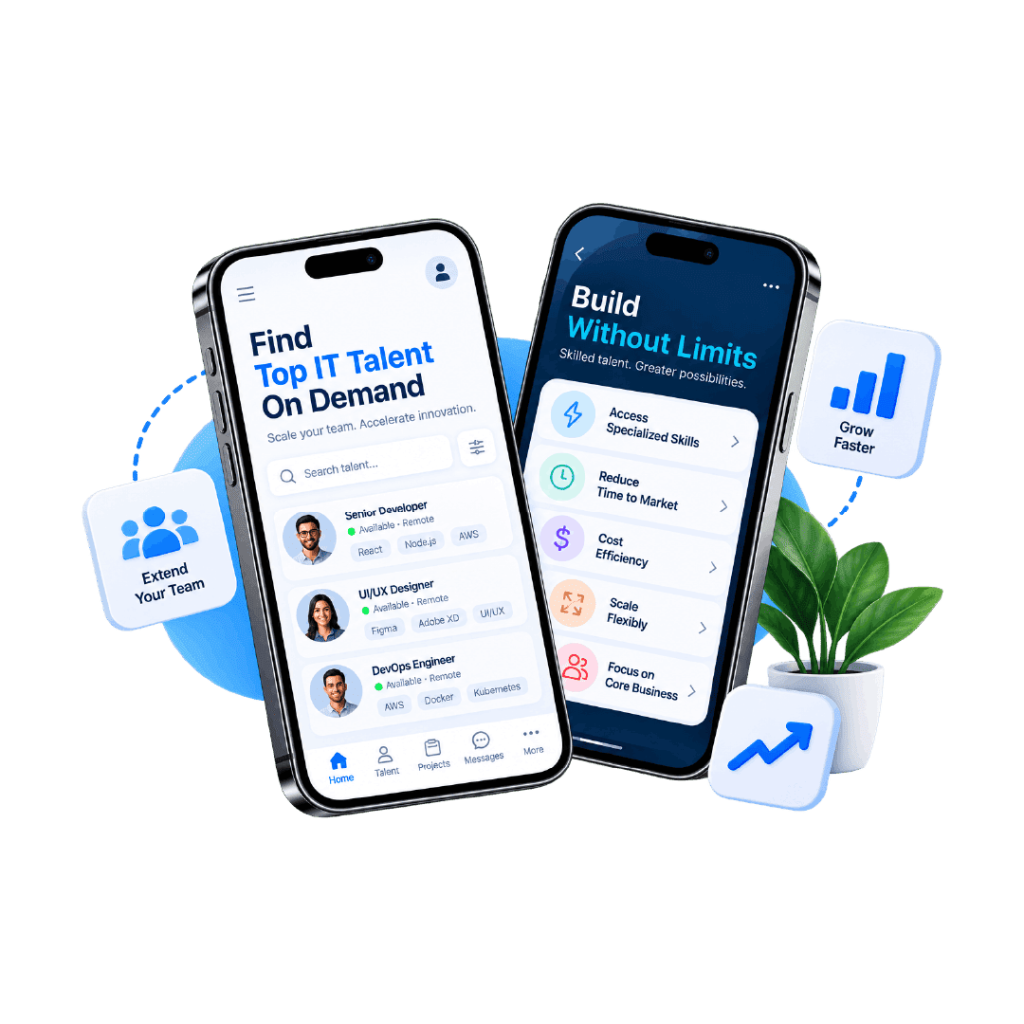
IT staff augmentation gives businesses access to specialized technology professionals without requiring them to build every capability through permanent hiring. It can help companies fill skill gaps, scale development capacity, access specialized expertise, and maintain direct control over their software projects.
Technology teams are being asked to do more while technology itself continues to change quickly. AI, cloud computing, cybersecurity, data engineering, and modern application frameworks are creating new technical requirements that many organizations cannot always cover with their existing workforce.
The World Economic Forum’s Future of Jobs Report 2025 identifies skills gaps as the biggest barrier to business transformation, with 63% of surveyed employers describing them as a major obstacle. The report also identifies AI and big data, networks and cybersecurity, and technological literacy among the fastest-growing skill areas through 2030.
That does not mean every company needs to increase permanent headcount.
Sometimes the smarter approach is to bring in the specific expertise required for a particular project, product release, migration, or technology initiative.
This is where IT staff augmentation can fit.
Businesses can use IT staff augmentation services to extend an existing development team with specialized professionals while retaining control over the project’s priorities, workflows, and technical direction.
What Is IT Staff Augmentation?
IT staff augmentation is a workforce model where external technology professionals join an existing internal team to provide additional skills or development capacity for a defined period or ongoing engagement.
Instead of handing an entire project to an outside company, the business can add individual specialists or a larger team to its existing engineering organization.
Depending on the project, that could mean adding:
- Software developers
- Mobile developers
- Backend engineers
- Frontend developers
- AI and LLM developers
- QA engineers
- DevOps specialists
- Cloud engineers
- Data and business intelligence developers
The important distinction is control.
With staff augmentation, the external developer becomes an extension of the team rather than operating as a completely separate delivery organization.
1. Fill Critical Technology Skill Gaps
One of the biggest IT staff augmentation benefits is the ability to bring in skills that your current team does not have.
Imagine your internal team has strong backend developers but suddenly needs to introduce generative AI into an existing product.
Recruiting a permanent AI engineer could take significant time.
Training an existing developer could take even longer.
Staff augmentation provides another option: add an AI specialist who can contribute to the project while your existing team continues handling its core responsibilities.
The need for specialized skills is becoming more important as technology changes. The World Economic Forum expects AI and big data, cybersecurity, and technological literacy to be among the fastest-growing skills through 2030.
This makes access to specialized talent increasingly relevant to digital transformation projects.
2. Scale Your Development Team Around Project Demand
Software projects rarely require the same number of people at every stage.
A typical project might need:
| Project Stage | Potential Team Requirement |
| Planning | Product and technical specialists |
| Development | More software engineers |
| Testing | Additional QA capacity |
| Launch | Engineering, QA and DevOps |
| Maintenance | Smaller development team |
Hiring permanent employees every time workload increases can create unnecessary long-term commitments.
The staff augmentation model lets companies adjust development capacity around actual project requirements.
For example, a company preparing for a major product launch might temporarily add frontend developers, backend engineers, QA specialists, or DevOps engineers.
After the launch, the business can reassess the additional capacity based on its roadmap.
3. Reduce Recruitment Pressure
Traditional technical hiring requires considerable internal effort.
Businesses may need to manage:
- Candidate sourcing
- Resume screening
- Technical assessments
- Interviews
- Reference checks
- Negotiations
- Onboarding
- Payroll and administration
The challenge becomes greater when recruiting for specialized roles.
The World Economic Forum reports that 70% of surveyed employers expect to hire people with new skills between 2025 and 2030, while skills gaps remain a major transformation barrier.
Staff augmentation can reduce some of the sourcing burden because the provider handles candidate identification and technical vetting.
For example, The Apps Developers states that developers in its network undergo technical screening, live coding evaluation, and communication checks before profiles are presented to clients.
The client still makes the final hiring decision.
4. Access Specialized Developers
A business does not always need a particular technical skill permanently.
Consider a company modernizing a legacy application.
It may need a specialist in a particular framework for six months but has little reason to maintain that position after the modernization project is complete.
This is one situation where staff augmentation can make sense.
Specialists can be added for requirements involving:
- AI and LLMs
- Cloud architecture
- Mobile development
- Legacy modernization
- Data engineering
- Cybersecurity
- DevOps
- Business intelligence
- eCommerce platforms
The goal is not to collect as many developers as possible.
It is to access the right technical capability when the business needs it.
5. Keep Direct Control Over Development
One of the most important differences between IT staff augmentation vs outsourcing is how the work is managed.
With staff augmentation, external developers can work inside the client’s existing environment.
That may include the company’s:
- Project management system
- Communication tools
- Code repository
- Development methodology
- Sprint structure
- Coding standards
- Review process
The client remains responsible for defining priorities and directing the work.
This makes staff augmentation particularly suitable for organizations that already have technical leadership but need additional execution capacity.
6. Increase Development Capacity Without Increasing Permanent Headcount
Your existing engineers may be capable of delivering the roadmap but simply lack enough time.
That creates a difficult choice.
You can delay features.
You can reduce scope.
Or you can increase development capacity.
Staff augmentation provides another option by adding engineers without necessarily changing the company’s permanent organizational structure.
This can be especially useful when several initiatives compete for the same internal engineering resources.
Instead of moving your senior developers away from important product work, you can add specialists to handle additional development requirements.
7. Accelerate Adoption of New Technologies
Technology adoption often creates a knowledge gap.
A business may understand its product extremely well but lack experience with a new technology it wants to introduce.
AI is a good example.
The World Economic Forum reports that 86% of employers expect AI and information processing technologies to transform their business by 2030. It also reports that 77% of surveyed employers plan to prioritize reskilling and upskilling workers to work alongside AI.
A company can therefore combine internal knowledge with external specialist expertise.
For example:
Internal team: Product knowledge, customer understanding, existing architecture
Augmented specialist: AI architecture, LLM integration, model evaluation
Together: A product feature designed around the company’s actual business requirements
That combination can be more practical than expecting one team to master every emerging technology simultaneously.
8. Handle Short-Term and Specialized Projects More Flexibly
Some projects have a defined beginning and end.
Examples include:
- Cloud migration
- Mobile application launch
- Legacy modernization
- Data migration
- Security improvement
- Platform redesign
- Major product release
Permanent recruitment may not align with these requirements.
With staff augmentation, businesses can add the required specialists for the duration of the project and then reassess the team afterward.
This creates more flexibility around technology workforce planning.
9. Build a More Adaptable Technology Team
The biggest long-term benefit of staff augmentation may be adaptability.
Technology teams increasingly need to combine different disciplines.
A modern product might require:
| Business Requirement | Potential Specialist |
| Cross-platform mobile app | Flutter developer |
| Enterprise backend | Java developer |
| AI functionality | LLM developer |
| Data analytics | Power BI developer |
| High-performance services | Golang developer |
| Web application | React or Next.js developer |
| API infrastructure | Node.js developer |
| Native mobile experience | Android or iOS developer |
The point is not that every company needs all of these specialists.
The point is that technology requirements can change quickly.
A flexible staffing strategy lets businesses build around those requirements instead of maintaining a fixed team structure that may no longer match the product roadmap.
Developers You Can Add to Your Existing Team
The right staff augmentation partner should be able to match developers to your actual technology stack rather than simply provide generic software engineers.
The Apps Developers currently provides access to developers across mobile, web, backend, data, eCommerce, and emerging technologies through its staff augmentation offering.
Depending on your project requirements, you can explore:
- Hire Flutter Developers for cross-platform mobile applications.
- Hire Java Developers for enterprise applications and Java backend systems.
- Hire Magento Developers for Magento-based commerce projects.
- Hire Python Developers for backend, automation, data, and AI-related development.
- Hire Laravel Developers for PHP and Laravel backend development.
- Hire Node.js Developers for APIs, real-time applications, and backend systems.
- Hire Next.js Developers for modern React-based web applications.
- Hire React Developers for scalable frontend applications.
- Hire Spring Boot Developers for enterprise Java backends and APIs.
- Hire Power BI Developers for reporting, dashboards, and business intelligence projects.
- Hire Golang Developers for high-concurrency and performance-focused backend services.
- Hire LLM Developers for LLM-powered applications and AI development.
- Hire Android Developers for native Android applications.
- Hire iOS Developers for native Apple applications.
This creates a more useful hiring path than treating staff augmentation as a generic “developer for hire” service.
The technology should follow the product requirement.
IT Staff Augmentation vs Traditional Hiring
| Factor | Traditional Hiring | IT Staff Augmentation |
| Team expansion | Permanent | Flexible |
| Specialist access | Dependent on recruitment | Can access broader talent pools |
| Hiring administration | Managed internally | Provider can support sourcing and vetting |
| Project control | Internal | Remains with client |
| Long-term commitment | Higher | More flexible |
| Best fit | Permanent core roles | Skill gaps and changing project needs |
Neither model is universally right.
Permanent hiring makes sense when a capability is central to your organization for the long term.
Staff augmentation can make more sense when you need additional capacity or specialized expertise without creating a permanent position.
When Should You Use IT Staff Augmentation?
Staff augmentation is worth considering when:
- Your internal team has a specific skill gap.
- A project needs additional developers.
- You have a tight product deadline.
- You need temporary specialist expertise.
- Your technology roadmap is changing quickly.
- You want to scale engineering capacity without rebuilding the entire team.
- You already have internal product or technical management.
It is less suitable when you want an external provider to take complete responsibility for delivering an entire project.
In that situation, a full software development engagement may be more appropriate.
How to Choose an IT Staff Augmentation Partner
Do not choose a provider based only on the number of developers available.
Look at how the engagement actually works.
Check Technical Vetting
Ask how developers are assessed before they reach your team.
Interview Candidates Yourself
You should be able to evaluate technical capability and team fit before making a decision.
The Apps Developers states that clients interview and select developers after receiving a curated shortlist.
Clarify Communication
Determine:
- Who manages the developer?
- How often will you communicate?
- Which project tools will be used?
- How will progress be reported?
Understand Replacement Policies
Ask what happens if a developer leaves or is not a good fit.
The replacement process should be clear before the engagement begins.
Confirm Scalability
If your project grows, determine whether the provider can add complementary specialists without forcing you to restart the hiring process.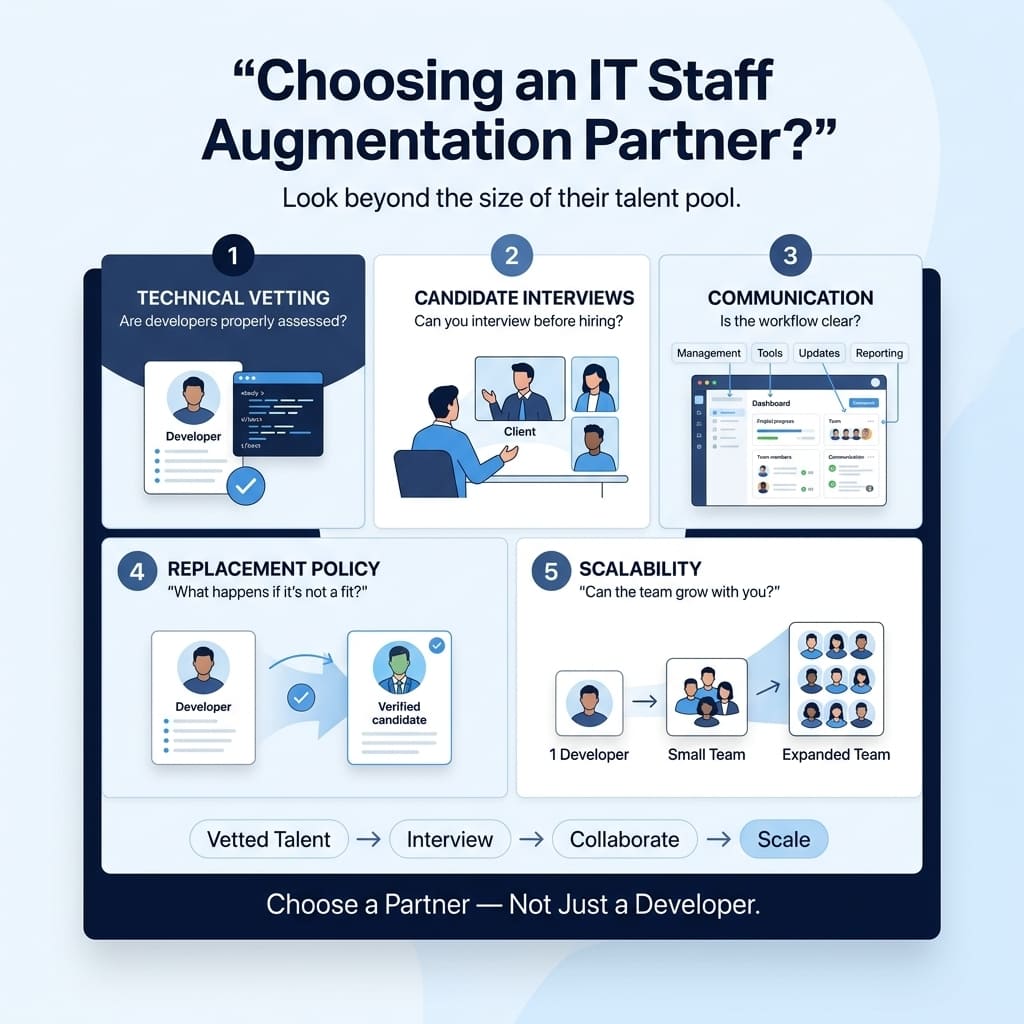
Conclusion
IT staff augmentation is ultimately about adding the right capability at the right time.
It can help a business respond to changing technology requirements without treating every new skill gap as a permanent recruitment problem.
The model can be particularly useful when your internal team already understands the product but needs more engineering capacity or specialized expertise to execute the roadmap.
The key is to avoid treating staff augmentation as simply buying additional development hours.
Define what you need the developer to own.
Choose the technology and seniority level around that responsibility.
Make sure the developer can work within your existing processes.
And evaluate the provider’s vetting, communication, replacement, and scaling processes before you commit.
For businesses that need to extend their technology team with specialized talent, The Apps Developers provides IT staff augmentation across a broad range of development technologies and lets clients interview and select developers before starting an engagement.
The goal is straightforward: build the team your current project needs without creating unnecessary complexity around how that team is hired.