

A backend scalability guide worth following covers five areas: load balancing to distribute traffic, auto-scaling infrastructure that adds capacity on demand, a caching layer to reduce repeated database load, asynchronous processing for anything that doesn’t need to happen instantly, and connection pooling to keep the database itself from becoming the bottleneck everything else runs into. Get these right before growth arrives, and scaling becomes a matter of configuration. Get them wrong, and growth becomes an outage.
This is a companion piece to the architectural side of scalability, decisions like horizontal versus vertical scaling or monolith versus microservices, and focuses specifically on the infrastructure layer: what actually needs to be in place so a backend can absorb real traffic growth without falling over. If you’re preparing for a launch, a marketing push, or simply watching usage climb steadily and wondering what breaks first, this is the practical layer underneath those bigger architecture decisions.
What Is Backend Scalability?
Backend scalability is a system’s infrastructure-level capacity to handle increasing traffic and data volume by adding resources, servers, cache, database capacity, without requiring a fundamental redesign every time load grows. It’s the operational half of the scalability conversation. Architecture decides what’s theoretically possible; backend infrastructure decides whether that theoretical capacity actually gets realized under real, unpredictable traffic.
Signs Your Backend Needs to Scale
Response times that were fine a few months ago start creeping upward as the same endpoints handle more concurrent requests. Database connection limits get hit during traffic spikes, throwing errors that have nothing to do with the actual business logic being correct. Background jobs, email sending, report generation, data exports, start backing up and delaying because they’re competing for the same resources as user-facing requests. None of these individually means a rewrite is needed. Together, they’re the backend telling you its current infrastructure was sized for a smaller version of the product than the one it’s now running.
Core Elements of a Backend Scalability Guide
1. Load Balancing
A load balancer distributes incoming traffic across multiple backend servers, preventing any single server from becoming overwhelmed while others sit idle. Without one, scaling horizontally, adding more servers, doesn’t actually help, since there’s no mechanism directing traffic to the new capacity.
Load Balancing Algorithms Compared
Different load balancing strategies distribute traffic differently, and the right choice depends on how uniform your backend requests actually are.
| Algorithm | How It Works | Best Fit |
| Round Robin | Distributes requests sequentially across servers | Simple deployments where servers have equal capacity |
| Least Connections | Sends requests to the server with the fewest active connections | Workloads with variable request duration |
| IP Hash | Routes a given client consistently to the same server | Applications needing session persistence without a shared session store |
| Weighted | Distributes proportionally based on assigned server capacity | Mixed-capacity server fleets |
Round Robin is the simplest and often sufficient starting point, but Least Connections tends to handle real-world traffic more gracefully once request processing time starts varying meaningfully between endpoints, which is nearly always the case once a backend has grown past its earliest, simplest version.
2. Auto-Scaling Infrastructure
Auto-scaling adds server capacity automatically as load increases and removes it as load drops, which is what turns a load balancer’s traffic distribution into genuine elastic capacity rather than a fixed pool of servers hoping to be enough. Cloud providers handle much of this natively now.
Google Cloud’s own documentation on autoscaling and load balancing is a solid reference for how this works in practice, letting infrastructure scale out ahead of a traffic spike and back down once it passes, rather than running peak-capacity infrastructure around the clock at unnecessary cost.
3. Caching Layers
A caching layer, typically an in-memory store like Redis or Memcached sitting between the application and the database, absorbs repeated reads for data that doesn’t change on every request. This is frequently the single highest-leverage backend scalability improvement available, since a well-designed cache can eliminate a large share of database load entirely for the most frequently accessed data, buying real headroom before any database-level scaling work becomes necessary at all.
4. Database Connection Pooling
Every database connection carries real overhead, and opening a new one for every incoming request exhausts available connections quickly under real load. Connection pooling maintains a reusable set of open connections that requests borrow and return, rather than opening and closing a fresh connection every time, which is one of the most common places a backend that worked fine in testing starts failing under genuine concurrent traffic.
5. Asynchronous Processing and Message Queues
When to Introduce a Message Queue
Any task that doesn’t need to be completed before a response is sent back to the user, sending a confirmation email, generating a report, processing an uploaded file, is a candidate for moving out of the request-response cycle entirely and into a background queue.
Common Queue Technologies
RabbitMQ, Amazon SQS, and Redis-backed queues are all common choices, each with different tradeoffs around delivery guarantees, ordering, and operational complexity, but the underlying principle is the same regardless of which is chosen: decouple slow or non-critical work from the fast path a user is actually waiting on.
Example: Decoupling Email Sending From a Signup Request
A signup endpoint that sends a welcome email synchronously ties the user’s entire signup experience to the reliability and speed of the email provider. Queuing that email send instead means the signup response returns immediately, and the email goes out moments later, invisible to the user but meaningfully more resilient to a slow or temporarily failing email service.
6. CDN and Static Asset Offloading
Serving static assets, images, scripts, stylesheets, directly from application servers means every one of those requests competes for the same resources handling actual business logic. Routing them through a content delivery network instead removes that load entirely from the backend and typically serves the asset faster too, since a CDN edge location is usually physically closer to the requesting user than the origin server. This is a comparatively simple change with an outsized effect on backend headroom, since static assets frequently make up a large share of total request volume on a typical web application.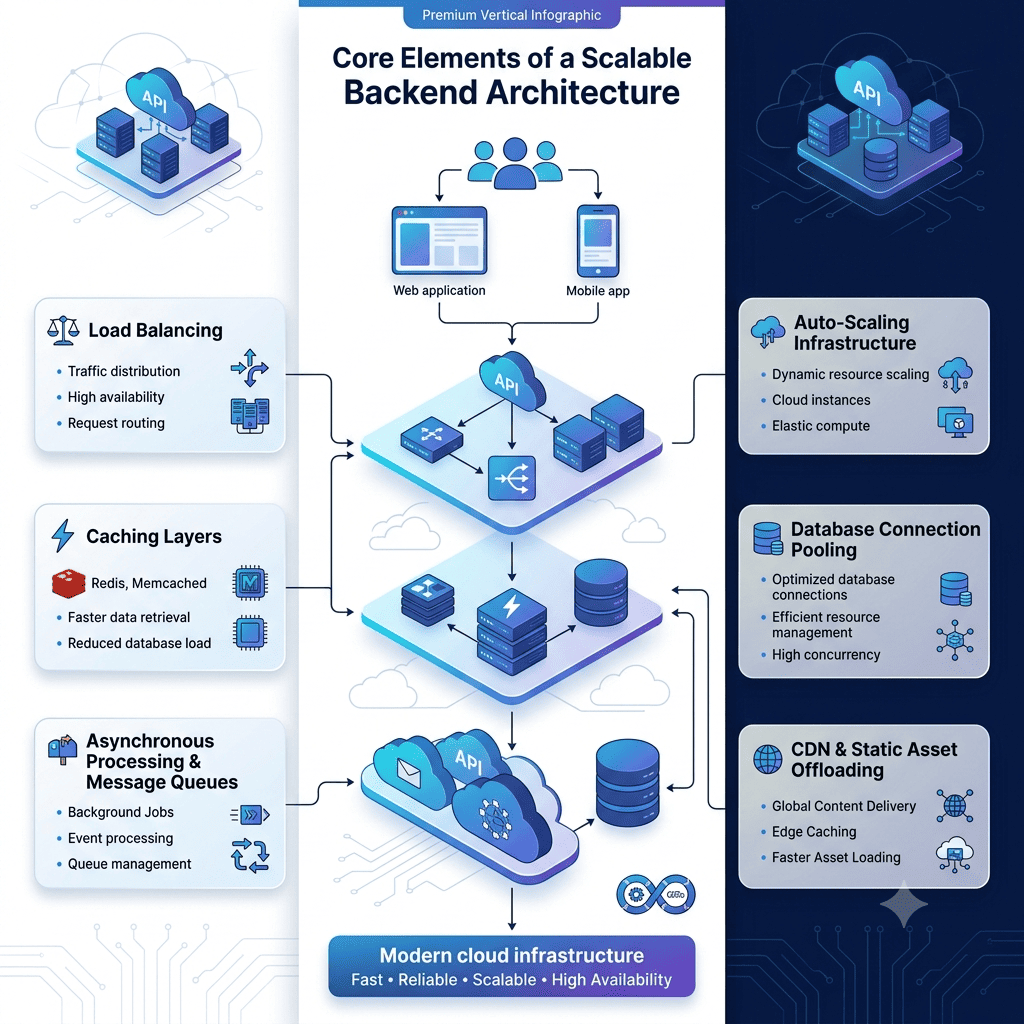
SQL vs NoSQL for Backend Scalability
Database choice is one of the more consequential decisions in any backend scalability guide, and it’s worth deciding deliberately rather than defaulting to whatever’s most familiar.
Factor | SQL (Relational) | NoSQL |
Data structure | Structured, relational, enforced schema | Flexible, often schema-less |
Horizontal scaling | Harder, though modern solutions exist | Generally designed for it from the start |
Consistency model | Strong consistency by default | Often eventual consistency, tunable in some systems |
Best fit | Transactional data, complex relationships | High-volume, loosely structured, or rapidly evolving data |
Query flexibility | Powerful, standardized query language | Varies significantly by database, often more limited |
Neither is universally more scalable. A well-tuned relational database with proper indexing and read replicas handles significant scale for most business applications. NoSQL earns its place specifically when data doesn’t fit a relational model well, or when the scale and access pattern genuinely benefit from the distributed architecture most NoSQL systems are built around from the ground up.
Capacity Planning and Load Testing
Scaling reactively, adding resources only after something breaks, is a stressful and expensive way to run a growing backend. Load testing against realistic traffic patterns before a known growth event, a marketing campaign, a seasonal spike, a product launch, surfaces bottlenecks while there’s still time to fix them calmly, rather than during the event itself when every fix carries real business cost. Capacity planning doesn’t need to predict traffic perfectly; it needs to identify which component breaks first under load, so that’s the one addressed before growth actually arrives.
Common Backend Scalability Mistakes
Teams frequently scale the application server layer while leaving the database as the single, unscaled bottleneck underneath everything, since adding more app servers is often the easiest, most visible fix, even when it’s not where the actual constraint lives. Caching gets added without a clear invalidation strategy, leading to stale data bugs that are often more disruptive than the performance problem the cache was meant to solve. Auto-scaling gets configured with thresholds that react too slowly, adding capacity only after users have already experienced the slowdown rather than ahead of it. And background job queues frequently get introduced without monitoring, so a queue quietly backing up for hours goes unnoticed until a customer complains their email or report never arrived.
How The Apps Developers Approaches Backend Scalability
Scalability planning is built into the same API and backend development process we use for every project, sized to a realistic growth trajectory rather than either under-provisioned for launch or over-engineered for scale that may be years away.
The infrastructure work that actually makes scaling possible, load balancing, auto-scaling configuration, caching, and monitoring, runs through the same DevOps and cloud solutions practice that handles deployment pipelines and incident response, since scalability isn’t a one-time setup so much as an operational discipline that needs to keep functioning as the product grows.
If you’re not confident your current backend would hold up under a real traffic spike, or you’re scoping a new build and want scalability planned in rather than retrofitted under pressure, that’s worth a direct conversation. You’re welcome to talk to our team about what your specific growth trajectory actually requires.