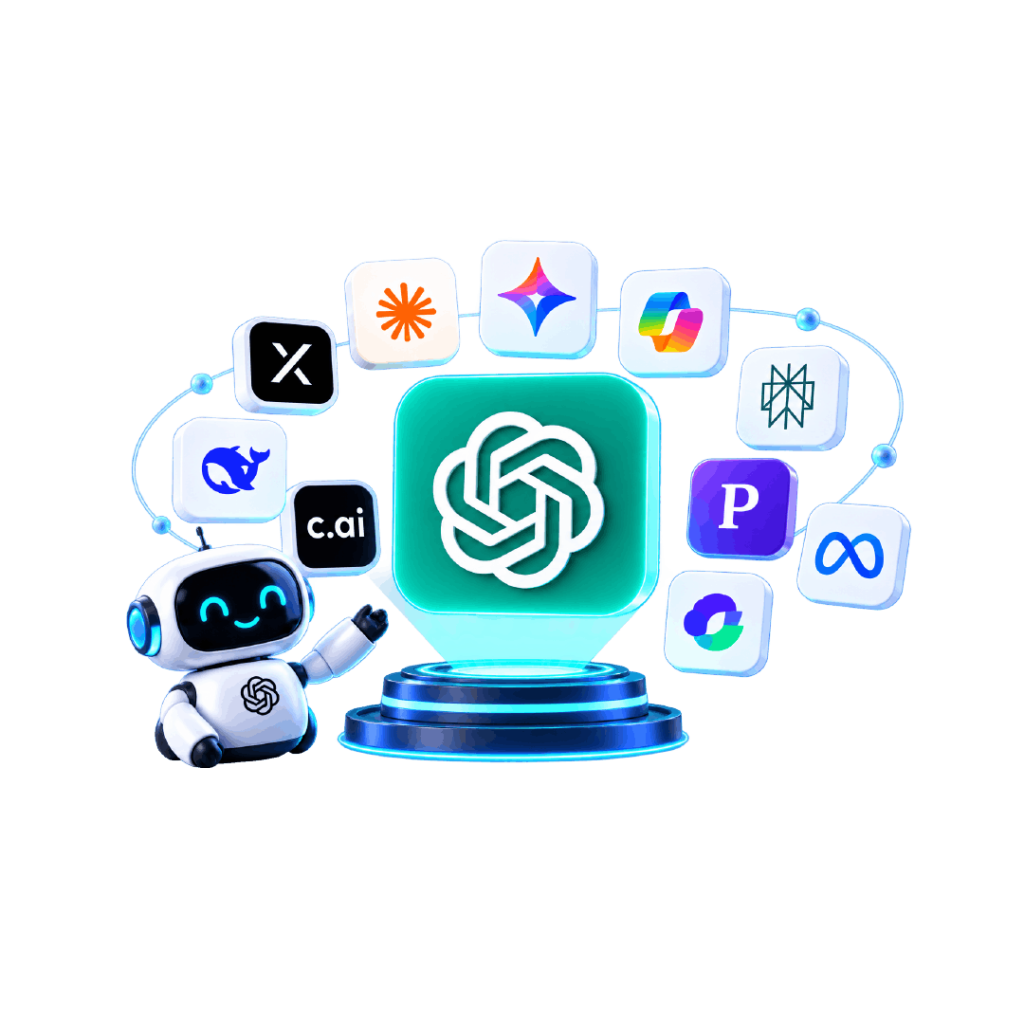
The best ChatGPT alternatives in 2026 include Claude, Google Gemini, Perplexity, Microsoft Copilot, Grok, DeepSeek, Meta AI, Mistral, Poe, and Pi. The right alternative depends on what you need most, whether that is research, coding, writing, Google or Microsoft integration, social features, or access to multiple AI models.
ChatGPT is no longer the only major AI assistant worth considering. The market has expanded into specialized tools that approach AI differently.
Some alternatives focus on research and citations. Others are designed around coding, productivity, multimodal interaction, social platforms, or access to several AI models from one interface.
For businesses considering their own AI-powered product, this shift also creates opportunities to build more specialized experiences through AI development services rather than relying entirely on a general-purpose chatbot.
This guide compares 10 apps like ChatGPT based on their core strengths and practical use cases.
Quick Comparison of ChatGPT Alternatives
AI App | Best Suited For | Key Strength |
Claude | Writing and coding | Long-form reasoning and project work |
Google Gemini | Google users | Google ecosystem integration |
Perplexity | Research | Search with citations |
Microsoft Copilot | Microsoft users | Microsoft 365 workflows |
Grok | Real-time interaction | Web, X and multimodal features |
DeepSeek | AI experimentation | Reasoning and developer access |
Meta AI | Everyday users | WhatsApp, Instagram and Facebook integration |
Mistral | Developers and businesses | European AI ecosystem |
Poe | Multi-model users | Multiple AI models in one platform |
Pi | Personal conversations | Conversational interaction |
1. Claude
Claude is an AI assistant from Anthropic designed for writing, analysis, coding, research, and working with documents.
Claude has become one of the most prominent ChatGPT alternatives, particularly for users working with long documents, complex reasoning, and software development.
Anthropic currently highlights document analysis, coding, web research, projects, artifacts, and integrations among Claude’s capabilities.
Best for: Writing, coding, documents, analysis, and research.
Consider it if: You want an AI assistant built around sustained project work rather than only short questions.
2. Google Gemini
Google Gemini is Google’s AI assistant and is particularly useful for people already working within Google’s ecosystem.
Gemini supports conversational assistance across text and multimodal interactions, while Google’s broader ecosystem gives it a natural fit for users already relying on Google services.
Best for: Google users, multimodal tasks, planning, and productivity.
Consider it if: Gmail, Google Workspace, Android, and other Google services are already central to your workflow.
3. Perplexity
Perplexity is an AI answer engine focused on web research and cited responses.
Instead of simply generating an answer from a model, Perplexity searches the web and provides sources that users can inspect. Its current product also supports deeper research workflows, multiple models, file and app connections, and API access.
Best for: Research, fact-finding, current information, and source-backed answers.
Consider it if: You want to see where an answer came from instead of relying on an uncited response.
4. Microsoft Copilot
Microsoft Copilot is Microsoft’s AI assistant ecosystem, designed particularly around Microsoft products and productivity workflows.
Its strongest appeal is for organizations already using Microsoft 365, Windows, and Microsoft’s broader business ecosystem.
Best for: Microsoft 365 users and workplace productivity.
Consider it if: Your organization already relies heavily on Microsoft tools and wants AI embedded into existing workflows.
5. Grok
Grok is xAI’s AI assistant, available through web and mobile applications with capabilities including conversation, coding, file analysis, image and video creation, voice, and connected tools.
Its positioning makes it interesting for users who want an AI assistant with strong connections to current web and X-related information.
Best for: Real-time interaction, multimodal work, and users interested in the X ecosystem.
6. DeepSeek
DeepSeek is an AI platform offering conversational AI, developer APIs, and models designed for reasoning, coding, and multimodal tasks.
Its official platform currently includes DeepSeek Web, an app, an API platform, and documentation, with its latest model lineup continuing to evolve in 2026.
Best for: Developers, AI experimentation, coding, and cost-conscious AI projects.
Consider it if: You want another model ecosystem to test alongside mainstream AI providers.
7. Meta AI
Meta AI is Meta’s AI assistant, available across its web, mobile, desktop, and social platforms including WhatsApp, Instagram, Messenger, and Facebook.
Meta says its current assistant can help with research, writing, image generation, coding, shopping, files, and tasks, while remaining integrated into products many users already use.
Best for: Everyday AI assistance and Meta platform users.
Consider it if: You want AI assistance without constantly switching between separate applications.
8. Mistral
Mistral’s AI ecosystem provides businesses and developers with another alternative to the largest US-based AI providers.
Its appeal is particularly relevant for organizations evaluating model choice, deployment options, and European AI infrastructure.
Best for: Developers, businesses, and teams evaluating alternative model ecosystems.
Consider it if: AI infrastructure, model control, or European technology considerations matter to your organization.
9. Poe
Poe is a multi-model AI platform that lets users access multiple AI systems from one interface.
Rather than committing to a single model provider, Poe currently offers access to models and bots from several AI ecosystems, including OpenAI, Anthropic, Google, and others.
Best for: Comparing AI models and experimenting with different assistants.
Consider it if: You regularly switch between models depending on the task.
10. Pi
Pi is a conversational AI assistant focused on natural, personal interactions rather than functioning primarily as a research or developer platform.
Its appeal is its conversational approach, making it suitable for brainstorming, reflection, everyday questions, and informal discussions.
Best for: Personal conversations, brainstorming, and everyday assistance.
Which ChatGPT Alternative Should You Choose?
There is no single AI assistant that is ideal for every situation.
Your Priority | Alternative to Consider |
Long-form writing and coding | Claude |
Google ecosystem | Gemini |
Research with citations | Perplexity |
Microsoft workplace | Copilot |
Real-time and multimodal use | Grok |
AI experimentation | DeepSeek |
Social platform integration | Meta AI |
Alternative AI ecosystem | Mistral |
Multiple models | Poe |
Conversational interaction | Pi |
The best choice depends on your workflow, privacy requirements, existing software ecosystem, and the type of AI tasks you perform most frequently.
ChatGPT Alternatives for Businesses
Businesses should evaluate AI assistants differently from individual users.
Important considerations include:
- Data privacy
- API availability
- Security
- Integration capabilities
- Model performance
- Cost at scale
- User management
- Monitoring
- Customization
If your organization needs an AI assistant built around proprietary data, workflows, or customer-facing functionality, simply choosing an existing chatbot may not be enough.
A custom solution can combine an LLM with your own application, database, APIs, authentication system, and business logic.
The Apps Developers’ LLM developer services can support businesses building AI assistants, RAG applications, AI agents, and other production LLM solutions.
You can also explore how to hire an LLM developer to understand the technical skills required for building these systems.
For businesses evaluating investment, our guide to LLM developer rates covers the factors that influence AI development costs in 2026.
Conclusion
The rise of ChatGPT alternatives in 2026 shows that AI assistants are becoming increasingly specialized.
Claude is positioned around writing, coding, documents, and reasoning. Gemini fits naturally into Google’s ecosystem. Perplexity focuses on cited research. Copilot serves Microsoft workflows, while Meta AI brings assistance into social and messaging platforms. Other options such as Grok, DeepSeek, Mistral, Poe, and Pi address different needs.
Instead of asking which chatbot is universally better, start with a more useful question:
What do you actually need the AI to do?
For businesses that need something more specific than an off-the-shelf assistant, custom LLM development can turn the capabilities of modern AI models into a product designed around a particular workflow, audience, and business problem.
Frequently Asked Questions
What are the best apps like ChatGPT in 2026?
Popular alternatives include Claude, Gemini, Perplexity, Microsoft Copilot, Grok, DeepSeek, Meta AI, Mistral, Poe, and Pi. Their strengths differ by use case.
Which ChatGPT alternative is best for research?
Perplexity is specifically designed around web research and cited answers, making it particularly suitable when source verification matters.
Which ChatGPT alternative is best for coding?
Claude is a strong option for coding, debugging, code analysis, and software development workflows. Anthropic specifically highlights coding and code analysis among Claude's capabilities.
Are ChatGPT alternatives free?
Several alternatives offer free access, although features, usage limits, models, and premium capabilities vary. Always check the provider's current plan details before choosing a tool.
Can a business build its own ChatGPT-like app?
Yes. A business can build a custom AI application using an LLM API or other model infrastructure and connect it to its own data, APIs, authentication, workflows, and user interface.