PostgreSQL is a relational, SQL-based database built around structured tables and strict data integrity, while MongoDB is a document-based NoSQL database built around flexible, JSON-like records and horizontal scaling. Neither one replaces the other in every case. The right choice depends on how structured your data actually is, how your application reads and writes it, and how your team plans to scale.
Most “PostgreSQL vs MongoDB” debates online collapse into “relational is old, document is modern” or the reverse, and both framings miss the point. We’ve shipped production systems on both, sometimes in the same architecture, and the decision rarely comes down to which database is technically superior. It comes down to what your data actually looks like and how it changes over time.
There isn’t one best database for web applications in general, which is exactly why the real PostgreSQL vs MongoDB differences matter more than whichever one happens to be trending in a given year.
What Is PostgreSQL?
PostgreSQL is an open-source, object-relational database management system that stores data in structured tables with defined columns, enforces relationships between those tables, and guarantees transactional consistency through ACID compliance. As a relational PostgreSQL database, it’s built to represent structured business data with precision, not approximate it.
It’s been under active development since the late 1980s, originally as a research project at UC Berkeley, and it’s grown into one of the most feature-complete relational databases available. Despite its “SQL” roots, modern PostgreSQL also handles semi-structured data well through its JSONB type, covered below. The official PostgreSQL documentation is a genuinely thorough technical reference.
What Is MongoDB?
MongoDB is an open-source, document-oriented NoSQL database that stores data as flexible, JSON-like documents (technically BSON) grouped into collections, without requiring a fixed schema before you write data. A MongoDB database organizes itself around what the data actually looks like in your application, rather than forcing it into predefined tables first.
Instead of rows and columns, you get documents: self-contained records that can nest arrays and sub-objects directly inside them. A single document can represent an entire customer order, line items and shipping details included, without joining across separate tables to reconstruct it. MongoDB’s official documentation covers the model in depth, along with its aggregation framework.
SQL vs NoSQL: The Foundational Difference
PostgreSQL and MongoDB sit on opposite sides of a split that shapes almost every other difference between them.
SQL (relational) databases, like PostgreSQL, organize data into tables with predefined columns and data types. Relationships between tables are explicit, enforced through foreign keys, and queried using SQL, a declarative language designed specifically for working with structured, related data.
NoSQL databases, a category that includes document stores like MongoDB, key-value stores, and graph databases, prioritize flexibility over rigid structure. MongoDB specifically uses a document model, where related data often lives together in one record instead of being split across tables.
Neither model is a strict upgrade of the other. They’re different answers to the question of how data should be organized, and that question has different right answers depending on the application.
Relational vs Document Databases: A Practical Comparison
| Factor | PostgreSQL (Relational) | MongoDB (Document) |
| Data model | Tables with fixed schema and typed columns | Flexible documents (BSON), schema optional |
| Relationships | Enforced via foreign keys and joins | Typically embedded or manually referenced |
| Query language | SQL | MongoDB Query Language (MQL), aggregation pipeline |
| Schema flexibility | Changes require migrations | Documents can vary in structure without migration |
| Transactions | Native ACID transactions across tables | Multi-document ACID transactions supported since version 4.0 |
| Horizontal scaling | Possible, generally more involved to set up | Built-in sharding designed for horizontal scale |
| JSON support | JSONB with indexing and query operators | Native, since documents are JSON-like by design |
| Best fit | Structured data with clear relationships | Data that varies in shape or nests naturally |
JSONB: Where PostgreSQL Borrows From the Document World
One detail that surprises people new to this comparison: PostgreSQL has supported JSON data natively for years, and its JSONB type closes a lot of the gap people assume only exists on the document side. JSONB stores JSON in a decomposed binary format, so you can index individual fields inside a JSON blob and query them efficiently, not just store and retrieve the whole thing as a string.
In practice, this means a PostgreSQL table can have a mix of strict, typed columns alongside a JSONB column holding something more variable, like a product’s custom attributes that differ by category. You get relational guarantees where you need them and flexibility where you don’t, inside a single database. It’s not a replacement for a true document model when your entire dataset is irregular, but it covers a surprising amount of the middle ground.
Transactions and Data Integrity
PostgreSQL’s transaction model is one of its strongest, most battle-tested features. Every write respects ACID properties (atomicity, consistency, isolation, durability) across however many tables a transaction touches, using multi-version concurrency control (MVCC) to let reads and writes happen concurrently without locking the whole table. For something like a financial ledger, where a failed transaction absolutely cannot leave data half-updated, that’s the kind of guarantee you want baked into the database itself rather than reconstructed in application code.
MongoDB has closed much of this gap since introducing multi-document ACID transactions in version 4.0, working across a replica set or sharded cluster. That said, MongoDB’s document model is often designed from the start to minimize the need for multi-document transactions, by embedding related data in a single document so one write covers several related updates at once. The two databases solve consistency differently: PostgreSQL makes multi-table transactions a core strength, while MongoDB’s modeling philosophy often avoids needing them as often.
Indexing and Query Performance
MongoDB vs PostgreSQL performance comparisons online tend to focus on raw benchmark numbers, which miss the point as much as the SQL vs NoSQL framing does. Both databases support indexing, and query optimization in both cases comes down to the same underlying question: does the index match how you actually query the data.
MongoDB indexes documents similarly at a conceptual level, including compound indexes, text indexes, and geospatial indexes, and its aggregation pipeline gives you a flexible way to reshape and filter data in stages. Where it tends to differ in practice is how naturally it handles queries against nested, variable document structures, since the index can target a field several levels deep in a document without the join logic a relational schema would otherwise require.
PostgreSQL, for its part, offers a mature set of index types, B-tree, hash, GiST, GIN, and more, each suited to different query patterns, including specialized indexes for JSONB fields and full-text search, with query planning handled by a cost-based optimizer that’s had decades of refinement.
Scalability and Architecture
This is where the two databases genuinely diverge in design philosophy, not just syntax.
When people ask about PostgreSQL vs MongoDB scalability specifically, this is the section that actually answers it. PostgreSQL was architected around vertical scaling and strong consistency on a single primary node, with database replication to read replicas handling additional read traffic. Horizontal write scaling (sharding writes across multiple nodes) is achievable through extensions and tooling, but it’s not a first-class, built-in feature the way it is in MongoDB. For most applications, a well-tuned PostgreSQL instance with replication in place handles very substantial load without needing to be shard at all.
MongoDB was built with horizontal scaling as a core design goal from early on. Sharding distributes data across multiple servers based on a shard key, and the database handles routing queries to the right shard automatically. This matters most for applications with genuinely massive, rapidly growing datasets that need to scale writes across many machines rather than one increasingly large one.
Advantages and Disadvantages
PostgreSQL
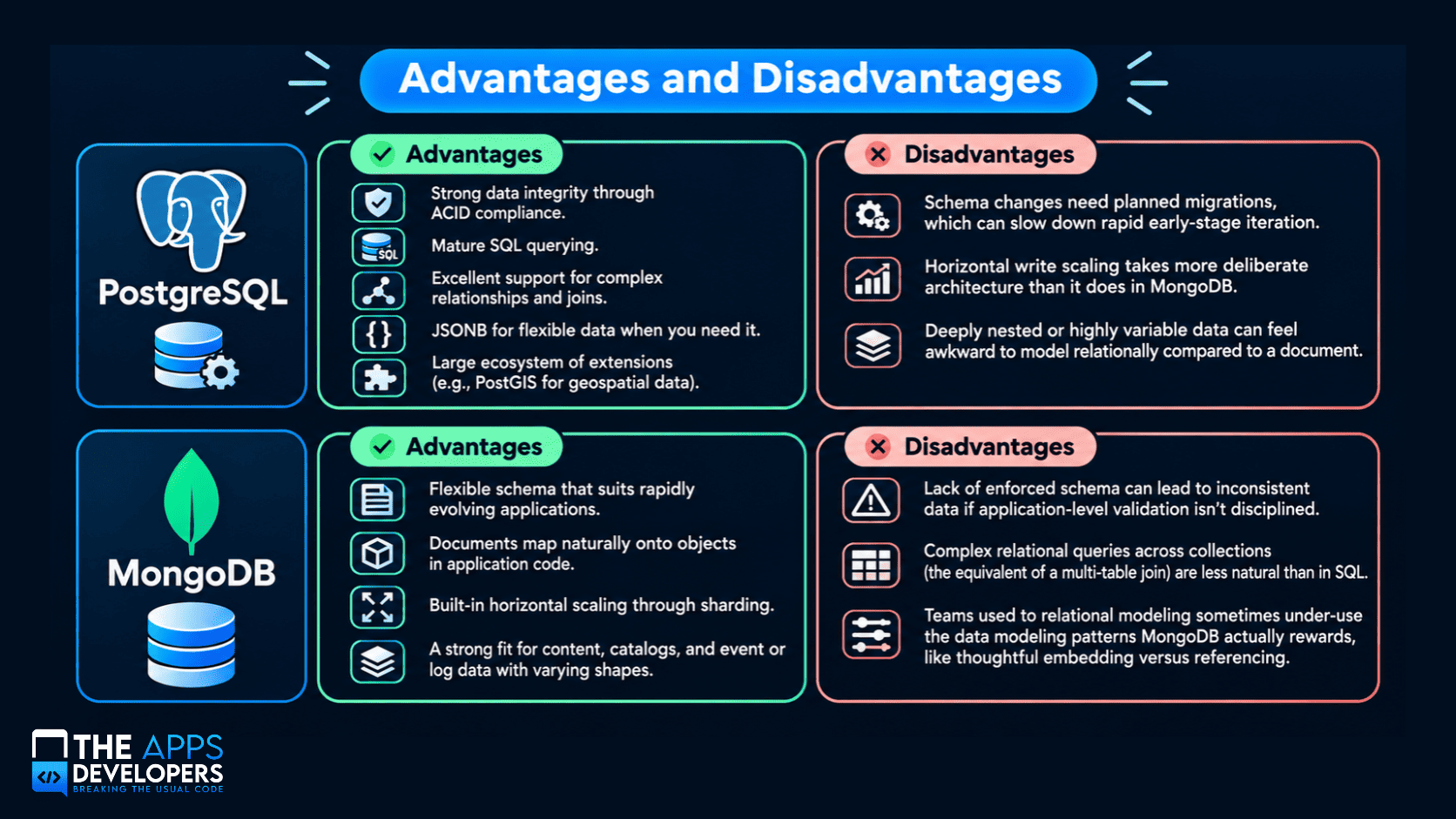
Advantages: strong data integrity through ACID compliance, mature SQL querying, excellent support for complex relationships and joins, JSONB for flexible data when you need it, and a large ecosystem of extensions, PostGIS for geospatial data being a standout example.
Disadvantages: schema changes need planned migrations, which can slow down rapid early-stage iteration, horizontal write scaling takes more deliberate architecture than it does in MongoDB, and deeply nested or highly variable data can feel awkward to model relationally compared to a document.
MongoDB
Advantages: flexible schema that suits rapidly evolving applications, documents map naturally onto objects in application code, built-in horizontal scaling through sharding, and a strong fit for content, catalogs, and event or log data with varying shapes.
Disadvantages: lack of enforced schema can lead to inconsistent data if application-level validation isn’t disciplined, complex relational queries across collections (the equivalent of a multi-table join) are less natural than in SQL, and teams used to relational modeling sometimes under-use the data modeling patterns MongoDB actually rewards, like thoughtful embedding versus referencing.
Practical Use Cases
| Use Case | Better Fit | Why |
| Financial systems, accounting, inventory | PostgreSQL | Strong ACID guarantees and relational integrity matter more than flexibility |
| Content management systems | MongoDB | Content structures vary by type and change over time |
| Multi-tenant SaaS platforms | Either, depends on architecture | Both can work well; the decision often comes down to isolation strategy, which our guide on multi-tenant vs single-tenant SaaS covers in more depth |
| Product catalogs with varying attributes | MongoDB, or PostgreSQL with JSONB | Document flexibility helps, though JSONB can cover simpler versions of this need |
| Ecommerce platforms (catalog plus checkout) | Often both, split by function | Product catalogs vary in shape and suit MongoDB, while orders, payments, and inventory benefit from PostgreSQL’s relational integrity |
| Reporting and analytics on relational data | PostgreSQL | SQL’s join and aggregation capabilities are purpose-built for this |
| Real-time applications with rapidly evolving data shapes | MongoDB | Schema flexibility avoids migration overhead during fast iteration |
| Applications requiring complex, enforced data relationships | PostgreSQL | Foreign keys and constraints catch integrity issues at the database layer |
A Decision Framework
Instead of asking “which database is better,” it helps to ask a few more specific questions about your actual application.
Does your data have clear, stable relationships? If most of your entities relate to each other in predictable ways, orders to customers, invoices to line items, a relational model in PostgreSQL will likely serve you better long term.
Does your data vary significantly in shape, or change structure often? If different records in the same collection naturally have different fields, or your schema is still evolving quickly, MongoDB’s document model avoids a lot of migration friction.
How important is strict consistency across multiple pieces of data at once? If a single business operation must update several related records atomically or not at all, PostgreSQL’s transactional model is the more natural fit.
What does your scaling trajectory actually look like? If you’re planning for very high write volume distributed across many servers from the outset, MongoDB’s sharding is more turnkey. If you’re more likely to scale reads and keep writes on a well-tuned primary, PostgreSQL handles that well.
None of these questions have a universally correct answer. They’re meant to surface what your application actually needs, which is the only honest way to make this call. This kind of decision is exactly what we work through with clients early in a project, as part of our API and backend development process.
Can You Use Both?
Yes, and plenty of production systems do. It’s common to use PostgreSQL for core transactional data, orders, accounts, billing, while using MongoDB for activity logs, content, or search-adjacent data that doesn’t need relational guarantees. The tradeoff is operational: running two database systems means two things to monitor, back up, and scale, a real cost worth weighing against the benefit. Our DevOps and cloud solutions team handles exactly this kind of multi-database infrastructure when it’s the right call for a project.
Choosing the Right Database for Your Project
The PostgreSQL vs MongoDB decision isn’t really about picking a winner. It’s about matching a database’s actual design philosophy to what your application needs to do, today and as it grows. Get this choice right early, and your data layer supports your product instead of constraining it later.
If you’re scoping a new application and want help thinking through the right database architecture for your specific use case, talk to our API and backend development team. We’ll work through your data model with you before any code gets written, not after a migration becomes unavoidable.
Frequently Asked Questions
When should you use PostgreSQL instead of MongoDB?
Use PostgreSQL when your data has clear, stable relationships that benefit from enforced structure, when you need strict multi-table transactional consistency, or when complex joins and reporting queries are a core part of how the application works.
Is MongoDB better than PostgreSQL?
Not universally. MongoDB tends to fit better than PostgreSQL when your data varies in shape between records, your schema is still evolving quickly, or you need horizontal scaling across many servers built in from the start. For structured, relationship-heavy data, PostgreSQL is usually the stronger fit instead.
Which database is better for SaaS applications?
Both work well for SaaS, and the better fit usually comes down to your tenancy model rather than the application category itself. Multi-tenant platforms with mostly uniform, relational data often lean on PostgreSQL, while platforms with per-tenant customization or rapidly evolving feature sets sometimes favor MongoDB’s schema flexibility.
Is PostgreSQL or MongoDB better for ecommerce?
Many ecommerce platforms use both. Product catalogs often have varying attributes by category, which suits MongoDB’s document model, while orders, payments, and inventory usually benefit from PostgreSQL’s relational integrity and transactional guarantees.
Which database is better for complex queries?
PostgreSQL is generally the stronger choice for complex queries involving multiple joins, aggregations, and relationships across tables, since SQL and its query optimizer are purpose-built for exactly that. MongoDB’s aggregation pipeline can handle complex transformations too, but deeply relational queries across collections are less natural than in SQL.
Can PostgreSQL and MongoDB work together?
Yes, this is a common pattern. Teams often use PostgreSQL for core transactional data and MongoDB for less structured data like logs or content, accepting the added operational overhead of running two database systems in exchange for using each where it fits best.