- Home
- App Development
- Blog Details
- 12 mins read
How IoT-Enabled Mobile Apps Improve Logistics and Fleet Management
- Published on:
- Written by:
- Share:
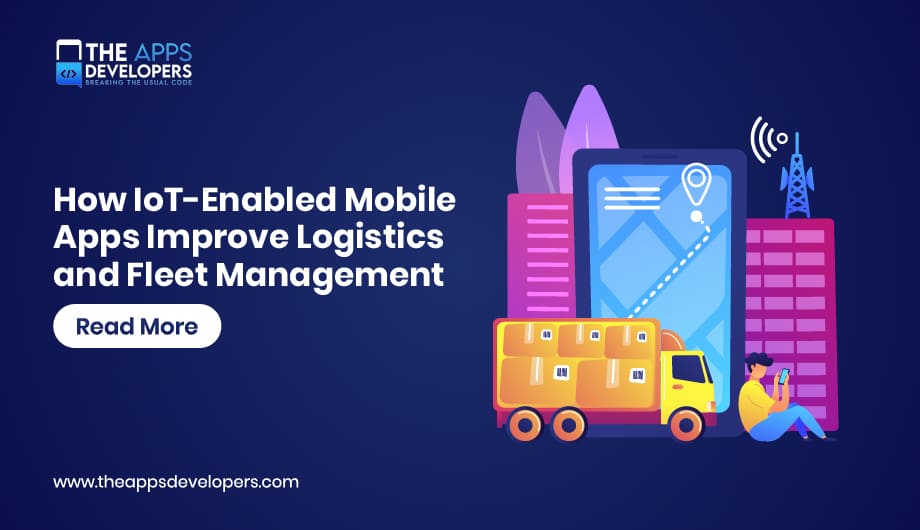
IoT-enabled mobile apps improve logistics and fleet management by turning live data from GPS trackers, vehicle sensors, and temperature monitors into alerts, routes, and decisions that drivers and managers can act on immediately. The results are fewer surprises: less idle time, earlier maintenance, better-protected cargo, and accurate delivery updates.
Most fleets already collect some data. The problem is that it sits in a telematics portal nobody checks until something goes wrong. A well-built app puts the right signal in front of the right person, on the device they already carry. Our mobile app development services team builds these driver and manager apps, and our IoT app development work covers the device and data side that feeds them.
This guide explains how IoT in logistics works, where it improves fleet operations, which features matter, and what to consider before building.
What Is an IoT-Enabled Fleet Management App?
An IoT-enabled fleet management app is a mobile application that receives data from connected devices on vehicles, trailers, containers, or cargo, such as GPS trackers, engine diagnostics, temperature sensors, and door sensors, and turns it into live tracking, alerts, and workflows for drivers, dispatchers, and fleet managers.
Telematics hardware collects the data. The app is where people use it.
How IoT in Logistics Works
- Devices capture data. GPS units, OBD-II or CAN bus readers, temperature probes, fuel sensors, BLE tags, and cameras record location and condition.
- Data travels to the cloud. Devices send small messages over cellular networks, often using lightweight protocols such as MQTT, which suits unreliable connections.
- The platform processes it. Services such as AWS IoT Core or Azure IoT Hub manage devices and route messages to rules, databases, and analytics.
- Apps act on it. Driver apps show tasks and warnings; manager dashboards show the fleet and flag exceptions; customers receive delivery updates.
How IoT Fleet Management Apps Improve Operations
IoT fleet management apps improve operations in six measurable areas: visibility, maintenance, cargo protection, driver safety, fuel use, and customer communication.
Real-Time Fleet Visibility
Dispatchers no longer phone drivers to find out where they are. A live map shows every vehicle, geofences log arrivals and departures automatically, and ETAs update with actual traffic and stop times.
Maintenance Before Breakdowns
Fixed service schedules and repairs after something fails give way to alerts based on engine fault codes, mileage, and engine hours, so vehicles are serviced when the data says they need it.
Cargo Protection
Instead of checking temperature only at pickup and delivery, sensors report continuously and the app alerts the driver the moment a load moves outside its safe range.
Safer Driving
Harsh braking, speeding, and fatigue patterns are flagged as they happen and used for coaching, rather than discovered later through complaints or insurance claims.
Lower Fuel and Idle Costs
Idle time and fuel use are tracked per vehicle and route every day, not reviewed once a month from fuel card statements.
Better Customer Communication
Automatic tracking links and digital proof of delivery replace most “where is my delivery?” calls.
The common thread is speed. Problems that used to surface at the end of the day or in the monthly report now surface while there is still time to act.
IoT in Logistics: High-Value Use Cases
The use cases with the fastest payback are live asset tracking, cold chain monitoring, predictive maintenance, driver behavior coaching, and automated proof of delivery.
IoT Asset Tracking
GPS and BLE tags track trucks, trailers, containers, pallets, and expensive equipment. Geofences trigger arrival and departure events automatically, so dispatchers stop chasing status updates and yard teams find trailers faster.
Cold Chain Monitoring
Food, pharmaceuticals, and chemicals must stay within temperature ranges. Sensors report continuously, and the driver app alerts the driver first, giving them a chance to fix a door or reefer setting before the load is lost. Logged readings also become the compliance record for the shipment.
Predictive Maintenance for Fleets
Engine fault codes, battery voltage, tire pressure, mileage, and engine hours feed maintenance rules. Instead of waiting for a breakdown, the app schedules service when data shows it is needed and blocks unsafe vehicles from dispatch.
Driver Safety and Compliance
Accelerometer and camera data highlight harsh braking, speeding, and distraction for coaching rather than punishment. In the United States, commercial fleets subject to hours-of-service rules must record driving time with electronic logging devices under FMCSA regulations, and ELD data often feeds the same driver app.
Last-Mile Delivery
Live ETAs, customer tracking links, photo and signature proof of delivery, and failed-delivery reasons captured in a tap. Our logistics app development work focuses on these delivery workflows, while automotive app development covers vehicle-connected experiences more broadly.
Fleet Management App Features That Matter
A useful IoT fleet system usually has two front ends: a driver app focused on today’s work and a manager dashboard focused on exceptions across the fleet.
Driver App
- Today’s route, stops, and job details, with navigation handoff.
- Pre-trip and post-trip vehicle inspections with photos.
- Live alerts for temperature, maintenance, or route changes.
- Proof of delivery with photo, signature, and notes.
- Offline mode that syncs when signal returns.
- Large buttons and minimal typing, since drivers use it in cabs and loading docks.
Manager Dashboard
- Live fleet map with filters by status, region, or vehicle type.
- Exception queue: late deliveries, temperature breaches, fault codes, harsh driving.
- Maintenance schedules and vehicle health scores.
- Fuel, idle time, and utilization reports.
- Driver scorecards and coaching history.
Managers often prefer the dashboard on a large screen, while drivers live in the mobile app.
Custom vs Off-the-Shelf Fleet Management Software
Off-the-shelf telematics platforms work well for standard tracking and compliance, while custom fleet management app development makes sense when your workflows, integrations, or customer experience set you apart.
| Factor | Off-the-Shelf Telematics App | Custom IoT Fleet App |
| Time to deploy | Days to weeks | Months |
| Cost model | Per vehicle monthly fees | Build cost plus hosting and support |
| Hardware | Usually tied to the vendor’s devices | Mix of devices and vendors |
| Workflows | Generic dispatch and tracking | Built around your jobs, customers, and rules |
| Integrations | Limited connectors | TMS, WMS, ERP, billing, and customer portals |
| Data ownership | Stored and shaped by the vendor | Fully yours |
| Best fit | Small fleets with standard needs | Growing fleets, 3PLs, and logistics products sold to others |
Many companies combine both: they keep a proven telematics provider for hardware and pull its data through APIs into a custom app that matches their operations.
Architecture Behind the App
IoT data arrives fast and in volume, so the backend needs message ingestion, time-series storage, a rules engine for alerts, and APIs for the apps. A dedicated API and backend development team designs that pipeline. Managed services can speed up early builds, though fleets at scale usually need more control.
Security, Cost, and Implementation
Securing Connected Fleets
Every connected device is a potential entry point. Use unique device credentials and certificates, encrypt data in transit, update firmware securely, and give each user only the access their role needs. The NIST Cybersecurity for IoT Program publishes practical baselines for device security.
What Drives Cost
Fleet management app development cost depends on scope. Typical market estimates range from about $40,000 for a driver app built on an existing telematics provider’s data to $150,000 or more for a custom platform with multiple device types, rules engines, and TMS or ERP integrations. The main drivers are the number of device types, integrations, offline needs, analytics depth, and whether you are building for your own fleet or for many customers.
Rolling It Out
- Pick one problem with a clear cost, such as spoiled loads or breakdowns.
- Pilot on a small group of vehicles and drivers.
- Tune alert thresholds so drivers are not flooded with noise.
- Expand once the data proves the result.
Automated deployment and monitoring through DevOps and cloud solutions keep the platform reliable as more vehicles come online.
Put Your Fleet Data to Work
IoT in logistics only pays off when data reaches the people who can act on it, fast. The Apps Developers builds IoT-enabled driver apps, manager dashboards, and backends that connect devices with business systems. If you’re planning a connected fleet solution, contact our team to discuss your requirements and explore how a custom app could solve your fleet’s biggest operational challenges.
Frequently Asked Questions
How is IoT used in logistics?
IoT is used in logistics to track vehicles and assets in real time, monitor cargo temperature and condition, detect maintenance needs from engine data, record driver behavior, and automate delivery updates and proof of delivery.
Can a custom app work with our existing GPS trackers?
Usually yes. Most telematics providers offer APIs or data feeds, so a custom app can use existing hardware instead of replacing it. Confirm API access and data limits with your provider early.
How does IoT help with cold chain monitoring?
Temperature sensors report readings continuously, and the app alerts drivers and managers the moment a load moves outside its safe range. The stored readings also serve as a compliance record for each shipment.
How much does fleet management app development cost?
Typical estimates range from about $40,000 for a driver app using an existing telematics provider’s data to $150,000 or more for a custom multi-device platform with integrations. Scope and integrations drive the final figure.
Table of Contents

Taha Mirza
Taha Hissam Mirza is a technology writer at The Apps Developers, covering mobile app development, web development, software engineering, and emerging technologies. He explores industry trends, development strategies, and practical solutions that help businesses make informed technology decisions. Through research-driven insights and easy-to-understand articles, Taha simplifies complex technical concepts and helps startups, entrepreneurs, and enterprises understand how to build scalable, secure, and user-friendly digital products.