- Home
- App Development
- Blog Details
- 12 mins read
How Remote Patient Monitoring Apps Are Transforming Healthcare Delivery
- Published on:
- Written by:
- Share:
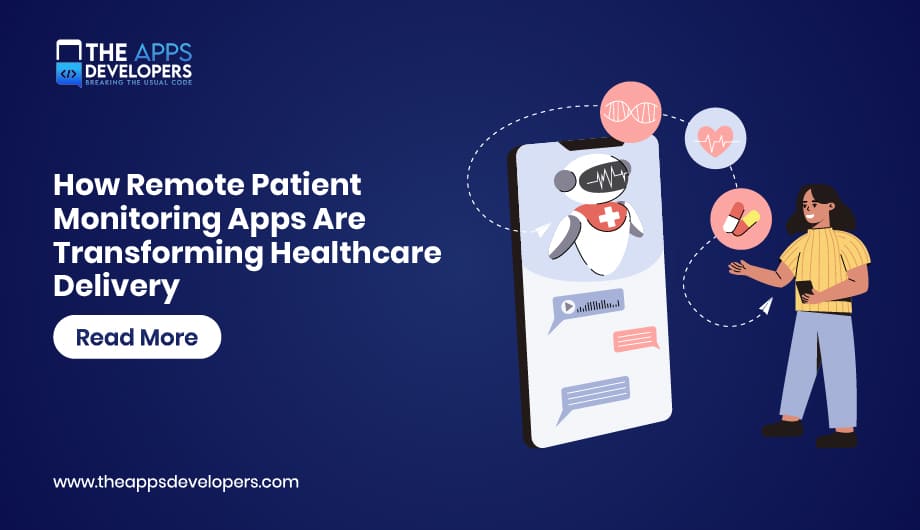
Remote patient monitoring apps are transforming healthcare delivery by collecting readings such as blood pressure, glucose, weight, and oxygen levels from patients at home and sending them to care teams in near real time. Clinicians can act on trends between visits instead of waiting for the next appointment, which supports earlier intervention and better management of chronic conditions.
The traditional model sees a patient for fifteen minutes every few months and relies on memory for everything in between. Remote patient monitoring fills that gap with continuous, objective data. Our mobile app development services team builds the patient apps and clinician tools that make that data usable, and our healthcare app development work covers the compliance and integration side.
This guide explains how a remote patient monitoring app works, where it changes care, which features matter, and what to plan for before building one.
What Is a Remote Patient Monitoring App?
A remote patient monitoring app is a healthcare application that collects physiological data from connected medical devices used at home, such as blood pressure cuffs, glucometers, pulse oximeters, and weight scales, and transmits it securely to a care team that reviews readings, receives alerts, and follows up with the patient.
How Remote Patient Monitoring Works
- Enroll. A clinician enrolls the patient and sets target ranges for each reading.
- Measure. The patient uses a connected device at home. Data syncs over Bluetooth to the phone app or directly over a cellular connection built into the device.
- Transmit. Readings travel encrypted to the RPM platform.
- Triage. Rules flag readings outside the patient’s thresholds, and the clinician dashboard prioritizes who needs attention.
- Act. Nurses or care managers message, call, or schedule a visit, and every interaction is documented.
RPM vs Telehealth vs Remote Therapeutic Monitoring
These terms are often mixed up, but they describe different services.
| Factor | Remote Patient Monitoring (RPM) | Telehealth Visits | Remote Therapeutic Monitoring (RTM) |
| What it is | Ongoing collection of physiological data | Live video or phone consultations | Ongoing tracking of therapy-related data |
| Data type | Blood pressure, glucose, weight, SpO2, heart rate | Conversation and visual assessment | Medication adherence, therapy exercises, symptoms, pain |
| Timing | Continuous between visits | Scheduled sessions | Continuous between visits |
| Typical conditions | Hypertension, diabetes, heart failure, COPD | Broad primary and specialty care | Musculoskeletal, respiratory, behavioral therapy |
| Device requirement | Connected medical device | Camera and microphone | Device or app, depending on program |
Many programs combine them: RPM surfaces a problem, and a telehealth visit resolves it.
How Remote Patient Monitoring Apps Transform Healthcare Delivery
Remote patient monitoring apps change care delivery in five main ways: they move care between visits, prioritize clinician attention, engage patients in their own management, extend care to people who struggle to travel, and make programs measurable.
Care Happens Between Appointments
A rising blood pressure trend or a sudden weight gain in a heart failure patient becomes visible within days rather than months. Care teams can adjust treatment or check in before a small change becomes an emergency visit.
Clinician Time Goes Where It Is Needed
Instead of reviewing every patient equally, nurses work from an exception list of out-of-range readings and missed measurements. One care manager can follow a larger panel because the system does the sorting.
Patients Become Active Participants
Seeing their own readings, trends, and goals helps patients connect daily habits with results. Reminders and simple feedback keep measurement routines going.
Access Improves for Rural and Older Patients
Patients who live far from clinics, lack transport, or have mobility problems can be monitored closely without frequent trips. Devices with built-in cellular connections help people without smartphones or reliable internet.
Programs Become Measurable
Enrollment, measurement adherence, alert response times, and outcomes are all recorded, giving health systems the data they need to evaluate and fund the program.
Remote Patient Monitoring Use Cases by Condition
Remote patient monitoring works best for conditions where regular home readings directly guide treatment decisions.
Hypertension
A connected blood pressure cuff shows whether medication is working at home, not just in the clinic. The app flags sustained high readings and missed measurements.
Diabetes
Glucometers and continuous glucose monitors reveal highs, lows, and patterns around meals, helping care teams adjust medication and coaching between visits.
Heart Failure
Daily weight and blood pressure readings matter because rapid weight gain can signal fluid retention, often days before symptoms send a patient to the emergency room.
COPD and Asthma
Pulse oximeters and spirometers track falling oxygen levels and worsening lung function, so the team can step in early during a flare.
Post-Surgical Recovery
Temperature, oxygen readings, and wound photos help catch fever, infection, or slow recovery after a patient goes home.
Essential Remote Patient Monitoring App Features
An RPM solution usually has two sides: a simple patient app and a clinician dashboard built around triage.
Patient App
- Easy device pairing with step-by-step guidance.
- Automatic reading sync, with manual entry as a fallback.
- Measurement reminders at times that suit the care plan.
- Trend charts written in plain language, not clinical jargon.
- Secure messaging with the care team and education content.
- Accessibility: large text, high contrast, and very few steps, since many users are older adults.
Clinician Dashboard
- Patient panel sorted by risk, with configurable thresholds per patient.
- Alert queue for out-of-range readings and missed measurements.
- Time tracking for monitoring and patient interactions, which reimbursement often requires.
- Notes, care plans, and audit history.
- Reports for program performance.
Remote Patient Monitoring Devices, Integrations, and Architecture
Bluetooth vs Cellular Devices
Bluetooth devices pair with the patient’s phone and cost less, but depend on the patient having a smartphone and keeping the app working. Cellular devices send readings directly with no pairing, which suits older patients and improves adherence, at a higher device and data cost. Many programs offer both.
EHR Integration
Readings that stay in a separate portal get ignored. Integrating with the EHR puts data where clinicians already work. The HL7 FHIR Observation resource is the standard way to represent vital signs and measurements, and most major EHRs now support FHIR APIs.
Platform Architecture
An RPM platform needs device data ingestion, a rules engine for thresholds and alerts, secure storage, clinician-facing APIs, and audit logging. Our IoT app development work covers the device connectivity layer, while a dedicated API and backend development team builds the services behind both apps. Choosing a managed backend affects compliance, since every service touching patient data must be covered by a business associate agreement.
Compliance, Reimbursement, and Cost of RPM App Development
This section is general guidance, not legal or billing advice. Confirm current requirements with your compliance and billing teams.
HIPAA and Data Security
RPM apps used by providers handle protected health information, so the HIPAA Security Rule applies: encryption, access controls, audit logs, risk assessments, and business associate agreements with vendors.
FDA Considerations
The connected devices themselves are often FDA-cleared medical devices. Software that only collects and displays readings usually carries lower regulatory risk than software that interprets data to diagnose or recommend treatment. The FDA Digital Health Center of Excellence is the starting point for understanding where your features fall.
RPM Reimbursement
In the United States, Medicare reimburses RPM through specific CPT codes covering device setup, device supply with data transmission, and clinician management time. Requirements around days of data collected and minutes of interaction are set in the annual CMS Physician Fee Schedule and have changed in recent years, so your app should track readings and time in a way that matches current rules.
What Drives Cost
RPM app development cost typically ranges from about $60,000 for a focused patient app and dashboard using one device type to $200,000 or more for a multi-device platform with EHR integration and billing support. These are typical market estimates, not quotes. The main drivers are the number of device types, EHR integration, billing and time tracking features, and compliance work.
Build a Remote Patient Monitoring Program That Clinicians Actually Use
Remote patient monitoring apps work when readings are easy for patients to send and easy for clinicians to act on. The Apps Developers builds RPM patient apps, clinician dashboards, device integrations, and the secure backend behind them. If you’re planning a remote patient monitoring solution, contact our team to discuss your requirements and explore a practical plan, from device selection to EHR integration.
Table of Contents

Taha Mirza
Taha Hissam Mirza is a technology writer at The Apps Developers, covering mobile app development, web development, software engineering, and emerging technologies. He explores industry trends, development strategies, and practical solutions that help businesses make informed technology decisions. Through research-driven insights and easy-to-understand articles, Taha simplifies complex technical concepts and helps startups, entrepreneurs, and enterprises understand how to build scalable, secure, and user-friendly digital products.