The best banking apps in the USA in 2026 are Chase, Bank of America, Capital One, Wells Fargo, Citi, Huntington, Ally, SoFi, Chime, and Varo. Chase ranked #1 among national banks in J.D. Power’s 2026 mobile app study, Huntington ranked #1 among regional banks, and Ally and SoFi are the strongest picks if you’re happy banking without a branch.
Here’s a quick test. How many times did you open your banking app last week? For most of us, it’s more often than we visited a branch all year. We check balances in a checkout line, snap photos of checks on the kitchen counter, and pay a friend back for pizza before the bill even arrives.
That’s exactly why the app matters more than the building now. A clunky banking app costs you time every single day, and a hidden fee costs you money. So we compared the major US banking apps on what actually matters: independent satisfaction research, fees, security, and how each one fits a different kind of customer.
We work on financial products ourselves through Fintech App Development, so we’ll also point out what makes the best apps tick under the hood.
What Is a Mobile Banking App?
A mobile banking app is a smartphone app from a bank or financial company that lets you check balances, deposit checks, pay bills, send money, and manage cards without visiting a branch.
You’ll find three kinds of providers behind these apps:
- Traditional banks like Chase and Wells Fargo, which have branches and ATMs.
- Online banks like Ally and Varo, which hold their own bank charters but have no branches.
- Fintech companies like Chime, which offer bank accounts through partner banks.
That last group often looks identical to a bank on your phone, but there’s an important difference we’ll get to below.
How We Ranked These Banking Apps
We didn’t pick favorites. Each app was judged on five things:
- Independent research, mainly the J.D. Power 2026 U.S. Banking Mobile App Satisfaction Study.
- Fees, including monthly fees and overdraft policies.
- Security features like multifactor authentication, biometrics, and card controls.
- Everyday usefulness: check deposit, bill pay, Zelle, and alerts.
- Fit, meaning how clearly each app serves a specific type of customer.
Best Banking Apps in the USA at a Glance
| App | Type | Best For | Standout Feature |
| Chase | National bank | Overall experience | #1 national bank in J.D. Power’s 2026 app study |
| Bank of America | National bank | Money insights | Erica virtual assistant |
| Capital One | National bank | No-fee everyday banking | 360 Checking with no monthly fees |
| Wells Fargo | National bank | Branch and app together | Fargo virtual assistant |
| Citi | National bank | Global customers | No overdraft fees |
| Huntington | Regional bank | Regional banking | #1 regional bank in J.D. Power’s 2026 app study |
| Ally | Online bank | High-yield savings | No branches, no overdraft fees |
| SoFi | Online bank | All-in-one money app | Banking, investing, and loans in one place |
| Chime | Fintech | Fee-free spending | Early direct deposit |
| Varo | Online bank | Simple no-fee banking | Small cash advances without a credit check |
Top 10 Banking Apps in the USA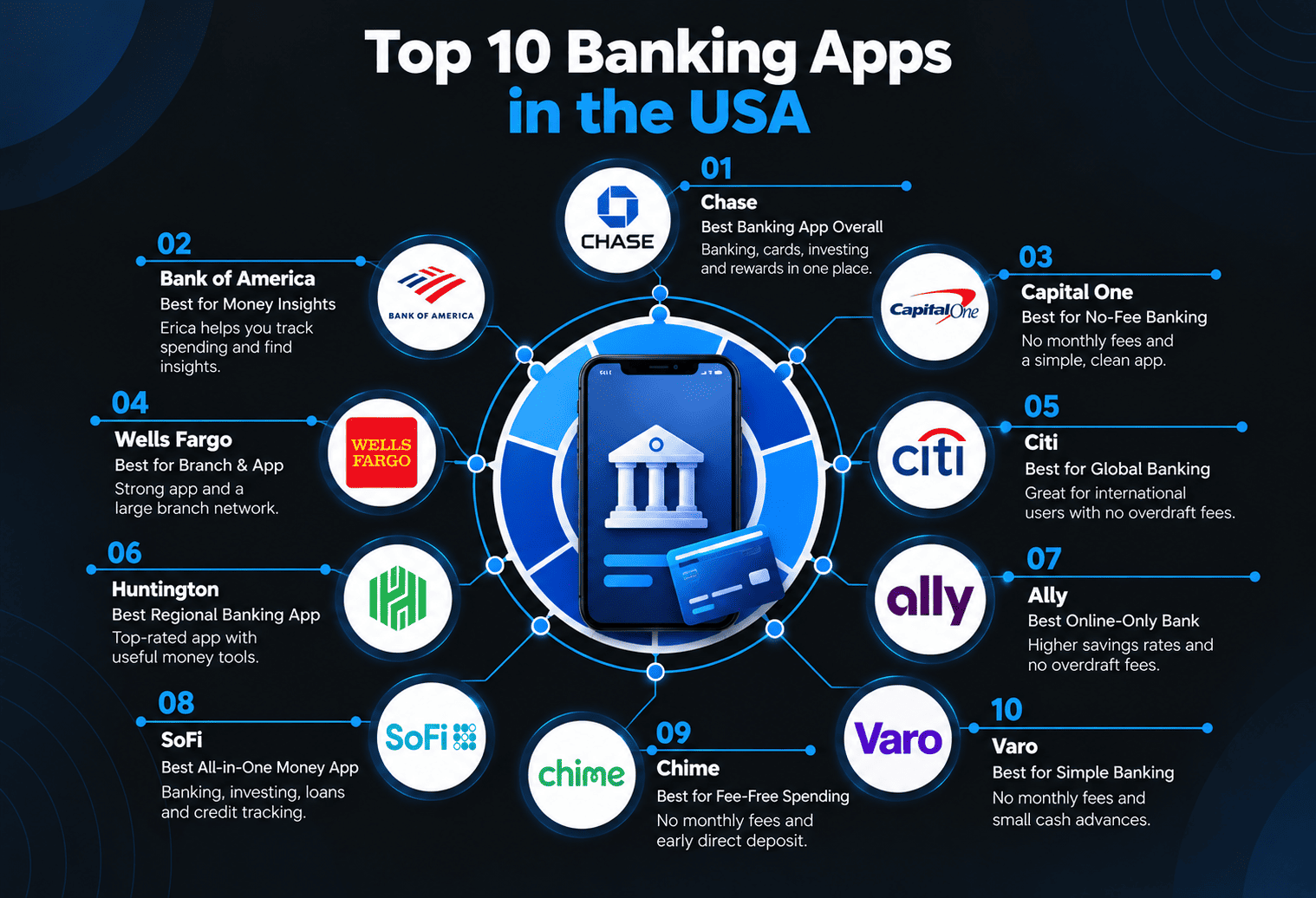
1. Chase: Best Banking App Overall
If you want one app that does almost everything well, start here. Chase Mobile puts checking, savings, credit cards, investing, and rewards side by side, and it’s fast. In May 2026, Chase announced it ranked #1 among national banks in J.D. Power’s 2026 U.S. Banking Mobile App Satisfaction Study, with strong marks for design and performance.
Best for: people who want banking, cards, and investing in one place.
2. Bank of America: Best for Money Insights
Bank of America‘s secret weapon is Erica, a built-in virtual assistant that answers questions, spots unusual charges, and nudges you when spending creeps up. It’s also been a consistent performer, ranking highest among national banks in J.D. Power’s 2025 study before Chase took the top spot in 2026.
Best for: customers who want help understanding where their money goes.
3. Capital One: Best for No-Fee Everyday Banking
Capital One 360 Checking charges no monthly fees and has no minimum balance, which is still rare for a big national bank. The app is clean and simple, and your Capital One credit cards live in the same place.
Best for: anyone who wants big-bank reliability without big-bank fees.
4. Wells Fargo: Best for Branch and App Together
Some people still like a branch nearby, and Wells Fargo‘s huge network delivers that. Its app covers the basics well, from mobile check deposit to Zelle, and its Fargo assistant handles quick questions.
Best for: customers who bank on their phone but still visit a branch now and then.
5. Citi: Best for Global Banking
Citi makes sense if your life crosses borders, whether you travel often or send money internationally. It also dropped overdraft fees, which takes some stress out of tight months.
Best for: frequent travelers and globally connected customers.
6. Huntington: Best Regional Banking App
Huntington proves you don’t need a national giant to get a great app. In June 2026, Huntington announced it ranked highest among regional banks in J.D. Power’s 2026 online banking and mobile app studies. Its money management tools are genuinely useful, not just decoration.
Best for: customers in Huntington’s regions who want a top-rated app with a local feel.
7. Ally: Best Online-Only Bank
Ally has no branches, and that’s the point. Without that overhead, it typically pays more on savings than big traditional banks, and it charges no overdraft fees. Its savings “buckets” make it easy to split one account into goals like travel, a car, or an emergency fund.
Best for: savers who don’t need in-person banking.
8. SoFi: Best All-in-One Money App
SoFi wants to be your whole financial life in one app: checking, savings, investing, loans, and credit tracking. It works especially well for younger customers who’d rather not juggle five different apps.
Best for: people who want banking and investing under one login.
9. Chime: Best for Fee-Free Spending
Chime is popular for no monthly fees, early direct deposit, and fee-free overdraft coverage for eligible members. One thing to know, though: Chime is a financial technology company, not a bank. Your money is held by its partner banks, and eligible deposits are FDIC-insured through them.
Best for: everyday spending without fees.
10. Varo: Best for Simple, No-Fee Banking
Unlike Chime, Varo holds its own national bank charter. It keeps things simple with no monthly fees and a friendly app, and it offers small cash advances without a credit check to help bridge a gap before payday.
Best for: customers who want a straightforward digital bank with no fees.
Traditional Banks vs Online Banks vs Fintech Apps
Traditional banks are best for full service and branch access, online banks are best for savings rates and low fees, and fintech apps are best for simple, fee-free spending.
| Factor | Traditional Banks | Online Banks | Fintech Apps |
| Examples | Chase, Bank of America, Wells Fargo | Ally, SoFi, Varo | Chime |
| Branches | Yes | No | No |
| Monthly fees | Often waivable with conditions | Usually none | Usually none |
| Savings rates | Usually lower | Usually higher | Varies |
| FDIC insurance | Through the bank | Through the bank | Through partner banks |
| Best for | Full-service banking | Savers and digital-first users | Everyday spending |
How to Choose the Right Banking App
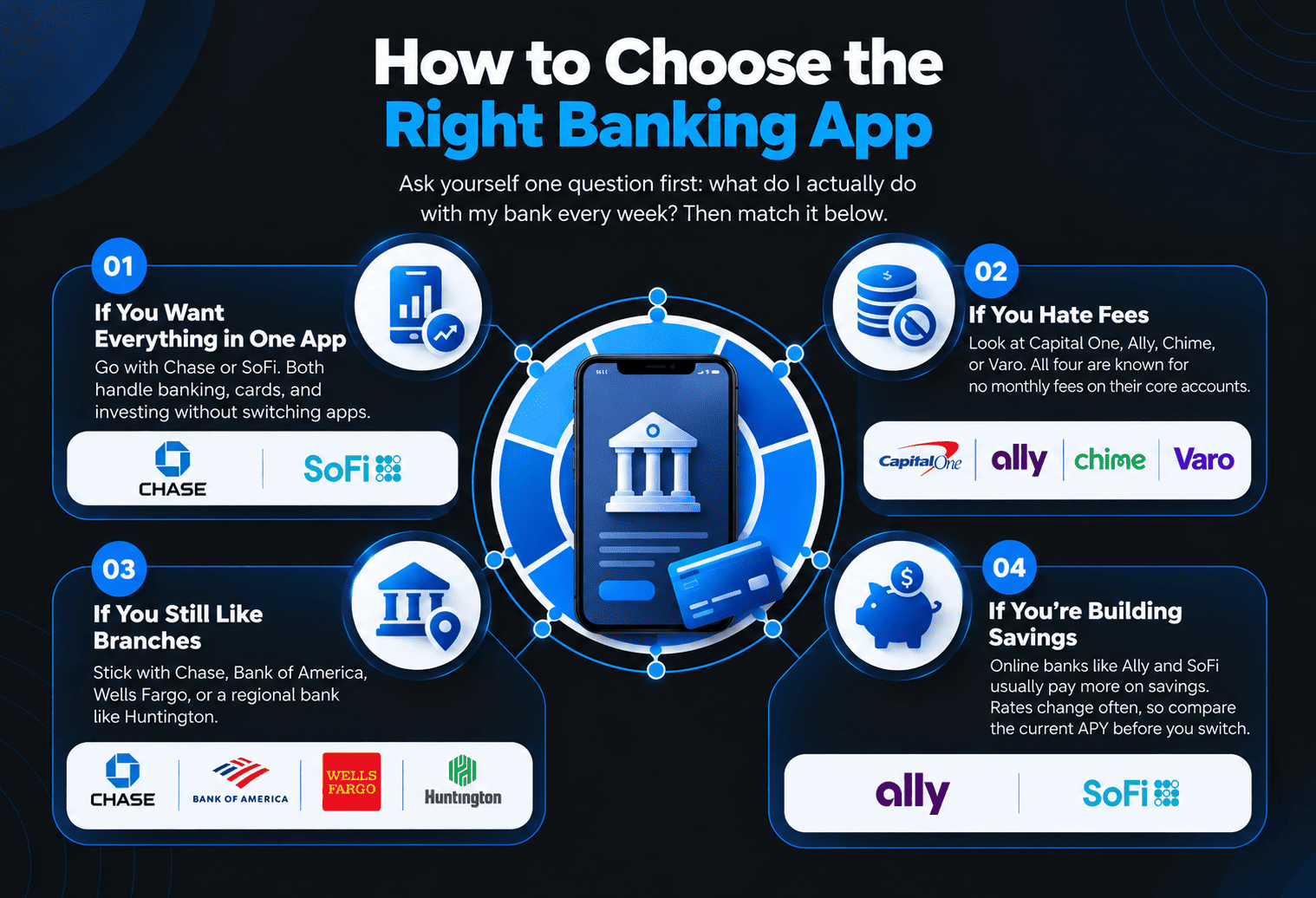
Ask yourself one question first: what do I actually do with my bank every week? Then match it below.
If You Want Everything in One App
Go with Chase or SoFi. Both handle banking, cards, and investing without switching apps.
If You Hate Fees
Look at Capital One, Ally, Chime, or Varo. All four are known for no monthly fees on their core accounts.
If You Still Like Branches
Stick with Chase, Bank of America, Wells Fargo, or a strong regional bank like Huntington.
If You’re Building Savings
Online banks like Ally and SoFi usually pay noticeably more on savings than large traditional banks. Rates change often, so compare the current APY before you switch.
Are Banking Apps Safe?
Yes. Banking apps from established, FDIC-insured banks are generally safe, especially when you turn on multifactor authentication, use biometrics, and keep your phone updated.
Security and satisfaction actually go together. J.D. Power’s 2025 research found that satisfaction was 16 points higher among national banking app users who used multifactor authentication before logging in.
It’s also worth confirming FDIC coverage before you open any account. Standard coverage is $250,000 per depositor, per insured bank, for each ownership category, and the FDIC’s deposit insurance guide explains how that works, including for fintech apps that use partner banks.
A few habits go a long way: never bank on public Wi-Fi without protection, ignore texts that ask you to “verify” your account, and turn on instant alerts for every transaction.
What Makes a Great Banking App? (For Banks and Fintech Founders)
Look closely at the top of this list, and a pattern appears. Chase and Huntington didn’t win with flashy features. They won with speed, clarity, and trust. If you’re building a banking or fintech app, that’s the bar.
Design That Feels Calm
When money is involved, confusion feels like risk. Every screen should make the next step obvious, which is why careful UI/UX design has such a direct effect on customer trust.
Integrations That Never Miss
Behind every balance sit core banking systems, card processors, identity checks, and fraud tools. Solid API and backend development keeps those numbers accurate in real time.
Plenty of fintech apps also add stored balances, rewards, or peer-to-peer payments. Our guide to mobile wallet development explains how those features work.
Security Built In, Not Bolted On
Banking apps need KYC and AML checks, PCI DSS protection for card data, device binding, and smart session timeouts. Our guide to web app session management covers how to keep accounts secure without annoying customers.
Uptime matters too. Nothing makes customers panic like an app that won’t show their balance, so experienced DevOps and cloud solutions are essential for monitoring and fast recovery.
Conclusion
The best banking app in the USA depends on how you bank. Chase leads for an all-around experience, Bank of America helps you understand your spending, Capital One makes no-fee banking easy, Ally and SoFi reward savers, and Chime and Varo keep everyday spending simple. Whichever you choose, confirm FDIC coverage and switch on every security feature the app offers.
Building a banking or fintech app of your own? Book a free consultation with The Apps Developers, and we’ll help you plan a secure, compliant product your customers will trust.
Frequently Asked Questions
Which bank has the best mobile app in the USA?
Chase has one of the best mobile banking apps in the USA. It ranked #1 among national banks in J.D. Power’s 2026 U.S. Banking Mobile App Satisfaction Study, while Huntington ranked #1 among regional banks.
What is the safest banking app?
The safest banking apps come from FDIC-insured banks and offer multifactor authentication, biometric login, and instant alerts. Chase, Bank of America, Capital One, and Wells Fargo all include these protections.
Which banking apps have no monthly fees?
Capital One 360 Checking, Ally, Chime, and Varo are popular options with no monthly fees on their core accounts. Always review the full fee schedule before opening an account.
Is Chime a real bank?
No. Chime is a financial technology company, not a bank. Its accounts are provided through partner banks, and eligible deposits are FDIC-insured through those banks.
What is the difference between an online bank and a fintech app?
An online bank, like Ally or Varo, holds its own bank charter. A fintech app, like Chime, offers accounts through partner banks. Both can be FDIC-insured, but in different ways.
Is it safe to deposit checks with a banking app?
Yes. Mobile check deposit through an established bank’s app is encrypted and widely used. Keep the paper check for a short period until the deposit fully clears.