- Home
- App Development
- Blog Details
- 12 mins read
Frontend vs Backend vs Full-Stack Development: Understanding the Differences
- Published on:
- Written by:
- Share:
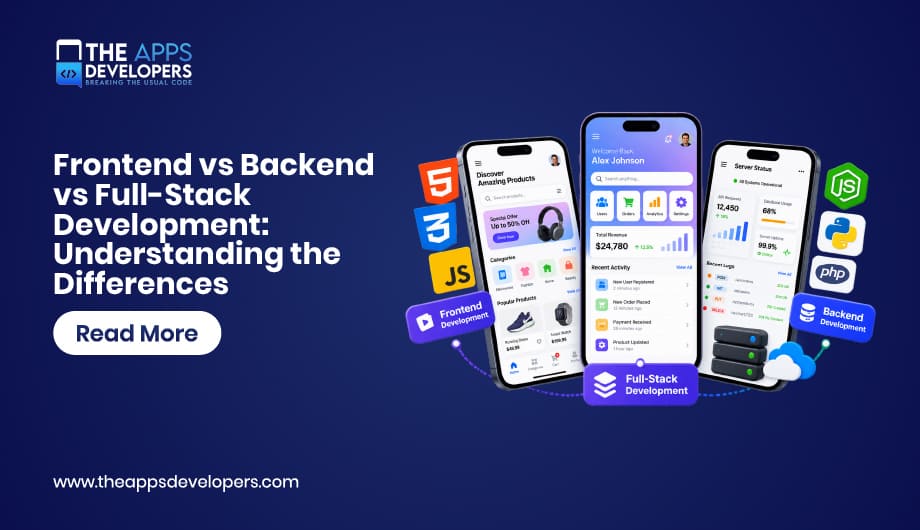
Frontend development builds everything users see and interact with in the browser, backend development builds the servers, databases, APIs, and business logic that power it, and full-stack development covers both layers. Most serious web applications need strong skills in both, whether that comes from specialists, full-stack developers, or a mix of the two.
The distinction matters most when you are planning a budget or a team. Hire only frontend talent and your product looks good but cannot handle real data. Hire only backend talent and the system works but users struggle to use it. Our web application development services team staffs each project across both layers based on where the complexity actually sits.
This guide explains frontend vs backend vs full-stack development in practical terms: what each role does, the technologies involved, how they compare, and how to decide which developers your project needs.
What Are Frontend, Backend, and Full-Stack Development?
Every web application has two sides: the part users see and the part that does the work behind it. A simple way to picture it is a restaurant. The dining room, menu, and service are the frontend. The kitchen, storage, and supplier orders are the backend. A full-stack developer is comfortable in both rooms.
What Is Frontend Development?
Frontend development is the practice of building the client side of a web application, meaning the layouts, screens, forms, navigation, and interactions that users see and use in their browser. Frontend developers turn designs into working interfaces using HTML, CSS, JavaScript, and frameworks such as React, Next.js, Vue.js, or Angular.
What Is Backend Development?
Backend development is the practice of building the server side of an application, including the business logic, databases, APIs, authentication, integrations, and infrastructure that process requests and store data. Backend developers work with languages and frameworks such as Node.js, Java with Spring Boot, Python with Django, PHP with Laravel, and Ruby on Rails.
What Is Full-Stack Development?
Full-stack development is the practice of building both the frontend and backend of an application, so one developer or team can deliver a complete feature from the user interface to the database. Full-stack developers usually go deep in one stack, such as React with Node.js, rather than mastering every technology on both sides.
For a well-maintained, vendor-neutral reference on how these layers fit together, MDN Web Docs remains one of the most trusted resources in web development.
Frontend vs Backend vs Full-Stack: Side-by-Side Comparison
The main difference between frontend and backend is where the code runs and what it is responsible for: frontend code runs in the user’s browser and handles presentation and interaction, while backend code runs on servers and handles data, logic, and security. Full-stack development spans both.
| Factor | Frontend Development | Backend Development | Full-Stack Development |
| Where code runs | User’s browser or device | Servers and cloud infrastructure | Both |
| Main focus | User interface, interactions, performance users feel | Business logic, data, APIs, security, integrations | Complete features end to end |
| Core languages | HTML, CSS, JavaScript, TypeScript | JavaScript (Node.js), Java, Python, PHP, Ruby, Go, C# | One frontend stack plus one backend stack |
| Common frameworks | React, Next.js, Vue.js, Angular | Spring Boot, Express, NestJS, Django, Laravel, Rails | Combinations such as React with Node.js, or Vue with Laravel |
| Works with | Designers, product managers, backend developers | Frontend developers, DevOps, data teams | Whole product team |
| Key quality measures | Usability, accessibility, page speed, responsiveness | Reliability, security, scalability, data integrity | Delivery speed and feature completeness |
| Typical problems solved | Confusing flows, slow pages, layout bugs on mobile | Slow queries, failed integrations, data leaks, downtime | Gaps and handoff delays between layers |
| Best fit | Interface-heavy products, design systems, complex dashboards | Integration-heavy, data-heavy, high-traffic, or regulated systems | MVPs, small teams, feature teams on modern stacks |
None of the three is better in general. The right mix depends on where your product’s complexity lives.
Frontend Development: What It Covers in a Real Project
Frontend work is often underestimated as “making it look nice.” In practice, the frontend decides whether people can complete tasks quickly, whether pages load fast on a mid-range phone, and whether users with disabilities can use the product at all.
Frontend Developer Responsibilities
- Turning UI/UX designs into responsive layouts that work across browsers and screen sizes.
- Building interactive components such as forms, tables, filters, charts, and multi-step workflows.
- Managing client-side state, for example a shopping cart, an unsaved draft, or live dashboard filters.
- Connecting the interface to backend APIs and handling loading, error, and empty states.
- Optimizing performance so pages load and respond quickly.
- Meeting accessibility standards for keyboard navigation, screen readers, and color contrast.
Frontend Technologies Used Today
Frontend development uses a range of technologies across different parts of the development process:
- Languages: HTML, CSS, JavaScript, TypeScript
- Frameworks and libraries: React, Next.js, Vue.js, Nuxt, Angular, Svelte
- Styling: Tailwind CSS, Sass, CSS modules, component libraries
- State and data fetching: Redux, Zustand, TanStack Query
- Testing: Jest, Vitest, Playwright, Cypress
- Build tools: Vite, webpack, Turbopack
Frontend Quality Measures That Affect Business Results
Google’s Core Web Vitals measure loading speed, responsiveness, and visual stability, and they influence both user experience and search visibility. Accessibility matters for usability and, in many markets, legal compliance; the W3C Web Content Accessibility Guidelines (WCAG) are the standard most organizations follow.
Frontend development works closely with design. A clear UI/UX design process gives frontend developers tested flows and consistent components, which shortens development and reduces rework. Companies that need more frontend capacity often hire React developers, since React is one of the most widely used libraries for complex web interfaces.
Backend Development: The Engine Behind the Application
If the frontend is what users judge, the backend is what makes the product trustworthy. It stores data correctly, enforces who can do what, connects to other systems, and keeps working when traffic spikes.
Backend Developer Responsibilities
- Designing database schemas and writing efficient queries.
- Building REST or GraphQL APIs that frontend and mobile apps use.
- Implementing business rules, such as pricing, approvals, and inventory logic.
- Handling authentication, authorization, and session security.
- Integrating payment gateways, CRMs, ERPs, email, and other third-party services.
- Running background jobs for reports, notifications, and imports.
- Planning for scalability, caching, logging, and monitoring.
Backend Technologies Used Today
Backend development uses a range of technologies across different parts of the application:
- Languages and runtimes: Node.js, Java, Python, PHP, Ruby, Go, C#
- Frameworks: Express, NestJS, Spring Boot, Django, FastAPI, Laravel, Ruby on Rails, .NET
- Databases: PostgreSQL, MySQL, MongoDB, Redis
- APIs and messaging: REST, GraphQL, WebSockets, RabbitMQ, Kafka
- Infrastructure: AWS, Azure, Google Cloud, Docker, Kubernetes
Backend Security and Architecture Decisions
Most serious security issues in web applications are backend problems: broken access control, injection, and weak authentication. The OWASP Top 10 lists the most common risks and is a practical checklist for backend teams.
Architecture choices also shape long-term cost. When integrations, data rules, or scale are central to the product, a dedicated API and backend development team usually delivers the most value.
Full-Stack Development: Strengths and Limits
Full-stack development is popular because it removes handoffs. One developer can design an API, build the screen that uses it, and ship the feature without waiting on another team. That speed is valuable, but it has limits worth understanding before you staff a project around it.
Common Full-Stack Combinations
| Stack | Frontend | Backend | Database | Typical Use |
| MERN | React | Node.js with Express | MongoDB | SaaS products, dashboards, MVPs |
| Next.js full stack | Next.js (React) | Next.js server functions or Node.js | PostgreSQL | Content-rich apps, SEO-sensitive products |
| TALL or Laravel with Vue | Vue.js or Livewire | Laravel (PHP) | MySQL or PostgreSQL | Business portals, admin systems |
| Django with React | React | Django (Python) | PostgreSQL | Data-heavy and analytics platforms |
| Rails with Hotwire | Hotwire | Ruby on Rails | PostgreSQL | SaaS, marketplaces, internal tools |
| Spring Boot with Angular or React | Angular or React | Java with Spring Boot | PostgreSQL or Oracle | Enterprise applications |
Full-Stack Developer vs Specialist: Where Each Wins
Full-stack developers win on early-stage products, small teams, prototypes, and feature teams that own a slice of the product end to end. They reduce coordination overhead and keep momentum high.
Specialists win when one layer becomes demanding. A complex design system, strict accessibility requirements, or a performance-critical interface calls for a dedicated frontend expert. Heavy integrations, high traffic, complex data models, or regulated data call for dedicated backend engineers. Very few people are truly expert at both, and the gaps tend to show as products grow.
A practical rule: full-stack developers are excellent generalists for building features, but complex architecture, security design, and infrastructure still benefit from specialist review.
Which Do You Need: Frontend, Backend, or Full-Stack Developers?
Choose full-stack developers for MVPs and small products, add frontend specialists when the interface is complex or customer-facing at scale, and add backend specialists when integrations, data, security, or traffic drive the product’s difficulty. Most growing products end up with a blended team.
Web Development Team Structure by Project Type
| Project Type | Where the Complexity Sits | Recommended Team Mix |
| MVP or prototype | Speed and validation | One to three full-stack developers, a designer, part-time QA |
| Marketing-heavy web platform or content product | Interface, SEO, performance | Frontend specialists, one backend or full-stack developer |
| SaaS product | Both layers, plus billing and roles | Full-stack core team, with frontend and backend specialists as it grows |
| Enterprise business application | Integrations, permissions, data | Backend specialists, frontend developers, solution architect, DevOps |
| Mobile app with web admin panel | Shared APIs and data | Backend developers, mobile developers, frontend or full-stack for the admin panel |
| Redesign of an existing app | User experience and frontend performance | UI/UX designer and frontend specialists, backend support as needed |
Questions That Point to the Right Mix
- Is the hardest part of your product what users see, or what happens with the data?
- How many external systems must the application connect to?
- Do you handle payments, health data, or other regulated information?
- How many users do you expect in the first year, and how fast might that grow?
- Do you already have in-house developers, and on which layer?
If the answers point mostly to the interface, weight the team toward frontend. If they point to data, integrations, and security, weight it toward backend. If you are still validating the idea, start with full-stack developers and specialize later.
Do Not Forget DevOps
None of the three roles fully covers deployment pipelines, cloud infrastructure, monitoring, and backups. Some full-stack and backend developers handle basic setups, but production systems benefit from proper DevOps and cloud solutions, especially once real customers depend on uptime.
Hiring Frontend, Backend, or Full-Stack Developers: Cost and Engagement Options
The cost of frontend, backend, and full-stack developers depends far more on seniority, location, and technology than on the role title. Senior backend engineers with integration, security, or cloud experience often command higher rates, while full-stack developers can lower total cost on smaller projects by reducing the number of people involved.
What Drives Developer Cost
- Seniority. A senior engineer who makes sound architecture decisions often costs less overall than a junior developer who needs rework.
- Location. Rates vary widely between regions for the same skills.
- Technology. Demand for specific stacks, such as Java enterprise integration or advanced React performance work, affects pricing.
- Engagement length. Long-term dedicated arrangements are usually priced differently from short project work.
Build the Right Team for Your Web Application
Understanding frontend vs backend vs full-stack development comes down to one question: where does your product’s complexity live? Interfaces that people must use quickly need strong frontend skills. Data, integrations, and security need strong backend skills. Early products and small teams gain the most from full-stack developers who can move across both.
The Apps Developers provides complete web application development teams as well as dedicated frontend, backend, and full-stack developers who join your existing team. If you are scoping a new product or need to fill specific skill gaps, you can contact our team to discuss your requirements and determine the right team mix, engagement model, and next steps.
Frequently Asked Questions
Is it better to hire a full-stack developer or separate frontend and backend developers?
Hire full-stack developers for MVPs, small products, and fast-moving feature teams. Hire separate frontend and backend specialists when the interface is complex, integrations are heavy, data is sensitive, or traffic is high. Many teams combine both.
Which languages are used for frontend and backend development?
Frontend development uses HTML, CSS, JavaScript, and TypeScript with frameworks such as React, Next.js, Vue.js, and Angular. Backend development commonly uses Node.js, Java, Python, PHP, Ruby, Go, or C# with frameworks such as Spring Boot, Django, Laravel, and Ruby on Rails.
Is backend development harder than frontend development?
Neither is simply harder. Backend development involves data modeling, security, scalability, and integrations, while frontend development involves usability, accessibility, browser compatibility, and performance on varied devices. Each has its own deep expertise.
How much does it cost to hire a full-stack developer?
Full-stack developer cost depends on seniority, location, technology stack, and engagement model. Rates vary widely across regions, so compare quotes based on experience with your stack and the scope of work rather than hourly rate alone.
Table of Contents

Taha Mirza
Taha Hissam Mirza is a technology writer at The Apps Developers, covering mobile app development, web development, software engineering, and emerging technologies. He explores industry trends, development strategies, and practical solutions that help businesses make informed technology decisions. Through research-driven insights and easy-to-understand articles, Taha simplifies complex technical concepts and helps startups, entrepreneurs, and enterprises understand how to build scalable, secure, and user-friendly digital products.