
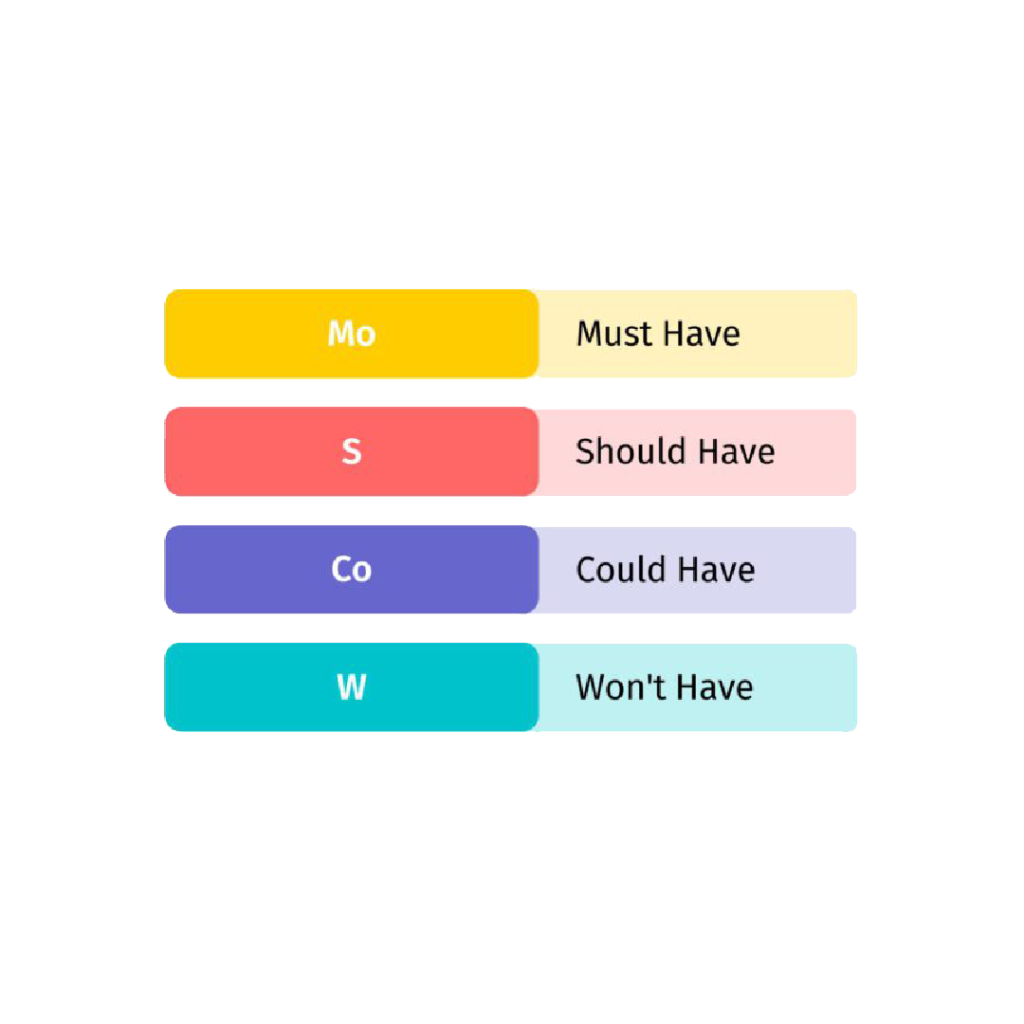
The MoSCoW method prioritizes mobile app features by sorting them into four categories, Must have, Should have, Could have, and Won’t have, giving your team a shared, simple language for deciding what actually gets built first. It works by forcing every feature request through an honest question: does the app genuinely fail without this, or would it just be nice to have.
Feature prioritization is where a lot of mobile app projects quietly go wrong, not because the ideas are bad, but because everything gets treated as equally important until a launch date forces impossible tradeoffs. MoSCoW exists specifically to have that conversation early, deliberately, and with the whole team aligned, rather than discovering the disagreement during a stressful pre-launch scramble.
The real value of a framework like this isn’t the specific labels, it’s what having labels forces a team to actually do. Without a shared prioritization language, feature debates tend to default to whoever argues loudest, whoever has the most seniority, or whoever mentioned their idea most recently. MoSCoW replaces that dynamic with a structured, repeatable conversation everyone on the team can participate in equally, regardless of title or tenure.
What Is the MoSCoW Method?
The MoSCoW method is a prioritization framework, developed by the DSDM Consortium, that sorts every feature or requirement into one of four categories based on how essential it actually is to the product’s success. Unlike more complex scoring systems that require calculating numeric values for reach, impact, or effort, MoSCoW works through team consensus and a shared vocabulary, which is exactly why it gained real traction in Agile software development specifically, where fast, clear alignment matters more than precise mathematical scoring.
The Four MoSCoW Categories Explained
Must Have Is Defined As
Must have features are the non-negotiable core of your app, requirements without which the product simply doesn’t function or fails to meet a legal, safety, or fundamental business requirement. For a healthcare app, this means compliance and security features protecting patient data. For a retail app, this might mean a working checkout flow and accurate inventory tracking, features the app is genuinely useless without.
The genuine test for this category is a strict one worth applying rigorously: if you removed this feature entirely, would the app still function as a viable product a user could actually use for its core purpose? If the honest answer is yes, even if the experience would be worse, the feature likely belongs in a different category, not Must have.
Should Have Is Defined As
Should have features that are important and add real, meaningful value, but the app can technically launch and function without them, with a clear plan to add them soon after. These often include performance improvements, expanded functionality, or features that meaningfully improve the experience without being a fundamental requirement for the app to work at all.
Could Have Is Defined As
Could have features that are desirable but genuinely optional, nice additions that improve the experience without being missed if they’re not included in an initial release. Custom branding options, additional third-party integrations, or minor convenience features typically land here, valuable but not worth delaying a launch to include.
Won’t Have Is Defined As
Won’t have features are explicitly out of scope for the current release, not because they’re bad ideas, but because the team has deliberately agreed they don’t belong in this specific version. Documenting this category matters as much as the others, since it gives stakeholders a clear, honest record of what was considered and consciously deferred, rather than simply forgotten or ignored.
This last category is frequently the most politically sensitive of the four, and handling it well matters for team trust as much as for the product itself. A stakeholder whose feature idea gets explicitly logged as Won’t have for this release, with a clear reason attached, tends to feel genuinely heard even when the answer is no. The same stakeholder whose idea simply disappears from the conversation without acknowledgment tends to assume it was ignored or forgotten, a very different, more frustrating experience even when the underlying decision would have been identical either way.
How to Run a MoSCoW Prioritization Session for Your App
Start by aligning your team and stakeholders on the project’s actual goals and the criteria you’ll use to judge importance, since skipping this step means different people will apply the four categories inconsistently based on unstated, conflicting assumptions about what actually matters. List every feature under consideration for the release, then work through them together, category by category, asking specifically whether the app fails without each one before moving on to whether it simply improves the experience. Decide on rough resource allocation across categories before you start assigning individual features, a common starting guideline for an early-stage app is roughly 80 percent of development resources toward Must haves and 20 percent toward Should haves, shifting to a more even split as the product matures and the core experience is already solid.
Run this as a real, structured working session rather than an asynchronous document everyone edits separately. The genuine value of MoSCoW comes from the conversation it forces, hearing why a stakeholder believes their feature belongs in a higher category, and working through that disagreement together in real time, produces far better alignment than a spreadsheet silently filled out in isolation, where disagreements never surface until much later, at a point when they’re far more disruptive to resolve.
Also agree in advance on how disagreements will actually get resolved, before they happen, not in the heat of an actual disagreement. Whether that means a product lead has final say, a majority vote settles ties, or some other clear mechanism, having this decided ahead of time keeps a genuine disagreement about one feature from stalling the entire prioritization session.
MoSCoW vs RICE: Which Should You Use?
RICE Is Defined As
RICE is a quantitative prioritization framework scoring each feature on Reach, Impact, Confidence, and Effort, producing a numeric score that ranks features against each other with mathematical precision rather than team consensus alone.
Factor | MoSCoW | RICE |
Approach | Qualitative, consensus-based | Quantitative, numeric scoring |
Speed | Fast, simple to apply | Slower, requires real data and calculation |
Data requirements | Minimal | Requires reach, impact, and effort estimates |
Best for | Early-stage prioritization, fast alignment | Feature sequencing with real usage data available |
Precision | Lower, relies on team judgment | Higher, when input data is genuinely accurate |
Many product teams actually use both at different stages, MoSCoW early on to establish broad scope and stakeholder alignment for an initial release, then RICE later once real usage data exists to sequence individual features with more mathematical precision.
The practical reason this combination works well comes down to what data each framework actually needs to function properly. MoSCoW needs almost nothing beyond team judgment and stakeholder input, which is exactly why it fits a pre-launch project with no real usage data yet. RICE needs genuine reach, impact, and effort estimates to produce a meaningful score, inputs a team simply doesn’t have reliably until an app has real users generating real behavioral data to draw from. Using MoSCoW first and RICE later isn’t inconsistency, it’s matching each framework to the stage of the project where its actual requirements can genuinely be met.
Real Examples: MoSCoW Applied to a Mobile App
A team building a retail mobile app identified a barcode scanner, inventory lookup, and loyalty program integration as Must haves, the features the app’s core retail function genuinely depends on. A separate SaaS platform team working on a major update identified improved security and compliance as Must haves specifically to meet industry standards, while classifying enhanced analytics and automation as Should haves, valuable additions the platform could still function without at launch. Support for multiple languages and custom branding landed in Could have for that same team, real value, but not worth delaying the update to include.
Notice what these two examples have in common despite covering entirely different industries, in both cases the Must have category tracks directly back to what the product fundamentally exists to do, retail transactions functioning correctly, platform data staying secure and compliant, rather than to whatever features happened to generate the most internal excitement during planning. That discipline, tying Must have status to genuine functional or regulatory necessity rather than enthusiasm, is what keeps the category meaningful instead of becoming a dumping ground for every feature someone feels strongly about.
How Much of Your Budget Should Go to Each Category?
A commonly recommended starting allocation dedicates roughly 80 percent of available development resources to Must have features and 20 percent to Should haves for an early-stage or first release, ensuring the core, non-negotiable functionality gets built properly before any resources go toward secondary improvements. As a product matures past its initial release, teams typically shift toward a more even resource split across categories, since the core experience is already established and incremental improvements across Should and Could categories start delivering more marginal value than they would have during an initial launch.
Treat this percentage as a genuine starting guideline rather than a rigid rule applied identically to every project. A project with unusually complex Must have requirements, deep regulatory compliance work, for example, might reasonably need to allocate closer to 90 or even 95 percent of resources there for a first release, leaving very little room for anything else until that core foundation is genuinely solid. The specific number matters less than the underlying discipline it enforces, deciding your resource commitment to each category deliberately, before individual features get assigned, rather than discovering the actual split only after the fact once a budget or timeline is already blown.
Limitations of the MoSCoW Method
MoSCoW isn’t universally loved among product management practitioners, and it’s worth understanding its real limitations honestly rather than treating it as a flawless framework. It lacks a built-in scoring mechanism, which means two team members can disagree sharply about whether something is a Must or a Should with no objective tiebreaker beyond further discussion, a real weakness compared to frameworks like RICE that produce a defensible numeric answer. It also doesn’t account well for feature interdependencies or the kind of nuanced tradeoffs a more sophisticated, data-driven framework can capture, which is why some experienced product managers recommend it mainly for fast, early-stage alignment rather than as an ongoing, permanent prioritization system for a mature product.
Heading into 2026 specifically, some product management commentary has also pushed back on classic frameworks like MoSCoW needing real updating for an AI-native development environment, where features get built faster and where distinguishing value delivered to a human user versus an AI agent interacting with your app has become a genuinely new consideration older frameworks weren’t originally designed to handle. This doesn’t make MoSCoW obsolete, but it’s a reasonable reminder that no single framework, however well-established, should be applied rigidly without adapting it to how your specific product and its users actually behave.
None of this means MoSCoW isn’t worth using, it means using it with realistic expectations about what it’s actually good at. It’s genuinely strong for getting a team quickly aligned on broad scope and honest tradeoffs early in a project, and genuinely weaker as a tool for precise, ongoing sequencing decisions once a product has real usage data available that a more quantitative framework could put to better use.
Common Mistakes When Using MoSCoW
- Treating too many features as Must haves. If more than half your list ends up in the Must category, the framework isn’t actually doing its job of forcing genuine tradeoffs.
- Skipping the upfront alignment on criteria. Different stakeholders applying inconsistent standards for what counts as essential produces a categorization nobody actually agrees with once the disagreement surfaces later.
- Never revisiting the categorization as the project evolves. Priorities shift as you learn more, and treating an initial MoSCoW pass as permanent rather than periodically revisited wastes the framework’s real flexibility.
- Forgetting to document Won’t haves clearly. Stakeholders who don’t see their request explicitly acknowledged, even as deferred, tend to assume it was simply forgotten rather than deliberately deprioritized.
- Using MoSCoW alone for a project needing more precision. For sequencing decisions once real usage data exists, pairing MoSCoW with a quantitative framework like RICE often produces better results than relying on consensus-based categorization indefinitely.
Getting feature prioritization right early shapes everything that follows in a mobile app project, timeline, budget, and how cleanly a first release actually meets real user needs. That’s exactly the kind of planning mobile app development work should be grounded in from the requirements stage, not left to informal debate once development is already underway.
A prioritization exercise run properly before development starts pays off well beyond the initial planning meeting itself. It gives every subsequent conversation about scope, timeline, or budget a shared reference point to return to, rather than relitigating the same disagreements repeatedly as the project progresses. When a stakeholder later asks why a specific feature isn’t in the first release, a documented MoSCoW categorization gives you a clear, already-agreed-upon answer instead of an awkward, improvised justification in the moment.
Frequently Asked Questions
Is MoSCoW better than RICE for prioritizing app features?
Neither is universally better, MoSCoW is faster and works well for early-stage alignment without requiring hard data, while RICE offers more mathematical precision once real usage data exists, and many teams use both at different project stages.
How many features should be Must haves in a MoSCoW list?
There's no fixed number, but if more than roughly half your feature list ends up classified as Must have, the framework likely isn't forcing the genuine tradeoffs it's meant to surface, and the categorization deserves a harder second look.
What's a common mistake teams make with MoSCoW prioritization?
Treating too many features as Must haves is one of the most common mistakes, along with skipping upfront alignment on what criteria actually define each category, both of which undermine the framework's core purpose of forcing honest, clear tradeoffs.
Should MoSCoW categories change once development starts?
Yes, priorities should be revisited periodically as a project evolves and the team learns more, rather than treating an initial MoSCoW categorization as permanent, since new information or shifting business objectives can genuinely change what counts as essential.