
Fintech app development cost in 2026 typically runs 50,000 to 150,000 dollars for a focused MVP, 150,000 to 300,000 dollars for a production-ready app with full KYC/AML and PCI DSS compliance, and 300,000 to 600,000 dollars or more for a full neobank or enterprise platform with complex ledgers and heavy regulatory scope. The single most consistent figure across the industry, cited almost identically by more than a dozen independent development firms, is that compliance and security work alone consumes 20 to 40 percent of the total budget, not a rounding error, the actual difference between a fintech app and a standard mobile app.
That compliance premium is worth sitting with for a second, because it’s the real reason fintech app development cost estimates online look so wildly different from each other, ranging from roughly 20,000 dollars at the low end to over a million at the high end across the sources checked for this guide. The spread isn’t dishonesty or bad methodology, it reflects a genuinely wide range of real products hiding under the same label, a budgeting app with no direct banking function and a full digital bank with KYC, ledgers, and bank partnerships are both technically “fintech apps,” priced nothing alike. Chris Skinner, the fintech author and analyst, put the underlying shift plainly: banking is no longer somewhere you go, it’s something you do, and that shift is exactly why the software behind it costs what it costs. This guide breaks down what actually drives fintech app development cost, as part of the same Mobile App Development budgeting conversation that should happen before any fintech contract gets signed.
What Determines Fintech App Development Cost?
App Category and Regulatory Exposure
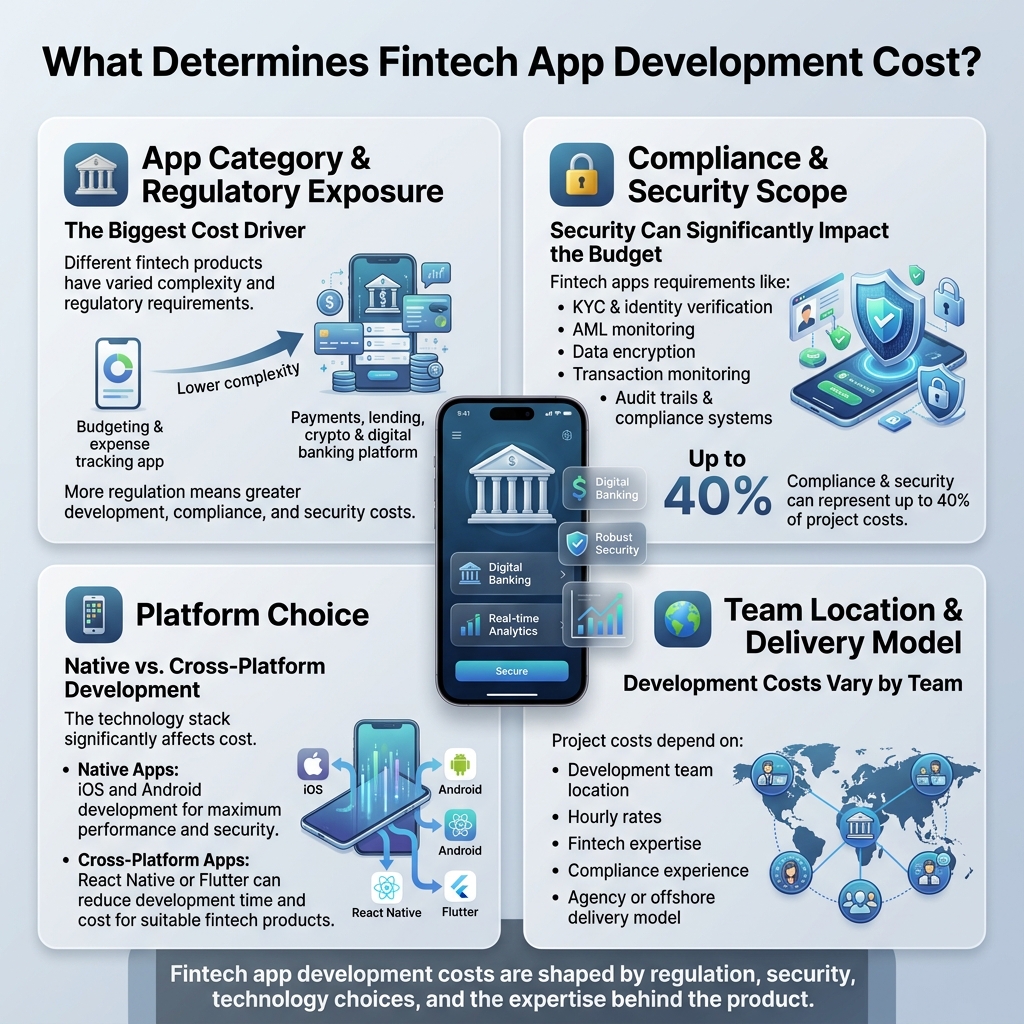
App category is the single largest driver of fintech app development cost, since a personal budgeting app with no direct banking function carries a fundamentally lighter regulatory load than a payments app, lending platform, or full digital bank moving real customer money. Non-regulated tools like budgeting or spend-tracking apps can start as low as 45,000 to 55,000 dollars, according to Interexy’s 2026 cost analysis, while regulated products, payments, lending, crypto, start closer to 80,000 dollars purely because mandatory KYC and AML work enters the picture from day one.
Compliance and Security Scope
Compliance, KYC/AML, and security work can eat up to 40 percent of total project spend, according to Interexy’s breakdown, a figure echoed almost word for word by Bolder Apps (“20-40%”) and TechExactly (“30-40%”), a genuinely rare level of agreement for a cost topic this variable overall. This isn’t one line item either, it spans identity verification, transaction monitoring, encryption architecture, and the audit trail infrastructure regulators expect to see during a real review.
Platform Choice: Native vs. Cross-Platform
Choosing iOS/Android native development versus a cross-platform framework can account for up to 40 percent of the initial budget on its own, according to Interexy, and while native stacks, Swift for iOS, Kotlin for Android, remain the preferred choice for high-security applications like crypto wallets or trading platforms in 2026, cross-platform frameworks like React Native or Flutter can cut costs by 30 to 40 percent for products where that extra native-level security margin matters less.
Team Location and Delivery Model
The same fintech project can shift 2 to 3 times in total cost purely based on where the development team is located, according to Interexy’s analysis, with rates for offshore teams running as low as 25 to 49 dollars per hour compared to considerably higher Western agency rates, though genuine fintech-specific compliance experience matters more than hourly rate alone when evaluating a lower-cost option.
Fintech App Development Cost by Tier
| Tier | Typical Cost Range (USD) | What’s Included |
| MVP / proof of concept | 50,000 to 150,000 | Single core flow, basic KYC, minimal integrations |
| Production-ready app | 150,000 to 300,000 | Full PCI DSS and KYC/AML compliance, multiple integrations |
| Enterprise / neobank platform | 300,000 to 600,000+ | Complex ledgers, heavy regulatory scope, multi-product |
These figures reflect a synthesis across thirteen independent industry sources tracking the 2026 fintech app market, and while individual published estimates vary considerably at the extremes, from roughly 20,000 dollars for a bare-bones proof of concept to over a million for the most complex enterprise builds, the middle tiers show real, meaningful convergence worth treating as a reliable planning baseline.
Cost by App Type
Fintech isn’t one product category, and the type of app you’re building shifts the baseline considerably before compliance or platform choices even enter the picture.
| App Type | Typical MVP Range | Why |
| Budgeting / personal finance | 45,000-60,000 | Minimal direct banking function, lighter compliance load |
| Payment / digital wallet | 50,000-150,000 | KYC required, payment rail integration |
| Lending | 70,000-180,000 | Credit decisioning logic, regulatory complexity |
| Investment / trading | 100,000-250,000 | Real-time market data, portfolio management complexity |
| Banking / neobank | 120,000-300,000+ | Full KYC/AML, ledger systems, banking partnerships |
Reading this table usefully means recognizing that “fintech app” as a search term covers products with genuinely different regulatory starting points, a budgeting app and a neobank aren’t different sizes of the same project, they’re different categories of project entirely.
The Real Cost of Specific Compliance Requirements
KYC and AML Integration
User verification is the fastest-growing cost category in fintech app development for 2026 specifically. Integrating a KYC provider like Sumsub or Onfido costs 15,000 to 30,000 dollars at the implementation stage alone, according to Acquaint Softtech’s 2026 pricing guide, and that’s only the starting point as biometric liveness detection continues to get more sophisticated and, correspondingly, more expensive to implement well.
PCI DSS Compliance
PCI DSS compliance costs 15,000 to 50,000 dollars for initial implementation, according to Bolder Apps’ 2026 analysis, with annual recertification carrying its own ongoing cost on top of the initial build. Our ecommerce compliance and security guide covers PCI DSS 4.0.1’s current requirements in more depth, all previously future-dated requirements became fully mandatory in March 2025, a standard that applies just as directly to fintech apps handling payment card data as it does to ecommerce platforms.
SOC 2 Type II Certification
SOC 2 Type II audits add 50,000 to 150,000 dollars in year one alone, according to Bolder Apps’ breakdown, a cost most generic development quotes exclude entirely, worth confirming explicitly is included, or isn’t, before comparing quotes from different providers.
Team Cost Allocation: Where the Budget Actually Goes
Understanding how a fintech budget actually splits across disciplines helps evaluate whether a specific quote reflects genuine, complete scope.
| Category | Typical Share of Budget |
| Mobile frontend | 25-30% |
| Backend and API development | 30-35% |
| Compliance and security architecture | 15-25% |
| Design (UI/UX) | 10-15% |
| QA and testing | 8-12% |
This breakdown, drawn from Bolder Apps’ 2026 analysis, holds a genuinely consistent pattern across the tiers, and it’s a useful sanity check against any quote that looks unusually low, if compliance and security architecture isn’t clearly represented as a real, substantial share of the total, that’s worth asking about directly rather than assuming it’s simply bundled in somewhere less visible.
Post-Launch Costs Most Founders Underestimate
Third-Party API and Service Fees
Payment gateways, KYC verification services, credit score checks, fraud detection systems, and banking APIs typically charge monthly or per-transaction fees starting at 500 dollars a month and scaling to 5,000 dollars or more as usage grows, according to SpaceO Technologies’ 2026 breakdown, a genuine, recurring operational cost separate from the initial development budget.
Regulatory Change Costs
Annual budgets can increase by 10 to 20 percent purely to account for ongoing updates as regulations evolve, CCPA, GDPR, PCI DSS revisions, according to the same SpaceO analysis, since regulatory changes mid-cycle require real code adjustments, documentation updates, and re-testing, not just a policy document revision.
The Broader Hidden Cost Pattern
After launch, expect 30,000 to 100,000 dollars or more per year in combined hidden costs, API fees, audits, hosting, licensing, according to Interexy’s analysis, a figure that should be built into any realistic total cost of ownership model from the start rather than discovered incrementally after launch. Our must-have finance app features guide covers the specific functional requirements, real-time processing, fraud detection, authentication, that these ongoing costs actually support in production, useful context for why this recurring spend isn’t optional overhead but the operational cost of keeping those features genuinely reliable.
AI Features: A Cost Category That’s Easy to Underestimate
AI is where fintech budgeting gets genuinely slippery in 2026, and it’s worth understanding why before assuming an AI feature is simply another API call added to the estimate. Fraud detection, credit scoring, and automated customer support are the fastest-growing fintech technology categories this year, according to Bolder Apps’ analysis, but the feature itself is only part of the real spend, prompt versioning, model behavior controls, usage logging, and ongoing visibility into how the AI is actually performing all become genuine operating concerns once a feature is live, not one-time engineering line items that disappear after launch. Founders who treat an AI feature as a simple integration cost, rather than an ongoing operational commitment with its own maintenance surface, consistently learn the gap the expensive way, once a model needs retraining, monitoring reveals unexpected behavior, or usage costs scale faster than anticipated. Budgeting realistically for AI-powered fintech features means accounting for this ongoing operational layer explicitly, not folding it into a single upfront development number and assuming the work is finished at launch.
Why the Cheapest Quote Is Often the Riskiest One
If a quote falls far below the ranges covered throughout this guide, it usually means critical work has been left out entirely, security testing, QA hardening, operational tooling, or partner readiness, according to BrainX Tech’s 2026 cost guide, rather than genuinely reflecting a more efficient build. This connects directly to a pattern worth internalizing specifically for fintech, unlike a standard app where a stripped-down MVP is a reasonable, low-risk way to test a concept, a stripped-down fintech MVP that skips compliance and security work carries genuine legal and financial exposure the moment it handles real user funds or real personal financial data, not just a lower-quality product.
Why a Real Discovery Phase Is Worth Paying For
Most credible development partners can offer a rough ballpark cost within a few days of an initial conversation, but a genuinely accurate quote requires a real discovery phase, typically two weeks, mapping out every specific feature and integration point rather than working from a general product description. This upfront investment matters more in fintech than in most other app categories specifically because so much of the eventual cost depends on regulatory obligations and integration requirements that aren’t obvious from a feature list alone, whether a specific state requires its own licensing consideration, which KYC provider actually fits the target user base, how deep a banking integration genuinely needs to go. Skipping this phase to save time or a modest upfront discovery fee routinely costs considerably more later, once real requirements surface mid-build and force scope changes against an already-committed fixed-price agreement that didn’t account for them.
Fintech Banking Infrastructure and Cost
Beyond the app itself, how you access banking infrastructure, direct bank charter versus a banking-as-a-service partnership, shapes cost considerably, and our fintech app development services and compliance guide covers this decision in depth, including the real due diligence cost that’s become standard practice following recent industry disruption in the banking-as-a-service space.
The backend architecture supporting reliable transaction processing and banking partner integration runs through the same API and backend development discipline required for any application handling genuine financial data at scale, and getting this right the first time is considerably cheaper than the rework a poorly scoped backend integration requires later.
Common Mistakes That Inflate Fintech App Development Cost
Businesses frequently scope a fintech MVP with the full feature wishlist rather than a single core flow, when a validation-focused MVP with one clear function tests the actual business hypothesis far more cheaply than an overbuilt first version. Compliance costs get treated as a single line item rather than the multiple distinct obligations they actually are, KYC integration, PCI DSS, SOC 2, each with its own real cost and timeline, producing budgets that undershoot the true total once every requirement becomes clear.
Platform decisions get made without weighing the real 30 to 40 percent cost difference between native and cross-platform development against the specific security requirements of the actual product being built. And post-launch costs get ignored entirely during initial budgeting, leaving a business under-resourced for the genuine 30,000 to 100,000-plus dollars a year in ongoing API fees, audits, and compliance maintenance that a real fintech application requires to keep operating safely.
How to Get an Accurate Fintech App Development Cost Estimate
A real estimate starts with clarity on app category, budgeting tool versus payments app versus full banking platform, and honesty about compliance scope, which specific regulatory obligations actually apply before requesting a quote. This connects to the same complexity-driven patterns covered in our broader mobile app development cost guide, vague project descriptions produce vague, unreliable quotes, while a clearly scoped project produces a genuinely accurate estimate rather than a number that falls apart once real requirements surface mid-build.
How The Apps Developers Prices Fintech App Development
Every fintech quote starts with a genuine scoping conversation about app category, compliance requirements, and banking infrastructure needs, not a generic rate card, because the cost drivers covered above genuinely do produce very different numbers for fintech apps that might sound similar on the surface. That’s part of the same Mobile App Development process we bring to any project.
The compliance and backend infrastructure work behind any fintech application runs through the same API and backend development discipline we apply to any application requiring genuine security and regulatory rigor, scoped honestly from the start rather than discovered as a costly surprise mid-project.
If you’re trying to get from a rough range to an actual number for your specific fintech concept, that scoping conversation is the fastest way to get there. You’re welcome to talk to our team about what your fintech app would realistically cost before committing to a number from a generic pricing page.
Frequently Asked Questions
How much does it cost to build a fintech app in 2026?
A focused MVP typically costs 50,000 to 150,000 dollars, a production-ready app with full KYC/AML and PCI DSS compliance runs 150,000 to 300,000 dollars, and a full neobank or enterprise platform costs 300,000 to 600,000 dollars or more, depending primarily on app category and compliance scope.
Why does compliance cost so much in fintech app development?
Compliance and security work, KYC/AML integration, PCI DSS, SOC 2 certification, consistently consumes 20 to 40 percent of total project budget across independent industry sources, since it spans identity verification, transaction monitoring, encryption architecture, and the audit trail infrastructure regulators require, not a single, simple line item.
How much does KYC integration cost specifically?
Integrating a KYC provider like Sumsub or Onfido typically costs 15,000 to 30,000 dollars at the implementation stage, and this figure continues to rise as biometric liveness detection technology becomes more sophisticated and correspondingly more complex to implement well.
Does building native or cross-platform affect fintech app cost significantly?
Yes. Platform choice can account for up to 40 percent of the initial budget, and while native development remains preferred for high-security products like crypto wallets or trading platforms, cross-platform frameworks like React Native or Flutter can reduce costs by 30 to 40 percent for products where that additional security margin matters less.
What ongoing costs should I budget for after a fintech app launches?
Expect 30,000 to 100,000 dollars or more annually in combined post-launch costs, third-party API and service fees, security audits, hosting, and compliance maintenance as regulations evolve, a real, recurring cost separate from the initial development budget that many founders underestimate.
Does AI functionality add significant cost to a fintech app?
Yes, and often more than founders initially expect. Beyond the feature integration itself, AI functionality like fraud detection or automated credit scoring carries real ongoing operational costs, prompt versioning, model monitoring, usage tracking, that continue well past launch rather than ending once the feature ships.
Should I pay for a discovery phase before getting a fixed-price fintech app quote?
Generally yes. A real discovery phase, typically about two weeks, surfaces the specific regulatory and integration requirements that most heavily affect final cost, and skipping it in favor of a fast, generic estimate usually costs more later once real requirements emerge mid-build against an already-fixed budget.