
VR training simulations let employees practice high-risk, expensive, or logistically difficult procedures in a fully controlled, immersive environment, and the case for this approach is backed by real, substantial data: PwC’s landmark enterprise study found VR-trained employees completed training up to 4 times faster than classroom learners and were 275 percent more confident applying what they learned. Industries from healthcare to manufacturing to aviation now use VR training for genuinely different reasons, but the underlying value proposition, safe, repeatable practice for scenarios too risky or costly to rehearse in the real world, holds constant across all of them.
That data point isn’t an isolated marketing claim, it comes from a real, substantial study, 1,600 participants across 12 US locations comparing classroom, e-learning, and VR delivery of the same training content. A separate, peer-reviewed 2024 meta-analysis covering 52 studies across 14 industries in the journal Safety Science reached a similar conclusion specifically for safety training, VR consistently outperformed conventional methods on both immediate learning and long-term retention. This guide breaks down the specific industries and use cases where VR training simulation delivers genuine, measurable value, as part of the same Mobile App Development process that VR training applications are ultimately built within.
What Is VR Training Simulation?
VR training simulation is the use of fully immersive, headset-based virtual environments to let employees practice job-relevant skills, procedures, and decision-making in a realistic, repeatable, and safe setting, without the cost, risk, or logistical constraints of practicing the same scenario in the real world. Unlike a video or slide-based training module, VR training puts the learner inside an interactive scenario where their own actions and decisions directly shape the outcome, a structural difference that shows up clearly in the confidence and retention data covered throughout this guide.
Why VR Training Outperforms Traditional Methods
The PwC Enterprise Study
PwC’s study, “The Effectiveness of Virtual Reality Soft Skills Training in the Enterprise,” remains the most comprehensive enterprise VR training research available, comparing classroom, e-learning, and VR delivery of the same unconscious bias and inclusive leadership training across 1,600 participants. VR-trained employees completed the training up to 4 times faster than classroom learners, were 275 percent more confident applying what they learned, a 40 percent improvement over classroom and 35 percent over e-learning, and reported feeling 3.75 times more emotionally connected to the content than classroom learners.
Why the Cost Argument Matters at Scale
VR training reached cost parity with classroom training at 375 learners and with e-learning at 1,950 learners, according to the same PwC research, and became 52 percent less expensive than classroom training at 3,000 learners. This scaling economics matters directly for how a business should think about VR training investment, the upfront cost of building a simulation is genuinely higher than a slide deck, but that cost is fixed and amortizes across every learner who goes through it, while classroom training’s per-learner cost, instructor time, facility use, scheduling, never fully disappears no matter how many people are trained.
Peer-Reviewed Evidence Beyond PwC’s Study
A 2024 meta-analysis published in the peer-reviewed journal Safety Science, covering 52 individual studies across 14 industries, found VR safety training consistently outperformed conventional methods on both immediate learning outcomes and long-term retention, independent academic confirmation of the pattern PwC’s enterprise study identified.
VR Training Across Industries
Healthcare: Surgical and Clinical Training
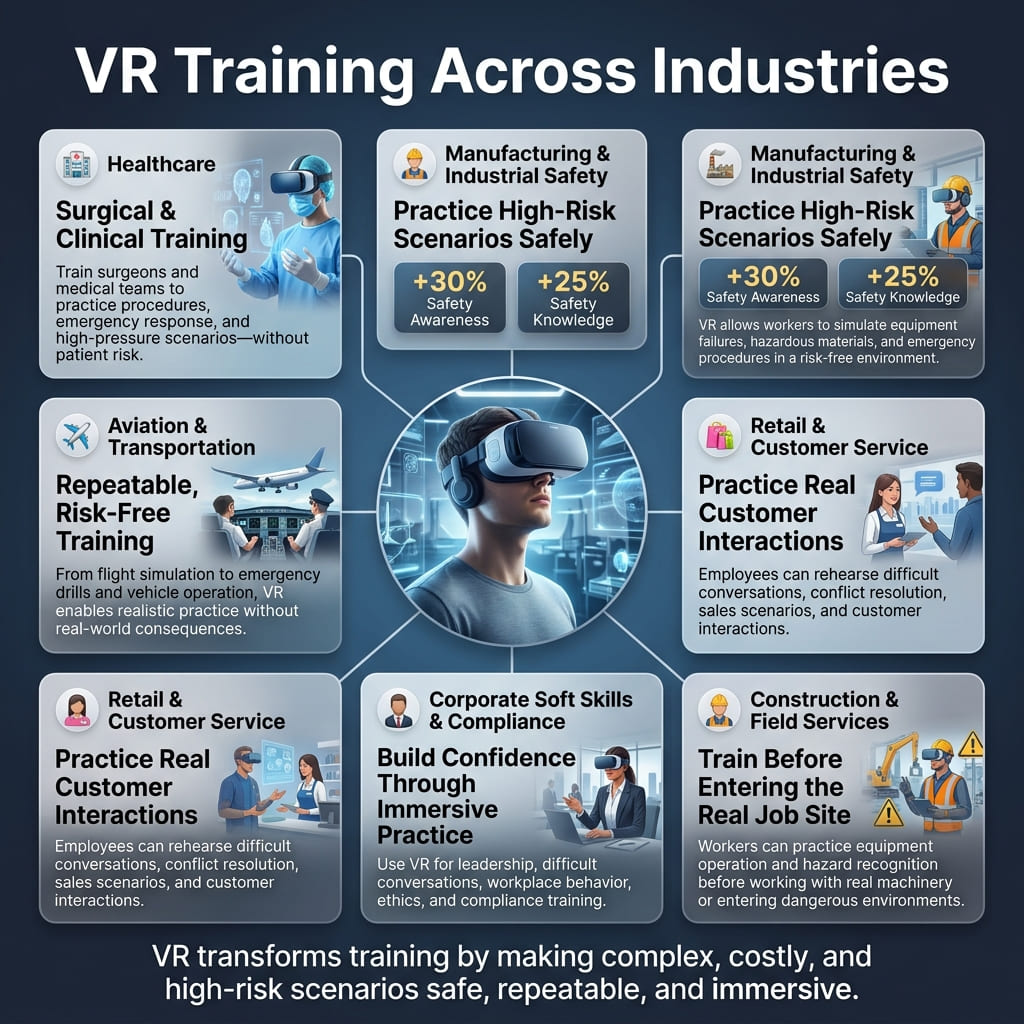
Healthcare has been among the most active adopters of VR training simulation, letting surgeons and clinicians rehearse procedures repeatedly without patient risk, and letting broader clinical staff practice emergency response scenarios, code situations, mass casualty triage, that are logistically impossible to rehearse realistically any other way.
Manufacturing and Industrial Safety
The Safety Science Meta-Analysis Findings
Manufacturing and industrial settings show some of the clearest, most measurable VR training benefits, since the scenarios involved, equipment failures, hazardous material handling, emergency shutdown procedures, carry real risk that makes real-world practice either dangerous or prohibitively expensive to simulate physically.
High-Risk Scenario Practice
A 2025 study in Scientific Reports involving 200 industrial workers found VR-based training increased safety awareness by 30 percent and safety knowledge by 25 percent compared to conventional training methods in Industry 4.0 manufacturing settings.
Example: Electrical Utility Worker Training
Among 50 electrical utility workers studied in a 2024 Heliyon research paper, a single VR training session produced nearly double the knowledge gain of a comparable lecture-based session, a striking result specifically because electrical utility work involves exactly the kind of high-consequence, hard-to-practice-safely scenarios where VR’s controlled environment provides genuine, irreplaceable value.
Aviation and Transportation
Flight simulation was one of the earliest, most mature applications of immersive training technology long before consumer VR existed, and modern VR training extends that same principle to a much broader range of transportation and logistics roles, ground crew procedures, emergency evacuation drills, vehicle operation training, that benefit from the same repeatable, risk-free practice environment.
Retail and Customer Service
Retail and customer-facing roles use VR training for scenario-based practice, handling a difficult customer interaction, de-escalating a conflict, or navigating a complex sales conversation, situations where the emotional and interpersonal dynamics genuinely benefit from immersive practice in a way a written script or video simply can’t replicate.
Corporate Soft Skills and Compliance Training
This is precisely the category PwC’s landmark study covered directly, unconscious bias and inclusive leadership training, and it generalizes well to other soft-skill and compliance categories, harassment prevention, difficult conversation practice, ethics training, where the goal is building genuine behavioral confidence, not just information recall.
Construction and Field Services
Construction and field service roles use VR training for equipment operation practice and hazard recognition, letting new employees build familiarity with complex machinery and job-site safety scenarios before ever operating real equipment on an actual site, reducing both onboarding time and real-world incident risk during the early, highest-risk period of a new hire’s tenure.
The Instructor’s Role Doesn’t Disappear, It Changes
A common misconception treats VR training as fully replacing human instructors, when in practice the most effective deployments tend to redefine the instructor’s role rather than eliminate it. Live-facilitated multi-user VR sessions let an instructor guide a group through a scenario in real time, observing decisions and providing feedback in the moment, a genuinely different but still deeply human-centered teaching model compared to a fully automated, self-paced simulation. Even asynchronous, self-guided VR training benefits from human oversight in its design and ongoing refinement, reviewing where trainees consistently struggle, updating scenarios as procedures or equipment change, and ensuring the simulation stays accurate to real, current job conditions rather than becoming a static asset that quietly drifts out of date. Organizations that treat VR training as a one-time content build, rather than an ongoing program requiring the same instructional oversight and iteration as any other training modality, tend to see its effectiveness erode over time even if the initial deployment was genuinely well built.
Retention: The Metric That Matters Most Over Time
Immediate confidence and completion speed matter, but long-term retention is really the metric that determines whether a training investment pays off months after the session ends, not just whether it looked successful on the day it was delivered. The Safety Science meta-analysis covered above specifically evaluated both immediate learning and long-term retention across its 52 included studies, finding VR training held its advantage over conventional methods on both, not just the immediate, more easily measured outcome. This matters because a training format that produces strong short-term results but fades quickly offers less real value than one where the improvement genuinely persists into the weeks and months when an employee actually needs to apply what they learned, during an actual emergency, an actual difficult customer interaction, an actual equipment malfunction, not just during a follow-up quiz taken the same week as the training itself. Organizations evaluating VR training should look past headline completion and confidence numbers to whatever retention or on-the-job performance data is available, since that’s the number that actually reflects whether the investment changed real behavior.
VR Training vs. Traditional Training vs. E-Learning: Cost and Outcomes
Understanding how these three approaches actually compare, based on the PwC research specifically, helps ground a realistic expectation of what VR training delivers and at what point it becomes the more cost-effective choice.
| Factor | Classroom Training | E-Learning | VR Training |
| Training speed | Baseline | Roughly 1.5x faster than classroom | Up to 4x faster than classroom |
| Learner confidence | Baseline | Lower improvement vs. VR | 275% more confident (40% over classroom) |
| Emotional engagement | Baseline | Lower vs. VR | 3.75x more emotionally connected |
| Cost parity point | N/A (baseline) | N/A (baseline) | 375 learners (vs. classroom), 1,950 (vs. e-learning) |
| Cost at scale (3,000 learners) | Highest, scales linearly | Lower than classroom | 52% less than classroom |
Reading this table usefully means recognizing that VR training’s advantage isn’t just about a single metric, speed, confidence, and cost all move in the same favorable direction as scale increases, which is exactly why VR training makes the most economic sense for organizations training larger, recurring populations rather than a one-off, small-group session.
When VR Training Makes Sense (and When It Doesn’t)
VR training makes the strongest case when a scenario is genuinely dangerous, expensive, or logistically difficult to practice in the real world, exactly the pattern showing up across healthcare, manufacturing safety, and aviation. It also makes sense at meaningful training scale, given the cost parity data above, an organization training a handful of people occasionally will rarely see the same return as one training hundreds or thousands of employees on a recurring basis.
VR training makes less sense for simple, low-stakes information transfer that a document or short video handles perfectly well, building an immersive simulation for content that doesn’t actually benefit from spatial or emotional realism adds real cost without a corresponding benefit.
Scaling a VR Training Program Beyond the Pilot Stage
Most organizations start VR training with a single pilot scenario, understandably, given the upfront cost and the genuine value of validating the approach before a larger rollout. The transition from a successful pilot to an organization-wide program is where the real economics covered earlier actually kick in, a single pilot scenario evaluated in isolation will rarely clear the cost-parity threshold PwC’s research identifies, but a broader training curriculum spanning multiple scenarios, onboarding, safety, soft skills, compliance, sharing the same underlying VR infrastructure and hardware investment, reaches that scale considerably faster. Planning for this transition from the start, building the pilot with reusable infrastructure and content patterns rather than a fully bespoke, one-off build, makes the difference between a VR training pilot that stays a pilot indefinitely and one that actually becomes the organization’s default training modality for the scenarios where it genuinely fits.
Building a VR Training Application: Technical Considerations
VR training development shares real technical foundations with the broader VR app development process, 3D content creation, interaction design, and performance optimization, all directly relevant to whether a training simulation actually delivers the outcomes covered above or ends up abandoned due to poor usability or discomfort.
Multi-user scenarios, letting a live instructor guide multiple trainees simultaneously, or letting trainees practice team-based procedures together, add real backend complexity, the same API and backend development discipline behind any application requiring reliable, synchronized real-time state across multiple connected users.
Measuring Training Outcomes, Not Just Engagement
A genuinely useful VR training deployment tracks the same outcomes any training program should, completion rates, assessment scores, and ideally downstream performance or safety metrics in the actual job, rather than stopping at usage or engagement statistics that don’t connect back to whether the training actually worked. This connects to the same cost-benefit discipline covered in our mobile app development cost guide, the investment in a VR training program should be justified against measurable outcomes specific to the actual training goal, not against generic engagement numbers that look impressive but don’t demonstrate real impact.
Common Mistakes in VR Training Simulation Development
Organizations frequently build VR training for content that doesn’t genuinely benefit from immersion, simple policy or informational content that a document handles just as effectively, spending real budget on a format the content never actually needed and never would have needed regardless of how well the simulation itself was executed. Training gets deployed without a clear plan for measuring actual learning outcomes, relying instead on usage statistics that don’t demonstrate whether the training actually improved real-world performance or safety, leaving a program that might genuinely be working with no real evidence to justify its continuation or expansion.
Scale gets underestimated during the initial business case, since VR training’s cost advantage genuinely depends on reaching a meaningful learner population, a small pilot program evaluated purely on per-learner cost will look expensive compared to classroom training in ways that don’t reflect the technology’s real economics at proper scale, sometimes killing a genuinely promising program before it ever reaches the scale where its advantages would have become obvious. And comfort and usability get treated as secondary concerns, producing training simulations that cause genuine physical discomfort, directly undermining the completion rates and confidence gains the format is specifically supposed to deliver, turning what should have been a strong learning outcome into a program employees actively try to avoid.
How The Apps Developers Approaches VR Training Simulation Development
We scope VR training projects around the specific scenario, risk profile, and learner population involved, as part of the same Mobile App Development process we bring to any project, matched to whichever industry and training goal a business is actually trying to address.
Design work receives particular attention given how directly it affects training outcomes, since the discipline behind building a comfortable, genuinely effective VR training interaction is a specialized part of UI/UX design with real, measurable stakes for whether the training actually works.
If you’re evaluating VR training for your industry and want an honest assessment of whether the scenario genuinely fits, and what real ROI would look like at your organization’s scale, that’s worth a direct conversation. You’re welcome to talk to our team about what a properly scoped VR training simulation would look like for your specific use case.
Frequently Asked Questions
Does VR training actually work better than traditional training methods?
According to PwC’s enterprise study, yes, substantially. VR-trained employees completed training up to 4 times faster than classroom learners and were 275 percent more confident applying what they learned, findings independently supported by a 2024 peer-reviewed meta-analysis of 52 safety training studies across 14 industries.
Which industries benefit most from VR training simulation?
Healthcare, manufacturing, aviation, and other fields involving high-risk, expensive, or logistically difficult-to-practice scenarios see the clearest documented benefits, since VR’s core value is providing safe, repeatable practice for situations too dangerous or costly to rehearse in the real world.
At what point does VR training become cost-effective compared to classroom training?
According to PwC’s research, VR training reaches cost parity with classroom training at around 375 learners and becomes 52 percent less expensive at 3,000 learners, meaning VR’s cost advantage depends heavily on training a meaningful population rather than a small, one-off group.
Is VR training only useful for physical or technical skills?
No. PwC’s landmark study specifically covered soft skills, unconscious bias and inclusive leadership training, and VR training is widely used for customer service scenarios, difficult conversations, and compliance training where behavioral confidence, not just information recall, is the actual goal.
When does VR training not make sense?
For simple, low-stakes informational content that a document or short video handles effectively, or for training populations too small to reach VR’s cost-parity threshold, traditional or e-learning approaches typically remain the more practical and cost-effective choice.
Does VR training improve long-term retention, or just immediate performance?
Both, according to the available research. The Safety Science meta-analysis specifically evaluated long-term retention alongside immediate learning outcomes across its 52 included studies and found VR training maintained its advantage over conventional methods on both measures, not just the more easily measured short-term result.
How should an organization move from a VR training pilot to a full program?
By building the initial pilot with reusable infrastructure and content patterns rather than a fully bespoke one-off, so subsequent training scenarios can share the same underlying hardware and technical investment, reaching the cost-parity scale that makes VR training’s economics genuinely favorable considerably faster than isolated, standalone pilots ever would.