
VR app development is the process of building fully immersive, headset-based applications for training, simulation, real estate, education, and other business use cases, using platforms like Meta’s Quest ecosystem or PC-tethered systems, distinct from AR in that VR replaces a user’s environment entirely rather than overlaying content onto it. The honest state of the VR market right now is more nuanced than most content on this topic suggests, and understanding that nuance matters before committing a budget to a VR project.
Dedicated VR headset shipments actually fell 14 percent in 2025, according to IDC’s tracker data, with Meta Quest shipments specifically down 42.3 percent year over year, even as the broader XR device category grew 44.4 percent, driven entirely by display-less smart glasses rather than VR headsets. Apple’s Vision Pro tells a similarly telling story, shipments fell 78 percent to roughly 85,000 units in 2025, and according to research firm Treeview, 75 percent of those buyers were enterprises, not consumers.
That last detail matters more than the headline decline: consumer VR gaming has genuinely softened, but business and enterprise VR use cases, training, simulation, visualization, remain a resilient, growing category even as consumer hardware sales contract. This guide covers what businesses actually need to know before investing in VR, as part of the same Mobile App Development process that VR applications technically fall under even though the delivery hardware differs meaningfully from a phone or tablet.
What Is VR App Development?
VR app development is the process of designing and building fully immersive, three-dimensional applications experienced through a headset, replacing a user’s visual and often auditory environment entirely rather than overlaying digital content onto the real world the way augmented reality does. This distinction from AR isn’t just technical, it shapes everything about the use case a VR application is actually good for, VR excels at creating a controlled, fully simulated environment, exactly what makes it so effective for training and simulation specifically, while AR excels at enhancing a real-world interaction a user is still actively part of.
The Honest State of the VR Market in 2026
Consumer VR Hardware Is Contracting
The consumer VR headset market has genuinely softened. Meta, which holds roughly 80 percent of dedicated VR headset unit sales according to IDC, shipped 1.7 million Quest units across the first three quarters of 2025, a 16 percent decline against the same period the year before. Reality Labs, Meta’s VR and AR division, has accumulated approximately 92.2 billion dollars in operating losses through mid-2026, a staggering figure that puts the scale of Meta’s continued investment, and the market’s continued struggle to justify it through hardware sales alone, in real perspective.
Where the Real Growth Is Actually Happening
The broader XR device category grew 44.4 percent in 2025, but that growth came entirely from display-less smart glasses, not VR headsets, and Meta’s own smart glasses revenue, 2.15 billion dollars in 2025, outearned its Quest headset revenue, 660 million dollars, for the first time. This is a genuinely important nuance for any business evaluating VR: the hardware category as a whole isn’t declining, but the specific VR headset form factor consumers were expected to adopt en masse for gaming and entertainment has underperformed those expectations considerably.
Why Business VR Use Cases Remain Resilient
The Vision Pro’s enterprise-heavy buyer base, 75 percent of purchasers according to Treeview’s research, points directly at where VR’s genuine value has concentrated: training, simulation, and professional visualization use cases that don’t depend on mass consumer gaming adoption to justify their cost. A hospital training surgeons on a VR simulation, a manufacturer walking new hires through equipment procedures in a simulated environment, or a real estate firm offering immersive property tours, none of these use cases need VR headsets to become as ubiquitous as smartphones to deliver genuine, measurable value today.
Measuring ROI on Business VR Investments
Unlike a consumer app chasing download and engagement metrics, business VR applications should be evaluated against outcomes specific to their use case, training completion rates and post-training error reduction for a simulation application, time-to-close or reduced site-visit costs for a real estate visualization tool, or patient outcome improvements for a clinical therapy application. This distinction matters because generic engagement metrics, session length, daily active users, that make sense for consumer VR gaming don’t translate meaningfully to a training tool used by a defined employee population for a specific, bounded purpose. A well-scoped VR training program, for instance, might succeed by being used exactly as often as the training curriculum requires, no more and no less, which looks nothing like a growth curve a consumer app would be judged against. Setting the right success metrics before development begins, tied to the actual business problem VR is solving, avoids the common trap of judging a genuinely successful business VR deployment against consumer engagement benchmarks it was never designed to hit.
VR vs. AR: A Quick Distinction
Understanding this difference matters before evaluating any specific VR use case, since the two technologies solve genuinely different problems.
| Factor | Virtual Reality (VR) | Augmented Reality (AR) |
| Environment | Fully replaces the user’s surroundings | Overlays content onto the real world |
| Hardware | Dedicated headset required | Often works on a standard smartphone |
| Best fit | Immersive training, simulation, controlled environments | Real-world enhancement, product visualization, quick access |
| Consumer adoption | Contracting for dedicated headsets specifically | Broader reach via existing smartphone AR frameworks |
| Typical business use | Training, education, real estate, therapy/simulation | Retail, marketing, navigation, remote assistance |
Reading this table usefully means recognizing that a business shouldn’t default to VR simply because it sounds more immersive, or to AR simply because it’s more accessible, the right choice depends entirely on whether the use case genuinely benefits from a fully controlled, simulated environment or from enhancing a real-world interaction the user needs to remain present in.
Core Business Use Cases for VR
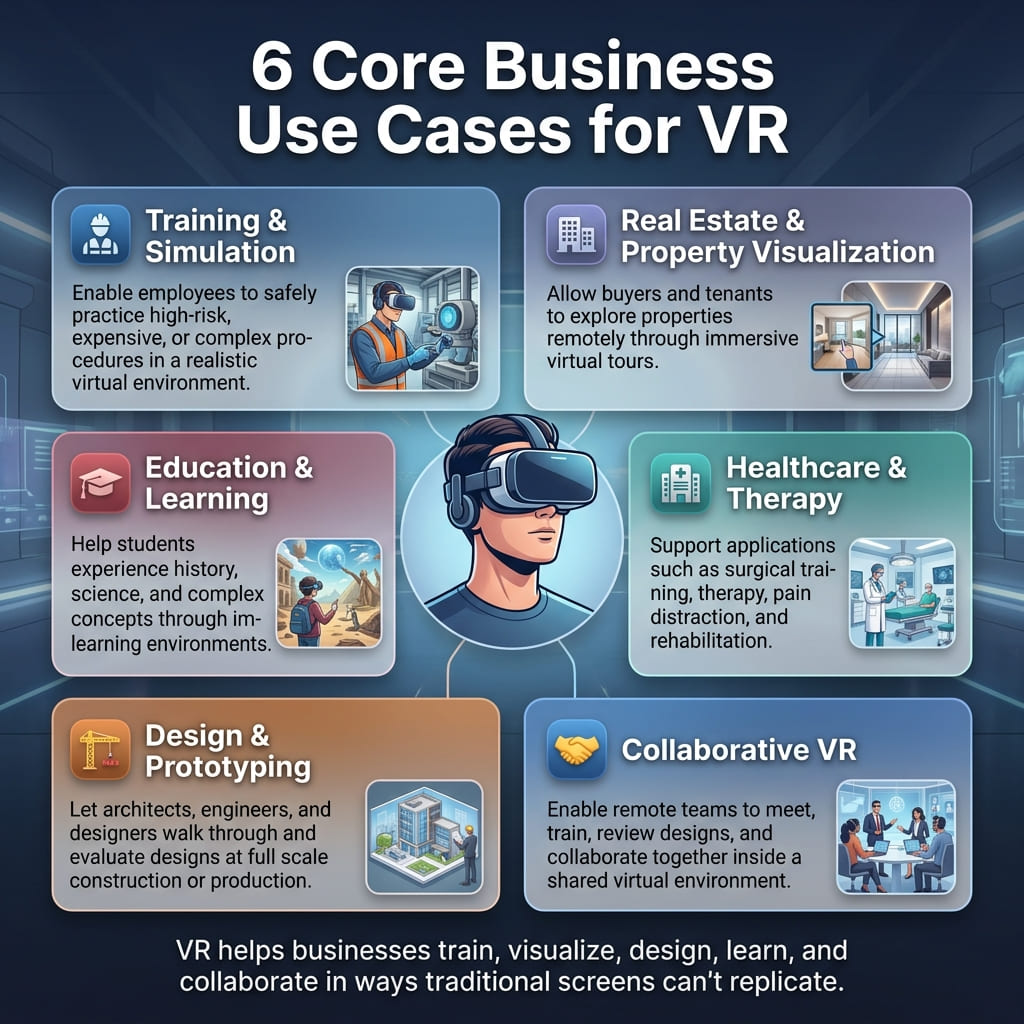
Training and Simulation
VR training lets employees practice high-risk, expensive, or logistically difficult procedures repeatedly in a safe, controlled, fully simulated environment, a use case that’s driven much of the genuine enterprise VR adoption behind the consumer hardware slowdown, since the return on investment doesn’t depend on mass headset ownership, just on the specific trained population having access to the hardware.
Real Estate and Property Visualization
Immersive property tours let prospective buyers or tenants experience a space remotely, particularly valuable for new construction, out-of-market buyers, or commercial real estate where physical site visits are costly and time-consuming to coordinate at scale.
Education
VR education applications let students experience historical environments, scientific concepts, or complex spatial relationships in ways textbooks and videos structurally can’t replicate, an immersive learning modality showing genuine, measurable engagement benefits in educational research specifically.
Healthcare and Therapy
Beyond surgical training, VR is used for exposure therapy, pain management distraction, and rehabilitation exercises, clinical applications where the fully controlled, immersive environment VR provides is genuinely part of the therapeutic mechanism, not just a delivery format.
Design and Prototyping
Architecture, industrial design, and engineering teams use VR to walk through a design at full scale before physical construction, catching spatial and usability issues that are far harder to identify from a 2D drawing or even a 3D model viewed on a flat screen.
Multi-User and Collaborative VR
Beyond single-user training and visualization, multi-user VR lets geographically distributed teams meet and collaborate within a shared simulated environment, a genuinely useful capability for design review sessions, remote training led by a live instructor, or collaborative walkthroughs of a real estate or architectural project with stakeholders who can’t be physically present together. This adds real technical complexity beyond a single-user VR build, network synchronization, shared state management, and voice communication all need to work reliably in real time, closer in some ways to the multiplayer game architecture challenges of synchronizing state across connected users than to a typical single-user business application.
VR Hardware Platforms Businesses Should Know
Meta Quest Ecosystem
Meta’s Quest line remains the dominant standalone VR headset platform by unit volume, roughly 80 percent of dedicated VR headset sales, making it the most practical default choice for most business VR applications given its combination of install base, standalone operation (no PC required), and mature development tooling.
PC-Tethered VR (Valve Index, PCVR)
PC-tethered VR systems offer higher fidelity and performance than standalone headsets, at the cost of requiring a connected, capable PC, a tradeoff that matters for specific high-fidelity training or design applications where visual precision genuinely affects the use case’s value, less so for broader deployment scenarios.
Enterprise-Focused Headsets
Devices like Apple’s Vision Pro, despite its consumer-market struggles, and various enterprise-specific headsets from other manufacturers, are increasingly positioned and priced for business deployment specifically, reflecting the same enterprise-over-consumer pattern showing up across the broader VR hardware market.
Comfort Standards and Accessibility in VR Design
Motion sickness and general discomfort remain a real, documented barrier to VR adoption, and addressing it isn’t optional polish, it’s foundational to whether an application actually gets used by the population it’s built for. Techniques like maintaining a stable horizon line, avoiding artificial acceleration where possible, and giving users control over their own movement rather than forcing camera motion all reduce the physiological mismatch between what a user sees and what their inner ear reports, the root cause of most VR-induced discomfort. This matters especially for business applications with a mandatory user population, employees required to complete VR training don’t have the option to simply stop using an uncomfortable consumer app, which makes comfort-conscious design a genuine workplace consideration, not just a nice-to-have for user satisfaction. Session length also deserves deliberate design attention, a training module that respects natural break points rather than requiring long, uninterrupted VR sessions reduces both discomfort and the fatigue that can undermine learning retention regardless of how well the content itself is designed.
Building a VR Application: What’s Actually Involved
VR development shares real technical DNA with game development, 3D content creation, real-time rendering, and interaction design, since VR applications are built using the same engines, Unity and Unreal Engine most commonly, that power most modern games. Performance optimization carries particular weight in VR specifically, since a poorly optimized VR experience doesn’t just perform badly, it can cause genuine physical discomfort for users, a consideration standard app or even AR development doesn’t carry with the same severity.
Content complexity, how detailed and interactive the simulated environment needs to be, is typically the largest driver of both development cost and timeline, following patterns similar to those covered in our mobile app development cost guide, where complexity and platform requirements consistently drive cost more than any single feature decision.
How VR Connects to the Broader AR and Immersive Technology Landscape
Many businesses evaluating VR are also weighing it against AR for the same underlying business problem, and our AR app development guide covers the equivalent decision framework from the AR side, useful context for understanding which immersive technology, or combination of both, actually fits a specific use case rather than committing to VR by default because it sounds more advanced or immersive.
Common Mistakes in VR App Development
Businesses frequently commission a VR project based on the assumption that consumer VR adoption will reach smartphone-level ubiquity, a projection the current market data doesn’t support, when the actual, resilient value lies in specific business use cases that don’t depend on mass consumer hardware ownership at all. Performance optimization gets treated as a late-stage polish item rather than a core design constraint from the start, producing experiences that cause real user discomfort and abandonment, a mistake that’s considerably more costly to fix after the fact than to design around from the beginning, since retrofitting comfort into an already-built interaction model often means reworking core movement and camera systems rather than making a surface-level adjustment.
Content complexity gets scoped without a realistic understanding of how much 3D asset creation and interaction design a genuinely useful training or simulation experience actually requires, leading to budgets that undershoot the real cost of building something that functions as intended. And businesses sometimes choose VR when the actual use case, quick reference, product visualization for a broad consumer audience, would genuinely be better served by AR’s lower hardware barrier and broader accessibility, a mismatch that only becomes obvious once adoption numbers come in well below what the project was built to achieve.
How The Apps Developers Approaches VR App Development
We scope VR projects around genuine business use cases, training, simulation, visualization, that hold up regardless of consumer hardware trends, as part of the same Mobile App Development process we bring to any project, rather than building around speculative consumer adoption assumptions the current market doesn’t support.
Design and performance optimization receive particular attention given how directly they affect user comfort and outcomes in VR specifically, since the discipline behind building a genuinely usable VR interaction is a specialized part of UI/UX design with real physiological stakes standard app design simply doesn’t carry.
If you’re evaluating VR for a genuine business use case and want an honest assessment of whether it fits, and what it would actually take to build well, that’s worth a direct conversation. You’re welcome to talk to our team about what a properly scoped VR application would look like for your specific goals.
Frequently Asked Questions
Is VR still worth investing in given the decline in headset sales?
For genuine business use cases, yes. Consumer VR gaming hardware has softened considerably, but enterprise and business applications, training, simulation, visualization, remain resilient and growing, since their value doesn’t depend on mass consumer headset ownership the way a consumer gaming application would.
What's the difference between VR and AR for business applications?
VR fully replaces a user’s environment, making it well suited to controlled training and simulation scenarios, while AR overlays content onto the real world, making it better suited to use cases where the user needs to remain present and aware of their actual surroundings, like retail visualization or navigation.
Which VR hardware platform should a business build for?
Meta’s Quest ecosystem is the most practical default for most business applications given its roughly 80 percent share of dedicated VR headset sales, standalone operation, and mature development tooling, though PC-tethered systems or enterprise-specific headsets may fit better for applications requiring higher visual fidelity.
Why did Apple's Vision Pro sales decline so sharply?
Vision Pro shipments fell 78 percent to roughly 85,000 units in 2025, reflecting broader consumer VR hardware softness, though notably 75 percent of buyers were enterprises rather than consumers, reinforcing that VR’s most resilient current demand comes from business use cases, not mass consumer adoption.
What makes VR development different from standard app development?
VR shares technical foundations with game development, 3D content, real-time rendering, and interaction design, and it carries a unique performance stake, poorly optimized VR experiences can cause genuine physical discomfort for users, a consideration that doesn’t apply with the same severity to standard app or even AR development.
How should a business measure ROI on a VR investment?
Against outcomes specific to the actual use case, training completion rates and error reduction for a simulation tool, reduced site-visit costs for real estate visualization, rather than consumer engagement metrics like session length or daily active users, which don’t translate meaningfully to a defined-purpose business application.
Does VR support multiple users collaborating in the same session?
Yes, multi-user VR lets distributed teams meet within a shared simulated environment for design reviews, live-led training, or collaborative walkthroughs, though it adds real technical complexity around network synchronization and shared state management beyond a single-user VR build.