
Serverless backend architecture makes the most sense for variable or unpredictable traffic, event-driven workloads, and early-stage products that need to launch fast without committing to infrastructure sized for growth that hasn’t happened yet, while it tends to make less sense for latency-sensitive applications, long-running processes, and workloads with steady, predictable, high-constant traffic where a traditional server often ends up cheaper and simpler. The decision isn’t about whether serverless is good or bad, it’s about matching the traffic pattern to the model built to handle it well.
That framing matters because serverless has been marketed for years as a near-universal upgrade, less operational overhead, automatic scaling, pay only for what you use, and that pitch is true often enough to be genuinely compelling, while being incomplete often enough to burn teams who adopt it everywhere without checking whether their specific workload actually fits the model. This guide is built around that fit question, not around convincing you serverless is either the future or a fad. If you’re scoping a new API and backend development project and serverless is on the table, this is the honest version of when it earns its place.
What Is Serverless Backend Architecture?
Serverless backend architecture runs application code in stateless, ephemeral compute instances managed entirely by a cloud provider, billed by actual execution time rather than for continuously running servers, with the provider handling all scaling, patching, and infrastructure management. The term is a bit of a misnomer, servers obviously still exist somewhere, but the defining characteristic is that a development team never provisions, configures, or maintains them directly. Code runs in response to a trigger, an HTTP request, a file upload, a scheduled event, and the underlying infrastructure appears and disappears around it automatically.
How Serverless Differs From Traditional and Container-Based Backends
A traditional backend runs on servers that are provisioned and kept running continuously, whether or not they’re actively handling requests at any given moment, which means the team is paying for and managing capacity around the clock regardless of actual usage. A container-based backend, orchestrated through something like Kubernetes, sits in between, offering more portability and control than serverless while still requiring a team to manage the underlying cluster, scaling policies, and infrastructure, just abstracted at the container level rather than the individual server level. Serverless removes that infrastructure management layer almost entirely, at the cost of less control over the execution environment and, as covered below, some real constraints on what kind of workload runs well within it. None of these three models has replaced the other two industry-wide, and that’s precisely because each genuinely fits a different shape of problem rather than representing successive generations where the newest option simply supersedes what came before.
When Serverless Backend Architecture Makes Sense
1. Variable or Unpredictable Traffic
Serverless architecture shines when traffic is spiky or genuinely hard to predict, a seasonal retail spike, a viral moment, a feature that gets heavy use for a few hours a day and almost none otherwise. Traditional infrastructure sized for peak load sits idle, and expensive, the rest of the time. Serverless scales to near-zero when there’s no traffic and scales up automatically when a spike hits, without anyone needing to have predicted the spike in advance or configured auto-scaling thresholds ahead of time.
2. Event-Driven Workloads
Anything naturally structured around discrete events, processing an uploaded file, responding to a webhook, running a scheduled batch job, reacting to a database change, tends to map cleanly onto the serverless execution model, since each of these is naturally a short-lived unit of work rather than a continuously running process.
3. Rapid Prototyping and MVPs
For a new product validating demand, serverless removes a meaningful chunk of upfront infrastructure work, no server provisioning, no capacity planning, no deployment pipeline for managing fleets of servers, which lets a small team focus entirely on product logic rather than infrastructure during the phase where speed matters most and the eventual scale is still genuinely unknown.
When Serverless Backend Architecture Doesn’t Make Sense
1. Long-Running Processes
Serverless functions have execution time limits, and workloads that genuinely need to run continuously or for extended periods, a long video processing job, a persistent websocket connection, a background worker maintaining state over hours, fit awkwardly or not at all within a model built around short-lived, stateless execution.
2. Latency-Sensitive Applications and Cold Starts
What Causes a Cold Start
A cold start happens when a serverless function hasn’t run recently and the platform needs to initialize a new execution environment before it can process a request, adding real, sometimes user-visible latency to that specific request compared to one hitting an already-warm instance.
Mitigating Cold Start Latency
Techniques exist to reduce this, keeping functions warm through scheduled pings, or using a provider’s paid provisioned concurrency options, but they add cost and complexity that partially undercuts the operational simplicity serverless was supposed to provide in the first place.
Example: Provisioned Concurrency
A payment confirmation endpoint that occasionally takes an extra second or two due to a cold start might be an acceptable tradeoff for a low-traffic internal tool, but it’s a real problem for a checkout flow where every additional second of latency has a measurable effect on conversion, which is exactly the kind of endpoint where provisioned concurrency, or simply not using serverless for that specific function, is worth the added cost. This is the same latency sensitivity covered in our Core Web Vitals guide, where response time directly affects both user experience and search ranking, a cold start hiding behind an API call is just as real a performance cost as a slow-loading frontend asset, even though it’s far less visible during development.
3. Predictable, High-Constant Traffic
For an application with steady, well-understood, consistently high traffic, the pay-per-execution model that makes serverless economical for spiky workloads can end up costing more than a traditional or container-based server running at consistently high utilization, where the fixed cost of continuously running infrastructure is spread across a predictably large volume of requests.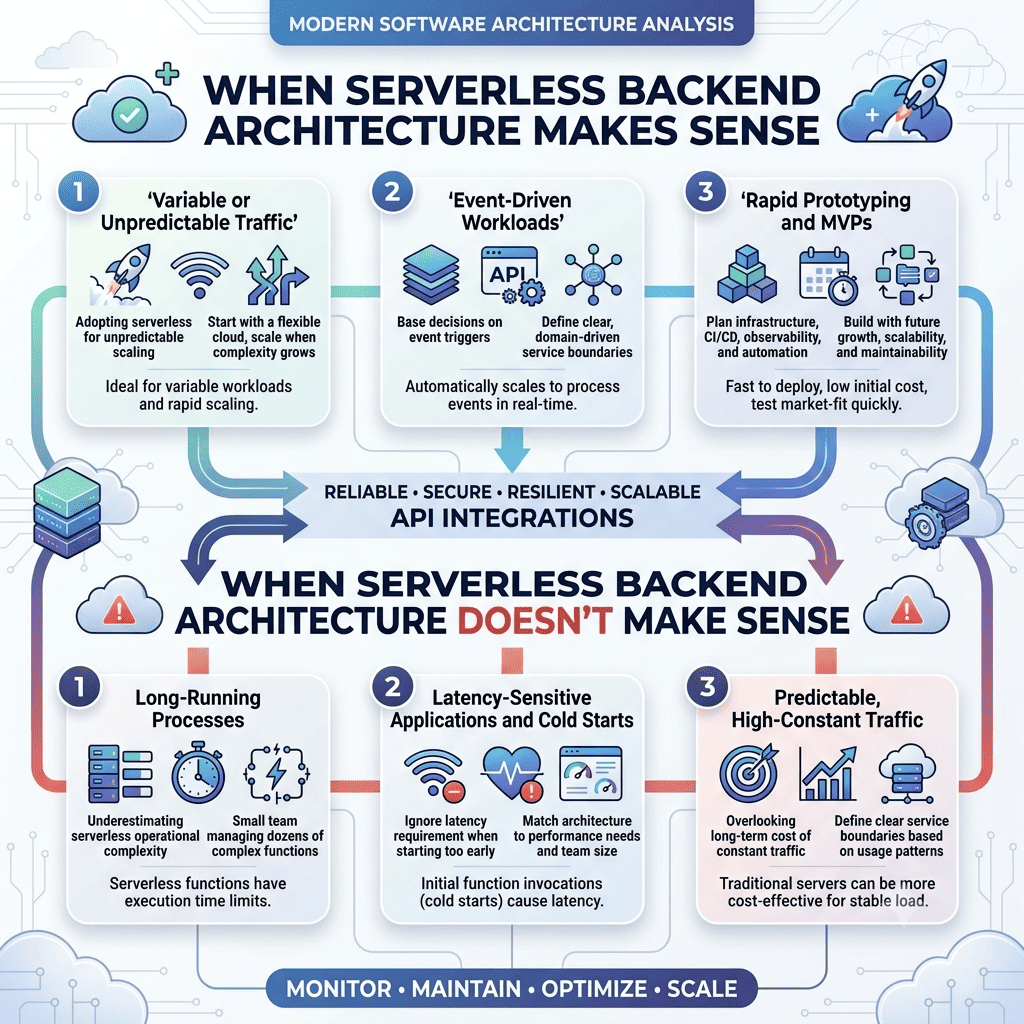
Serverless vs. Traditional Servers vs. Containers
Factor | Traditional Servers | Containers (e.g., Kubernetes) | Serverless |
Infrastructure management | Full responsibility | Cluster-level management required | Minimal, provider-managed |
Scaling | Manual or configured auto-scaling | Configurable, requires orchestration | Automatic, near-instant |
Cost model | Fixed, pay for provisioned capacity | Fixed plus orchestration overhead | Pay-per-execution |
Cold start latency | None | Minimal | Present, mitigable but not eliminated |
Best fit for traffic pattern | Steady, predictable, high-constant | Complex, multi-service workloads needing control | Variable, spiky, or event-driven |
Execution time limits | None | None | Yes, provider-imposed limits |
Reading this table honestly means recognizing that serverless isn’t a strictly more advanced option sitting above traditional servers and containers, it’s a different tool suited to a different traffic shape, and the right choice depends entirely on which shape your actual workload has, not which option sounds most modern.
Security Considerations Specific to Serverless
Serverless architecture doesn’t remove security responsibility, it relocates it. Instead of securing a server’s operating system and network perimeter, the security burden shifts almost entirely to function-level permissions, each function should have access to only the specific resources it needs, and to how secrets and credentials are managed across a much larger number of smaller, independently deployed units of code. The CNCF’s Serverless Working Group whitepaper touches on this shift directly, noting that serverless changes the security model rather than simplifying it away, a distinction that matters for any team assuming “managed infrastructure” automatically means “less to worry about.”
Many of the principles in our web app security checklist apply just as directly to serverless functions as to any traditional backend, least-privilege access control in particular becomes even more important when a single misconfigured function’s permissions can expose far more than intended, precisely because serverless makes it easy to grant broad permissions once and forget they exist across dozens of small functions.
Cost Considerations: When Serverless Saves Money and When It Doesn’t
The pay-per-execution model is genuinely compelling for workloads that spend meaningful time idle, since a traditional server sitting at 5 percent utilization overnight is still costing the same as one running at full load. AWS’s own documentation on Lambda frames this directly around eliminating the cost of provisioning for peak capacity that goes unused most of the time. But that same pricing model inverts once traffic becomes consistently high, since a function executing constantly, at high volume, for long periods, can accumulate a higher total cost than an equivalently sized traditional server running at similar utilization, particularly once data transfer and the operational overhead of managing many small function executions get factored in. A serious cost comparison needs real traffic modeling, not just the assumption that serverless is automatically cheaper because the marketing consistently frames it that way.
Hybrid Architectures: Serverless for Some Workloads, Not All
The framing of this guide, serverless versus traditional versus containers, can make it sound like a business has to pick one model for its entire backend, when in practice the strongest architectures are frequently hybrid. A core application might run on traditional servers or containers for its steady, predictable, latency-sensitive request traffic, while specific event-driven pieces, image processing after an upload, sending notification emails, running a nightly report generation job, run as serverless functions alongside it. This isn’t a compromise so much as applying the fit-first principle at the level of individual workloads rather than forcing an entire system into one execution model. Most mature engineering teams end up here eventually, treating serverless as one tool in a broader toolkit rather than a wholesale replacement for everything that came before it.
Common Mistakes When Adopting Serverless Backend Architecture
Teams frequently adopt serverless architecture wholesale because of its reputation rather than assessing whether their specific workload’s traffic pattern actually fits the model, then discover unexpected cold start latency or cost surprises only after real usage patterns emerge in production. Long-running or stateful processes get forced into serverless functions anyway, worked around with awkward polling or chaining patterns that add complexity precisely because the underlying execution model was never suited to that kind of work. Vendor lock-in also gets underestimated, serverless functions are frequently written directly against a specific provider’s event and invocation model in ways that make switching providers later considerably harder than switching a more portable, containerized workload would be. Mike Roberts’ widely referenced Serverless Architectures article, hosted on Martin Fowler’s site, covers this tradeoff directly, framing increased vendor dependency as one of the real costs of the model, not just an incidental detail.
How The Apps Developers Approaches Serverless Backend Architecture
Serverless is one option among several we evaluate for any web app’s backend, chosen when a workload’s actual traffic pattern genuinely fits the model, not defaulted to because it’s the option with the most current marketing momentum.
The infrastructure decisions behind serverless adoption, provisioned concurrency configuration, cost monitoring, and deciding which workloads belong in serverless functions versus containers or traditional servers, run through the same DevOps and cloud solutions practice that handles infrastructure decisions generally, since getting this right requires ongoing operational judgment, not a one-time architecture choice made at the start of a project and never revisited.
This same fit-first thinking runs through the architecture decisions covered in our SaaS web app architecture guide, where the right technical choice consistently depends on matching infrastructure to actual, current needs rather than to whichever pattern is most discussed in the industry at a given moment.
If you’re weighing serverless against a traditional or container-based backend for a new project, or reconsidering an existing architecture that isn’t performing the way it was expected to, that’s worth a direct conversation grounded in your actual traffic patterns. You’re welcome to talk to our team about which model genuinely fits your specific workload.