Mobile apps now play a major role in how people connect with businesses, shop online, book services, manage money, learn, and communicate. For many companies, a mobile app is no longer just an extra digital tool. It is often a key part of the customer experience.
However, not all mobile apps are built in the same way. Choosing the wrong type of app can lead to higher costs, poor performance, slow updates, and a weak user experience. This is why businesses need to understand the main types of mobile apps before starting development.
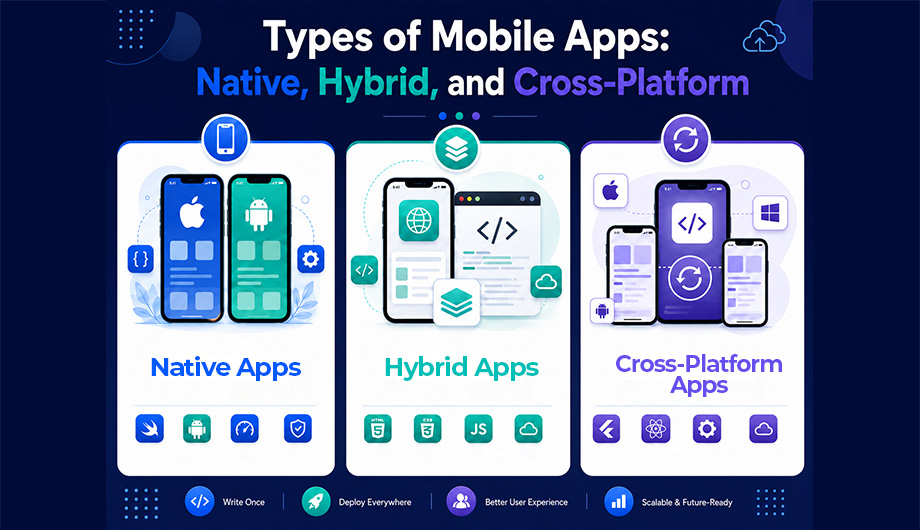
The three common types are native apps, hybrid apps, and cross-platform apps. Each one has its own strengths, limits, costs, and best use cases. In this guide, you will learn how these app types work, how they differ, and which option may be better for your business goals.
What Are Mobile App Types?
Mobile app types refer to the different ways an app can be built for smartphones and tablets. These differences mainly depend on the technology used, the level of performance required, the development cost, and the platforms the app needs to support.
Some apps are built separately for Android and iOS. Others use one codebase to run on both platforms. Some are created with web technologies and then placed inside a mobile app container.
The right choice depends on what the app needs to do. A simple content app may not need the same performance as a mobile banking app or a 3D game. Businesses should choose the app type based on budget, timeline, features, user expectations, and long term growth plans.
Native Mobile Apps
What Are Native Apps?
Native mobile apps are built specifically for one operating system, such as Android or iOS. Android native apps are usually developed using Kotlin or Java. iOS native apps are commonly built using Swift.
Because native apps are created for one platform, they can fully use the features, tools, and design standards of that operating system. This gives users a smooth and natural experience.
Key Features
Native apps offer high performance and fast response times. They can easily access device hardware such as the camera, GPS, microphone, contacts, sensors, and push notifications. They also follow platform specific design rules, which helps the app feel familiar to users.
Advantages
The biggest advantage of native apps is performance. They are usually faster and more stable than other app types. They also provide better security because developers can use platform level security tools.
Native apps also offer strong UI and UX consistency. An Android app can follow Android design standards, while an iOS app can follow Apple design standards. This improves usability and trust.
Disadvantages
Native development can be expensive. Businesses often need separate development teams for Android and iOS. This means two codebases, two testing processes, and more time for updates.
Native apps also take longer to develop when the business wants to launch on both major platforms at the same time.
Best Use Cases
Native apps are best for banking apps, gaming apps, high performance enterprise apps, apps with advanced security needs, and apps that need deep access to device hardware.
Hybrid Mobile Apps
What Are Hybrid Apps?
Hybrid mobile apps are built using web technologies such as HTML, CSS, and JavaScript. The app is then wrapped inside a native container so it can be installed on mobile devices like a normal app.
This approach allows developers to create one app that can run on multiple platforms. Frameworks such as Ionic and Cordova are often used for hybrid app development.
Key Features
Hybrid apps use a single codebase. This means the same core code can work across Android and iOS. They are useful when businesses want to launch quickly and control development costs.
Hybrid apps can also connect with some device features through plugins. For example, they may access the camera, location, or storage, depending on the framework and plugin support.
Advantages
The main advantage of hybrid apps is faster development. Since developers do not need to build separate apps for Android and iOS, the project can move quicker.
Hybrid apps are also more affordable than native apps in many cases. Maintenance is easier because most updates are made in one codebase. This makes hybrid apps suitable for small businesses, early stage ideas, and simple digital products.
Disadvantages
Hybrid apps usually do not perform as well as native apps. They may feel slower when handling complex animations, heavy data, or advanced features.
Access to device features can also be limited. Some plugins may not work perfectly on every platform. The user interface may also feel less smooth compared to native apps.
Best Use Cases
Hybrid apps are best for simple business apps, content based apps, internal company tools, MVPs, prototypes, and apps that do not require advanced performance.
Cross-Platform Mobile Apps
What Are Cross-Platform Apps?
Cross-platform mobile apps use one codebase for both Android and iOS. They are built using frameworks such as Flutter and React Native. Unlike basic hybrid apps, many cross-platform apps can deliver a near native experience.
This approach has become popular because it gives businesses a balance between cost, speed, and performance. Instead of building two separate native apps, developers can create one shared codebase and adjust parts of the app where needed.
Key Features
Cross-platform apps offer near native performance in many use cases. They also support shared development, which saves time and reduces repeated work.
Frameworks like Flutter and React Native have strong developer communities, useful libraries, and regular updates. They also support modern UI design, animations, and integrations with many third party tools.
Advantages
Cross-platform development is more cost effective than full native development. Since one codebase supports both Android and iOS, businesses can launch faster and manage updates more easily.
Another advantage is UI consistency. The app can look and feel similar across platforms, which is useful for brands that want a unified customer experience.
Cross-platform apps are also easier to maintain. Bug fixes, feature updates, and design changes can often be handled once instead of twice.
Disadvantages
Cross-platform apps may have slight performance trade offs in very complex apps. For example, advanced games, heavy animations, or apps with deep hardware use may still perform better as native apps.
Some advanced native features may require extra platform specific development. Businesses also depend on the chosen framework. If the framework changes, loses support, or creates compatibility issues, it can affect future development.
Best Use Cases
Cross-platform apps are suitable for startup MVPs, e-commerce apps, social media apps, on demand service apps, booking apps, education apps, and many business platforms that need strong performance without the full cost of native development.
Native vs Hybrid vs Cross-Platform Comparison
Feature | Native | Hybrid | Cross-Platform |
Performance | Highest | Medium | High |
Cost | High | Low | Medium |
Development Speed | Slow | Fast | Fast |
UX Quality | Best | Average | Near native |
Codebase | Separate | Single | Single |
Businesses should compare these options based on their goals, not only on cost. A low cost app may become expensive later if it performs poorly or cannot scale. At the same time, a fully native app may not be necessary for a simple business tool.
There is no one size fits all solution. The best choice depends on app complexity, user expectations, budget, timeline, and long term plans.
How to Choose the Right App Type
The right app type should match your business needs. Budget is often the first factor. If funds are limited, hybrid or cross-platform development may be more practical than native development.
Timelines also matter. If you need to launch quickly on both Android and iOS, a single codebase can save time. App complexity is another key point. Simple apps can work well as hybrid apps, while complex apps may need native or cross-platform development.
Performance needs should also guide the decision. If speed, security, and hardware access are critical, native apps are usually the best choice. If the budget is limited and the app is simple, a hybrid can work. If you need a balance between performance, cost, and scalability, cross-platform is often a strong option.
Future of Mobile App Development
Mobile app development is moving toward faster, smarter, and more flexible solutions. Frameworks like Flutter and React Native continue to grow because businesses want apps that work well on both Android and iOS without doubling development costs.
Cross-platform solutions are likely to remain in high demand in 2026 and beyond. AI integration is also becoming more common in mobile apps, from chat support to smart recommendations and personalised user experiences.
As development tools improve, businesses can expect faster launch cycles, better app performance, and more flexible mobile solutions.
Conclusion
Native, hybrid, and cross-platform apps each serve different business needs. Native apps offer the best performance, security, and user experience, but they cost more and take longer to build. Hybrid apps are faster and cheaper to develop, but they may not deliver the same performance or smooth experience. Cross-platform apps offer a balanced option with good performance, shared code, and faster updates.
Choosing the wrong app type can waste budget, slow growth, and create a poor user experience. Before development starts, businesses should review their goals, users, features, budget, and long term plans. A smart decision at the beginning can save time, reduce costs, and create a better mobile app for users.