

A monolith is usually the right starting architecture for most businesses, since it’s faster to build, simpler to operate, and easier for a small team to reason about, while microservices earn their added complexity once a system has genuinely distinct workloads, independent scaling needs, and a team large enough to own separate services without constant coordination overhead. The microservices vs monolith decision is less about which is technically superior and more about which complexity your team is actually equipped to manage right now.
This is one of the most opinion-heavy topics in backend architecture, and a lot of that noise comes from teams generalizing their own specific experience into universal advice. What actually matters is your situation, your team size, your traffic patterns, your growth trajectory, not whichever architecture is dominating conference talks this year. This guide is built around that decision, not around picking a side.
What Is Monolithic Architecture?
A monolithic architecture is a backend built and deployed as a single, unified application, where all the business logic, from user authentication to order processing to reporting, runs within one codebase and one deployable unit. Every part of the system shares the same runtime, the same database connection pool, and typically the same deployment pipeline. Scaling a monolith usually means running more copies of the entire application, even if only one part of it is actually under heavy load.
What Is Microservices Architecture?
A microservices architecture splits a backend into a collection of independently deployable services, each responsible for a specific business capability, communicating with each other over a network, typically through APIs or message queues. A microservices-based ecommerce backend might have a separate service for inventory, another for payments, and another for order fulfillment, each with its own codebase, its own database, and its own deployment schedule.
The core distinction in the microservices vs monolith comparison isn’t really about code organization, both can be well-organized or poorly organized internally. It’s about the deployment boundary. A monolith ships as one unit. Microservices ship as many independent units that have to coordinate at runtime instead of at compile time.
Microservices vs Monolith: Key Differences
| Factor | Monolith | Microservices |
| Initial development speed | Faster, less coordination overhead | Slower, requires upfront service boundary decisions |
| Deployment | Single deployment for the whole app | Independent deployment per service |
| Scaling | Scale the entire application together | Scale individual services independently |
| Operational complexity | Lower | Significantly higher, requires strong DevOps practices |
| Failure isolation | Weak, one failure can affect the whole system | Strong, a failing service doesn’t necessarily take down others |
| Team structure fit | Small, tightly coordinated teams | Larger teams with independent service ownership |
| Debugging and tracing | Simpler, everything runs in one process | Harder, requires distributed tracing across services |
| Best fit | Most startups, MVPs, small to mid-sized products | Products with distinct, independently-scaling workloads and mature engineering teams |
Reading this table honestly means noticing that microservices win on flexibility and scaling granularity, but lose on almost every dimension related to how hard the system is to actually run day to day. That tradeoff is the entire decision, and it’s why the answer depends so heavily on team maturity, not just company size or ambition.
When a Monolith Is the Right Choice
A monolith tends to be the right call when a team is small enough that the coordination overhead of microservices would outweigh any scaling benefit, when the product is still finding its market and the architecture needs to stay flexible while requirements shift, or when the operational maturity, mature CI/CD, container orchestration, distributed monitoring, needed to run microservices well simply isn’t there yet. Most startups and most MVPs fall squarely into this category, and choosing a monolith here isn’t a compromise, it’s the architecture that actually gets a product to market fastest with the least operational risk.
When Microservices Are the Right Choice
Microservices earn their complexity once a system has genuinely distinct workloads with different scaling needs, a reporting service that runs heavy batch jobs shouldn’t have to scale in lockstep with a checkout service handling real-time traffic, for instance. They also make sense once a team has grown large enough that multiple groups need to ship independently without blocking on each other’s release schedules, and once the organization has, or is willing to invest in, the DevOps maturity microservices demand. Well-known technology writer Martin Fowler has written extensively about this exact tradeoff, framing microservices less as a default best practice and more as a tool that trades simplicity for the ability to scale organizationally, a framing worth internalizing before committing to the architecture.
The Real Cost of Microservices
Operational Complexity
Running ten independent services instead of one application means ten sets of deployment pipelines, ten sets of monitoring dashboards, and a genuinely harder debugging problem when something goes wrong across service boundaries. This isn’t a one-time setup cost, it’s an ongoing operational tax that every team member pays for as long as the architecture exists.
Team Structure Requirements
Conway’s Law and Service Boundaries
Conway’s Law, the observation that systems tend to mirror the communication structure of the organization that builds them, is directly relevant here. Microservices work best when service boundaries map onto real team boundaries, a payments team owning the payments service, for instance. When that alignment doesn’t exist, microservices don’t reduce coordination overhead, they just relocate it from within a codebase to across a network, which is usually a worse place for it to live.
Getting Service Boundaries Wrong
A poorly split service boundary creates the worst of both worlds: the deployment and operational complexity of microservices, combined with the tight coupling of a monolith, since services that constantly need to call each other synchronously to complete a single business operation aren’t actually independent, they just look independent on an architecture diagram.
Example: A Poorly Split Checkout Service
A checkout flow split into five separate microservices that all have to respond successfully, in sequence, for a single order to complete has effectively rebuilt a monolith’s failure characteristics, one service going down still breaks checkout, while now also carrying the network latency and distributed debugging cost microservices were supposed to justify.
The Modular Monolith: A Middle Ground
A modular monolith, a single deployable application internally organized into clearly separated modules with well-defined boundaries, is worth serious consideration for teams caught between these two extremes. It gets much of the organizational clarity microservices promise, clear ownership boundaries, limited cross-module coupling, without the deployment and operational overhead of running many independent services. For many growing businesses, a well-structured modular monolith is the more honest middle ground than jumping straight to microservices before the team or the traffic actually demands it. It’s also a considerably easier system to split into real microservices later, if and when that becomes genuinely necessary, since the internal boundaries are already there.
Migrating From Monolith to Microservices, or Back
The Strangler Fig Pattern
For businesses that started with a monolith and have genuinely outgrown it, a full rewrite is rarely the right move. The strangler fig pattern, gradually extracting individual services out of an existing monolith while the rest continues running unchanged, lets a team migrate incrementally, validating each extracted service in production before committing further, rather than betting the business on a big-bang rewrite that stops feature development for months.
When Businesses Move Back to a Monolith
Less discussed but genuinely common: some businesses that adopted microservices too early end up consolidating services back into a monolith, or a modular monolith, once the operational cost outweighs the scaling benefit they were chasing. This isn’t a failure so much as a correction, recognizing that the original decision was made ahead of actual need, and reversing it is usually far cheaper the earlier it happens.
Common Mistakes When Choosing Between Microservices and Monolith
Teams frequently adopt microservices because it’s the architecture associated with companies they admire, without those companies’ actual scale, team size, or operational maturity. This is sometimes called premature decomposition, splitting a system into services before there’s a real, evidenced need, and it tends to slow a young product down rather than prepare it for growth that may still be years away. The opposite mistake also happens: staying on a poorly organized monolith long after clear signs, deployment bottlenecks, teams blocking each other constantly, one module’s bugs regularly taking down unrelated functionality, indicate a real architectural problem that a monolith alone won’t fix. And a specific, costly mistake is treating microservices adoption as a purely technical decision, ignoring that it also requires organizational changes, team structure, on-call ownership, that many businesses underestimate until they’re already committed.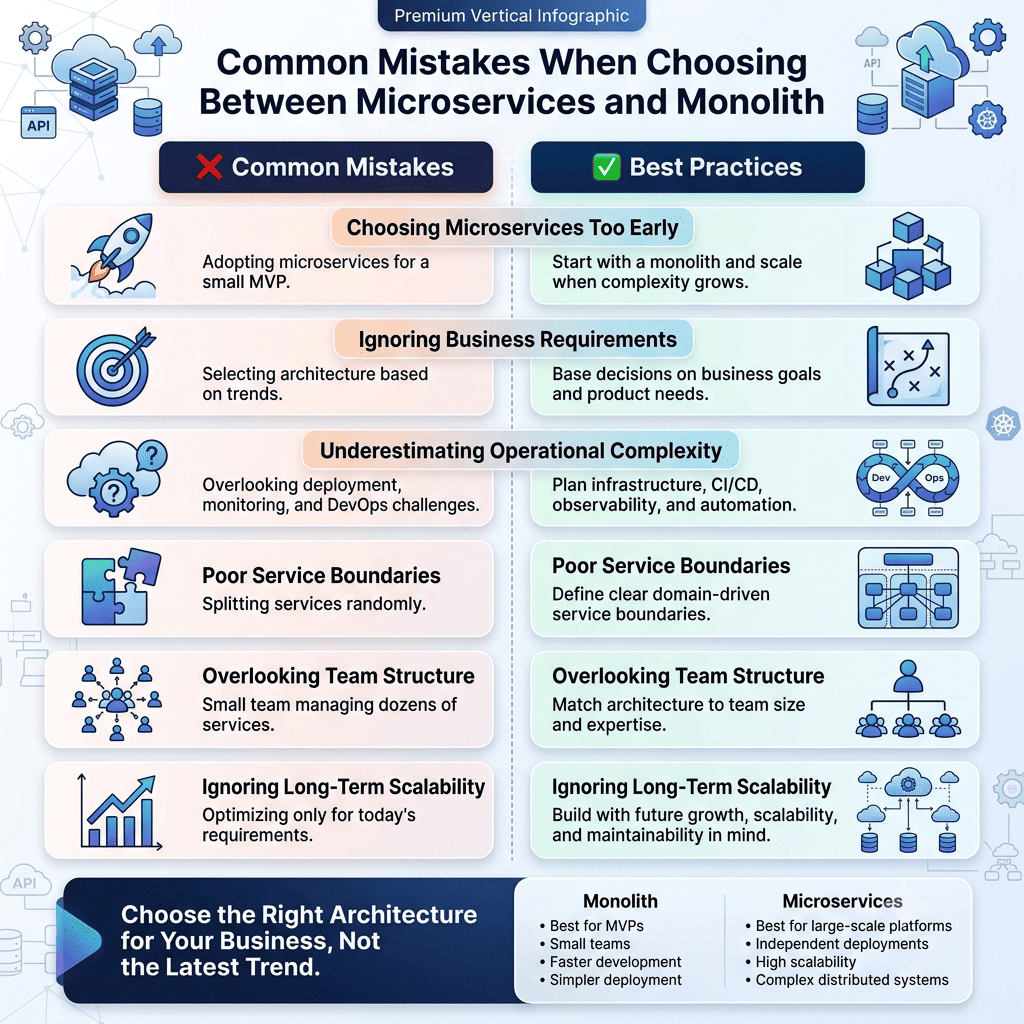
How The Apps Developers Approaches Backend Architecture Decisions
We treat the microservices vs monolith decision as part of the same scoping conversation that shapes any API and backend development project, evaluated against actual team size, growth trajectory, and operational maturity rather than defaulting to whichever architecture sounds more sophisticated in a pitch. That’s consistent with how we approach web app architecture generally, our SaaS web app architecture guide covers a lot of the same reasoning applied to multi-tenancy decisions, since both questions come down to matching architectural complexity to what a team can actually operate well today, not what might theoretically be needed years from now.
If you’re scoping a new backend or reconsidering an existing one, that’s a conversation worth having with real numbers on the table, current team size, expected growth, and actual traffic patterns, rather than deciding based on which architecture is trending. You’re welcome to talk to our team about which approach genuinely fits where your product is right now.