Building an AI-powered mobile assistant means connecting your app to a large language model through an API, giving it the ability to call tools or functions so it can actually take actions rather than just chat, and wrapping that with guardrails, memory management, and fallback logic so it behaves reliably in front of real users. Most teams don’t train their own model, they integrate an existing one from OpenAI, Anthropic, or Google and build the surrounding architecture around it.
A demo chatbot that answers a few sample questions is genuinely easy to put together in an afternoon. An assistant that reliably books an appointment, updates a record, or answers a question using your actual business data, and does it consistently for thousands of real users, is a different engineering project entirely. This guide walks through what that project actually involves.
The gap between those two things is where most teams underestimate the work. A working demo proves the concept, it doesn’t prove the assistant handles a user who phrases a request oddly, asks for something outside its scope, or triggers a tool call that fails halfway through. Production-grade reliability is a separate body of work from the initial proof of concept, and budgeting for only the demo phase is one of the more common reasons AI assistant projects run over timeline and cost.
What Is an AI-Powered Mobile Assistant?
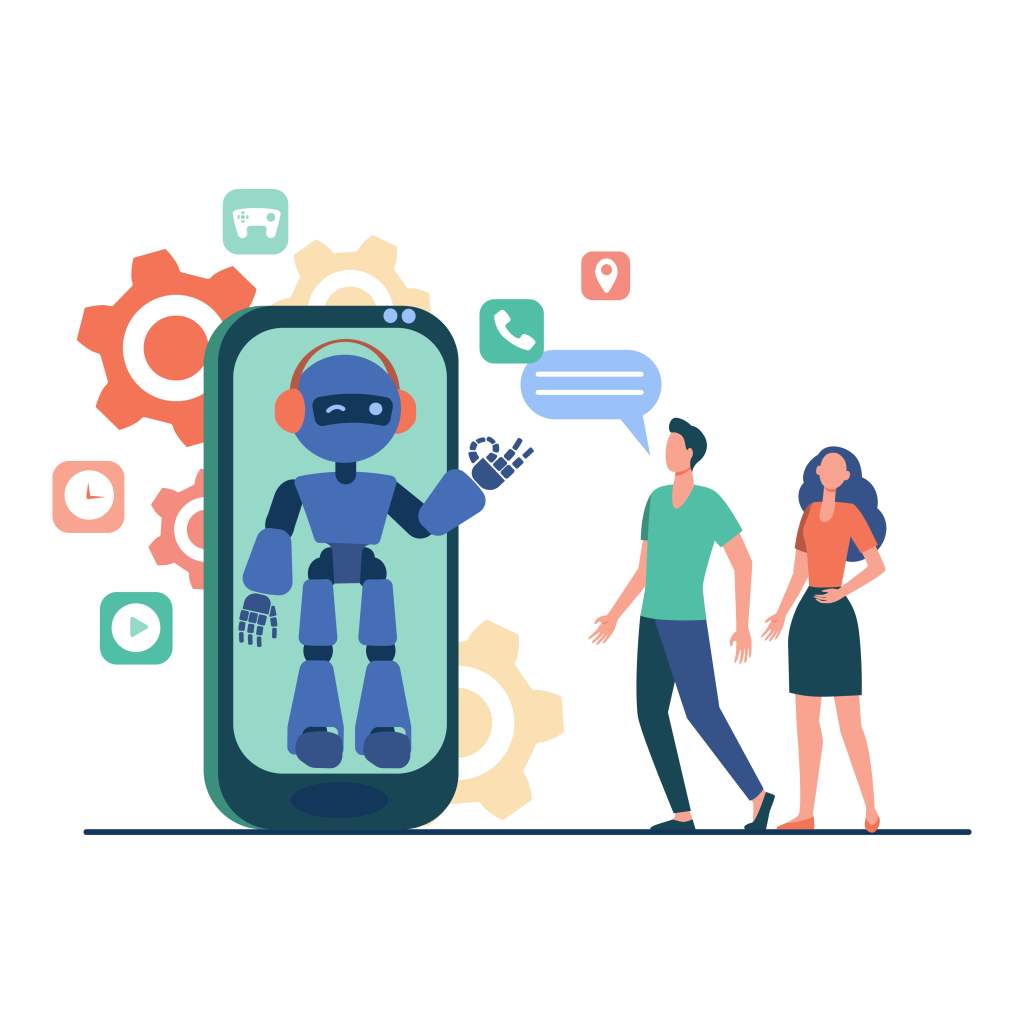
An AI-powered mobile assistant is a conversational interface inside a mobile app, built on a large language model, that can understand natural language requests and either answer them directly or take real actions by calling external tools and APIs on the user’s behalf. This goes beyond a scripted chatbot with predefined response trees. A genuine AI assistant interprets open-ended input and decides what to do with it, whether that’s retrieving information, executing a task, or asking a clarifying question when the request is ambiguous.
Chatbot vs AI Agent: What’s the Difference?
A chatbot follows predefined conversation flows and scripted responses, while an AI agent uses a language model to reason about a request and autonomously call multiple tools or APIs in sequence to complete it. This distinction matters because it directly determines how complex your build actually is.
Factor | Chatbot | AI Agent |
Conversation flow | Predefined, scripted paths | Dynamic, reasoned by the model |
Can take real actions | Limited, usually pre-built integrations | Yes, calls tools and APIs as needed |
Development complexity | Lower | Significantly higher |
Typical cost | Lower, thousands to tens of thousands | $40,000 to $100,000+ for production-grade agents |
Best for | Simple FAQ, guided support flows | Booking, task completion, multi-step requests |
Most mobile “assistants” that actually deliver real value in 2026 are AI agents, not chatbots, since users expect an assistant to do things, not just answer questions from a script.
How to Build an AI-Powered Mobile Assistant: Step by Step
Step 1: Define Exactly What the Assistant Should Do
Write down the specific tasks your assistant needs to handle before any development starts, since a vague goal like “help users with the app” produces an unfocused build that tries to do everything poorly. A narrow, well-defined scope, book a service appointment, answer questions about order status, summarize a document, gives you something you can actually build, test, and ship, rather than an open-ended assistant nobody can reliably validate.
This scoping step also determines whether you actually need an agent at all, or whether a simpler chatbot, or even a well-designed FAQ search, would genuinely serve the same users better and cost far less to build and maintain. It’s worth resisting the pull toward the most impressive-sounding version of the assistant before confirming the narrower version wouldn’t already solve the real problem your users have.
Step 2: Choose Your LLM and Integration Approach
Call an existing large language model through an API rather than training your own, since this is the lowest-complexity path and the one nearly every production team takes in 2026. Options include OpenAI’s models, Anthropic’s Claude, and Google’s Gemini family, each accessible through a documented API that handles the actual language understanding and generation. Your job at this stage is prompt design, guardrails, and the surrounding application logic, not building a model from scratch.
Step 3: Choose an Agent Framework If the Assistant Needs to Take Actions
Select a framework suited to your specific use case: LangGraph for complex, stateful agents managing multi-step workflows, the OpenAI Assistants API for fast iteration with managed conversation state, Anthropic’s tool use for Claude-based agents, or LangChain for broader ecosystem integrations across many different tools and data sources. This decision shapes your entire development timeline, so match the framework to how complex your assistant’s actual task sequences need to be, not to whichever framework is most talked about.
None of these frameworks are interchangeable in practice, despite how often they get compared as if they were. LangGraph earns its added complexity specifically when an assistant needs to maintain state across a genuinely multi-step process, an approval workflow with several stages, for instance, where a simpler request-response pattern breaks down. The OpenAI Assistants API trades some of that flexibility for speed, handling conversation state management for you, a real advantage when you want to ship an initial version quickly and iterate rather than build state management from scratch. Choosing based on your actual workflow complexity, rather than defaulting to whichever framework has the most tutorials online, avoids both over-engineering a simple assistant and under-building one that genuinely needs the more capable option.
Step 4: Design Tool Calling So the Assistant Can Take Real Actions
Tool calling, also called function calling, is the mechanism that lets a language model request a specific action, checking a calendar, updating a database record, sending a confirmation, rather than just generating text. Design each tool with a clear, unambiguous schema describing exactly what it does and what inputs it needs, since a poorly defined tool leads the model to call it incorrectly or misinterpret its results. This is the actual difference between an assistant that chats and one that gets things done.
Getting tool design right takes real iteration, not a one-time definition. A tool description that seems perfectly clear to the engineer who wrote it can still lead the model to call it at the wrong moment or with the wrong parameters, especially once real users start phrasing requests in ways your test cases never anticipated. Treating tool schemas as something to refine based on actual production behavior, not a fixed spec finalized before launch, catches this kind of drift before it becomes a pattern of user complaints.
Step 5: Add Retrieval for Answers Grounded in Your Own Data
Retrieval-augmented generation (RAG) lets your assistant pull relevant information from your own documents, product catalog, or knowledge base before generating a response, rather than relying only on what the underlying model already knows. This matters whenever the assistant needs to answer questions specific to your business, current inventory, your actual return policy, a customer’s specific order, information no general-purpose model was trained on.
Step 6: Manage Conversation Memory and Context
Keep conversation history focused rather than passing an assistant’s entire chat log into every request, since long, unfiled context tends to confuse a model and increases cost with every additional message included. A shorter, well-managed window of recent conversation turns, combined with retrieval for anything older or more specific, keeps responses sharper and keeps your per-interaction cost predictable.
Step 7: Decide What Runs On-Device vs in the Cloud
Route fast, private, or offline-critical interactions to on-device processing where your platform supports it, and reserve cloud-based LLM calls for anything requiring genuine reasoning or access to your backend systems. This is the same architectural decision covered in more depth in our guide to on-device AI vs cloud AI for mobile apps, and it applies directly here, since a genuinely capable AI agent almost always needs cloud-based reasoning for the parts requiring tool calls and multi-step logic, even if simpler interactions run locally.
Step 8: Build Guardrails, Fallback Logic, and Observability
Add explicit guardrails that constrain what the assistant can say and do, fallback responses for when a tool call fails or the model produces an unclear result, and logging infrastructure that lets your team see what the assistant actually did in production, not just what it was supposed to do. Production agent development requires this observability layer specifically because agents can fail in ways a simple chatbot never does, calling the wrong tool, misinterpreting an ambiguous request, or looping on a task it can’t complete.
Guardrails need to cover both what the assistant should never do and what happens when something genuinely goes wrong mid-task. A booking assistant that successfully reserves a time slot but fails to send the confirmation needs a defined recovery path, not a silent failure the user only discovers when they show up and there’s no reservation. Building this kind of failure handling in from the start, rather than patching it in after the first production incident reveals the gap, is what separates an assistant your team can trust with real user-facing tasks from one that technically works until it doesn’t.
Step 9: Test Under Real Conditions and Monitor Cost Per Interaction
Test the assistant against real, messy user input, not just clean example queries your team wrote, and monitor cost per interaction closely once live, since an agent that calls multiple tools per request can rack up meaningfully higher LLM costs than a simple single-response chatbot. Establishing an evaluation process that catches model or prompt regressions before they reach users matters as much here as the initial build, since LLM behavior can shift subtly when you update a prompt or switch model versions. A small change that improves one type of request can quietly degrade another, which is exactly why a repeatable evaluation set, not just spot-checking a few conversations by hand, is worth building before launch rather than after users start noticing something feels off.
What It Costs to Build an AI-Powered Mobile Assistant
A simple, API-based chat assistant answering FAQ-style questions typically costs a modest fraction of overall app budget, while a genuine AI agent capable of multi-step task completion, tool calling, and orchestration commonly adds $40,000 to $100,000 or more on top of baseline mobile app development cost. The gap between these two numbers reflects real engineering difference, not padding, agent development involves orchestration logic, tool design, observability infrastructure, and evaluation pipelines that a basic scripted chatbot simply doesn’t need.
Ongoing cost deserves as much attention as the initial build. Every LLM API call carries a real, per-token cost, and an agent that calls three or four tools to complete a single user request is paying for three or four times the model reasoning a simple one-shot response would need. This operational cost scales with usage in a way a traditional feature’s server cost usually doesn’t, which makes cost monitoring from day one, not an afterthought once the bill arrives, a genuine part of the architecture rather than a separate finance concern.
Common Mistakes Building Mobile AI Assistants
- Building an agent when a simpler chatbot would do the job. Not every assistant needs to take autonomous actions, and adding agent complexity to a task that’s really just answering FAQs wastes real budget on capability nobody uses.
- Skipping tool schema design and hoping the model figures it out. A vaguely defined tool produces inconsistent, hard-to-debug behavior, clear input and output definitions matter as much as the underlying prompt.
- No fallback for failed tool calls. An assistant with no graceful failure path either hangs, produces a confusing error, or worse, tells the user something succeeded when it didn’t.
- Passing unlimited conversation history into every request. This confuses smaller models, increases cost with every message, and rarely improves response quality beyond a focused recent window.
- Not monitoring cost per interaction until the bill arrives. Agent-based assistants can make several LLM calls per user request, and that cost compounds quickly at real usage volume if nobody’s watching it from day one.
- Assuming one LLM provider fits every use case. Different models genuinely perform differently on tool use, reasoning depth, and cost, and locking into one without testing alternatives can leave real performance or cost savings on the table.
Building the Right Assistant for Your App
An AI assistant that works cleanly in a demo but fails to complete real tasks reliably in production isn’t actually finished, it’s a prototype wearing a launch date. If you’re planning an AI-powered assistant for your mobile app and want it architected properly from tool design through cost monitoring, our mobile app development team builds this as core product architecture, not a feature bolted on after the rest of the app is done, with the guardrails, observability, and fallback handling that real users, not just a demo audience, actually need.
Frequently Asked Questions
Do I need to train my own AI model to build a mobile assistant?
No. Nearly all production teams in 2026 integrate an existing large language model through an API from a provider like OpenAI, Anthropic, or Google rather than training a custom model, which is faster, cheaper, and the standard approach for mobile assistant development.
What is tool calling in an AI assistant?
Tool calling, also called function calling, is the mechanism that lets a language model request a specific action, like checking a calendar or updating a record, by calling a defined function rather than only generating a text response.
Should my AI assistant run on-device or in the cloud?
Most capable AI assistants need cloud-based processing for genuine reasoning and tool calling, while faster, simpler, or privacy-sensitive interactions can run on-device.
How long does it take to build an AI-powered mobile assistant?
A simple, API-based assistant can launch in a matter of weeks, while a genuine AI agent with tool calling, retrieval, and production-grade guardrails typically takes several months given the added orchestration, testing, and observability work involved.
