

A solid api security checklist covers six areas: strong authentication and authorization, rate limiting, input validation, encryption in transit and at rest, least-privilege access control, and active logging and monitoring. Missing any one of these doesn’t just create a theoretical gap, it’s usually the exact category attackers target first, since APIs increasingly sit at the center of how businesses move data between systems, partners, and customers.
APIs have quietly become the most common attack surface for modern businesses, more so than the web or mobile front end most security conversations still default to. If you’re evaluating your own API’s security posture, or scoping a new integration and want it built correctly from the start, this checklist is meant to be actually usable, not just a list of buzzwords to nod along to.
What Is API Security?
API security is the practice of protecting an application programming interface from unauthorized access, data exposure, and abuse, covering everything from how a request proves who’s making it to how the response data gets handled once it leaves the server. It’s distinct from general application security in one important way: an API is often built to be consumed by systems and developers outside your direct control, which means the usual assumption that only your own frontend talks to your backend doesn’t hold.
Why Businesses Need an API Security Checklist Now
APIs have become the connective tissue between businesses, partners, mobile apps, and third-party integrations, and that growth in surface area has grown the attack surface right along with it. A vulnerability in a public-facing website is often visible and gets patched quickly once found. A vulnerability in an API can sit quietly for months, since APIs are frequently undocumented from the outside, tested less thoroughly than user-facing interfaces, and exposed to automated scanning at a scale human attackers rarely bother with manually.
The OWASP API Security Top 10 exists specifically because API vulnerabilities have consistently different patterns than traditional web application vulnerabilities, broken object-level authorization and excessive data exposure show up far more often in APIs than the SQL injection and cross-site scripting issues most general security training still centers on. That mismatch between where the real risk lives and where most teams focus their attention is exactly why a dedicated api security checklist, not just a general security review, matters.
The Core API Security Checklist
1. Authentication and Authorization
Authentication confirms who’s making a request. Authorization confirms what that requester is actually allowed to do once confirmed. Conflating the two is one of the most common root causes of API breaches, an API that correctly verifies identity but fails to check whether that identity should have access to the specific resource being requested is still fully exposed.
API Keys vs. OAuth vs. JWT
Choosing the right authentication mechanism depends heavily on who’s consuming the API and what kind of access they need.
| Method | How It Works | Best Fit | Key Limitation |
| API Keys | A static secret string sent with each request | Simple server-to-server integrations, internal tools | No built-in expiration or granular permissions unless custom-built |
| OAuth 2.0 | Token-based delegation, often via a third-party identity provider | User-facing apps, third-party integrations needing scoped access | More complex to implement correctly |
| JWT (JSON Web Tokens) | Self-contained, signed tokens carrying claims about the requester | Stateless authentication across distributed systems | Tokens are hard to revoke before expiration without extra infrastructure |
None of these three is a universal answer, and a mature API often uses more than one, API keys for internal service-to-service calls, OAuth for anything involving a third-party user granting access, and JWTs as the token format underneath either approach.
2. Rate Limiting and Throttling
An API without rate limiting is an open invitation to brute-force attacks, credential stuffing, and simple resource exhaustion, whether or not the request is otherwise authenticated correctly. Rate limiting should be applied per API key or per user, not just globally, since a global limit does nothing to stop one compromised credential from being hammered while everyone else’s traffic looks normal.
3. Input Validation and Injection Prevention
Every field an API accepts is a potential injection vector, SQL injection, command injection, or malformed data designed to break downstream processing. Validating input against a strict schema, rejecting anything that doesn’t match expected types and formats, closes off an entire category of attack before it reaches business logic. This matters more for APIs than for traditional web forms, since an API is frequently the first thing a scanner or bot probes precisely because it often has less validation scrutiny than a polished, user-facing form.
4. Encryption in Transit and at Rest
TLS for every API endpoint, no exceptions for “internal” or “low-risk” endpoints, is table stakes at this point, not a recommendation. Encryption at rest for any sensitive data the API handles or stores matters just as much, since a breach further down the stack (a compromised database, a misconfigured backup) shouldn’t hand over readable sensitive data just because the API layer itself was secure.
5. Least-Privilege Access Control
Every API credential, whether it belongs to a user, a partner integration, or an internal service, should have access to exactly what it needs and nothing more. Broad, all-access API keys handed out for convenience during development frequently never get scoped down before production, turning a minor internal shortcut into a major exposure if that key is ever compromised.
6. Logging and Monitoring
Anomaly Detection
Logging every request is only useful if something is actually watching for patterns that indicate abuse, a sudden spike in requests from one credential, repeated failed authentication attempts, or requests for resources a given user has never accessed before.
What to Log Without Creating a New Risk
Comprehensive logging has to be balanced against not logging sensitive data itself, since a log file storing raw API keys, passwords, or personal data creates a second attack surface out of the very system meant to help detect the first one.
Example: Redacting Sensitive Fields in Logs
A properly configured logging pipeline captures that a payment endpoint was called, by which credential, and with what response code, without ever writing the actual card number or authentication token into a log line that might sit in a less-protected system than the API itself.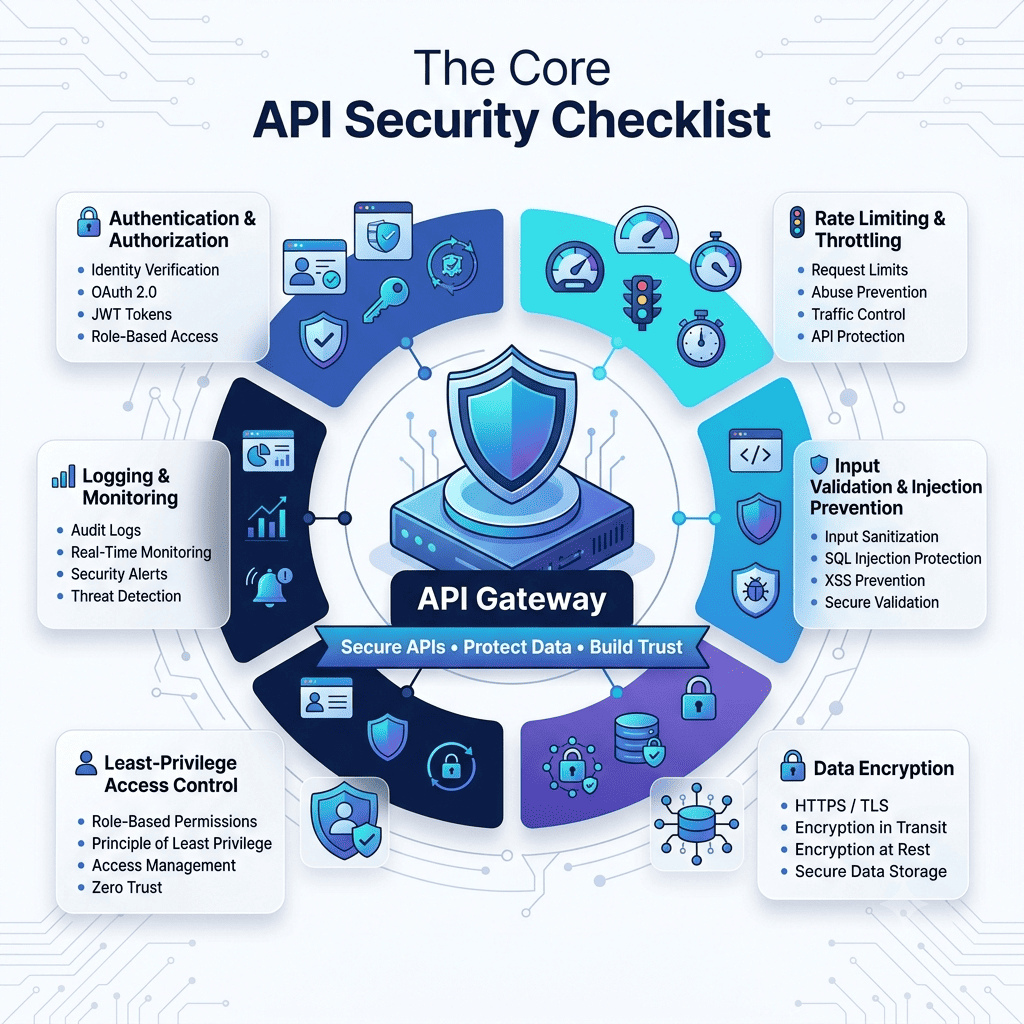
API Security and Compliance Considerations
For businesses handling regulated data, payment information, healthcare records, or personal data covered under privacy regulations, API security checklist requirements often extend beyond general best practice into formal compliance obligations. PCI DSS applies the moment an API touches payment card data, regardless of whether that data passes through briefly or gets stored, and tokenizing sensitive fields at the API layer is frequently the simplest way to keep the broader system out of strict compliance scope. GDPR and similar privacy regulations add requirements around what data an API is allowed to return and to whom, which ties directly back to the least-privilege and data-minimization principles covered above, over-fetching isn’t just a performance concern in a regulated context, it can be a compliance violation if an endpoint returns personal data a given caller had no legitimate reason to receive.
SOC 2 audits, increasingly requested by enterprise customers before they’ll sign a contract, specifically examine access controls, logging, and monitoring practices, which means the logging and authorization sections of this checklist aren’t just security hygiene, they’re frequently the exact evidence a SOC 2 auditor will ask to see documented. Building API security with these frameworks in mind from the start is considerably less expensive than retrofitting compliance evidence into a system that was never designed to produce it.
Common API Security Mistakes Businesses Make
Deprecated API versions frequently stay live and unmonitored long after a newer version replaces them, since decommissioning an old endpoint takes deliberate effort nobody prioritizes until it’s exploited. Excessive data exposure is another recurring pattern, an endpoint returns a full object with a dozen fields because it was easier to build that way, when the client only ever needed three, quietly leaking data that was never meant to be broadly accessible. Rate limiting frequently gets applied to public endpoints while internal or partner-facing ones are left wide open, on the assumption that “trusted” traffic doesn’t need the same scrutiny, an assumption that breaks the moment a partner’s own credentials get compromised. And a fair number of teams treat API security as a one-time setup rather than something that needs revisiting every time a new endpoint ships or a new integration is added.
A less obvious mistake is trusting third-party and partner integrations with the same broad access originally granted for testing, long after that integration goes live. A partner API key scoped for a proof-of-concept often quietly retains full access in production, simply because nobody circled back to narrow it once the relationship became permanent. Documentation gaps compound this, an undocumented internal API is often assumed to be low-risk purely because it’s obscure, which is a very different thing from actually being secure, and obscurity tends to fail the moment an automated scanner finds it anyway.
How Often Should You Audit API Security?
A full API security review is worth scheduling at least annually for any business handling meaningful data volume, but the more important trigger isn’t the calendar, it’s events: a new major integration, a significant increase in API traffic, or any change to authentication infrastructure should each prompt a focused review rather than waiting for the next scheduled audit. Continuous automated scanning for common vulnerability patterns, paired with periodic manual review for the logic-level issues automated tools miss, covers most of the realistic risk for a growing business without requiring a full-time dedicated security team.
How The Apps Developers Approaches API Security
API security gets built into the same API and backend development process that shapes authentication design and data architecture from day one, not treated as a checklist run once before launch and forgotten. That discipline carries through to the web apps and mobile apps consuming those APIs too, since a secure backend paired with a client that mishandles tokens or stores credentials insecurely still leaves the whole system exposed.
If you’re not confident your current API would hold up against the checklist above, or you’re scoping a new integration and want security built in rather than bolted on, that’s worth a direct conversation before it becomes an incident. You’re welcome to talk to our team about what a real API security review of your specific setup would involve.